Pompeii is one of the most famous cities from ancient history and was an important city in the time of Ancient Rome. Located near Naples in southern Italy, Pompeii was destroyed during an eruption of Mount Vesuvius in 79 CE. In the years after, the city was hidden under layers of volcanic ash until its rediscovery in the 18th century. Historians consider Pompeii to be a significant archaeological site and an important aspect of Ancient Roman history.
POMPEII – EARLY HISTORY
The history of Pompeii stretches back long before it became a Roman city. In fact, archaeological evidence from the site shows that the area has been an important area since around the 8th century BCE. It officially came under Roman control in 80 BCE, when the Roman general Sulla established it as a colony for his veterans. Under Roman rule, Pompeii prospered, developing into a wealthy city with grand temples, theaters, villas and markets. For instance, when the Romans took control they built a port, an amphitheatre and a complex water system making it a very attractive and busy place in Roman times. Furthermore, the city’s fertile volcanic soil supported vineyards, olive groves, and grain fields, while its location near the Mediterranean allowed merchants to export goods such as wine and olive oil. This played an important part in the history of Pompeii.
POMPEII – DESTRUCTION
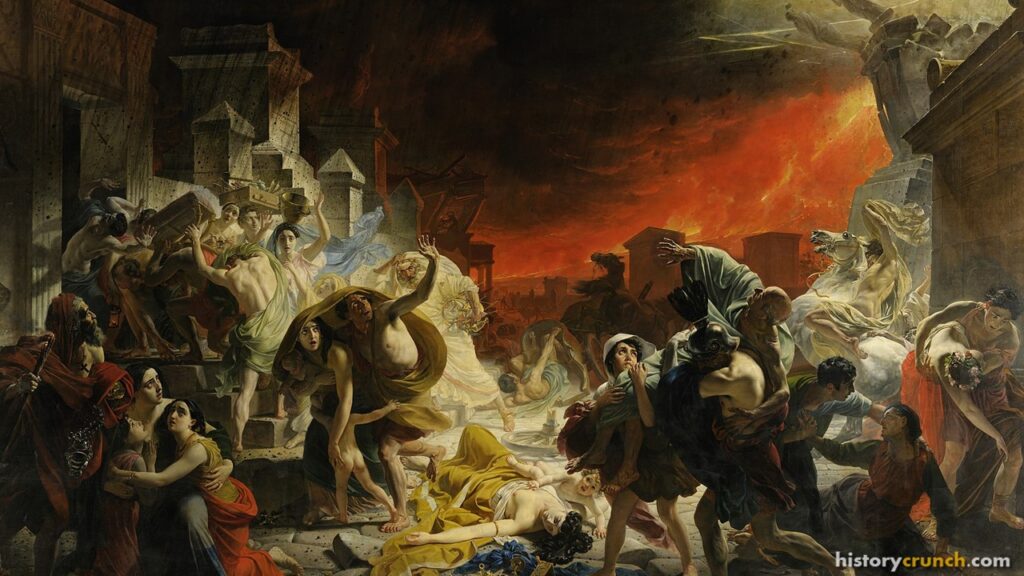
As mentioned above, the city of Pompeii was located very close to Mount Vesuvius, which was an active volcano. For many years the volcano laid dormant, and the people living in Pompeii thought little of it. However, on August 24th, 79 CE, about 160 years after the Roman rule first started, the volcano became very active and eventually erupted. The eruption completely destroyed Pompeii as six meters worth of lava, ash and pumice erupted out of Mount Vesuvius and buried Pompeii. As a result of the eruption, many of the 11,000 people reported to have been living there died.
Evidence for the destruction of Pompeii came in the form of a letter from Pliny the Younger who had seen Mount Vesuvius erupt from far away. Pliny the Younger reported that his uncle, an admiral of the Roman fleet, had been trying to rescue citizens of Pompeii but had died in his efforts. After the eruption Pompeii was left undisturbed for over 1500 years.
POMPEII – SIGNIFICANCE
The rediscovery of Pompeii and the historical study of its destruction was highly significant. In 1748, archaeologists accidentally rediscovered the site while digging for artifacts near Naples. In fact, they had discovered entire streets, buildings and artworks that had been frozen in time since the destruction of Pompeii. Furthermore, the volcanic ash that destroyed the city had also protected it from decay and preserved even the smallest details of Roman daily life. For example, excavations revealed houses with frescoes, shops with goods, graffiti on walls and even the bodies of victims. More specifically, the final moments of the people of Pompeii were captured in plaster casts that were made from the hollowed areas left in the hardened ash.
Many of the objects, buildings, and even people in Pompeii which were buried in the eruption of 79 CE were preserved for hundreds of years because there was so little air and moisture. As a result, Pompeii has given historians a really good insight into Roman life. As mentioned above, plaster was used to fill in gaps where artifacts and other things had been in order to show people where things once laid, and where people had died. As a result of all of this, today Pompeii has become a popular tourist destination with over 2.5 million visitors every year.
Pompeii also provides important insights into the art and architecture of Ancient Rome. The frescoes and mosaics found in its homes and villas are among the finest examples of Roman painting and showcased scenes from mythology, landscapes, and Ancient Roman daily life.