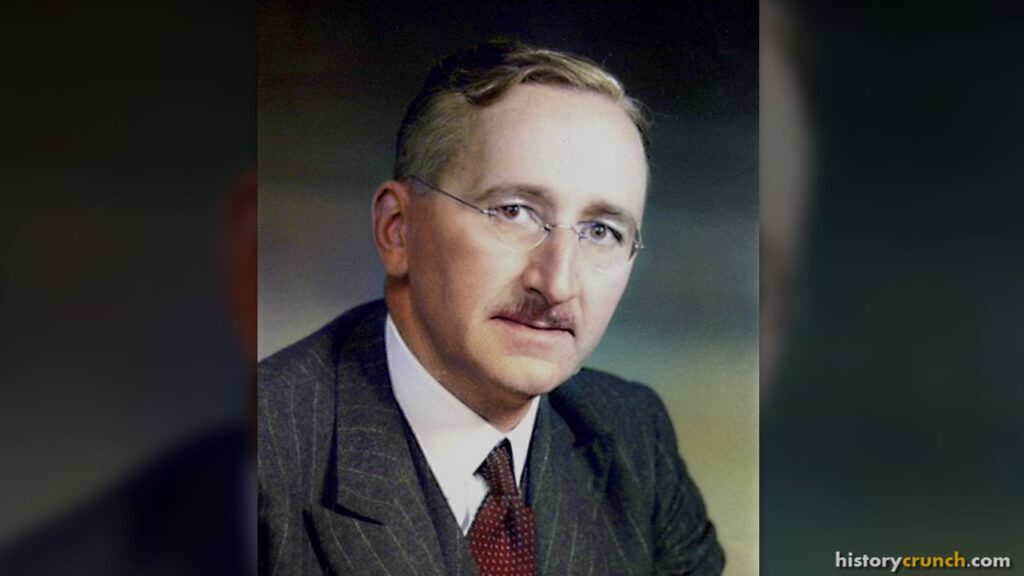
Friedrich Hayek was one of the most influential economists of the 20th century and his ideas have had a profound impact on economic thought still today. He is best known for his support for free market capitalism and his criticism of government control over the economy.
FRIEDRICH HAYEK – EARLY LIFE
Friedrich Hayek was born in Vienna, Austria on May 8th, 1899. His father was a doctor while his mother cared for the Hayek family. Hayek was intellectual and excelled throughout his education. In 1917, he signed up to the army and served in World War I. His experiences in the war led to his desire to study economics as he wanted to help governments prevent the financial mistakes that led to the war. After the war, Hayek studied law and political science at the University of Vienna. In the 1920s, he worked alongside other famous economists, including Ludwig von Mises, who strongly influenced his thinking about free markets.
FRIEDRICH HAYEK – ECONOMIC THEORIES
In 1927, Hayek became director of the Austrian Institute for Business Cycle Research. Hayek focussed much of his work on Austrian theory of business cycles, capital theory and monetary theory and exploring the links between all three. He became well known for his work and theoretic models about why markets fail to coordinate people’s plans and result in large scale unemployment.
Hayek was developing his theories at the same time as British economist John Maynard Keynes. Both were prominent economists during the Great Depression era but battled over their different beliefs. In short, Keynes believed governments should intervene in the economy to prevent recessions, while Hayek argued that too much government control would harm freedom and efficiency.
Hayek believed that recovery from a post-boom crash called for a return to sustainable production as well as adequate spending. However, people thought this ‘liquidate labour, liquidate stocks, liquidate the farmers’ methodology would not work. As a result, many economists thought that Keynes ‘General Theory of Employment, Interest and Money’ won over Hayek’s ideas; however Hayek and most members of the Austrian school of thought disagreed. After World War II, Hayek taught at the University of Chicago and later at the University of Freiburg in Germany.
FRIEDRICH HAYEK – LATER LIFE AND DEATH
Hayek returned to Europe in 1962 as professor of economic policy at the University of Freiburg, West Germany. In 1968 he went on to the University of Salzburg where he taught and continued to research. In 1974, Hayek was awarded the Nobel Prize jointly with Gunnar Myrdal for their ‘pioneering work in the theory of money and economic fluctuations and for their penetrating analysis of the interdependence of economic, social and institutional phenomena.’ Hayek continued to work, and publish papers and books throughout this period.
Hayek died March 23rd, 1992. Today he is remembered as one of the most significant economists of the 20th century, and his ideas greatly impacted historical events, such as the Great Depression and post-World War II America. In fact, through his writings and teachings, he became one of the greatest defenders of capitalism in the modern era.
FRIEDRICH HAYEK – SIGNIFICANCE
As stated above, Friedrich Hayek was one of the most significant economic thinkers of the 20th century. He was an ardent defender of capitalism and personal freedom during a time when socialism and communism were gaining popularity in the western world. Furthermore, he influenced global economic policy by strengthening the case for free markets, limited government, and individual liberty.
In 1974, Hayek won the Nobel Prize in Economics (shared with Gunnar Myrdal) for his work on money, economic fluctuations, and the interdependence of economic and social institutions. His ideas gained renewed influence in the 1980s, inspiring leaders such as Margaret Thatcher in Britain and Ronald Reagan in the United States, who both pushed for free market reforms and less government intervention in the economy. As such, modern economists consider Hayek to be a significant figure in our modern understanding of capitalism and the free market.