Karl Marx is perhaps one of the most influential philosophers of the last two centuries. His writings inspired revolutions in several countries and are still used today in support of workers’ rights and other socialist principles. His ideas are often associated with the timeframe of the Industrial Revolution since he witnessed and expressed concern for the horrible working conditions of the period.
 FactsthatCrunch
Karl Marx wrote and argued that industrial workers were exploited by wealthy owners under capitalism, and that a workers' revolution was needed to change society. His ideas, known as Marxism, shaped major political events after his death, including the Russian Revolution of 1917, and influenced workers' rights movements across Europe and North America.
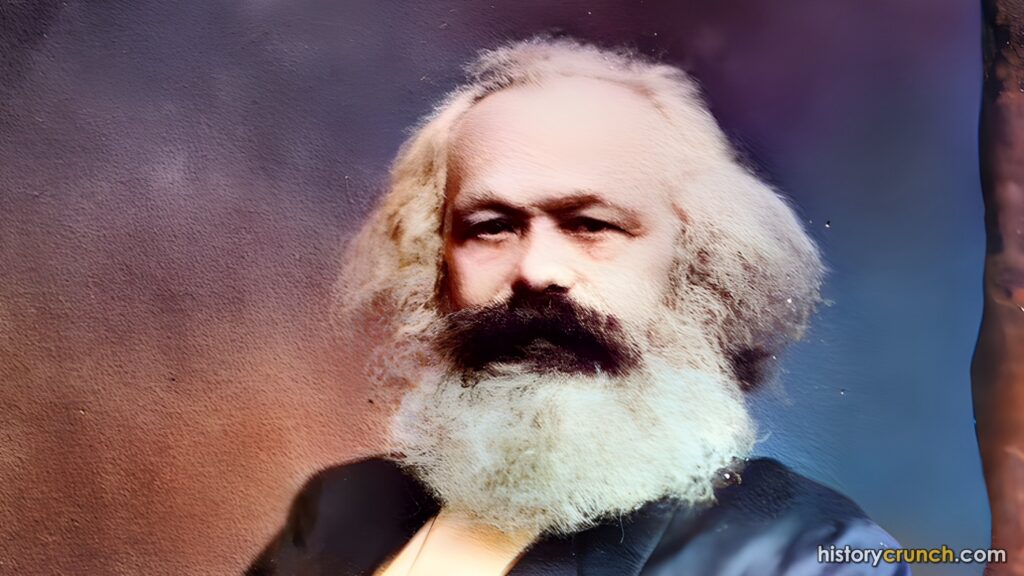
Karl Marx – Early Life
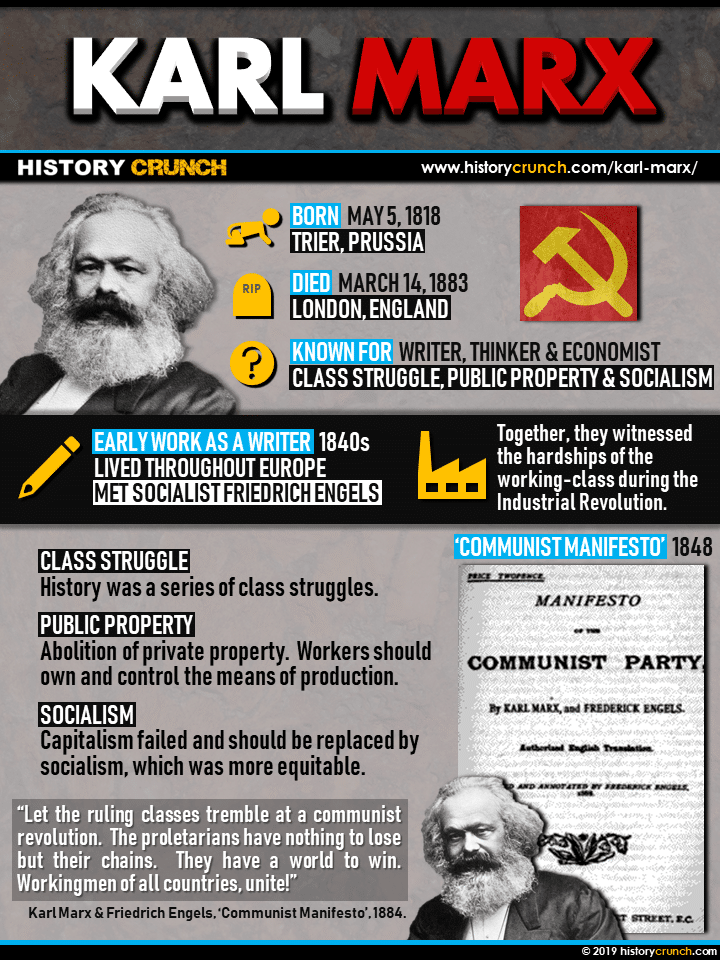
Karl Marx was born on May 5th, 1818, in Trier, Prussia which is modern-day Germany. His father, Heinrich Marx, worked as a lawyer and was interested in classical liberalA political tradition from the Enlightenment that valued individual freedom, private property, and free markets. ideals of the Enlightenment. His wife and Karl Marx’s mother, Henriette Pressburg, came from a successful business family before marrying Heinrich. As such, Karl was raised in a middle-class lifestyle. He was privately educated by his father until 1830 when he began to attend the Trier High School. In 1835, he attended the University of Bonn, studying law at the direction of his father. Due to his rowdy student life, his father forced him to leave the University of Bonn and instead study law at the University of Berlin.
Karl Marx became engaged to Jenny von Westphalen in 1836 as he was preparing for his studies at the University of Berlin. They didn’t marry until 1843. He excelled at the University of Berlin, and joined several groups that helped foster his leftist ideas. It was also around this time, in the late 1830s, that he began to write. While most of his early writings were fiction, including short stories and poetry, he soon began writing for academic works based on his political and economic ideals. For example, in 1842, he left Berlin for the city of Cologne, where he began writing for the Rheinische Zeitung or ‘Rhineland News’. It was here that he began to express his socialistSomeone who believes workers should collectively own and control the economy rather than wealthy private owners. ideas.
FactsthatCrunchMarx earned his doctorate in 1841 from the University of Jena, a school he never attended.
Marx had studied at the University of Berlin, but he sent his thesis on ancient Greek philosophy to Jena instead. Jena granted degrees for written work alone, without classes or an in-person defense, so it was faster. The doctorate did not bring him the university teaching job he hoped for, and he turned to journalism.
Karl Marx – Meeting Friedrich Engels
Marx moved to Paris, France in October of 1843, where he continued writing for several different papers that were radical in nature. However, one of the most important events of his professional life occurred on August 28th, 1844 when he met Friedrich Engels, a German socialist, at a café in Paris. The two would collaborate on their writings that focused on the conditions of the working class, and the growing income gap of classical liberal societies. Marx referred to his study of these conditions as the “political economyMarx’s own term for his study of how economic conditions shape society and the lives of working people.” whereas it has come today to be known as MarxismThe body of ideas from Karl Marx’s writings, focused on class struggle and the eventual replacement of capitalism..
After one of his newspapers was shut down in France, he and Engels, along with other socialist thinkers, moved to Brussels in Belgium. While in Brussels, he and Engels began collaborating on several different works. The most important and influential of these is known commonly as The Communist Manifesto.
 FactsthatCrunch
Marx and Engels began their lifelong partnership at a Paris café on August 28th, 1844.
Engels stopped in Paris on his way home from Manchester, England, where he had seen factory life up close. He and Marx met at the Café de la Régence and talked for about ten days. They found they agreed on almost everything about workers and capitalism, and they went on to write together for nearly forty years, including The Communist Manifesto.
Karl Marx – ‘The Communist Manifesto’
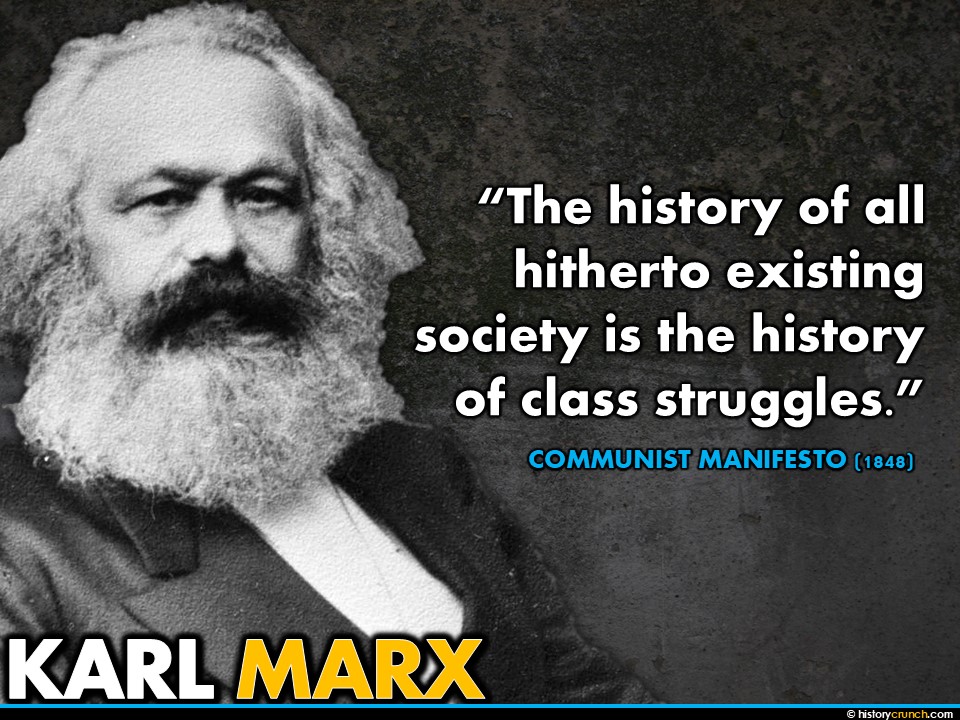
Written at the end of 1847 by both Marx and Engels, The Communist Manifesto was a political pamphlet first published in 1848 under the title ‘Manifesto of the Communist Party’. It was commissionedFormally hired or requested by an organization to produce a specific piece of writing or work. by the Communist League, an international communist organization that operated in Europe. Marx and Engels were associated with the Communist League and wrote The Communist Manifesto in order to clarify and articulate the ideas of the organization. In the pamphlet, Marx and Engels set forth the basic principles of Marxism that have gone on to influence many different thinkers and ideologies around the world.
The basic ideas of The Communist Manifesto were centered on the nature of society and the struggles between different classes. According to Marx and Engels, the only way to overthrow capitalism was by means of a class struggle between the proletariatIndustrial workers who own no property and must sell their labor to survive, as opposed to wealthy owners. (industrial workers) and the bourgeoisieThe wealthy class of owners who control factories and property under a capitalist economic system. (wealthy owners). They argued that this workers’ revolution was necessary before any significant change could be made in society. In general, they discussed the failings of capitalismAn economic system in which private owners control production and profit, which Marx argued exploited workers. and sought to bring about a final revolution that would end the struggle between classes. For example, in The Communist Manifesto, Marx and Engels argued that a socialist society formed by workers should involve a move towards the following: a shift from private property to public property, factories controlled and owned by the proletariat, free public education for all children.
Following the publication of The Communist Manifesto, Marx moved between Paris and Cologne. He was the editor of a newspaper that helped spread several of the main ideas of the Communist Manifesto. In Prussia, he actively sought to bring about a revolution against the monarchy in hopes that it would lead to a revolution against the bourgeoisie. Forced out of Prussia by government forces, and unable to return to Paris or Belgium, Marx moved his family to London, England instead. He arrived in London in 1849 and remained in the city for the rest of his life.
 FactsthatCrunch
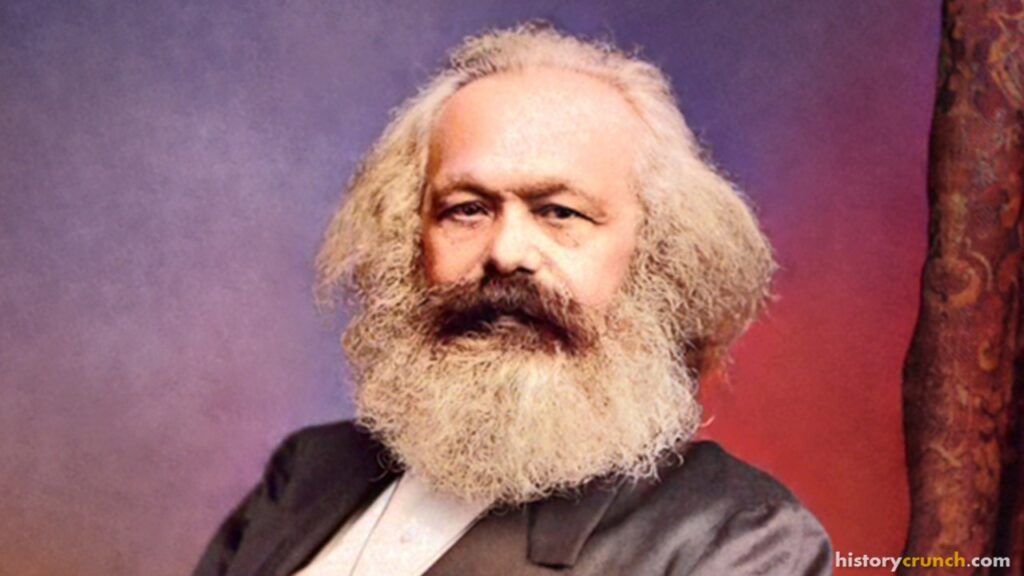
What did Marx and Engels argue in The Communist Manifesto was needed to overthrow capitalism?
Karl Marx – ‘Das Kapital’
During his time in London, Marx worked as a correspondent for the New York Daily Tribune. The newspaper was popular with working-class people in America and allowed Marx an avenue to express his socialist views. As well, he continued to write his own essays and pamphlets. The most famous of these was Das Kapital or Capital: Critique of Political Economy which was first published in 1867. In the work, Marx discussed the underlying foundation of capitalist economies and how capitalism would ultimately lead to socialism. He argued against earlier liberal principles that were supported by others including Adam Smith. Das Kapital was ultimately a three-volume work that did not fully get published until after Marx’s death.
 FactsthatCrunch
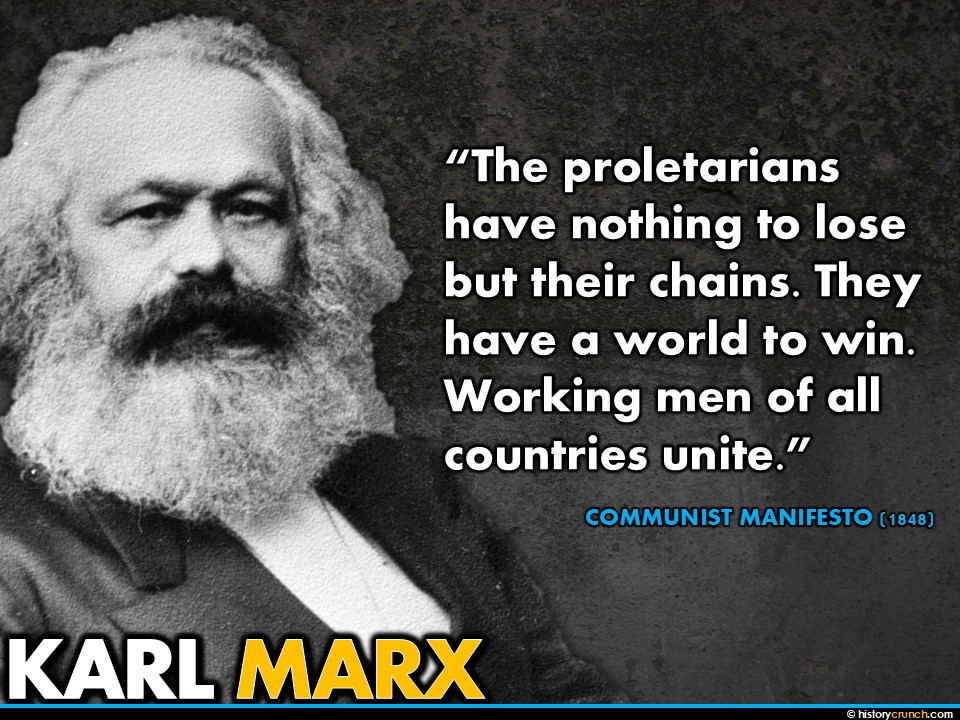
The knell of capitalist private property sounds. The expropriators are expropriated.
With these lines near the end of Das Kapital, Marx predicted that capitalism would concentrate wealth into fewer and fewer hands until workers rose up and took ownership for themselves. Socialist leaders across Europe later repeated the words to rally workers behind that vision.
Karl Marx – Death and Legacy
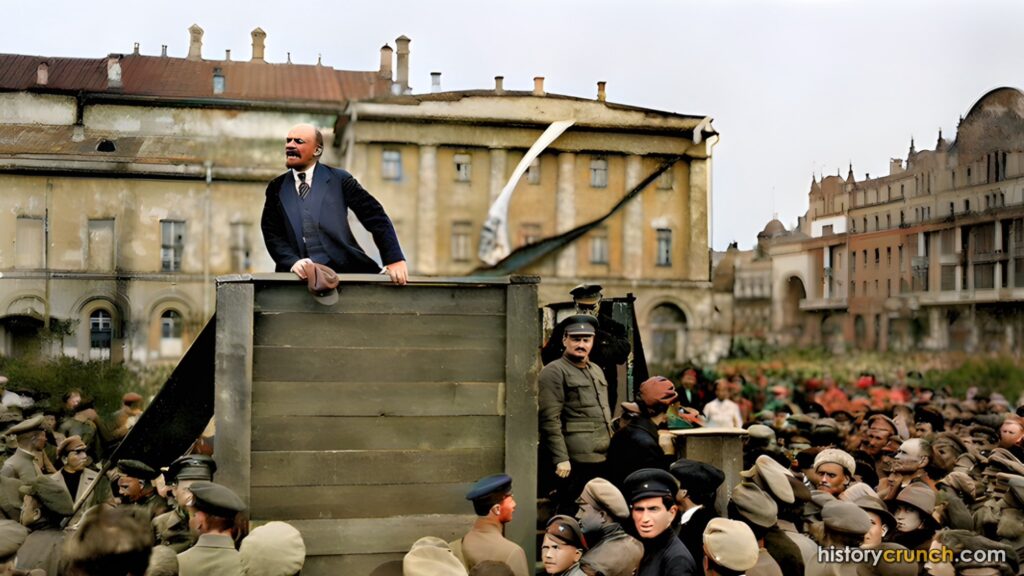
Marx died on March 14th, 1883 in London, England. He suffered from poor health in the last months of his life which included serious breathing problems. Although Marx failed to achieve many of the reforms he sought to during his life, his ideas spread across much of the political landscape at the time and influenced many other movements and political parties. His writings ultimately led to the spread of communism around the world and influenced worker rights movements in many democratic countries across Europe and North America. More specifically, the ideas of Karl Marx became known as Marxism and inspired revolutions, such as the Russian Revolution.
 FactsthatCrunch
Tap each impact to read what it led to.
Karl Marx – Infographic
Industrial Revolution timeline · 1760 – 1840
Key Vocabulary
Classical liberal
Political economy
Proletariat
Bourgeoisie
Capitalism
Commissioned
Marxism
Frequently Asked Questions
Who was Karl Marx?
Karl Marx was a German philosopher, economist, and revolutionary thinker born in 1818. His ideas about class struggle and capitalism became known as Marxism. He wrote during the Industrial Revolution and spoke out against the harsh working conditions of that time.
What did Karl Marx write?
Karl Marx is best known for two works, The Communist Manifesto and Das Kapital. He wrote The Communist Manifesto with Friedrich Engels in 1848. Das Kapital, first published in 1867, examined how capitalist economies worked and why he believed they would fail.
What is Marxism?
Marxism is the set of ideas based on Karl Marx’s study of society and economics. It focuses on the struggle between the working class, called the proletariat, and the wealthy owners, called the bourgeoisie. Marx believed a workers’ revolution was needed to end this struggle and replace capitalism.
Who did Karl Marx work with?
Karl Marx worked closely with Friedrich Engels, a German socialist he met in Paris in 1844. The two men shared concerns about the working class and the growing gap between rich and poor. They collaborated on many writings, including The Communist Manifesto.
How did Karl Marx influence history?
Karl Marx’s ideas helped spread communism around the world after his death in 1883. His writings inspired major events like the Russian Revolution of 1917. They also shaped workers’ rights movements in many countries across Europe and North America.
Cite This Article
To cite this article as a source, use one of the formats below.
MLA: Beck, Elias. “Karl Marx: A Detailed Biography.” HistoryCrunch, 26 September 2026, https://historycrunch.com/karl-marx/.
APA: Beck, E. (2026). Karl Marx: A Detailed Biography. HistoryCrunch. https://historycrunch.com/karl-marx/
Chicago: Beck, Elias. “Karl Marx: A Detailed Biography.” HistoryCrunch. September 26, 2026. https://historycrunch.com/karl-marx/
Sources
- Joel Mokyr, The Enlightened Economy.
- Robert C. Allen, The Industrial Revolution: A Very Short Introduction.
- The Science Museum Group
- Emma Griffin, A Short History of the British Industrial Revolution.