
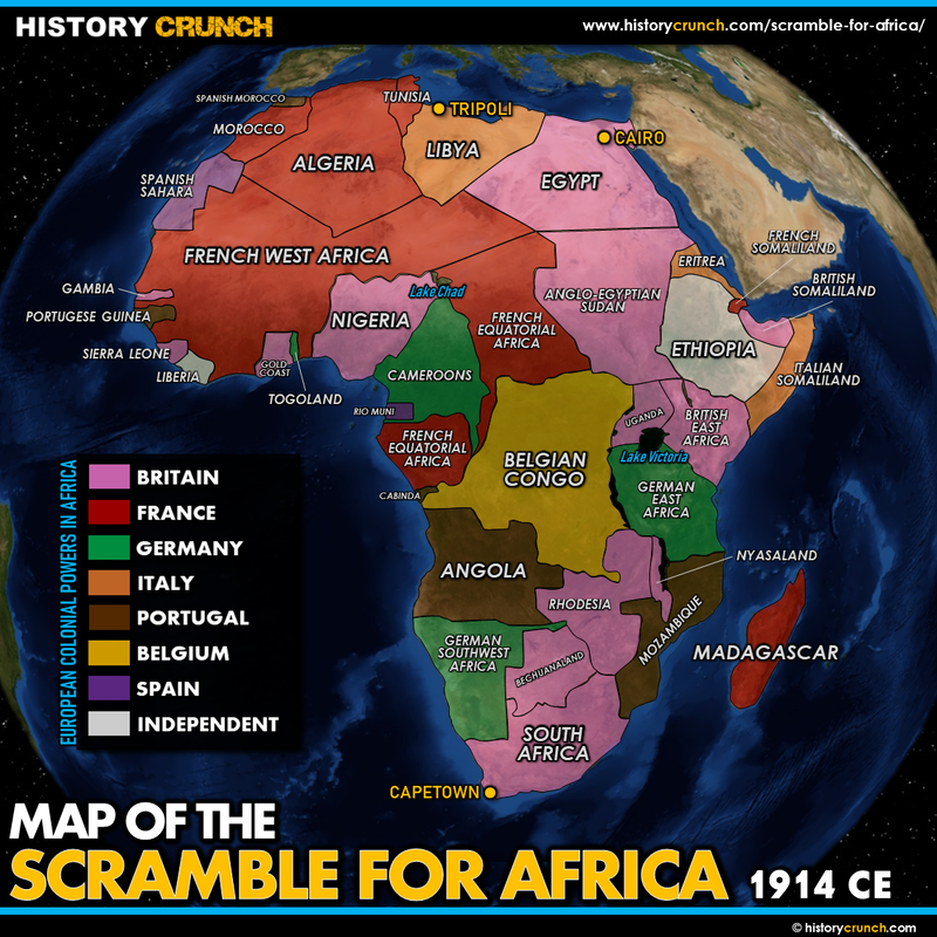
The Scramble for Africa is the forty-four years in which European powers took almost the entire African continent. In 1870 they held scattered posts on the coast. By 1914 every African state but two was under European rule, the borders had been drawn at a conference no African attended, and the rivalry it created was helping to push Europe into a world war.
From a Dutch vegetable garden at the Cape in 1652 to the borders of 1885 still holding in 1994.
The Scramble for Africa is the forty-four years in which European powers took almost the entire African continent. In 1870 they held scattered posts on the coast. By 1914 every African state but two was under European rule, the borders had been drawn at a conference no African attended, and the rivalry it created was helping to push Europe into a world war.
Nothing about Africa changed in 1870. Something about Europe did. What?
Four changes in Europe, and a canal.
Very few people conquer a continent believing they are doing wrong. What did they believe instead?
Science, religion and duty, and how each was used.
European columns were usually outnumbered. They usually won anyway.
Guns, quinine, steamships and telegraph wire.
Before 1869 Europe barely thought about Egypt. Within thirteen years Britain had invaded it.
A hundred miles of water, and what it was worth.
Britain abolished the trade it had profited from, then used abolition as a reason to go in.
The same argument doing two opposite jobs, fifty years apart.
Fourteen states met for 104 days to divide Africa, and not one African was there.
Who came, what was agreed, and what it is still blamed for.
Long straight lines, rivers used as edges, and peoples split down the middle.
Where the lines came from and why nobody has moved them.
Berlin agreed that a claim only counted if you actually controlled the ground. What followed?
One clause, and fifteen years of columns marching inland.
Governments did not want the cost. Companies did want the profit. So governments handed out charters.
Charters, shareholders and private force.
Leopold II never visited the Congo. He owned it personally for 23 years.
A hired explorer, a humanitarian promise and a rubber boom.
Forced labour was not unique to the Congo. The campaign against it was.
Photographs, testimony, a shipping clerk and a novelist.
180,000 British soldiers against a population smaller than a mid-sized city.
Rifles, distance, guerrillas and a policy Britain would rather forget.
Two poor republics nobody wanted became the richest ground in Africa in a single year.
Follow the money from the reef to the declaration of war.
The war was between two groups of settlers. The majority population was in it and left out of the settlement.
Service, camps, and the Union of 1910.
The Boer republics are usually the antagonists in a British story. Tell it from Pretoria.
Independence, gold, foreigners and the vote.
The same words are used for 1901 and for the 1940s. Working out what they do and do not share matters.
What happened, what it was called, and what it was not.
Britain won and came away shaken. Which lessons did it take, and which did it miss?
Trenches, rifles, reform and reputation.
A sickly teenager arrived chasing diamonds and left a country named after himself.
Diamonds, politics, a private army and a failed raid.
Livingstone hated the slave trade and died broke in a village. Stanley worked for a king who wanted a colony.
Two men, two motives, one consequence.
Every colonial power used forced labour. Leopold's Congo is still the byword. Why?
Private ownership, no oversight, and the difference that made.
Rhodes as a colossus in 1892. Leopold as a snake in 1906. Same magazine, same country, fourteen years apart.
Public opinion, read off the pictures people laughed at.
The usual account has Europe acting and Africa being acted upon. What does the evidence show?
Kingdoms, armies, treaties and two states that stayed free.
The explorers wrote books. The colonial officials wrote despatches. Who did not write?
The gaps in the record, and how historians work around them.
By 1914 every African state but two was under European rule. What was different about those two?
One army that won, one country nobody could quite claim.
Two European powers nearly went to war over Morocco twice in six years. Then they went to war over Serbia.
Rivalry, alliances, and how much weight the argument carries.
1905 and 1911, same place, same two powers, same near-miss.
What Germany wanted, and why it kept not getting it.
The Maxim gun was built for wars Europeans expected to win easily. In 1914 both sides had it.
One weapon, two continents, thirty years apart.
Railways, hospitals and schools on one side. Extraction, forced labour and imposed borders on the other.
How to weigh it, and why the question is harder than it looks.
Your articles make this link directly. It is the hardest claim on the timeline and it needs handling carefully.
Categories, identity cards, independence and thirty years of war.
Forty-four years, a century ago. What of it is still running?
Borders, languages, economies and what came after.
For more than two centuries European powers sat on the coast of Africa without taking much of it. The Dutch had a vegetable garden at the Cape, the Portuguese had trading forts, and everyone was really on their way to Asia. What changed was not Africa. It was a canal that made Egypt matter, a theory that said some peoples were fit to rule others, and an industrial economy that wanted raw materials and markets.
The Dutch East India Company established a settlement at the Cape of Good Hope in 1652. It was not meant to be a colony. It was a place for ships bound for India and the Far East to take on fresh food and water.
LEARN MORESHOW LESSwhy it matters · key numbersECONOMICAlmost every European foothold in Africa before 1870 was like this: a port, a fort, a supply stop on the way to somewhere richer. Africa was a coastline you sailed past, not a place you took.
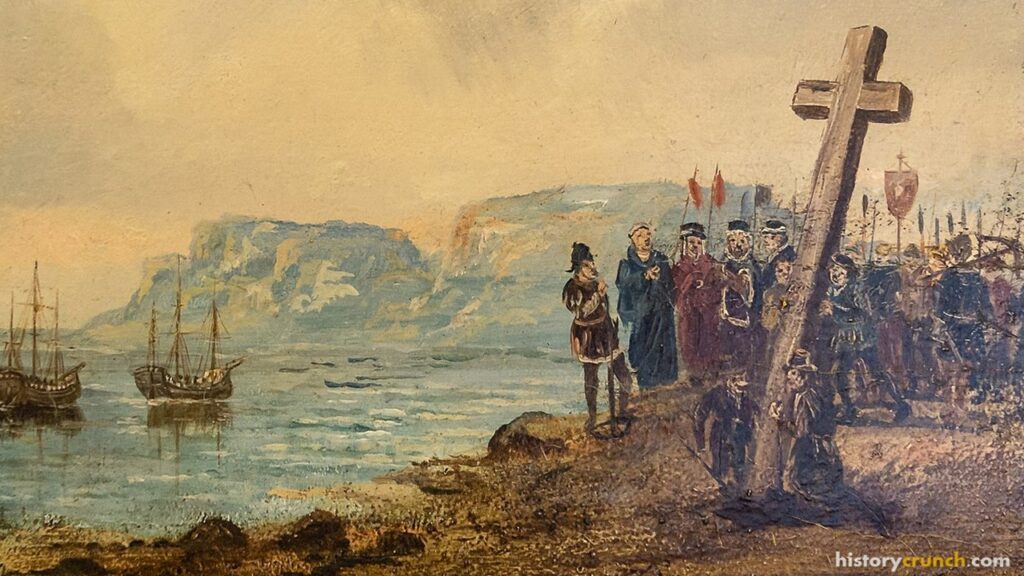
Bartolomeu Dias rounded the Cape of Good Hope in 1488 and planted a cross at Cape Point. Vasco da Gama followed the route to India in 1498. Neither voyage led to Portuguese settlement in southern Africa.
LEARN MORESHOW LESSwhy it mattersSOCIALEuropeans had known how to get there for a century and a half before anybody bothered to stay, which is worth putting to a class that assumes conquest follows contact automatically.
Britain seized the Cape Colony in the early 1800s after the Dutch East India Company went bankrupt, winning several engagements including the Battle of Blaauwberg in 1806.
LEARN MORESHOW LESSwhy it mattersMILITARYBritain wanted the Cape for the same reason the Dutch had: it sits on the sea road to India. Every British move in Africa for the next century is easier to follow if you remember that India is the prize and Africa is the route.
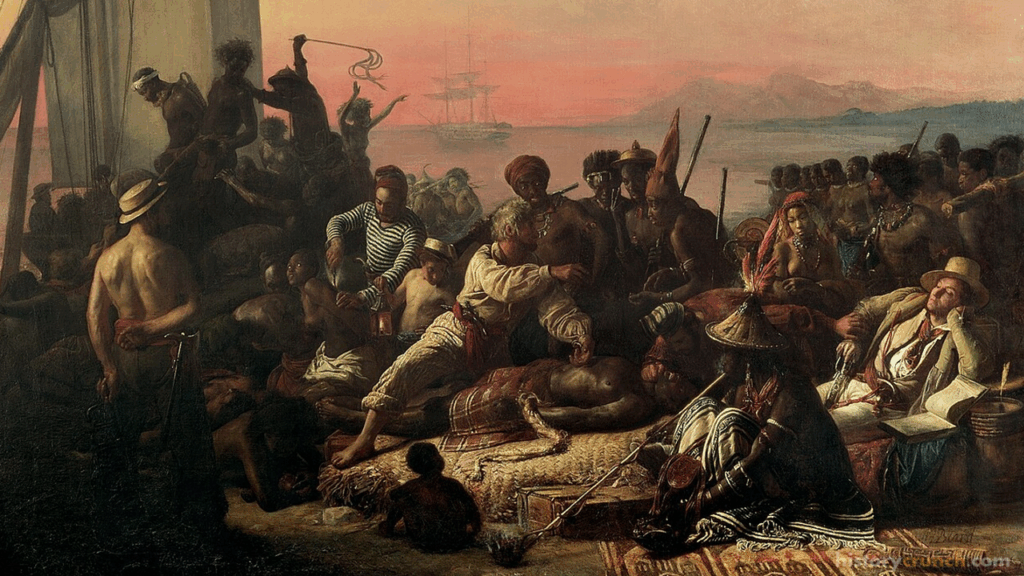
The Slave Trade Act of 1807 made it illegal for British ships to carry enslaved people. It did not free anyone already enslaved. Britain had been one of the largest carriers in the Atlantic trade.
LEARN MORESHOW LESSwhy it matters · key numbersSOCIALThe moral argument that abolished the trade is the same argument later used to justify conquest: Europe would go into Africa to end slavery there. That turn, from abolition to occupation, is one of the hardest things on this timeline to think about clearly.
Britain's hold on the Cape Colony was recognized by the other European powers as part of the Congress of Vienna settlement in 1815. Britain immediately began encouraging its own settlers to move in.
LEARN MORESHOW LESSwhy it mattersPOLITICALA conference in Europe decided who owned a piece of southern Africa, without anyone from southern Africa present. The Berlin Conference does the same thing on a continental scale sixty-nine years later.
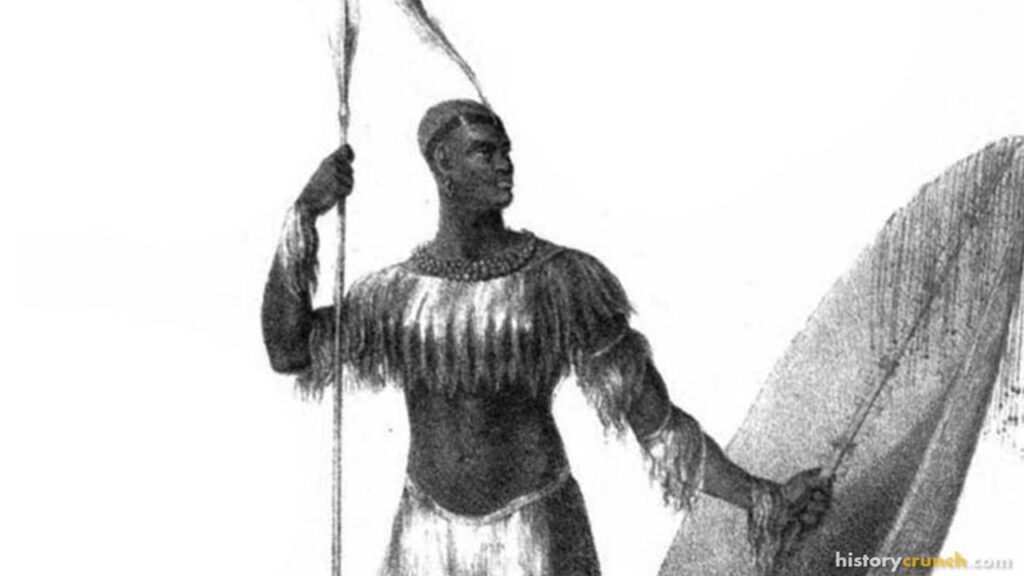
Shaka oversaw a large military expansion of the Zulu kingdom from about 1815 until the 1830s, reorganizing its army and its tactics and reshaping the politics of the whole region.
LEARN MORESHOW LESSwhy it matters · 1 key figureMILITARYAfrican states were not waiting passively to be colonized. They were expanding, fighting and negotiating with each other, and the Zulu kingdom went on to hand Britain one of its worst defeats of the century.
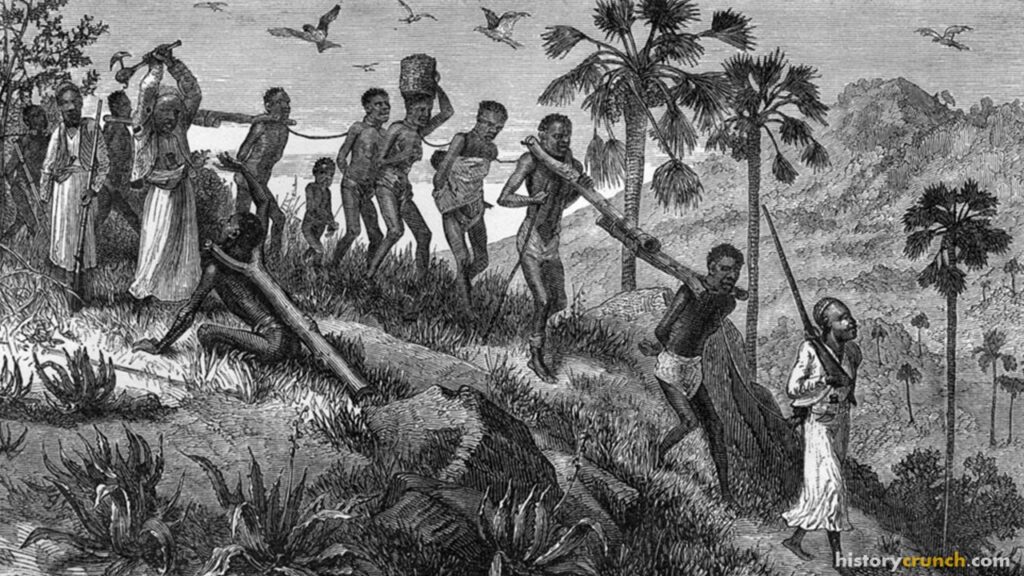
Parliament abolished slavery throughout the empire in 1833. British campaigners went on arguing against slavery elsewhere in the world for decades afterwards, including in East Africa, where the trade continued.
LEARN MORESHOW LESSwhy it matters · key numbersSOCIALThis is where the missionary case for going into Africa comes from, and it was sincerely held. It is also the case Leopold II used to get the Congo, which is why sincerity and consequence have to be judged separately.
From 1835 to 1840 thousands of Dutch-descended settlers left the British Cape Colony and moved into the interior of southern Africa, where they founded their own republics.
LEARN MORESHOW LESSwhy it matters · key numbersSOCIALThis is the origin of the Boer republics and therefore of the Boer War sixty-four years later. The quarrel between Britain and the Boers begins as a quarrel between settlers about who rules whom, not between Europe and Africa.
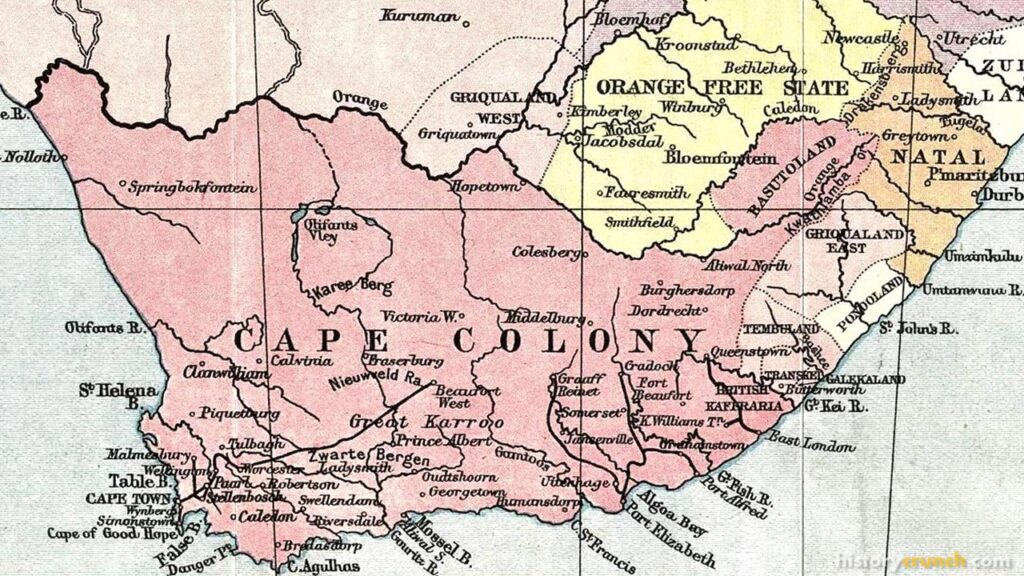
The Transvaal Republic was established in 1852 by Boer settlers who had left the Cape, followed by the Orange Free State in 1854. Both were independent of Britain.
LEARN MORESHOW LESSwhy it mattersPOLITICALTwo small farming republics, poor and landlocked, sitting on ground nobody had yet valued. That changes completely in 1886 when gold is found under one of them.
The Orange Free State was established in 1854. In the same year the Cape Colony elected its first parliament, though it remained under overall British control.
LEARN MORESHOW LESSwhy it mattersPOLITICALSouthern Africa by the 1850s is a patchwork: British colonies with elected assemblies, independent Boer republics, and African kingdoms, all on the same ground. The Scramble is what happens when that patchwork is forced into a single imperial map.
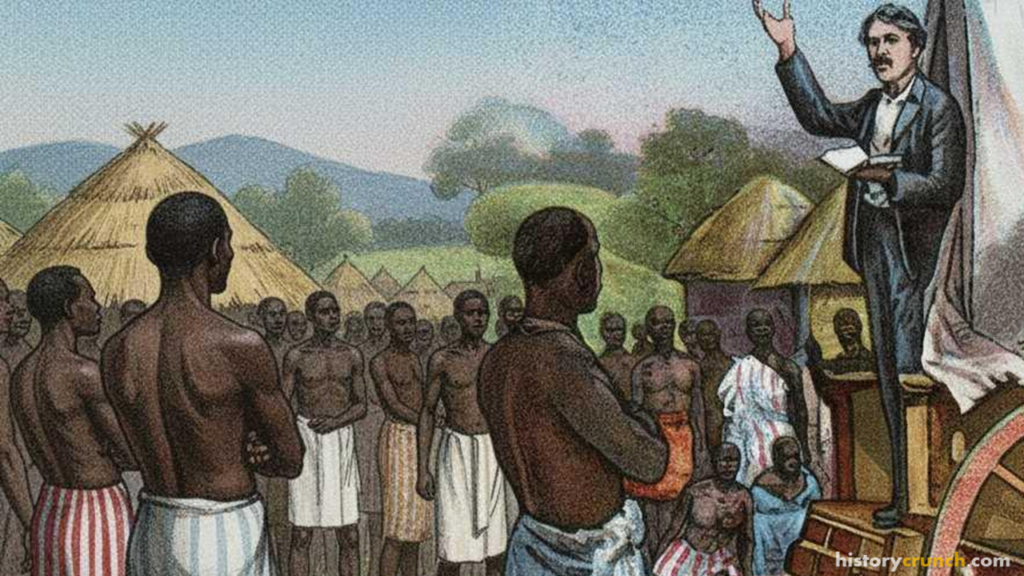
Guided by local Africans, David Livingstone arrived at the falls on the Zambezi River in November 1855 and gave them an English name. He was a missionary, a doctor and an explorer, and he opposed the slave trade on religious grounds.
LEARN MORESHOW LESSwhy it matters · 1 key figureSOCIALLivingstone's books and lectures made Africa real to a British public that had never thought about it. He wanted missions and trade to replace slaving. What his maps actually produced was a queue of governments and companies.
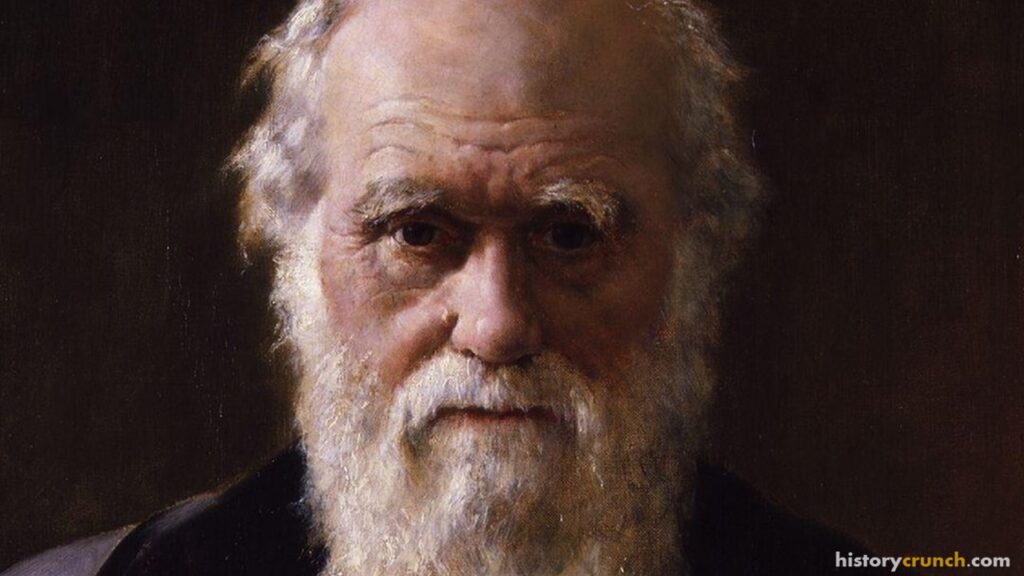
Charles Darwin published On the Origin of Species in 1859. It is a book about how species change over time through natural selection. It says nothing about human races being fit to rule one another.
LEARN MORESHOW LESSwhy it matters · key numbers · 1 key figureIDEASWithin a generation his name was attached to Social Darwinism, the claim that some peoples are naturally fit to rule others. It became one of the standard justifications for conquest, and Darwin did not make it.
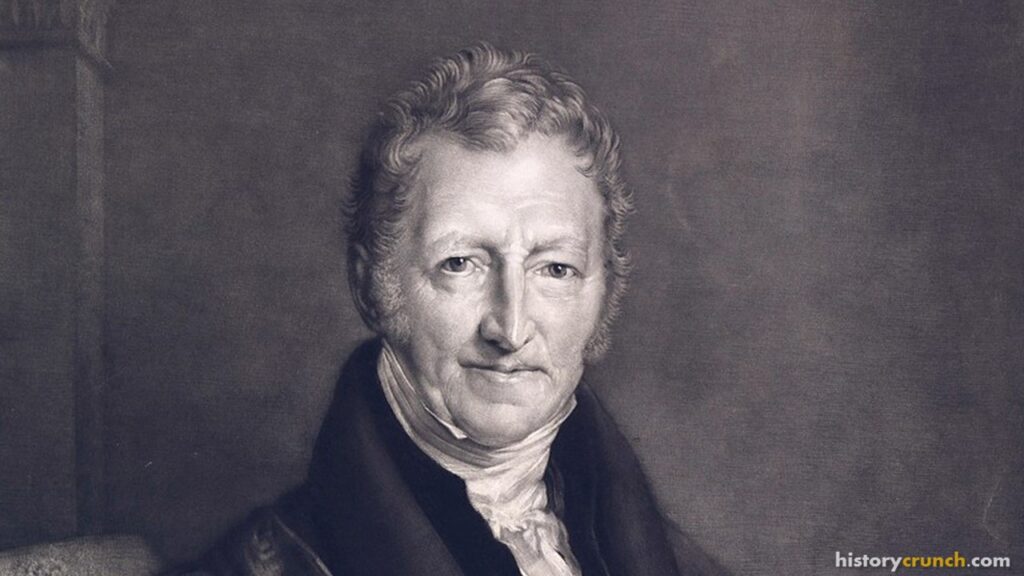
Thomas Malthus had argued decades earlier that population grows faster than food supply, so competition for resources is permanent. Darwin acknowledged the influence; Social Darwinists took the competition and applied it to nations and races.
LEARN MORESHOW LESSwhy it matters · 1 key figureIDEASBad ideas are usually assembled out of real ones. Tracing how a claim about finches and food became a claim about who deserves an empire is a useful exercise in how evidence gets misused.
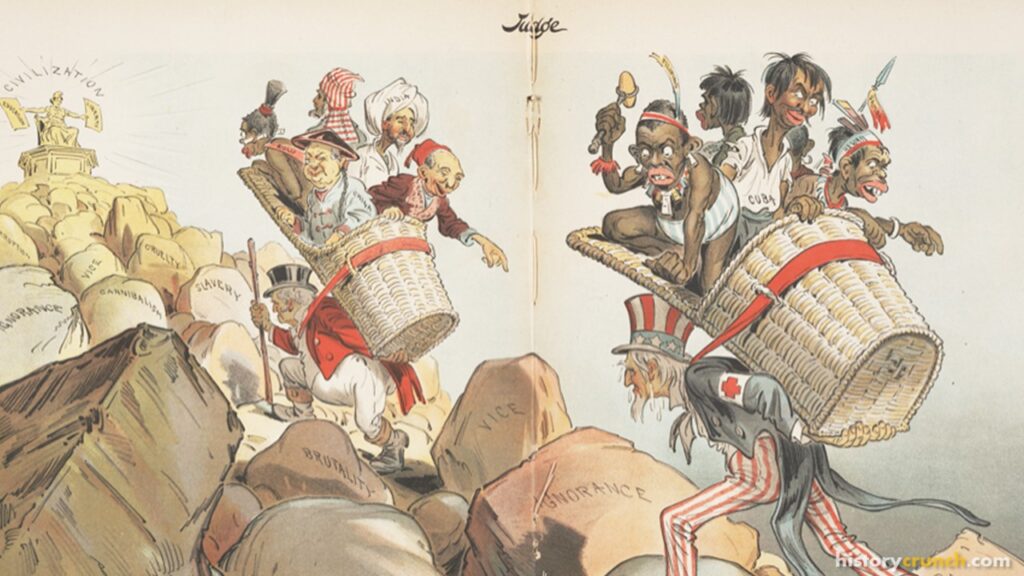
Alongside Social Darwinism ran ethnocentrism: the belief that European ways of living were the standard by which everyone else should be judged, and that ruling other people was a burden Europeans carried on their behalf. The cartoon here is from 1899 and mocks the idea even as it repeats it.
LEARN MORESHOW LESSwhy it mattersIDEASVery few people conquer a continent while believing they are doing something wrong. Understanding what Europeans told themselves is not excusing it; it is the only way to explain why so many ordinary, decent people went along with it.
The Suez Canal Company began construction in 1859. The canal would link the Mediterranean to the Red Sea and cut the sea journey from Europe to India by thousands of miles.
LEARN MORESHOW LESSwhy it mattersTECHNOLOGYEgypt was of little interest to Europe before this. A decade of digging turned it into the most strategically important country in Africa, and Britain occupied it twenty-three years later.
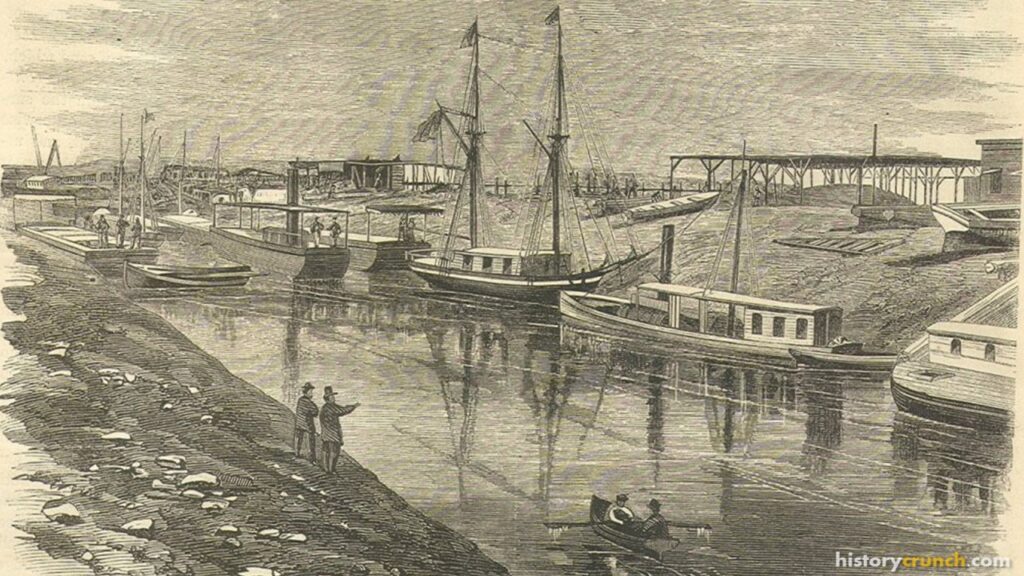
The Suez Canal opened on 17 November 1869 after ten years of construction. Britain came to call it the lifeline of the British Empire, because it was the fastest route to India.
LEARN MORESHOW LESSwhy it matters · key numbersTECHNOLOGYThis is the single most important thing on the timeline before 1884. Africa stops being a coastline on the way to somewhere else and becomes a place with something Europe urgently wants.
A decade of missionaries, explorers and journalists put the inside of the continent onto European maps and into European newspapers. David Livingstone went looking for souls and the source of the Nile and found neither. Henry Morton Stanley went looking for a story and found one that sold enormously. Their maps and their reports were read in London and Brussels as an inventory, and within a few years a king had hired one of them to go and get him a colony.
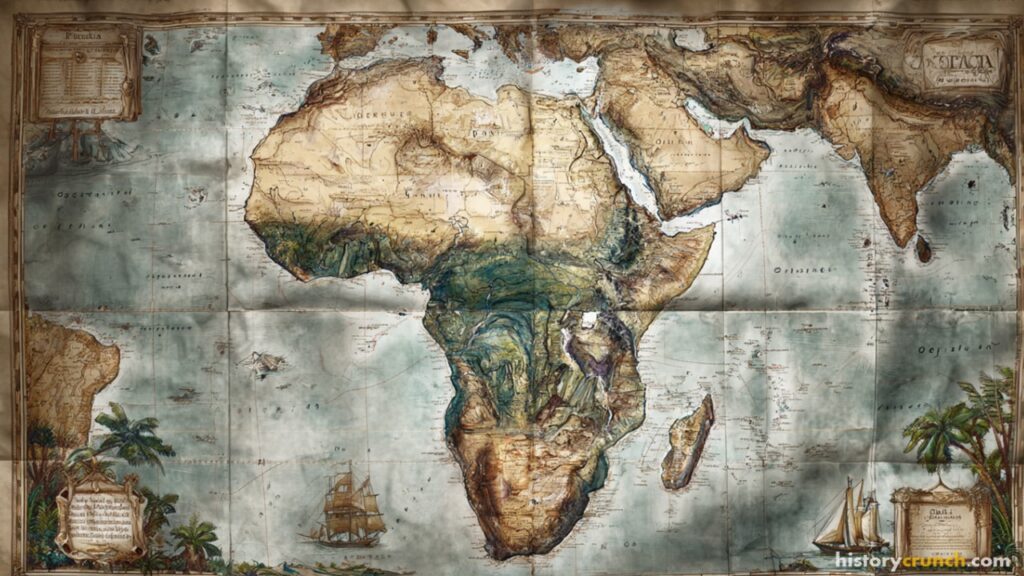
Historians date the Scramble for Africa from about 1870 to the outbreak of the First World War in 1914, the same years as the wider Age of Imperialism. In 1870 European powers held scattered coastal footholds. By 1914 the entire continent was under European rule except Liberia and Ethiopia.
LEARN MORESHOW LESSwhy it matters · key numbersPOLITICALForty-four years. That is the number to give a class, because it is short enough to be one working life and it covers the partition of an entire continent of hundreds of states and peoples.
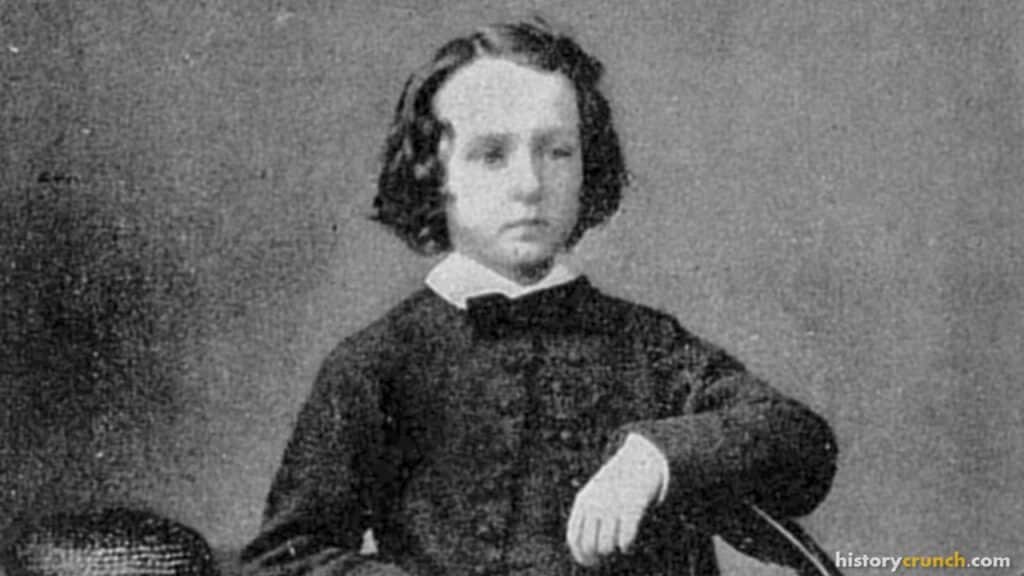
In 1871 Cecil Rhodes and his brother moved to Kimberley, where diamonds had recently been found. Rhodes had been sent to South Africa for his health. He was eighteen.
LEARN MORESHOW LESSwhy it matters · 1 key figureECONOMICRhodes matters more than any other single person on this timeline, and he arrives as a sickly boy chasing a diamond rush. Nothing about the next thirty years was planned by anybody in London.
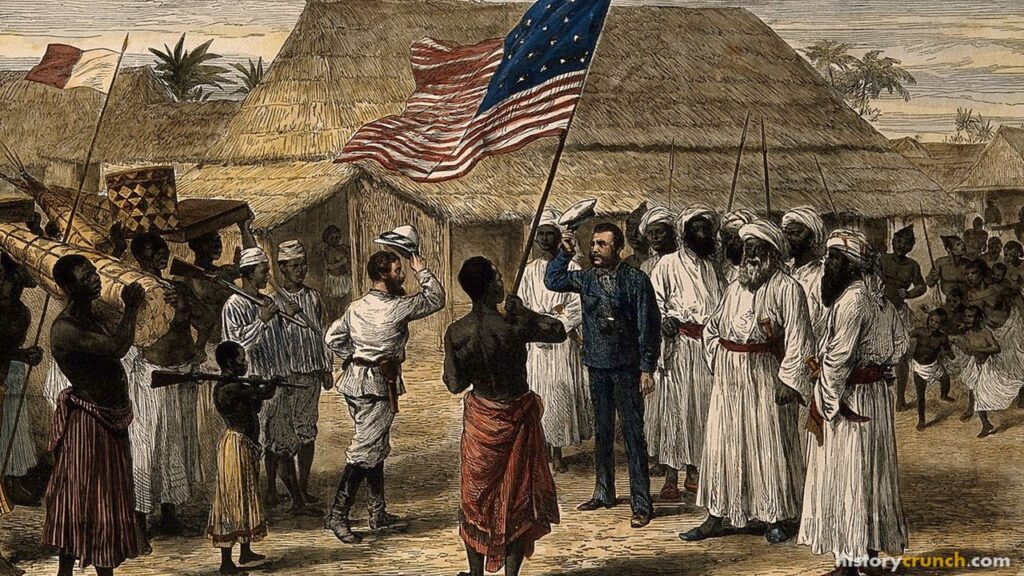
Henry Morton Stanley, a journalist sent by the New York Herald, arrived in eastern Africa in 1871 and found David Livingstone living at Ujiji on Lake Tanganyika. The greeting he reported became one of the most quoted lines of the century.
LEARN MORESHOW LESSwhy it matters · 2 key figuresSOCIALA newspaper sent a reporter to find a missionary, and the story sold enormously. Africa became a subject the European and American public followed, and public attention is what made government money available.
Livingstone had gone back to Africa in 1866 to find the source of the Nile. He caught pneumonia and cholera, and abandoned the expedition in October 1871. He never left Africa again.
LEARN MORESHOW LESSwhy it matters · 1 key figureSOCIALThe heroic version of exploration leaves out how often it failed. Livingstone was ill, lost, dependent on African guides and traders for years at a time, and wrong about the Nile.
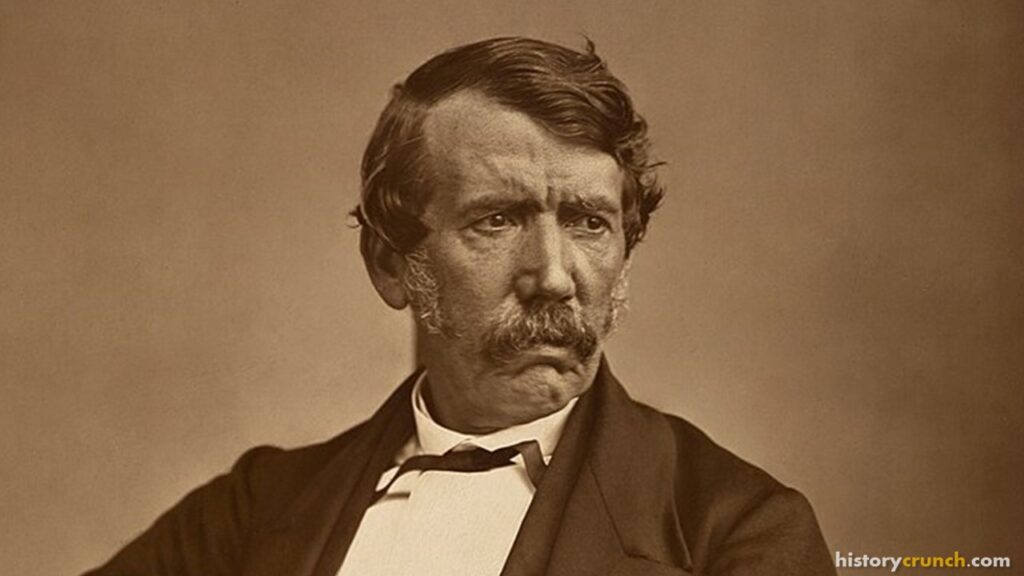
David Livingstone died on 1 May 1873, aged 60, in a small village in eastern Africa. His African companions carried his body to the coast so it could be sent home.
LEARN MORESHOW LESSwhy it matters · 1 key figureSOCIALHis death produced a wave of public feeling in Britain and a rush of missionary and commercial interest in the interior. More was done in Africa in his name after he died than he ever managed himself.
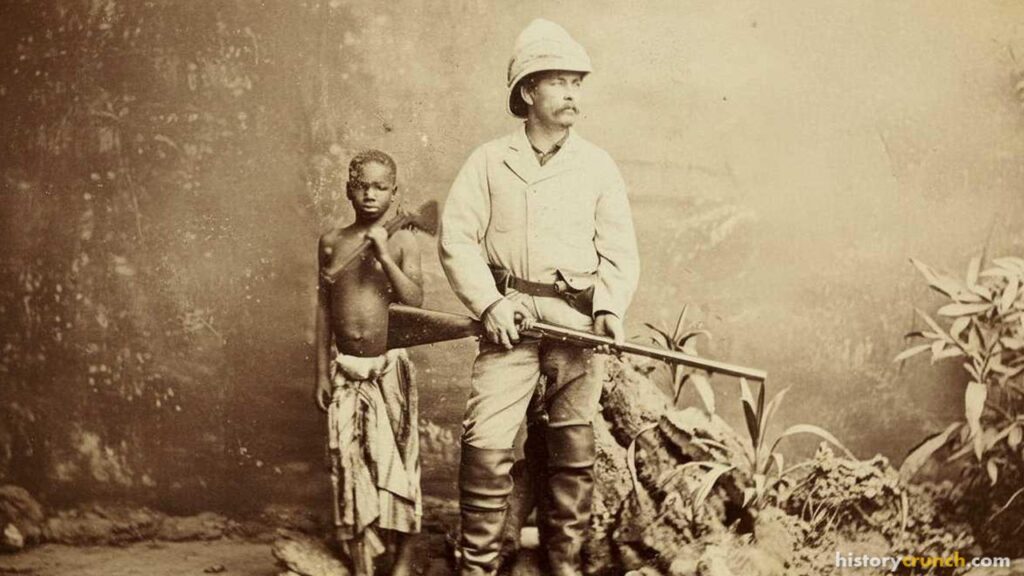
In 1878 Leopold II, King of the Belgians, hired Henry Morton Stanley to lead expeditions into the Congo River basin, sign treaties with local rulers and set up trading stations. Leopold was acting as a private individual, not as the Belgian state.
LEARN MORESHOW LESSwhy it matters · 2 key figuresECONOMICBelgium did not want an empire. Its king did, and bought one personally. That distinction is what let him rule the Congo with no parliament, no press and no oversight for twenty-three years.
In seven years Europe acquired a reason, a weapon and a set of rules. Britain took Egypt to protect the canal, Hiram Maxim built a gun that fired by itself, and fourteen states met in Berlin for 104 days to agree how Africa would be divided without them going to war with each other. No African was present. The rule they agreed, that a claim counted only if you controlled the ground, turned a paper argument into an invasion.
Tensions in southern Africa reached a high point in 1879 with the Anglo-Zulu War between Britain and the Zulu kingdom. Britain won the war, but not before suffering one of the worst defeats a European army had taken from an African force.
LEARN MORESHOW LESSwhy it mattersMILITARYIt is the clearest evidence that African states fought back and could win battles. It is also why the Maxim gun, five years later, changed everything: it removed the possibility of that kind of defeat.
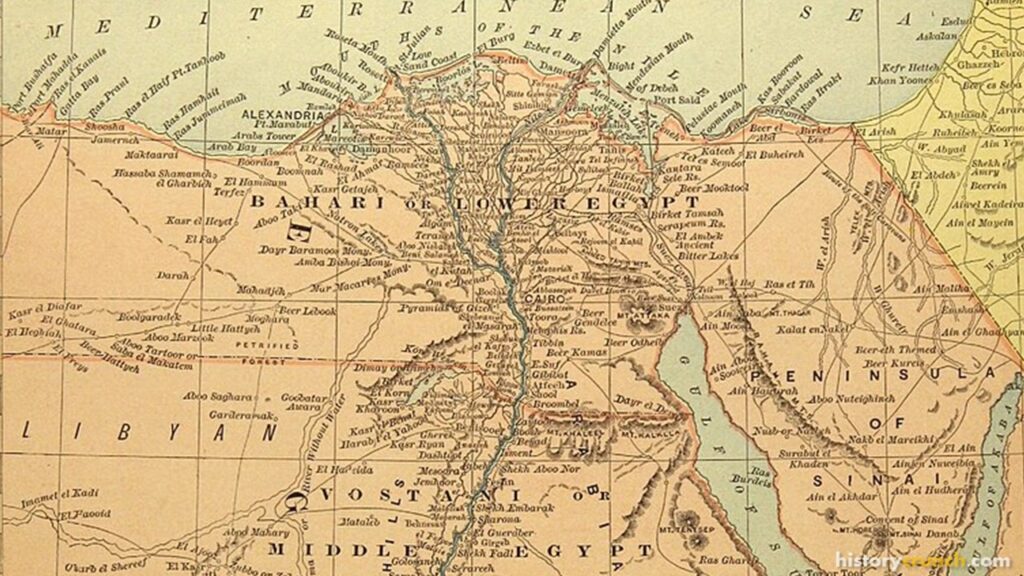
In 1881 Egypt went through major political and social upheaval, with a nationalist movement gaining ground. Britain feared nationalists taking full control of the country and, with it, the Suez Canal.
LEARN MORESHOW LESSwhy it mattersPOLITICALBritain did not occupy Egypt out of greed for Egypt. It occupied Egypt because Egyptians looked like they might start governing themselves, and the canal was too important to leave in their hands.
Cecil Rhodes was elected to the Cape of Good Hope Parliament in 1881 at the age of 27, while building his diamond business at the same time.
LEARN MORESHOW LESSwhy it matters · 1 key figurePOLITICALRhodes held business and political power together for fifteen years, and used each to advance the other. Watching how that works is more useful to a student than any single event he caused.
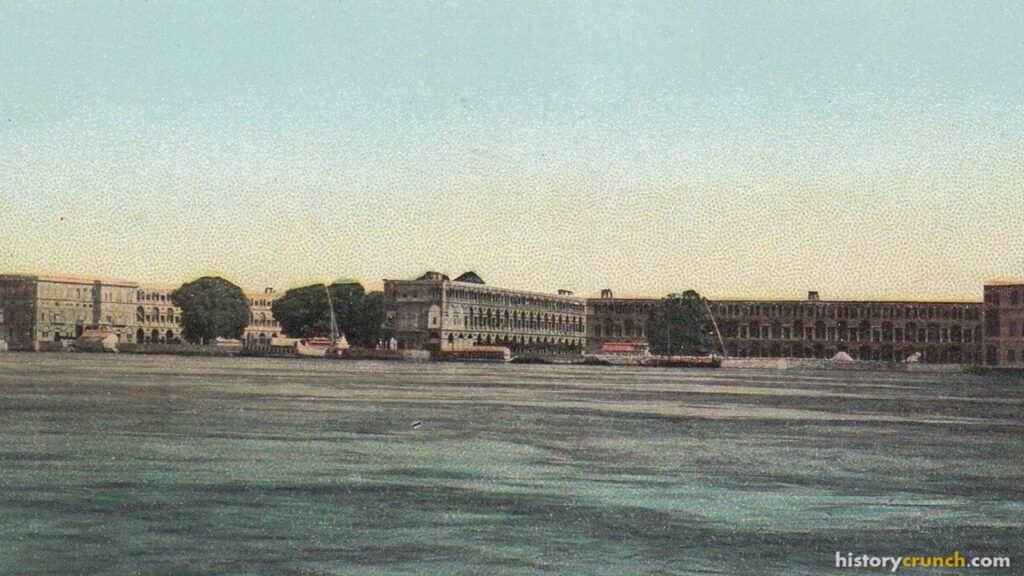
Britain fought the Anglo-Egyptian War from July to September 1882 and took control of the country. The occupation was described as temporary. British forces did not formally leave until June 1956.
LEARN MORESHOW LESSwhy it matters · key numbersMILITARYSeventy-four years of a temporary arrangement. It is the sharpest example on the timeline of how an occupation justified as a short-term emergency becomes permanent by simply never ending.
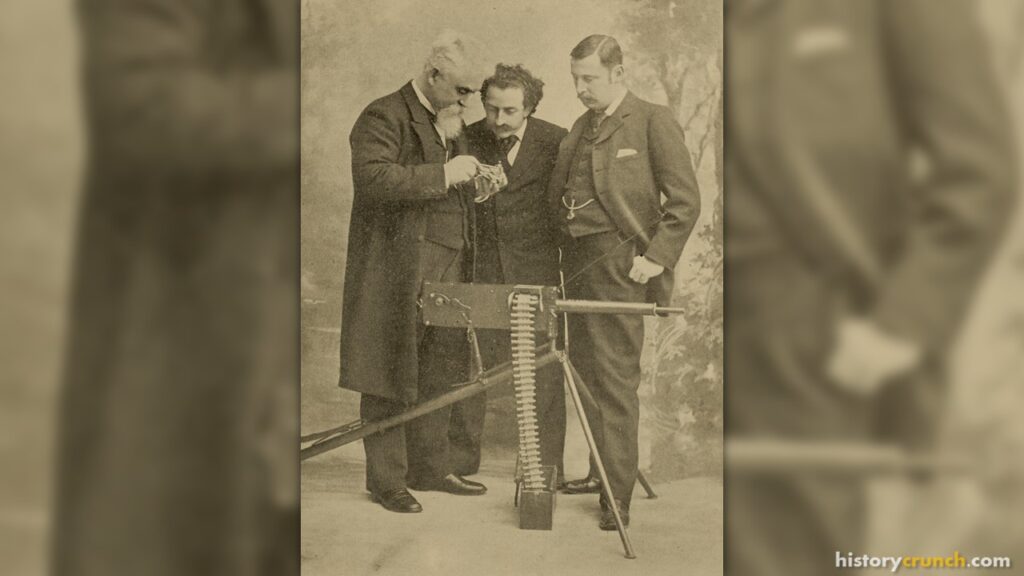
The Maxim gun, invented in 1884, used the recoil of each shot to load the next, so it fired continuously while the trigger was held. It is widely considered one of the main reasons European forces could defeat far larger African armies.
LEARN MORESHOW LESSwhy it matters · key numbers · 1 key figureTECHNOLOGYThe same year as the Berlin Conference. Europe agreed the rules for dividing Africa in the same twelve months that it acquired the weapon for enforcing them, and the two facts belong together.
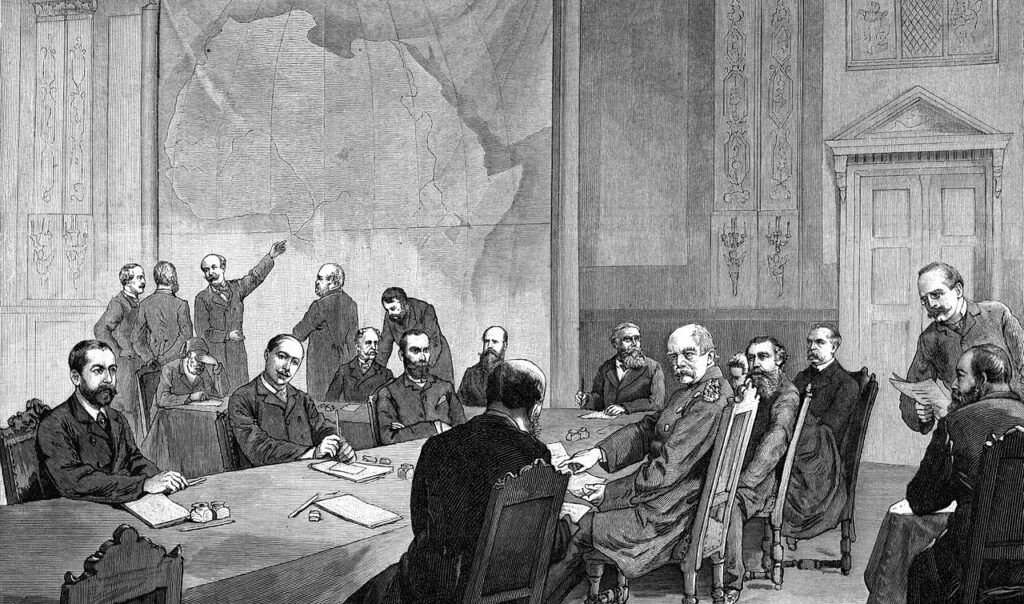
Called by the German Chancellor Otto von Bismarck, the Berlin Conference ran from 15 November 1884 to 26 February 1885. European powers met to agree rules for claiming African territory and to reduce the risk of war between themselves.
LEARN MORESHOW LESSwhy it matters · key numbers · 1 key figurePOLITICALThe conference was not about Africa's future. It was about European powers not shooting at each other while they took it. Nobody from Africa was invited, consulted or informed.
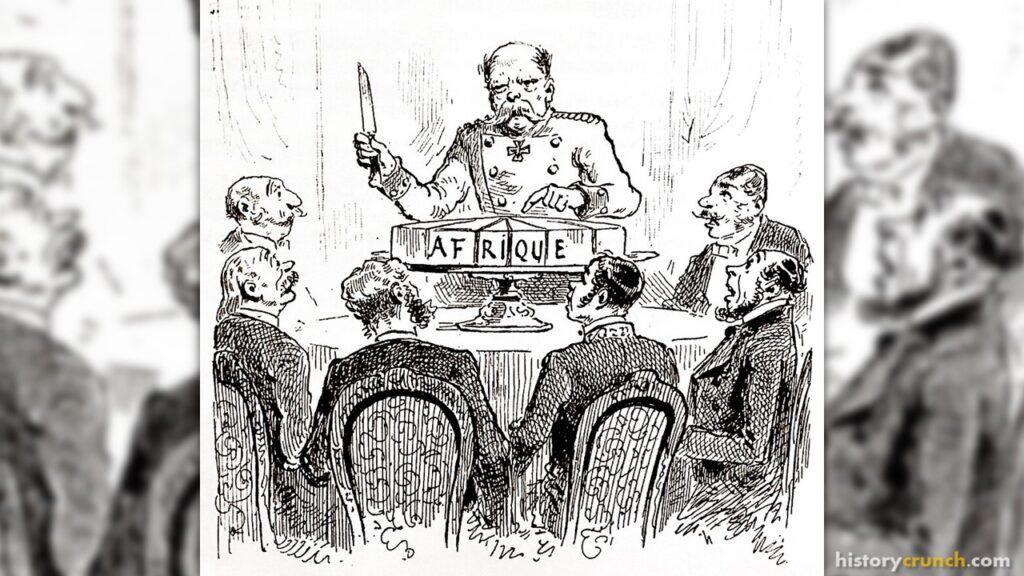
The Berlin Conference closed on 26 February 1885 with an agreement among the European powers on how Africa would be partitioned for colonization. Its central rule was effective occupation: a claim only counted if you could show you controlled the ground. Between 1870 and 1914 the whole continent came under European rule except Liberia and Ethiopia.
LEARN MORESHOW LESSwhy it matters · key numbersPOLITICALThe borders agreed here are mostly still the borders of Africa today. They were drawn to suit European claims, and they cut through language groups, kingdoms and trade networks without reference to any of them.
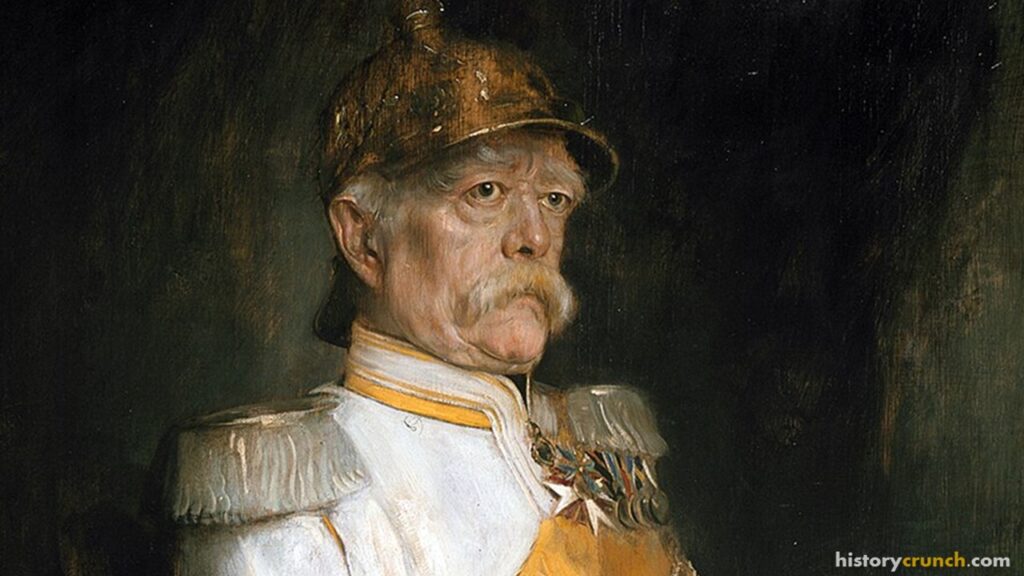
Otto von Bismarck had spent years dismissing colonies as an expensive distraction from Germany's position in Europe. He called the Berlin Conference to manage the rivalry between the other powers, and Germany came away with colonies of its own.
LEARN MORESHOW LESSwhy it matters · 1 key figurePOLITICALA useful corrective to the idea that empires were built by people who wanted them. Bismarck's concern was the balance of power in Europe, and Africa was the board he moved pieces on.
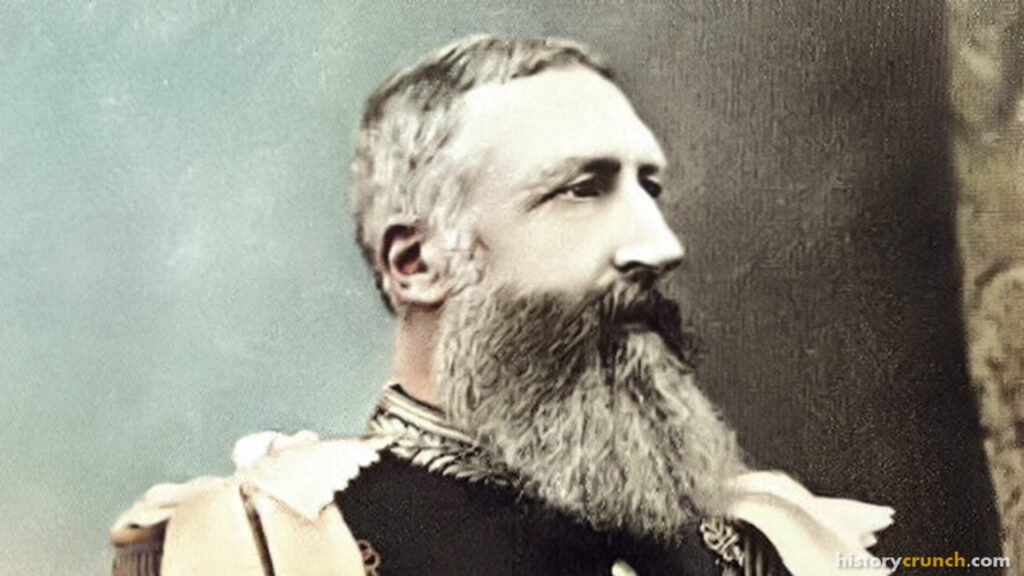
Leopold II formally created the Congo Free State in 1885 and ruled it as a personal possession rather than a Belgian colony. He had persuaded the powers at Berlin that his interest was humanitarian: ending the slave trade and opening the region to free commerce.
LEARN MORESHOW LESSwhy it matters · key numbers · 1 key figureECONOMICAn area seventy-six times the size of Belgium became one man's property, and he had won it by promising to stop slavery there. What followed was one of the worst forced-labour regimes in modern history.
Gold under an independent Boer republic, diamonds under a British one, and a man who wanted a British corridor from Cape Town to Cairo and had the money to try for it. Cecil Rhodes held a mining fortune and a colonial premiership at the same time, and used each to advance the other. His career ends in this chapter with a private invasion of a neighboring country that failed completely and set off a war anyway.
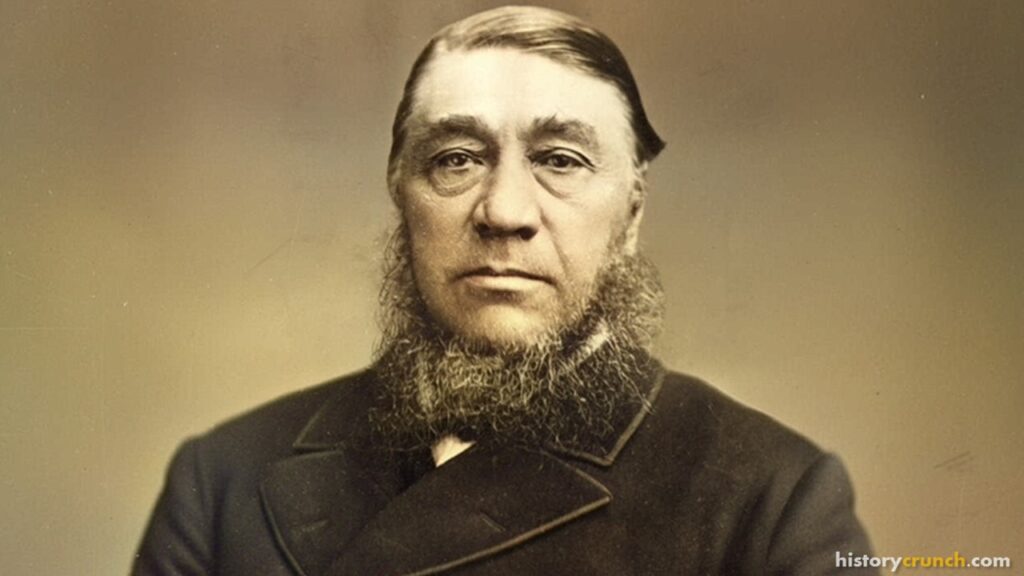
Gold was discovered in the Transvaal in 1886, on the territory of an independent Boer republic led by Paul Kruger. Prospectors and money poured in from across the world.
LEARN MORESHOW LESSwhy it matters · key numbers · 1 key figureECONOMICEverything that follows in southern Africa follows from this. The Boer republics went from poor and ignorable to the richest ground on the continent, and they were not British.
In 1886 Stanley led an expedition to rescue Emin Pasha, the governor of Equatoria in southern Sudan, who was cut off by a rising. The expedition was enormously publicized and extremely costly in African lives.
LEARN MORESHOW LESSwhy it matters · 1 key figureMILITARYRescue expeditions were a favourite subject for European newspapers and a convenient reason to move armed columns through territory nobody had yet claimed. The rescue and the claim travelled together.
Cecil Rhodes co-founded the De Beers Diamond Company in 1888, consolidating the Kimberley diamond fields under a single company.
LEARN MORESHOW LESSwhy it matters · 1 key figureECONOMICRhodes now had the money to raise private armies, fund expeditions and buy newspapers. The next decade shows what one very rich man with a political office can do to a continent when nobody stops him.
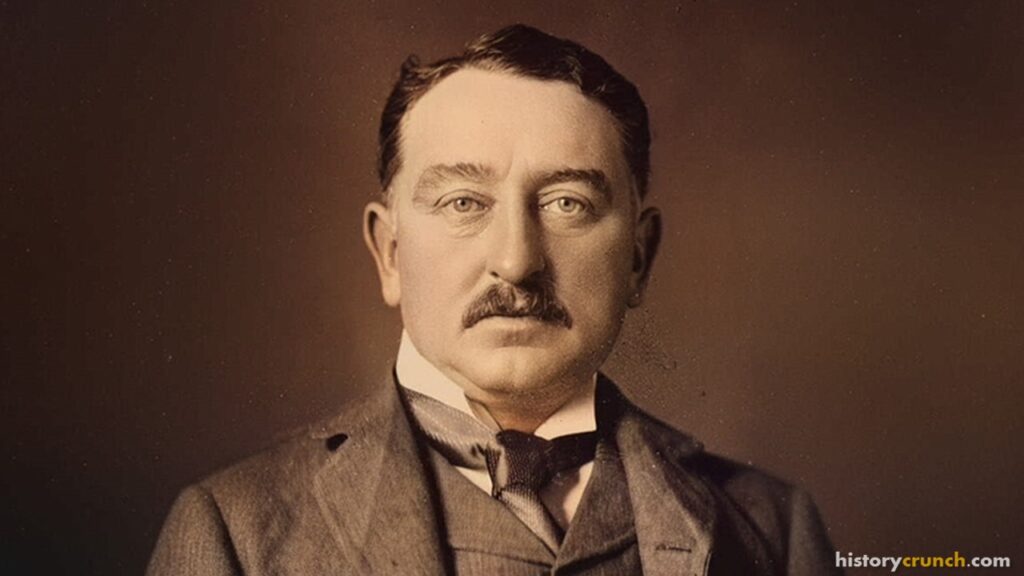
Cecil Rhodes served as Prime Minister of the Cape Colony from July 1890 until January 1896. He held the office while running the largest mining company in southern Africa.
LEARN MORESHOW LESSwhy it matters · key numbers · 1 key figurePOLITICALHe wanted a British-controlled corridor from Cape Town to Cairo, and he was now in a position to pursue it with public power and private money at the same time.
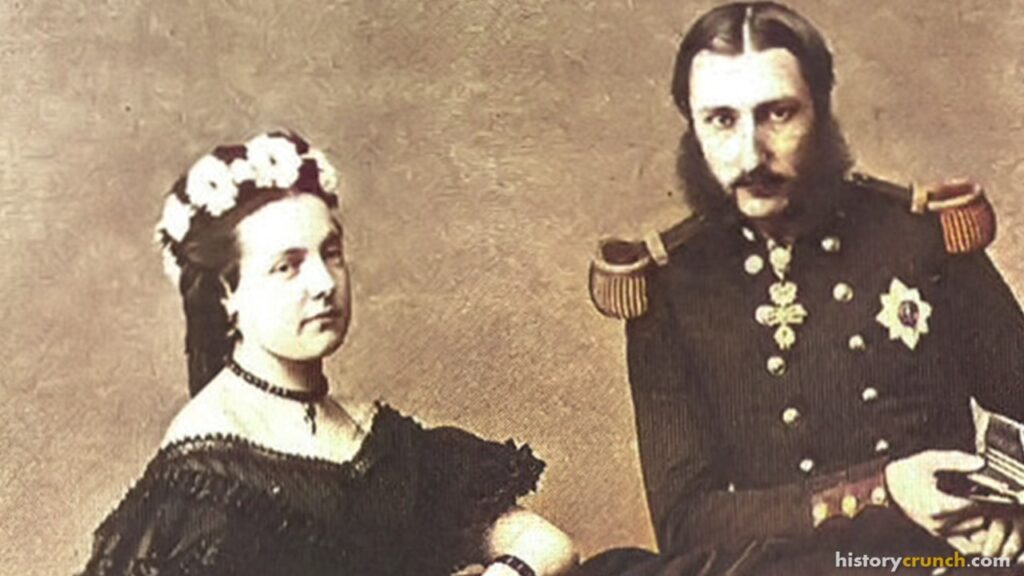
Leopold II awarded Stanley the Grand Cordon of the Order of Leopold in 1890, in recognition of the expeditions and treaties that had given the king the Congo.
LEARN MORESHOW LESSwhy it matters · 2 key figuresPOLITICALWorth putting beside what was happening in the Congo at the same time. The man who acquired it was being honored in Brussels while the forced-labour system he had helped establish was running at full speed.
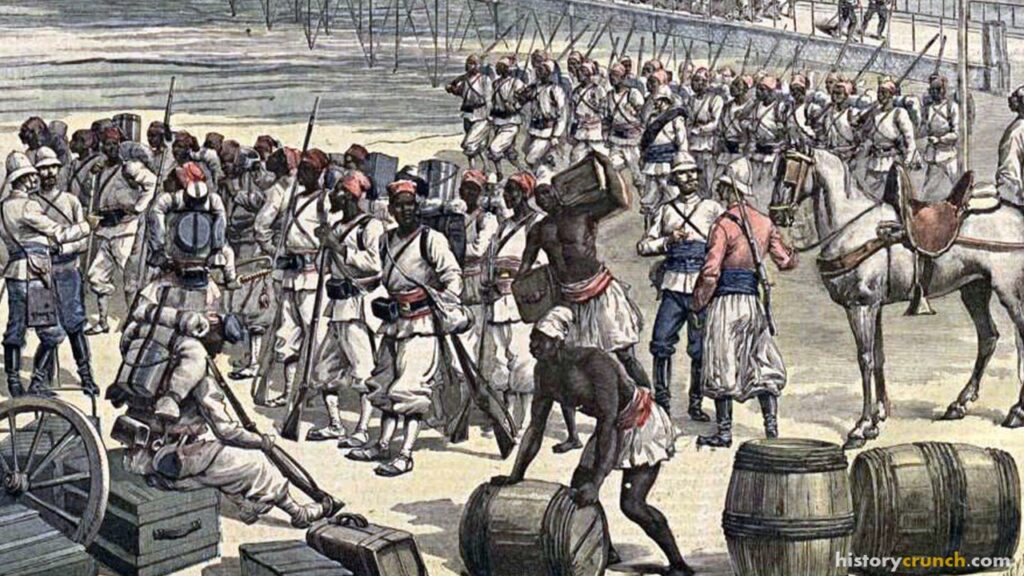
France, like Britain, raised large numbers of African troops. Senegalese soldiers served in the French army from the 19th century onward, and colonial armies across the continent were made up mostly of local recruits under European officers.
LEARN MORESHOW LESSwhy it mattersMILITARYThe conquest of Africa was not carried out by Europeans alone, and neither was its defence. Asking who actually did the fighting complicates the story in a way students find genuinely surprising.
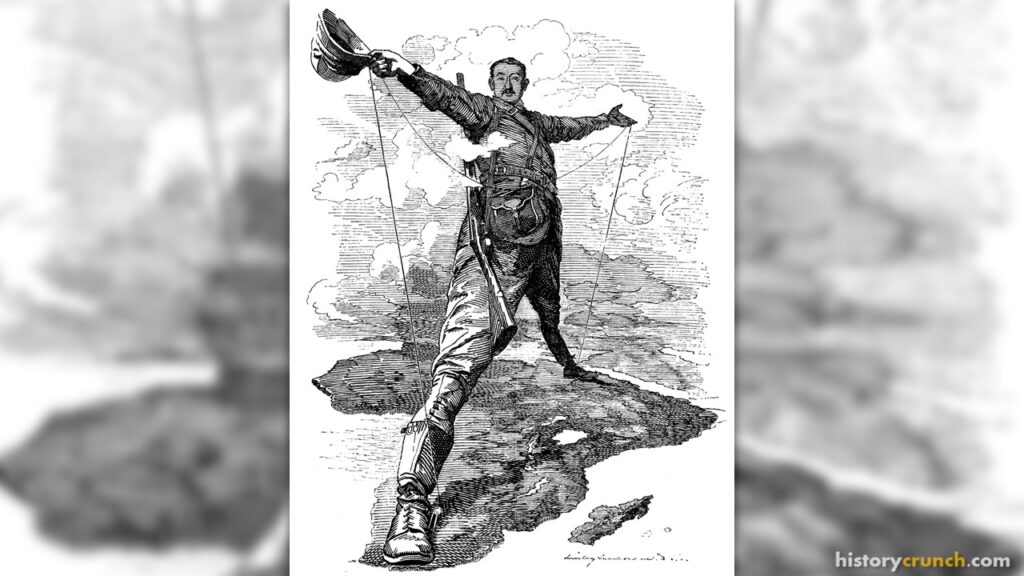
Edward Linley Sambourne's cartoon 'The Rhodes Colossus' appeared in 1892, showing Rhodes standing astride the continent with one foot in Cape Town and one in Cairo, holding a telegraph line.
LEARN MORESHOW LESSwhy it matters · 1 key figureSOCIALIt is the single best image on this timeline for teaching what the Scramble looked like from inside Britain: not shameful, not controversial, but a joke about a man's ambition, printed in a popular magazine.
The territory north of the Limpopo was taken not by Britain but by a chartered company, Rhodes's British South Africa Company, which had its own armed force. It was formally recognized as Rhodesia in 1895, named after him while he was alive.
LEARN MORESHOW LESSwhy it matters · 1 key figurePOLITICALA private company acquired a country and named it after its chairman. Students should sit with that for a moment before moving on; it is not a figure of speech.
From 29 December 1895 to 2 January 1896, a force organized with Rhodes's backing rode into the Transvaal intending to trigger an uprising against Kruger's government. The rising did not happen and the raiders were captured.
LEARN MORESHOW LESSwhy it matters · key numbersMILITARYIt failed completely and still changed everything. The Boers armed heavily afterwards, Britain and the Transvaal stopped trusting each other, and the road to the Boer War was open.
The embarrassment of the failed Jameson Raid ended Cecil Rhodes's political career. He resigned as Prime Minister on 12 January 1896, ten days after the raiders surrendered.
LEARN MORESHOW LESSwhy it matters · 1 key figurePOLITICALHis Cape-to-Cairo corridor was never completed. The map of Africa in 1914 is not the map anyone in particular designed; it is the residue of dozens of schemes, some of which failed exactly like this one.
Two small farming republics declared war on the largest empire in the world, and for six months they were winning. It took Britain 180,000 soldiers and two and a half years to finish it, and to do that it burned the farms and put the families in camps where thousands died. Britain won, at a cost to its money, its army and its reputation that shaped everything it did up to 1914.
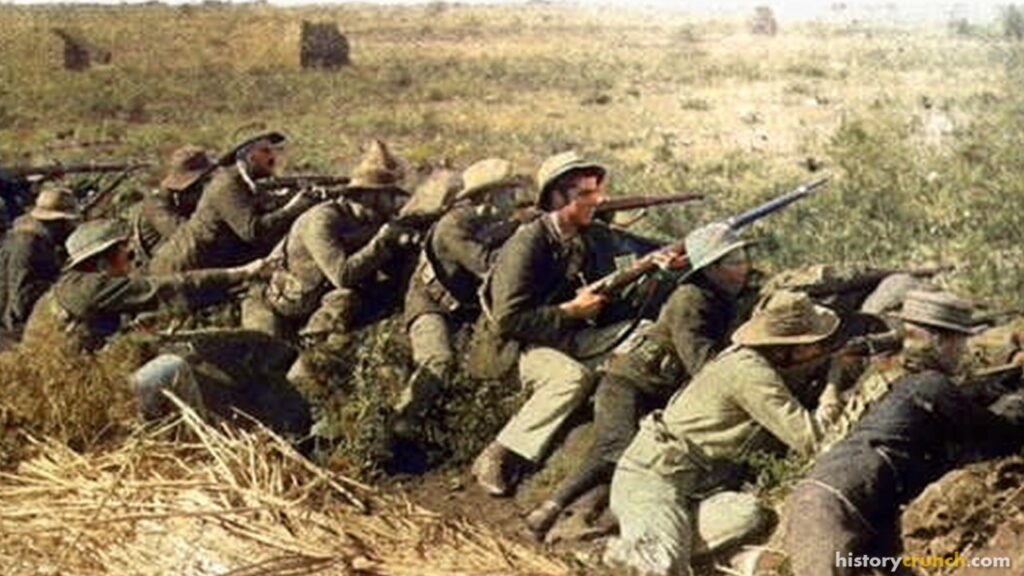
War was declared on 2 October 1899 when Boer forces from the Transvaal and Orange Free State crossed into the Cape Colony and Natal. Britain brought in troops from Australia, Canada, New Zealand, Rhodesia and South Africa.
LEARN MORESHOW LESSwhy it matters · key numbersMILITARYTwo small farming republics attacked the largest empire in the world, and for the first six months they were winning. It is the last war Britain fought before 1914, and it shook British confidence badly.
The first engagement of the Boer War was the Battle of Kraaipan on 12 and 13 October 1899, ten days after war was declared.
LEARN MORESHOW LESSwhy it mattersMILITARYSmall, quick and largely forgotten, which is what most of the war's fighting was actually like away from the famous sieges.
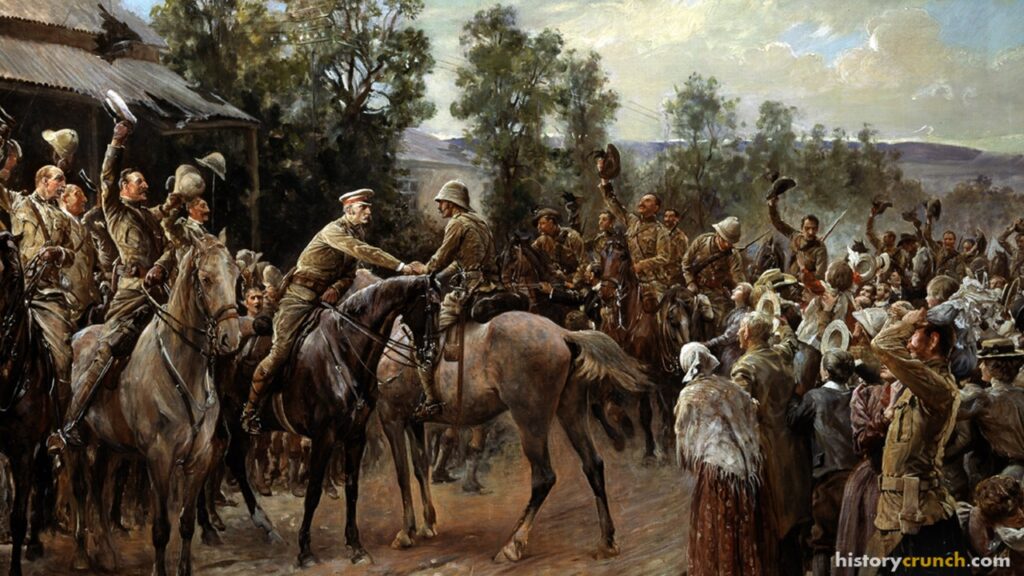
The Siege of Mafeking ran from 13 October 1899 to 17 May 1900. Trenches were used throughout. Its relief was celebrated in Britain with public rejoicing on a scale rarely seen.
LEARN MORESHOW LESSwhy it matters · key numbersMILITARYThe trenches are worth noticing. Fifteen years before the Western Front, this war was already showing what happens when magazine rifles and machine guns meet men advancing in the open.
Between 10 and 17 December 1899 British forces suffered a series of heavy defeats, a period remembered in Britain as Black Week.
LEARN MORESHOW LESSwhy it matters · key numbersMILITARYIt ended the assumption that a European army would simply roll over farmers with rifles. Britain responded by pouring in an army of a size it had not fielded since Napoleon.
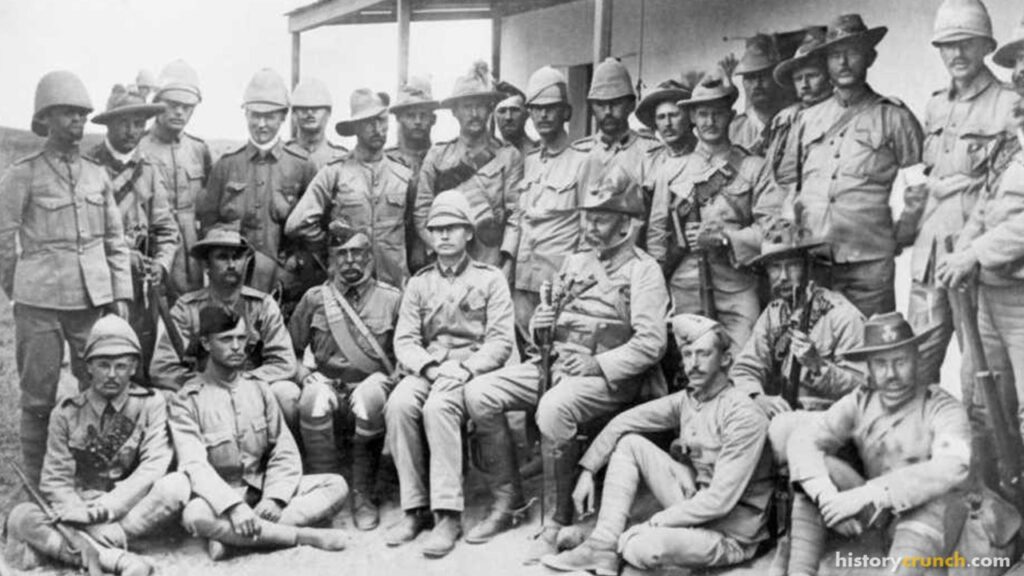
By January 1900 Britain had 180,000 soldiers in South Africa, drawn from across the empire, against Boer forces a fraction of that size.
LEARN MORESHOW LESSwhy it matters · key numbersMILITARYThe numbers are the story. It took the largest empire on earth, and a force many times its enemy's, more than two years to beat two republics with a combined population smaller than Birmingham.
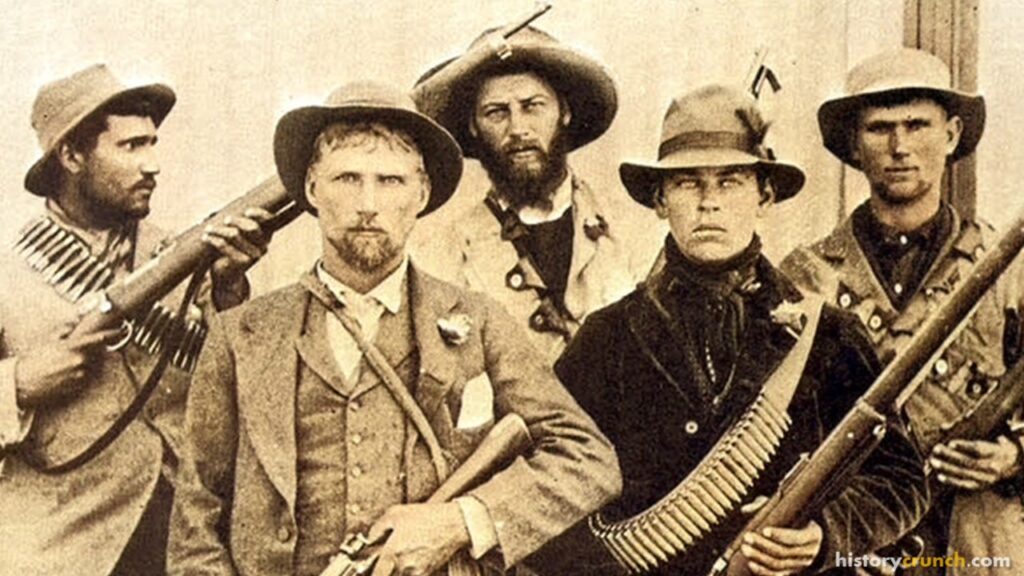
By the end of 1900 Britain controlled both the Transvaal and the Orange Free State and declared the major military operations over. The Boers then switched to guerrilla warfare and fought on for eighteen months.
LEARN MORESHOW LESSwhy it mattersMILITARYTaking the capitals did not win the war, which is a lesson armies have had to relearn repeatedly since. What followed was the part of the war Britain is least comfortable remembering.
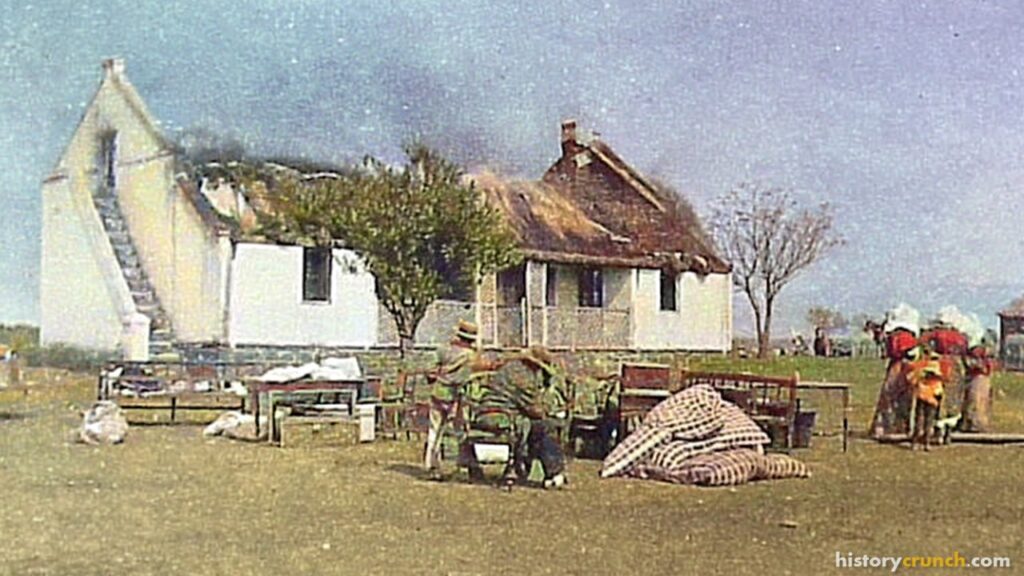
To deny the guerrillas food and shelter, British forces adopted a scorched earth policy, burning Boer farms and destroying crops and livestock across the republics.
LEARN MORESHOW LESSwhy it mattersSOCIALThis is the point where a war between armies becomes a war against a population. What to do with the families left without homes is the question the next card answers, and the answer was worse.
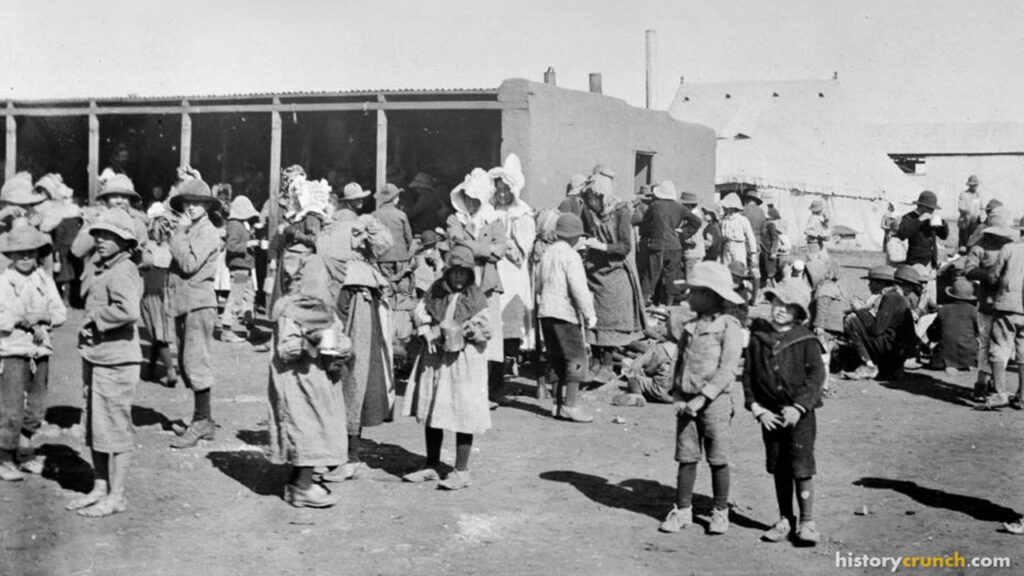
Boer women and children whose farms had been destroyed, along with large numbers of Black African civilians, were held in camps. Disease and inadequate food killed many thousands of them.
LEARN MORESHOW LESSwhy it mattersSOCIALThe term concentration camp enters wide English use here, forty years before the Nazi camps and meaning something different. Students need both the connection and the distinction made carefully, not left to a similar name.
Rhodes had a heart condition from childhood that worsened in his forties. He died on 26 March 1902, aged 48, two months before the war ended.
LEARN MORESHOW LESSwhy it matters · 1 key figurePOLITICALHe shaped the map of southern Africa more than any other individual and did not live to see the war his politics helped cause finish. His will funded the scholarships that still carry his name.
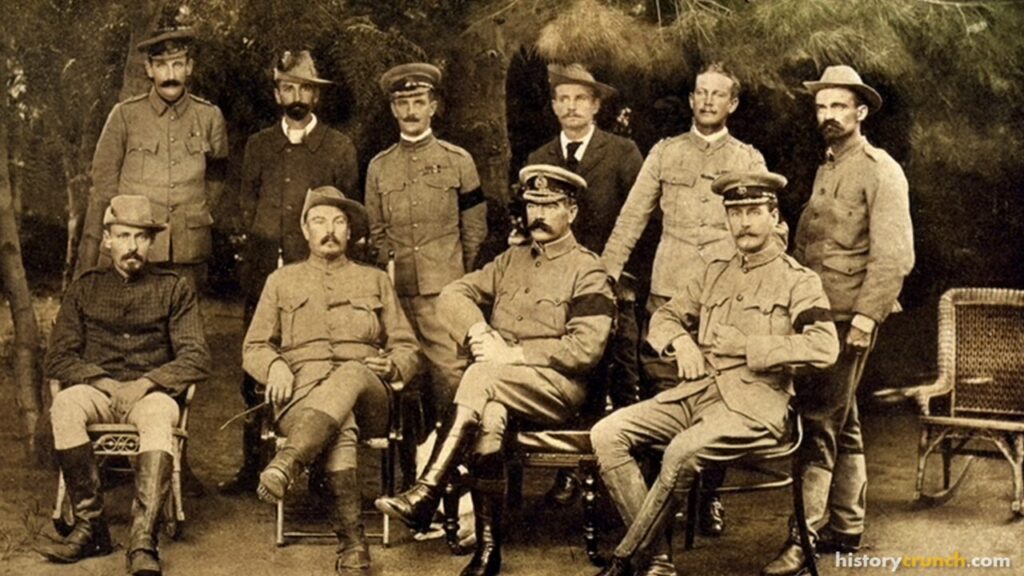
The Boer leadership surrendered and the war ended with the Treaty of Vereeniging in May 1902. The republics became British territory, with a promise of self-government later.
LEARN MORESHOW LESSwhy it matters · key numbersPOLITICALBritain won and paid an enormous price in money, lives and reputation. Within eight years the men it had beaten were governing the Union of South Africa, and Black South Africans had been left out of the settlement entirely.
Twice in six years France and Germany nearly went to war over Morocco, and both times the quarrel made Europe more dangerous rather than less. Meanwhile Belgium took the Congo away from its own king after twenty-three years of forced labour, Britain handed South Africa to the people it had just defeated, and by 1914 Britain held fifty-six colonies to Germany's ten. Then Europe found something else to fight about.
The Entente Cordiale was finalized on 8 April 1904. Britain and France, rivals for centuries, agreed to stop competing over colonial claims, with France given a free hand in Morocco and Britain in Egypt.
LEARN MORESHOW LESSwhy it matters · key numbersPOLITICALTwo empires traded pieces of Africa to fix a European relationship. Germany was not consulted and had almost nothing to trade, and that resentment is what causes both Moroccan crises.
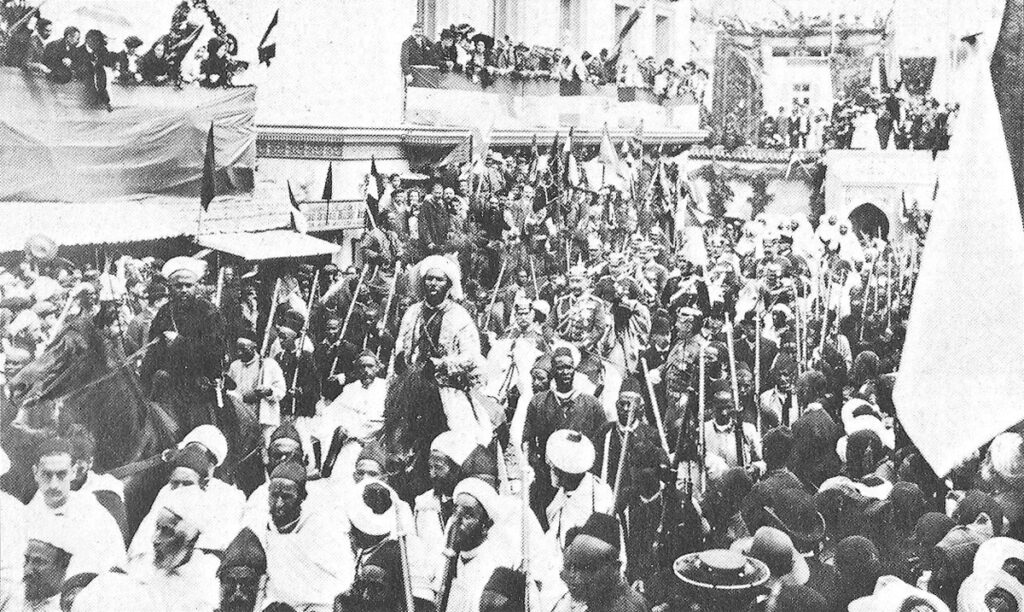
Kaiser Wilhelm II visited Tangier in Morocco on 31 March 1905 and spoke in support of Moroccan independence, directly challenging French influence there. France was furious, and through the spring and summer the two countries came close to war.
LEARN MORESHOW LESSwhy it matters · key numbers · 1 key figurePOLITICALA state visit that lasted a few hours nearly caused a European war. It shows how tight the situation already was by 1905, and how little it would take to break it.
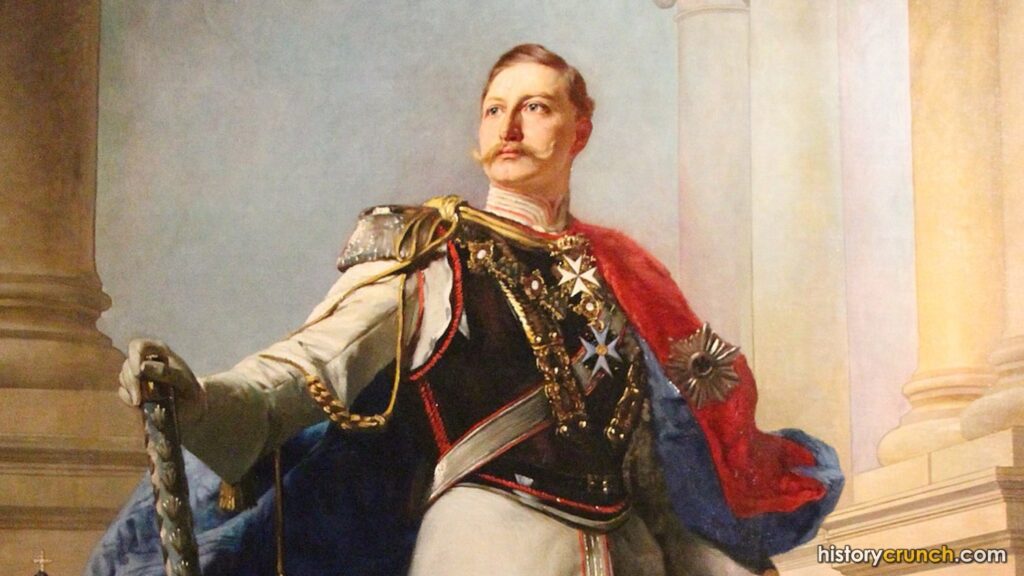
Wilhelm II ruled Germany from 1888 to 1918. Germany was a latecomer to empire, holding just ten colonies by 1914 against Britain's fifty-six, and the Kaiser resented the gap openly.
LEARN MORESHOW LESSwhy it matters · key numbers · 1 key figurePOLITICALNumbers explain the temper. A country that saw itself as Europe's strongest had almost nothing to show for it on the map, and that grievance shaped German foreign policy right up to 1914.
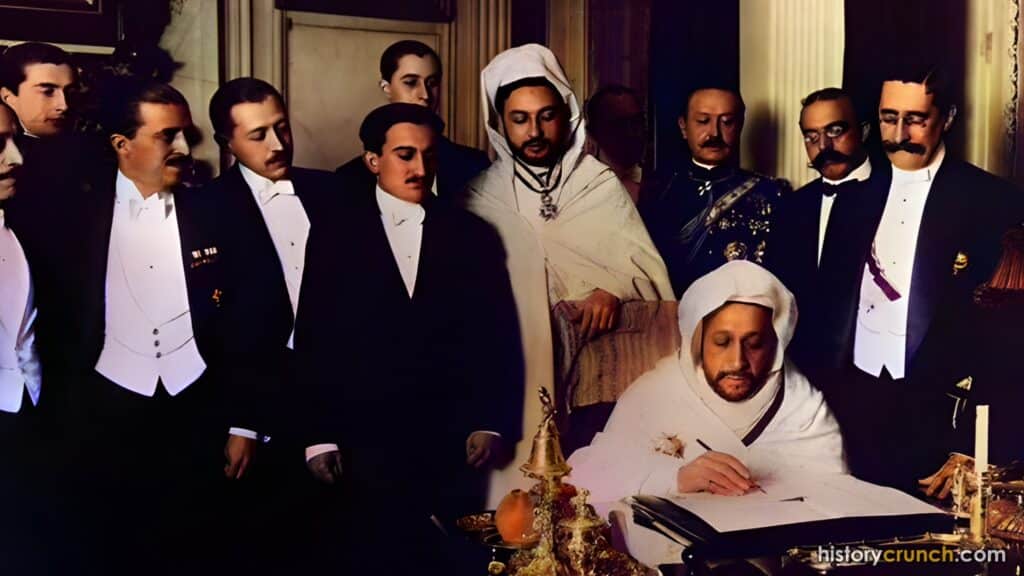
The Algeciras Conference ran from 16 January to 7 April 1906. France was supported by Britain, Italy, Russia, Spain and the United States. Germany was backed only by Austria-Hungary, and France kept its position in Morocco.
LEARN MORESHOW LESSwhy it matters · key numbersPOLITICALGermany called the conference expecting to break the Entente and instead found itself with one friend in the room. Every alliance that fought the First World War is visible in that seating plan.
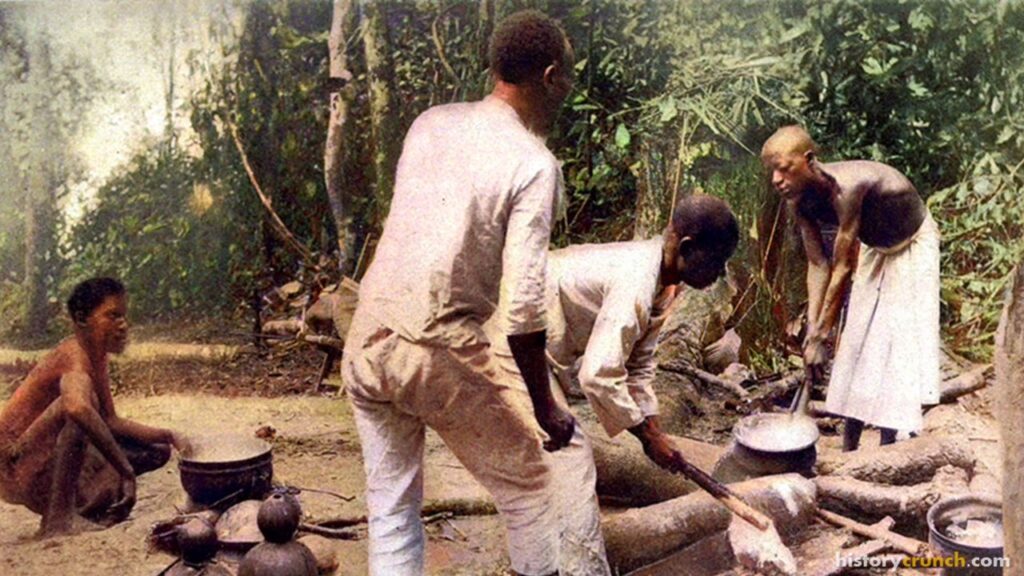
After years of international reporting on forced labour, mutilation and mass death in the Congo Free State, the Belgian parliament took the territory over in 1908 and renamed it the Belgian Congo. Leopold II demanded and received a payment for handing over what he had run privately.
LEARN MORESHOW LESSwhy it matters · key numbers · 1 key figurePOLITICALA campaign of journalism, photographs and missionary testimony forced a European state to seize a colony from its own monarch. It is the clearest case on the timeline of public evidence changing imperial policy.
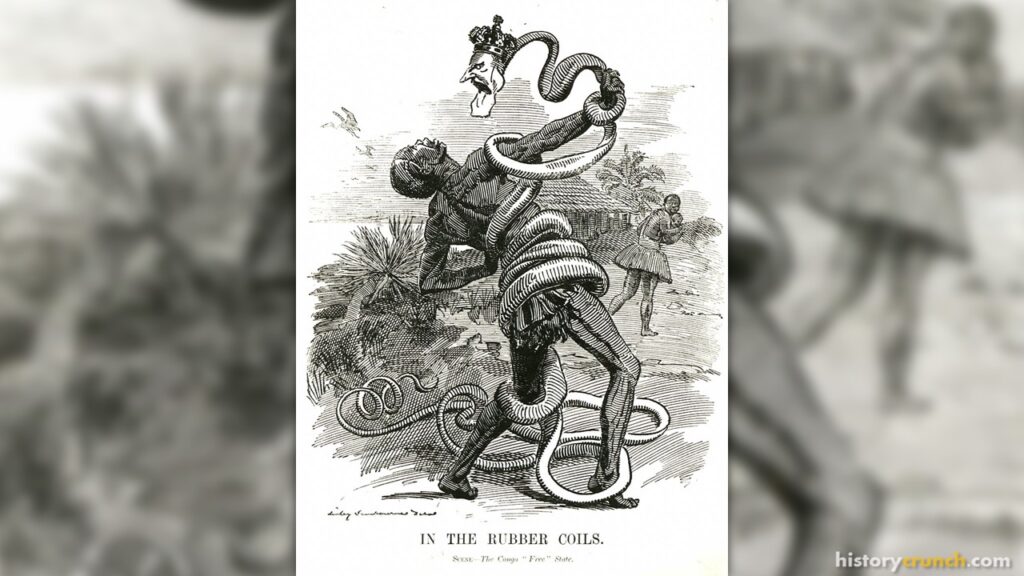
A Punch cartoon of 1906 by Edward Linley Sambourne depicted Leopold II as a rubber snake coiled around a Congolese rubber collector. Campaigners used cartoons, photographs and eyewitness accounts to force the issue into public view.
LEARN MORESHOW LESSwhy it mattersSOCIALThe same magazine that had drawn Rhodes as an admiring joke fourteen years earlier drew Leopold as a snake. Public opinion in Britain could turn hard against one empire's methods while being comfortable with its own.
Leopold II died on 17 December 1909 at the age of 74, having reigned since 1865. He is reported to have had a personal fortune as high as $500 million, much of it built on Congolese rubber and ivory.
LEARN MORESHOW LESSwhy it matters · key numbers · 1 key figureECONOMICHe never once set foot in the Congo. The whole thing was run at a distance, on paper, for profit, by a man who justified it in public as a humanitarian mission.
In 1910 the Cape Colony, Natal, the Transvaal and the Orange Free State were combined into the Union of South Africa, part of the British Empire. Former Boer leaders held senior office within a few years.
LEARN MORESHOW LESSwhy it matters · key numbersPOLITICALBritain fought a two-and-a-half-year war and then handed the country to the people it had beaten, on terms that excluded the Black majority from the vote. The arrangement made here runs directly into apartheid.
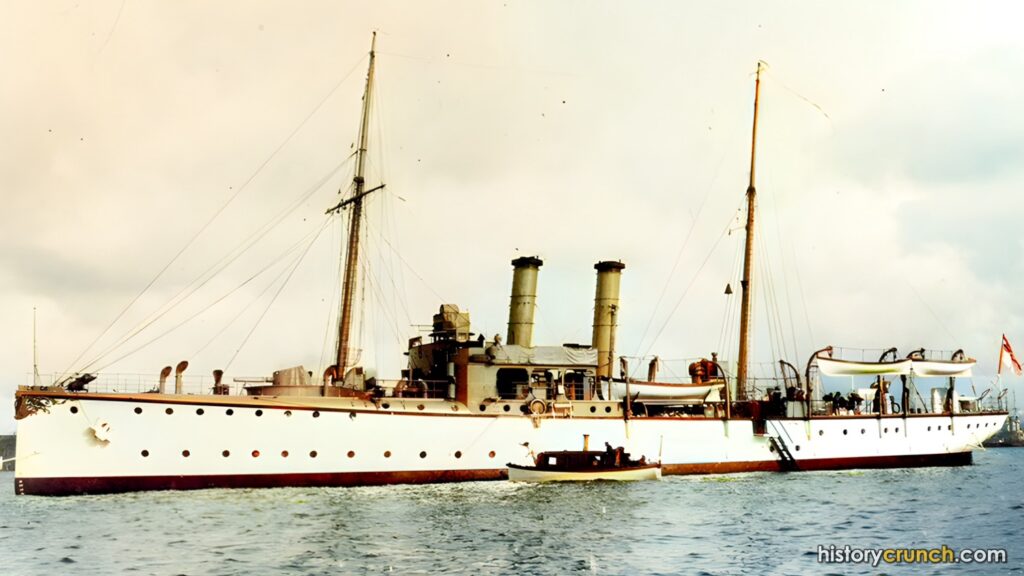
The Agadir Crisis began in April 1911 during a rebellion against the Moroccan Sultan. France moved troops in; Germany sent the gunboat SMS Panther to Agadir. By July both sides were looking for a way out, and the crisis ran until November.
LEARN MORESHOW LESSwhy it matters · key numbersMILITARYThe second time in six years that Morocco nearly started a European war. Both crises ended peacefully and both left Europe more divided, more armed and more certain the next one would not.
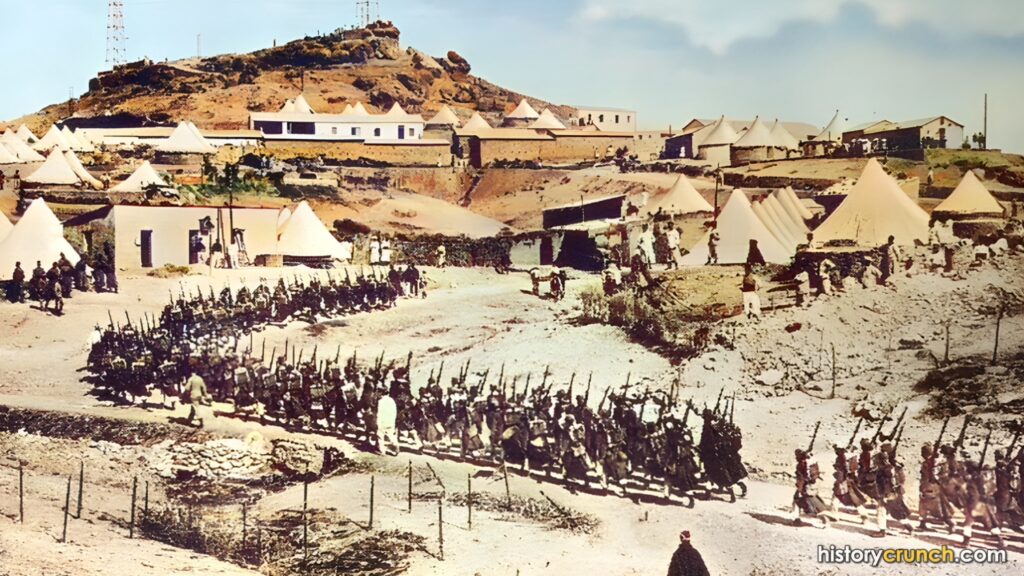
The crisis was settled by France gaining a free hand in Morocco and Germany receiving territory in the French Congo as compensation.
LEARN MORESHOW LESSwhy it mattersMILITARYTerritory and the people on it were traded between two European governments to settle an argument neither had with Morocco. That is the Scramble in one transaction.
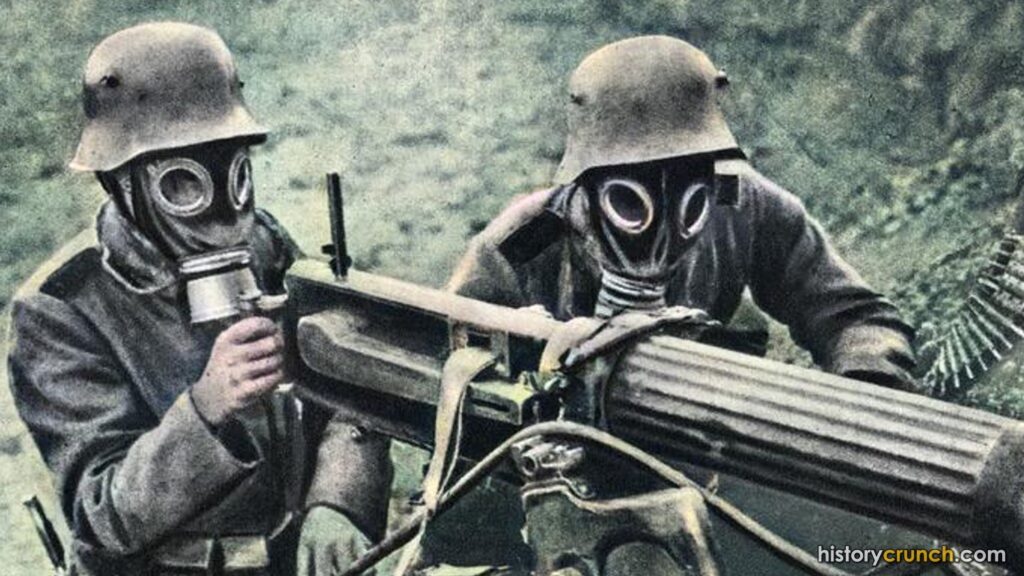
The Vickers machine gun, developed from the Maxim, was introduced in 1912 and became the standard British machine gun on the battlefields of the First World War.
LEARN MORESHOW LESSwhy it mattersTECHNOLOGYThe gun that made the conquest of Africa possible came back to Europe. The weapon Europeans had used on people they considered incapable of resisting was turned on each other within two years.
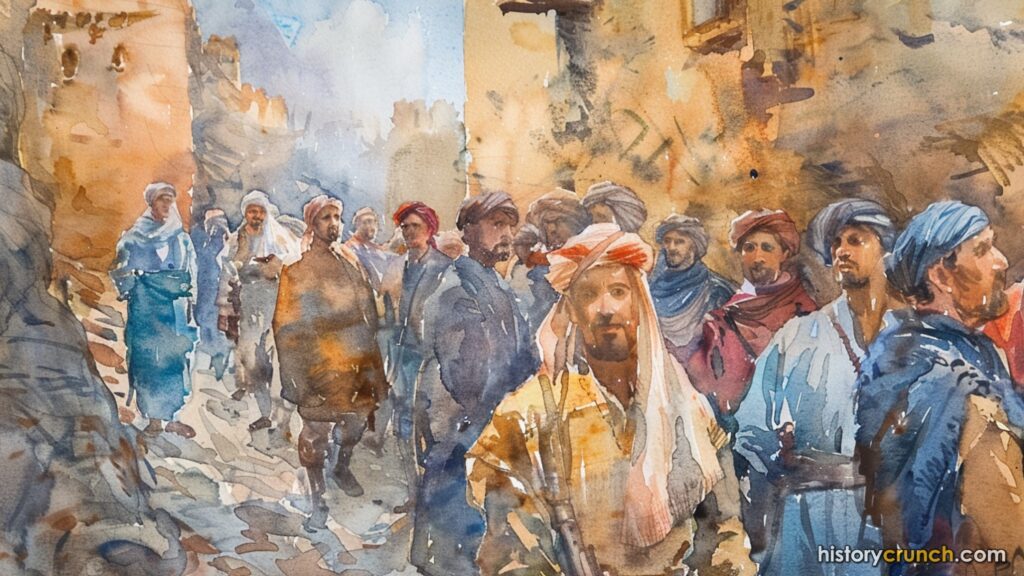
By 1914 Britain had 56 colonies around the world, France 29 and Germany just 10. Between 1870 and 1914 the whole of Africa had come under European rule except Liberia and Ethiopia.
LEARN MORESHOW LESSwhy it matters · key numbersPOLITICALThis imbalance is one of the standard explanations historians give for German aggression before 1914. It is worth asking a class whether resentment about colonies is a cause of a war or an excuse offered for one.
The Scramble for Africa is considered to end with the outbreak of the First World War in 1914. The rivalry it created between the European powers is counted by historians among the war's causes.
LEARN MORESHOW LESSwhy it matters · key numbersMILITARYForty-four years of competing for Africa ended in a war fought in Europe, in which African soldiers and carriers served and died in large numbers on both sides. The continent did not stop being fought over; the reason changed.
With the outbreak of the First World War, Britain took even more direct control of Egypt, formally ending the last of Ottoman authority there and declaring a protectorate.
LEARN MORESHOW LESSwhy it mattersPOLITICALThe temporary occupation of 1882 had lasted thirty-two years by this point and had just been deepened rather than ended. That pattern holds until 1956.
The railways ran to the ports. The borders drawn in Berlin outlived the empires that drew them and are mostly still there. Britain's temporary occupation of Egypt ended after seventy-four years. And in Rwanda, a country whose shape, neighbors and official ethnic categories were all decided by Europeans, the identity cards a colonial administration had introduced were still being used to decide who lived and who died in 1994.
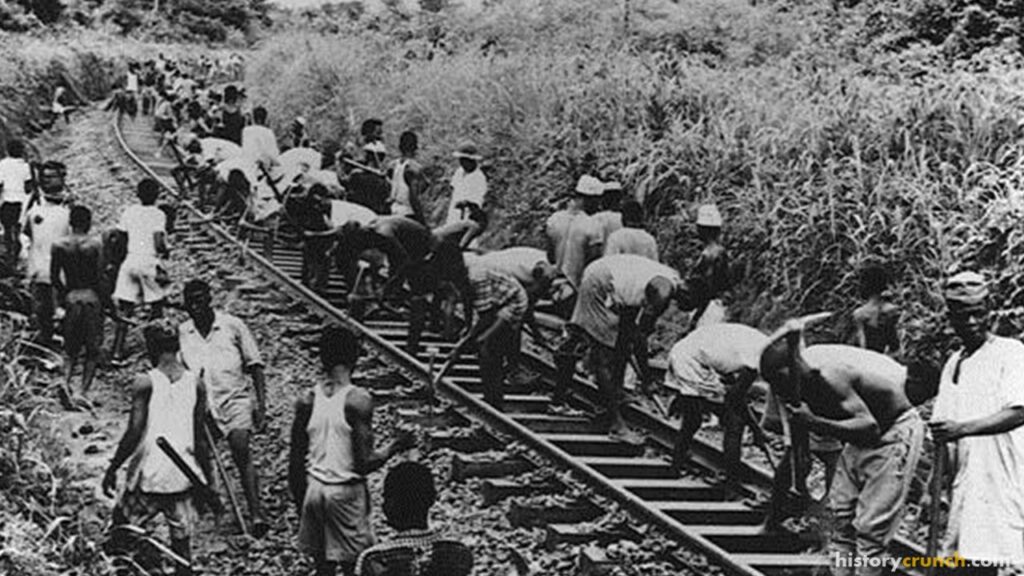
European powers built railways, roads, bridges and harbours across Africa, and in much of the continent governed through existing local rulers, a system called indirect rule. Almost all of the building was laid out to move raw materials from the interior to a port for shipping to Europe, rather than to connect African places to each other.
LEARN MORESHOW LESSwhy it mattersTECHNOLOGYThis is the most useful thing on the whole timeline for answering whether imperialism 'developed' Africa. The infrastructure is real and it was built to face outward, and much of it still does.
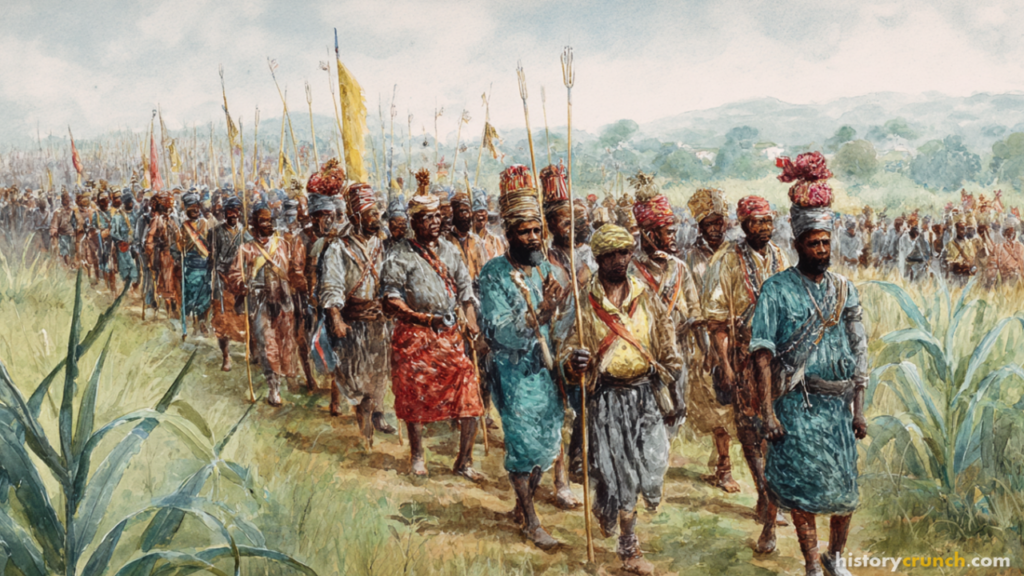
Historians identify both positive and negative impacts of European imperialism in Africa: infrastructure, schools and medicine on one side; extraction, forced labour, imposed borders, destroyed political systems and enormous loss of life on the other.
LEARN MORESHOW LESSwhy it matters · a debateSOCIALA class will want a verdict. The better exercise is to make them state what would have to be true for each side of the ledger to outweigh the other, and then look for that evidence.
Did European rule develop Africa, or drain it?
Railways, ports, roads, hospitals and schools were genuinely built, and survived independence. Written administration and formal education systems came with colonial rule, and some African states inherited infrastructure they could not have financed themselves at the time.
Almost all of it was built to move raw materials out to a port, not to connect African places to each other, and the economies shaped around single export commodities have proved extremely hard to change. Against the infrastructure sits forced labour, famine, war, dispossession and, in the Congo alone, deaths counted in the millions.
British forces did not formally leave Egypt until June 1956. The occupation that began as a temporary measure in 1882 had lasted seventy-four years.
LEARN MORESHOW LESSwhy it matters · key numbersPOLITICALPut the two dates side by side and the word temporary does a great deal of work. Later that same year Britain and France tried to take the canal back by force and failed, which is usually taken as the end of both as world powers.
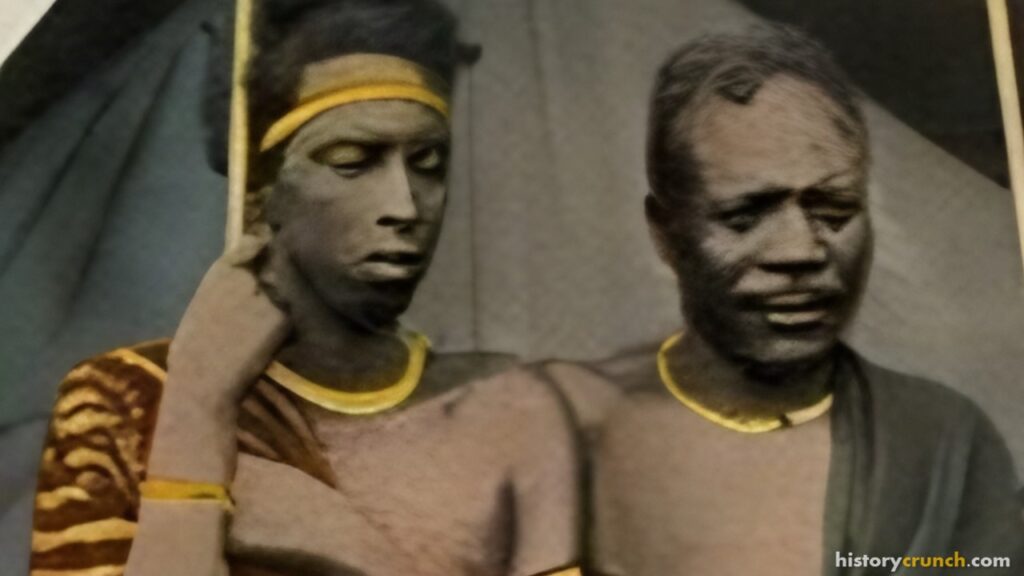
Germany took Rwanda after the Berlin Conference and Belgium ruled it afterwards until independence in 1962. The Belgians had formally categorized the population into Hutu and Tutsi, issuing identity cards and favouring one group in administration.
LEARN MORESHOW LESSwhy it matters · key numbersPOLITICALThe categories were not invented from nothing, but colonial rule hardened them into fixed, documented, official identities that decided a person's prospects. The country erupted into civil war almost immediately after independence.
Within a year of independence in 1962 Rwanda erupted into civil war. For the next thirty years Hutu and Tutsi movements clashed, with escalating violence and waves of refugees.
LEARN MORESHOW LESSwhy it mattersMILITARYThirty years is a long fuse, and the whole of it runs back to a system of classification imposed by an administration that had left. Independence did not remove what colonial rule had installed.
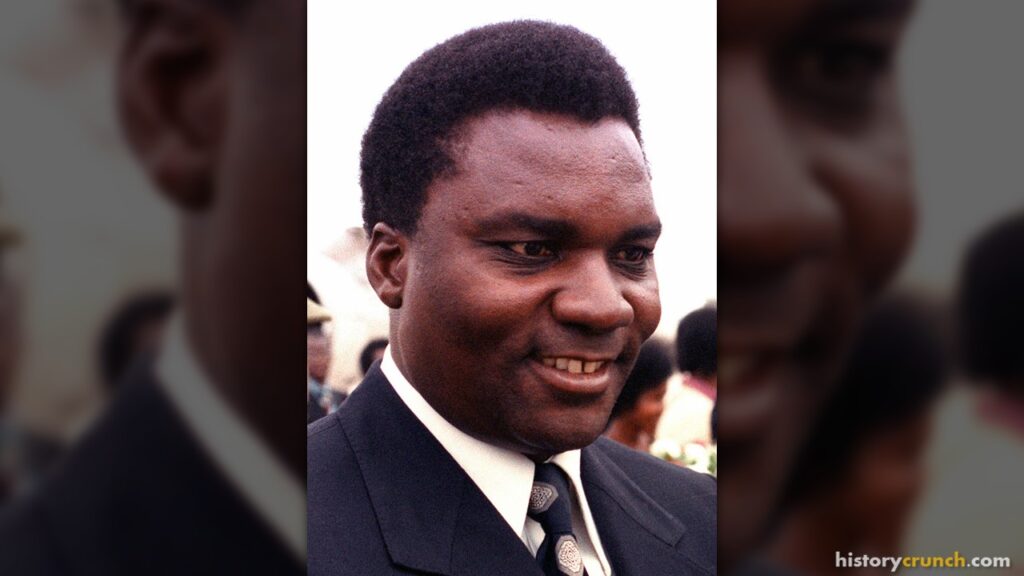
Juvenal Habyarimana had been President of Rwanda since 1973. He was assassinated on 6 April 1994 when his aircraft was shot down. Historians generally treat this as the spark of the genocide.
LEARN MORESHOW LESSwhy it matters · 1 key figurePOLITICALA spark is not a cause. Everything that made the killing possible – the categories, the identity cards, the thirty years of civil war, the organized militias – was already in place and waiting.
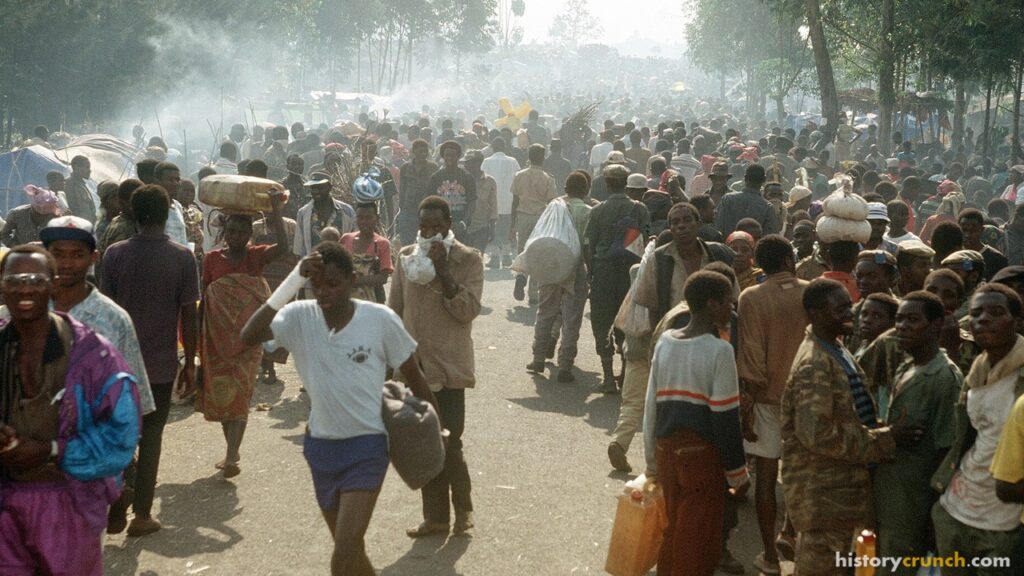
The genocide in Rwanda took place in 1994, with most of the killing concentrated in roughly three months from April to July. It was organized, it used the identity categories the colonial administration had formalized, and the international response was very limited.
LEARN MORESHOW LESSwhy it matters · key numbersSOCIALYour articles put this on the Scramble's timeline deliberately, because the classification that made it possible to know who to kill was a colonial administrative system. That is the hardest and most important claim on this page.
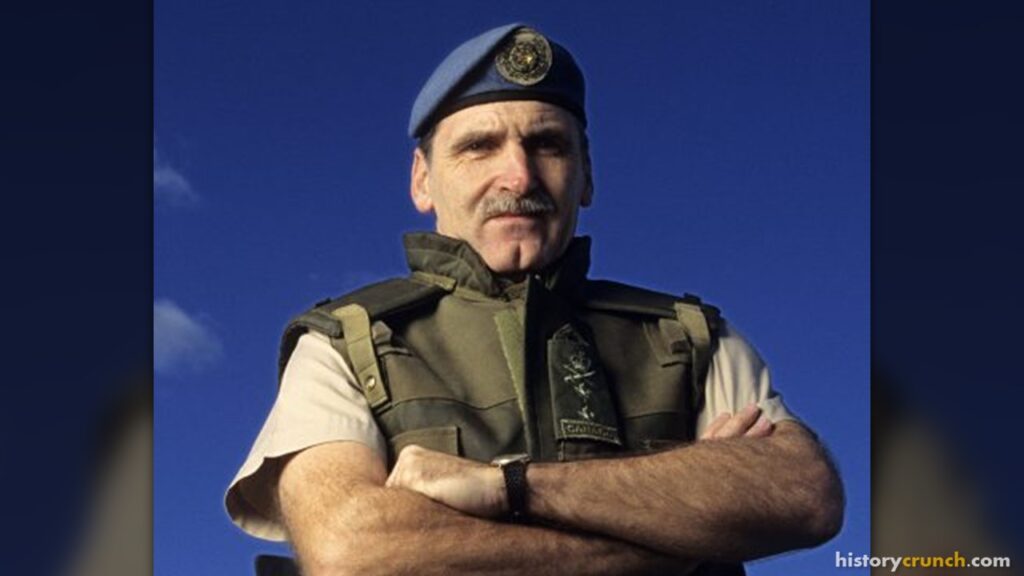
Romeo Dallaire commanded the United Nations Assistance Mission for Rwanda during the genocide. He warned of what was coming, requested reinforcement and a stronger mandate, and was refused while the killing went on.
LEARN MORESHOW LESSwhy it matters · 1 key figurePOLITICALIt is the answer to the question a class always asks, which is why nobody stopped it. Somebody on the ground saw it, said so, and asked for help, and the governments that could have sent it chose not to.
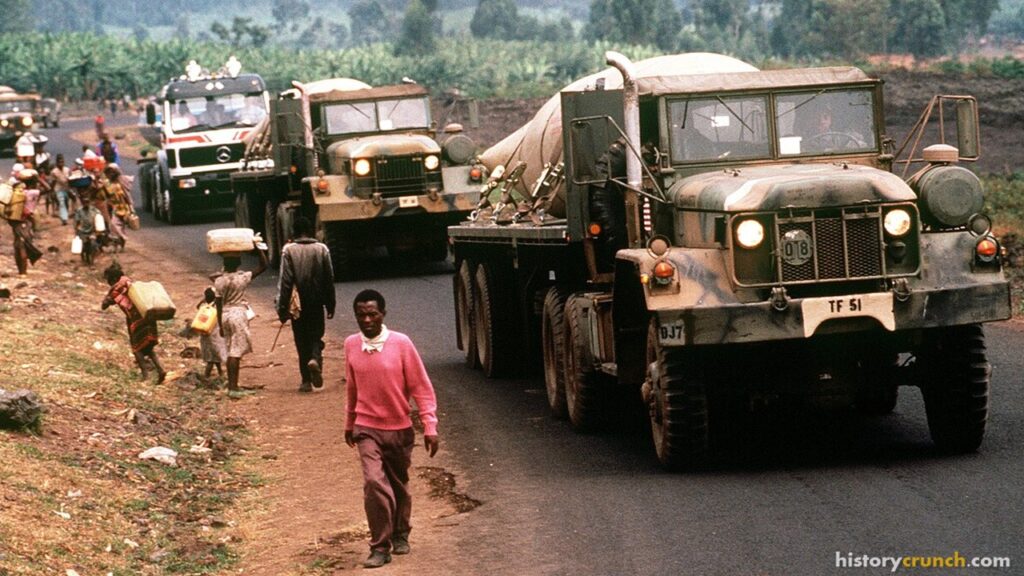
Enormous numbers of Rwandans fled into neighboring countries during and after the genocide, and international aid arrived in the refugee camps once the killing had largely stopped.
LEARN MORESHOW LESSwhy it matters · key numbersSOCIALThe last card on the timeline is a hundred and nine years after the Berlin Conference, in a country whose shape, categories and neighbors were all decided in Europe. That is what the Scramble left.

I'm a passionate history and geography teacher with over 15 years of experience working with students in the middle and high school years. I have an Education Degree with a focus in World History. I have been writing articles for History Crunch since 2015 and love the challenge of creating historical content for young learners!
To cite this timeline as a source, use one of the formats below.
MLA: Beck, E. “Scramble for Africa Timeline.” HistoryCrunch, 13 September 2026, https://historycrunch.com/scramble-for-africa-timeline/.
APA: Beck, E. (2026). Scramble for Africa Timeline. HistoryCrunch. https://historycrunch.com/scramble-for-africa-timeline/
Chicago: Beck, E. “Scramble for Africa Timeline.” HistoryCrunch. September 13, 2026. https://historycrunch.com/scramble-for-africa-timeline/
© History Crunch
Nothing about Africa changed in 1870. Something about Europe did. What?
Very few people conquer a continent believing they are doing wrong. What did they believe instead?
European columns were usually outnumbered. They usually won anyway.
Before 1869 Europe barely thought about Egypt. Within thirteen years Britain had invaded it.
Britain abolished the trade it had profited from, then used abolition as a reason to go in.
Fourteen states met for 104 days to divide Africa, and not one African was there.
Historians differ over how much the Berlin Conference actually determined. The traditional view treats it as the moment Africa was carved up. A revisionist view points out that the conference drew almost no specific borders, that most partition happened in the following fifteen years through treaties, companies and force on the ground, and that treating Berlin as the decisive moment lets the slower, messier process off the hook. What is not disputed is that no African party was present or consulted.
Long straight lines, rivers used as edges, and peoples split down the middle.
Berlin agreed that a claim only counted if you actually controlled the ground. What followed?
Governments did not want the cost. Companies did want the profit. So governments handed out charters.
Leopold II never visited the Congo. He owned it personally for 23 years.
Forced labour was not unique to the Congo. The campaign against it was.
180,000 British soldiers against a population smaller than a mid-sized city.
The Boer War camps remain contested. Britain's position at the time was that the camps were a humanitarian response to families made homeless by a war the Boers were prolonging. Critics then and since argue the homelessness was deliberately created by British farm-burning, that the camps were badly run and inadequately supplied, and that the death toll, especially among children, was foreseeable. A separate and long-neglected argument concerns the camps for Black Africans, which were worse recorded, worse supplied, and largely left out of the debate for most of a century.
Two poor republics nobody wanted became the richest ground in Africa in a single year.
The war was between two groups of settlers. The majority population was in it and left out of the settlement.
The Boer republics are usually the antagonists in a British story. Tell it from Pretoria.
The same words are used for 1901 and for the 1940s. Working out what they do and do not share matters.
Britain won and came away shaken. Which lessons did it take, and which did it miss?
A sickly teenager arrived chasing diamonds and left a country named after himself.
Livingstone hated the slave trade and died broke in a village. Stanley worked for a king who wanted a colony.
Every colonial power used forced labour. Leopold's Congo is still the byword. Why?
Rhodes as a colossus in 1892. Leopold as a snake in 1906. Same magazine, same country, fourteen years apart.
The usual account has Europe acting and Africa being acted upon. What does the evidence show?
The explorers wrote books. The colonial officials wrote despatches. Who did not write?
By 1914 every African state but two was under European rule. What was different about those two?
Two European powers nearly went to war over Morocco twice in six years. Then they went to war over Serbia.
1905 and 1911, same place, same two powers, same near-miss.
The Maxim gun was built for wars Europeans expected to win easily. In 1914 both sides had it.
Railways, hospitals and schools on one side. Extraction, forced labour and imposed borders on the other.
Your articles make this link directly. It is the hardest claim on the timeline and it needs handling carefully.
Historians and political scientists disagree about how much weight colonial rule carries in explaining 1994. One position holds that Belgian classification created rigid ethnic categories where flexible social ones had existed, issued the identity documents that later made systematic killing possible, and built a state that rewarded one group over another. Another argues that this understates post-independence choices: thirty years of Rwandan politics, a specific civil war, deliberate organization by a particular faction, and international inaction were all necessary, and none of them were determined in 1885. Most careful accounts treat colonial rule as a precondition rather than a cause, which is a distinction worth teaching explicitly.
Forty-four years, a century ago. What of it is still running?
No question matches that word.
Research question 1Nothing about Africa changed in 1870. Something about Europe did. What?
Research question 2Very few people conquer a continent believing they are doing wrong. What did they believe instead?
Research question 3European columns were usually outnumbered. They usually won anyway.
Research question 4Before 1869 Europe barely thought about Egypt. Within thirteen years Britain had invaded it.
Research question 5Britain abolished the trade it had profited from, then used abolition as a reason to go in.
Research question 6Fourteen states met for 104 days to divide Africa, and not one African was there.
Research question 7Long straight lines, rivers used as edges, and peoples split down the middle.
Research question 8Berlin agreed that a claim only counted if you actually controlled the ground. What followed?
Research question 9Governments did not want the cost. Companies did want the profit. So governments handed out charters.
Research question 10Leopold II never visited the Congo. He owned it personally for 23 years.
Research question 11Forced labour was not unique to the Congo. The campaign against it was.
Research question 12180,000 British soldiers against a population smaller than a mid-sized city.
Research question 13Two poor republics nobody wanted became the richest ground in Africa in a single year.
Research question 14The war was between two groups of settlers. The majority population was in it and left out of the settlement.
Research question 15The Boer republics are usually the antagonists in a British story. Tell it from Pretoria.
Research question 16The same words are used for 1901 and for the 1940s. Working out what they do and do not share matters.
Research question 17Britain won and came away shaken. Which lessons did it take, and which did it miss?
Research question 18A sickly teenager arrived chasing diamonds and left a country named after himself.
Research question 19Livingstone hated the slave trade and died broke in a village. Stanley worked for a king who wanted a colony.
Research question 20Every colonial power used forced labour. Leopold's Congo is still the byword. Why?
Research question 21Rhodes as a colossus in 1892. Leopold as a snake in 1906. Same magazine, same country, fourteen years apart.
Research question 22The usual account has Europe acting and Africa being acted upon. What does the evidence show?
Research question 23The explorers wrote books. The colonial officials wrote despatches. Who did not write?
Research question 24By 1914 every African state but two was under European rule. What was different about those two?
Research question 25Two European powers nearly went to war over Morocco twice in six years. Then they went to war over Serbia.
Research question 261905 and 1911, same place, same two powers, same near-miss.
Research question 27The Maxim gun was built for wars Europeans expected to win easily. In 1914 both sides had it.
Research question 28Railways, hospitals and schools on one side. Extraction, forced labour and imposed borders on the other.
Research question 29Your articles make this link directly. It is the hardest claim on the timeline and it needs handling carefully.
Research question 30Forty-four years, a century ago. What of it is still running?