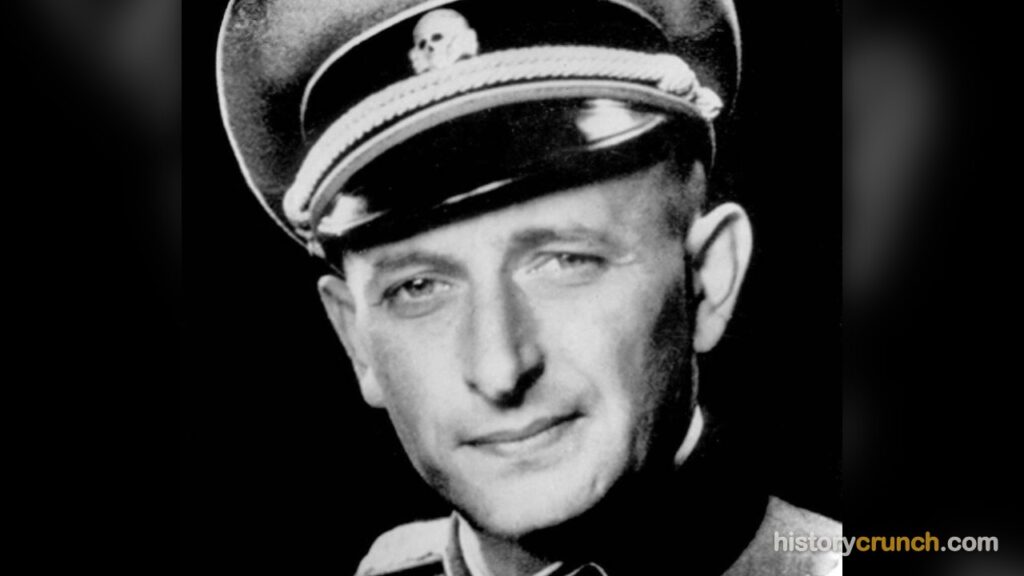
Adolf Eichmann is one of the most important figures connected to the Holocaust, the Nazi genocide that took place during the 1930s and 1940s and killed over 11 million people, including 6 million Jewish people. He was not a battlefield general or a famous speaker. Instead, he was a Nazi official who organized the trains, paperwork, and schedules that carried millions of Jewish people to ghettos, concentration camps, and death camps across Europe. Because of his central role in managing these deportations, he became known after World War II as one of the main planners of the mass murder known as the “Final Solution.”
Eichmann is remembered today for two reasons. First, he showed how ordinary government workers could take part in terrible crimes by treating mass murder as a series of office tasks. Second, his dramatic capture and public trial many years after the war helped the world learn the full truth about the Holocaust through the words of the survivors themselves.
Early Life and Background
Adolf Eichmann was born on March 19th, 1906, in the German city of Solingen. When he was still a boy, his family moved to Linz, a city in Austria, where he spent most of his childhood. His family belonged to the middle class, and his father ran a small business.
Eichmann was a weak student and did not finish his training in mechanical engineering. In the difficult economic times of the 1920s, he drifted through several jobs. For instance, he worked as a laborer, an office clerk, and a traveling salesman for an oil company. These were the same years when many Germans and Austrians grew angry and desperate, and when hatred of Jewish people, known as anti-Semitism, was spreading quickly across Europe.
In April of 1932, at the suggestion of an acquaintance, Eichmann joined the Austrian branch of the Nazi Party. Around the same time, he also joined the SS, an elite Nazi organization led by Heinrich Himmler that would later handle policing, intelligence, and the enforcement of the Nazis’ anti-Semitic policies. This decision placed Eichmann inside the machine that would soon carry out the Holocaust.
Rise to Power
When the Nazis rose to power in Germany in 1933 under Adolf Hitler, the Austrian government banned its own Nazi Party. Like many Austrian Nazis, Eichmann fled across the border into Germany. There he received a few months of military training with a group known as the Austrian Legion before joining the SS security service in 1934.
Eichmann slowly climbed the ranks by becoming an expert on what the Nazis coldly called the “Jewish Question.” More specifically, he studied Jewish communities, organizations, and culture so that the Nazi state could target them. This knowledge made him valuable to his superiors, and he was given greater responsibility over Jewish affairs.
When Germany took over Austria in 1938, Eichmann was sent to Vienna with the mission of forcing Jewish people out of the city. There he set up an office that pushed tens of thousands of Jewish people to leave, often after stripping them of their money and property. In fact, the system worked so efficiently that he was sent to Prague in 1939 to do the same, and he was then placed in charge of a Jewish affairs office within the SS central security headquarters in Berlin.
Role in the Holocaust
As World War II spread across Europe, the Nazi plan for Jewish people changed from forced emigration to imprisonment and finally to mass murder. Eichmann helped organize the ghettos, which were crowded, walled-off sections of cities where Jewish people were forced to live in terrible conditions. He also helped plan the deportation of Jewish people from Germany and other territories the Nazis controlled.
A key turning point came in January of 1942 at the Wannsee Conference, a secret meeting of high-ranking Nazi officials held near Berlin. At this meeting, the Nazis coordinated the “Final Solution,” their plan to murder the entire Jewish population of Europe. Eichmann attended the conference and took notes, and afterward he was formally trusted with carrying out the deportations that made the plan possible.
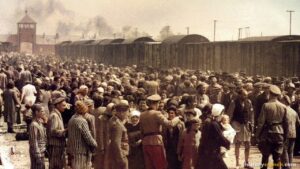
In this role, Eichmann became the man who managed transportation. He organized the trains that carried millions of Jewish people from across Europe to the death camps, where most were murdered in gas chambers or worked to death. As stated above, he treated this horrifying work like an ordinary office job, arranging timetables and quotas without ever firing a weapon himself.
One of the clearest examples of his work came in 1944 in Hungary. After the Nazis took greater control of the country, Eichmann personally directed the rapid deportation of hundreds of thousands of Hungarian Jewish people to the death camp at Auschwitz. In only a few months, a massive number of people were sent to their deaths, showing just how deadly his organizing skills had become.
Escape and Years in Hiding
When the war ended in 1945, Allied forces captured Eichmann, but they did not yet realize how important he had been. Because his name was not widely known at the time, he was able to escape from custody and disappear. For several years he lived quietly in Germany under a false name while avoiding the Nuremberg Trials, where other top Nazis were being punished.
In 1950, Eichmann fled Europe entirely and traveled to Argentina in South America. He settled near the city of Buenos Aires and lived under the false name Ricardo Klement, working ordinary jobs and eventually bringing his family to join him. For about a decade, he lived as a free man while survivors and investigators around the world slowly pieced together his identity and location.
Capture and Trial
Israel’s intelligence agency, known as the Mossad, eventually confirmed that Eichmann was hiding in Argentina. On May 11th, 1960, a team of Israeli agents seized him near his home in Buenos Aires in a secret operation later known as Operation Finale. They held him for several days and got him to sign a statement agreeing to stand trial before flying him out of the country in disguise.
On May 23rd, 1960, the Israeli Prime Minister David Ben-Gurion announced to the world that Eichmann had been captured and would face justice. The trial began in Jerusalem in April of 1961 and drew enormous attention, becoming one of the first trials in history to be shown on television. Eichmann faced 15 charges, including crimes against humanity, crimes against the Jewish people, and war crimes.
During the trial, Eichmann argued that he had only been following orders and was simply a small part of a larger system. The court rejected this defense. In December of 1961, he was found guilty on all counts and sentenced to death, and after his appeals were denied, he was hanged during the night between May 31st and June 1st, 1962. He remains the only person ever executed by the state of Israel, and his ashes were scattered at sea.
Significance of Adolf Eichmann
The significance of Adolf Eichmann comes from what his life reveals about how the Holocaust was carried out. He was proof that genocide required not only hateful leaders but also organized officials who managed the details. In reality, his careful planning of trains and deportations turned Nazi hatred into a deadly, working system that murdered millions.
His trial was also historically important on its own. The Nuremberg Trials of 1945 and 1946 had focused mostly on war crimes and did not fully expose the Holocaust. The Eichmann trial, by contrast, gave many Holocaust survivors their first chance to tell their stories in public, and it helped the world understand the true scale of the genocide.
Finally, Eichmann’s story raised lasting questions about guilt and responsibility. His claim that he was “just following orders” forced people to think hard about whether ordinary individuals can be held responsible for crimes committed by a government. For this reason, his name is still connected to debates about justice, obedience, and human rights that continue to matter today.
Frequently Asked Questions
Who Was Adolf Eichmann?
Adolf Eichmann was a Nazi SS official who organized the deportation of millions of Jewish people to death camps during the Holocaust. He was born in Germany in 1906, grew up in Austria, and rose through the SS by becoming an expert on Jewish affairs. He is often described as one of the main organizers of the “Final Solution.”
What Did Adolf Eichmann Do During the Holocaust?
Eichmann managed the transportation system that carried Jewish people to ghettos and death camps across Nazi-occupied Europe. He arranged train schedules, coordinated deportations, and made sure that victims were sent to camps such as Auschwitz. He did not carry out the killings himself, but his organizing made the mass murder possible.
How Was Adolf Eichmann Captured?
Eichmann was captured in Argentina on May 11th, 1960, by agents from Israel’s Mossad intelligence agency. He had been living under the false name Ricardo Klement near Buenos Aires. The secret mission to seize him and bring him to Israel was later known as Operation Finale.
Why Was the Eichmann Trial Important?
The Eichmann trial was important because it allowed Holocaust survivors to tell their stories in public for the first time on a global stage. Held in Jerusalem in 1961, it was one of the earliest televised trials and helped the world understand the full horror of the genocide. It also sparked new interest in tracking down other Nazi criminals.
What Happened to Adolf Eichmann?
Eichmann was found guilty of crimes against humanity and other charges and was executed by hanging on June 1st, 1962. He remains the only person ever put to death by the state of Israel. After his execution, his body was cremated and his ashes were scattered at sea so that he would have no grave.
Cite This Article
To cite this article as a source, use one of the formats below.
MLA: Millar, B. “Adolf Eichmann: A Detailed Biography.” HistoryCrunch, 15 August 2026, https://historycrunch.com/adolf-eichmann/.
APA: Millar, B. (2026). Adolf Eichmann: A Detailed Biography. HistoryCrunch. https://historycrunch.com/adolf-eichmann/
Chicago: Millar, B. “Adolf Eichmann: A Detailed Biography.” HistoryCrunch. August 15, 2026. https://historycrunch.com/adolf-eichmann/
Sources
- Jerry Bentley & Herbert Ziegler, Traditions & Encounters: A Global Perspective on the Past.
- J.M. Roberts & Odd Arne Westad, The Penguin History of the World.