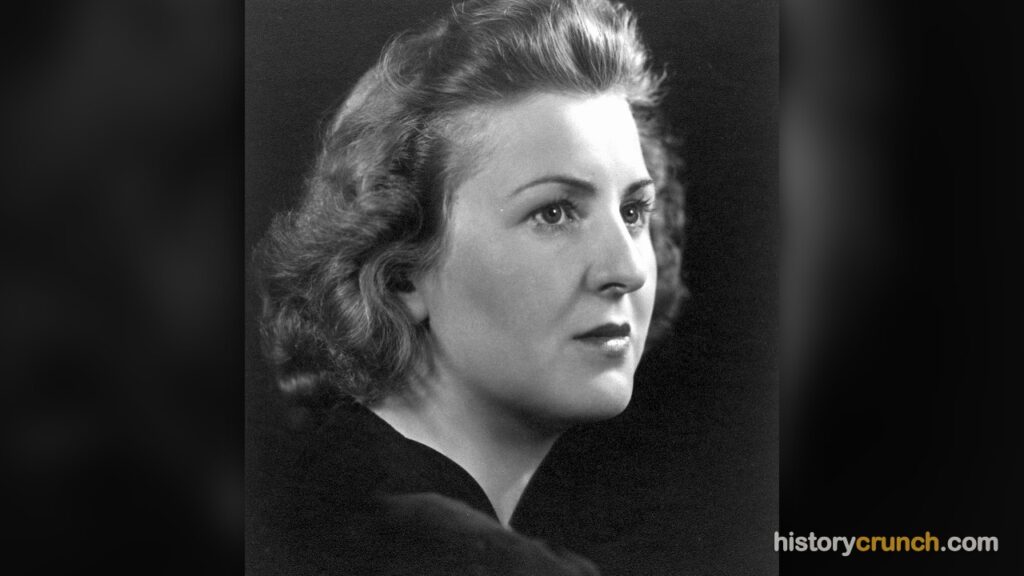
Eva Braun is remembered as one of the most mysterious figures connected to Nazi Germany, largely because she was the longtime companion and, for less than two days, the wife of Adolf Hitler. For more than a decade she lived at the edge of the most powerful and destructive regime in modern European history, yet almost no one in Germany even knew she existed. Her story offers a rare and unsettling glimpse into the private world of a dictator whose public actions helped cause World War II and the Holocaust.
Eva Braun was a German office worker, photographer, and model who became the private companion of Adolf Hitler in the 1930s. She held no political office and had no official title, but she shared Hitler’s personal life at his mountain retreat and eventually in his underground bunker in Berlin. Because Hitler kept their relationship hidden, Braun spent most of her adult life in isolation and secrecy, which is why so much about her remains debated today.
Early Life and Background
Eva Anna Paula Braun was born on February 6th, 1912, in Munich, Germany. She came from a lower middle-class Catholic family. Her father, Friedrich Braun, worked as a teacher, and her mother, Franziska, had been a dressmaker before marriage.
Eva was the middle of three daughters, with an older sister named Ilse and a younger sister named Gretl. Her parents divorced in 1921 but remarried the following year, likely because of the terrible financial pressures Germany faced during the years of hyperinflation. In fact, the early 1920s were a period of enormous economic hardship across the country, which shaped the lives of many ordinary German families like the Brauns.
As a young girl, Eva attended Catholic schools and a convent school, where she studied practical subjects such as bookkeeping, typing, and French. Her grades were only average, but she loved sports, including skiing, swimming, and gymnastics. More specifically, she was known as an athletic and fashionable teenager whose real interests were clothing, films, and physical activity rather than schoolwork.
Meeting Adolf Hitler
At the age of 17, Eva Braun took a job at the shop of Heinrich Hoffmann, who was Adolf Hitler’s personal photographer and an early member of the Nazi Party. She began as a shop assistant and saleswoman, and she soon learned to use a camera and develop photographs. This job placed her directly inside the world of the rising Nazi movement.
In 1929, Braun was introduced to a man she knew only as “Herr Wolf,” which was a false name Hitler used at the time. In reality, this quiet visitor was Adolf Hitler, then a rising politician who was about 23 years older than she was. At first she did not fully understand who he was, and she reportedly described him to her sister simply as an older gentleman with a small mustache.
Hitler soon began paying attention to the young shop assistant. As stated above, this happened during the years when the Nazi Party was quickly gaining support in Germany. Their relationship developed slowly and quietly, and by the early 1930s the two had grown much closer.
A Hidden Relationship
From the start, Hitler kept his connection to Eva Braun a closely guarded secret. Much of his popularity came from German women, and he wanted to appear single and completely devoted to the nation. As a result, he refused to be seen in public with Braun and would not allow her to travel with him or attend official events.
This secrecy left Braun feeling neglected and isolated, especially in the early years of the relationship. Her loneliness became so severe that she attempted suicide twice. The first attempt came in November of 1932, when she used a pistol, and the second came in May of 1935, when she took an overdose of sleeping pills.
After the second attempt, Hitler seems to have felt more responsibility toward her. He provided her with a villa in Munich, along with a car and a chauffeur. These gifts gave Braun a comfortable and secure life, but they did not change the fact that her role remained completely hidden from the public.
Life at the Berghof
In 1936, Hitler brought Eva Braun to live at the Berghof, his mountain retreat in the Bavarian Alps near Berchtesgaden. There she gradually became the woman of the house, taking over duties that had earlier been handled by Hitler’s half-sister. Even so, only a small number of powerful people in Germany knew about her presence.
At the Berghof, Braun lived a sheltered life of leisure while much of the world was at war. She spent her days exercising, swimming, skiing, sunbathing, reading romance novels, and watching films. For instance, she took a strong interest in photography and filmmaking, recording color home movies of Hitler and his inner circle that later became valuable historical evidence.
Throughout these years, Braun had no observable influence on Hitler’s political or military decisions. By all accounts she was kept completely apart from the workings of the Nazi government, including the planning of World War II and the horrors of the Holocaust. Her world was limited to the domestic and social life of the mountain retreat, far removed from the suffering caused by the regime she was tied to.
Final Days in Berlin
By late 1944, the tide of World War II had turned firmly against Germany and the Axis Powers. As Nazi Germany began to collapse, Braun’s mood darkened and her devotion to Hitler grew even stronger. In April of 1945, as Soviet forces closed in on Berlin, she made a fateful decision.
Against Hitler’s own orders, Braun traveled north from Munich to Berlin to join him in the Führerbunker, an underground shelter beneath the Reich Chancellery. Hitler had actually tried to persuade her to leave the doomed city, but she refused. She was determined to remain loyal to him until the very end.
To reward this loyalty, Hitler finally agreed to marry her. The couple wed in a brief civil ceremony in the bunker during the night that bridged April 28th and 29th, 1945, which most accounts record as April 29th. The wedding was witnessed by only a small group, and with it Eva Braun legally became Eva Hitler after so many years in the shadows.
The marriage lasted little more than a day. On April 30th, 1945, as Soviet troops fought through Berlin, Braun and Hitler took their own lives inside the bunker. It is widely believed that Braun swallowed a cyanide capsule while Hitler shot himself, and afterward their bodies were carried outside and burned according to Hitler’s wishes. Eva Braun was 33 years old.
Significance of Eva Braun
Eva Braun is significant not because of anything she accomplished politically, but because of what her life reveals about the private side of Adolf Hitler and the Nazi leadership. She had no power, no title, and no visible role in government, yet she stood closer to the dictator than almost anyone else during his final years. For this reason, her story continues to fascinate people who study the history of Nazi Germany.
Her photographs, letters, and home movies remain some of the most valuable records of daily life within Hitler’s inner circle. These materials show a strange and disturbing contrast, capturing relaxed personal moments among people responsible for enormous cruelty. In this way, Braun’s films and pictures help historians understand how ordinary and even comfortable life could appear at the center of such a destructive regime.
Braun also raises difficult questions that historians still debate today, especially about how much she knew and what moral responsibility she carried. She chose to live and die beside one of the most reviled figures in history, and that choice makes her both a puzzle and a warning. Her life is a reminder that the story of Nazi Germany includes not only battles and politics but also the personal choices of the people who surrounded its leader.
Frequently Asked Questions
Who was Eva Braun?
Eva Braun was the longtime private companion and, for less than two days, the wife of Adolf Hitler. She was a German office worker and photographer who met Hitler while working at his photographer’s shop in Munich. Although she lived close to the Nazi leader for years, she held no official role and remained almost completely unknown to the public.
How did Eva Braun meet Hitler?
Eva Braun met Hitler in 1929 while working at the shop of Heinrich Hoffmann, Hitler’s personal photographer. At the time she was only 17 years old, and Hitler introduced himself using the false name “Herr Wolf.” Their relationship developed slowly over the following years.
Why was Eva Braun kept secret?
Hitler hid his relationship with Braun because much of his political support came from German women. He wanted to seem single and fully devoted to the nation, so he never appeared in public with her. As a result, only a small circle of Nazi insiders knew that she even existed.
When did Eva Braun and Hitler get married?
Eva Braun and Adolf Hitler married in a civil ceremony in the Führerbunker in Berlin, during the night of April 28th to 29th, 1945. The wedding took place as Soviet forces surrounded the city and Nazi Germany was collapsing. The marriage lasted only about a day and a half before both took their own lives.
How did Eva Braun die?
Eva Braun died by suicide on April 30th, 1945, in Hitler’s underground bunker in Berlin. It is widely believed that she swallowed a cyanide capsule, while Hitler shot himself. She was 33 years old, and afterward their bodies were burned outside the bunker.
Cite This Article
To cite this article as a source, use one of the formats below.
MLA: Millar, B. “Eva Braun: A Detailed Biography.” HistoryCrunch, 15 August 2026, https://historycrunch.com/eva-braun/.
APA: Millar, B. (2026). Eva Braun: A Detailed Biography. HistoryCrunch. https://historycrunch.com/eva-braun/
Chicago: Millar, B. “Eva Braun: A Detailed Biography.” HistoryCrunch. August 15, 2026. https://historycrunch.com/eva-braun/
Sources
- Jerry Bentley & Herbert Ziegler, Traditions & Encounters: A Global Perspective on the Past.
- J.M. Roberts & Odd Arne Westad, The Penguin History of the World.