The French Empire in Africa was one of the most important examples of European colonialism during the Age of Imperialism, and by the early twentieth century France controlled a vast stretch of the African continent that reached from the Mediterranean coast deep into the western and central interior. This empire took shape over more than a century, beginning with the invasion of Algeria in 1830 and expanding rapidly during the Scramble for Africa in the decades before World War I. At its height, French territory in Africa covered huge portions of North Africa, West Africa, and Central Africa, along with island colonies in the Indian Ocean. The story of this empire involves conquest, resistance by African peoples, systems of colonial rule, and a lasting influence that shaped many modern African nations.
In simple terms, the French Empire in Africa was the collection of colonies, protectorates, and territories on the African continent that were governed by France. A colony was a territory that France ruled directly and often settled with its own citizens, while a protectorate was a state that kept its own local ruler on paper but was actually controlled by France in matters of trade, defense, and government. Together, these territories formed a network that France organized, taxed, and defended for its own economic and political benefit.
What Was the Scramble for Africa?
The French Empire in Africa belongs to a larger period that historians call the Scramble for Africa. The Scramble for Africa is considered to have occurred from approximately 1870 until the outbreak of World War I in 1914, and during these years almost all of Africa came under the control of the major European powers, including Britain, France, Germany, Belgium, and Portugal. The term is used because the European nations raced against one another to claim as much African land as they could before their rivals did.
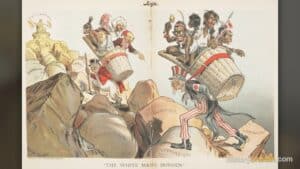
Several forces drove this rush for territory. European nations wanted raw materials for their factories, new markets for their goods, and strategic bases to protect their trade routes and warships. Europeans also held beliefs about their own supposed racial superiority, which helped inform their interactions with the people they encountered, including native Africans. Similar to the belief in their own racial superiority, Europeans promoted Christianity as superior to the religious beliefs of the indigenous peoples that they encountered, and in fact Christian missionaries often accompanied early explorers into the African interior.
To manage the competition without going to war, the European powers met at the Berlin Conference of 1884 and 1885. This meeting set rules for how the continent would be divided, requiring that a nation actually occupy a territory in order to claim it. As a result, France and its rivals pushed inland with soldiers and officials, and France emerged with one of the two largest empires on the continent.
How Did France Build Its Empire in Africa?
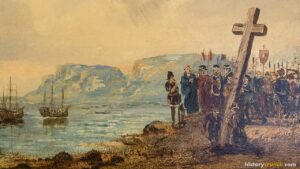
The long history of French colonization in Africa began in earnest in 1830, when a French army invaded and captured the city of Algiers in North Africa. This conquest opened the way for a long and often violent occupation of Algeria. Over the following decades, tens of thousands of European settlers moved into the region, and Algeria became so tied to France that in 1848 it was governed not as an ordinary colony but as an integral part of France itself.
France then expanded to the east and west of Algeria by creating protectorates. French North Africa expanded to include Tunisia in 1881 and Morocco in 1912. In each case, France left a local ruler in place as a symbol of authority while French officials controlled the real levers of power. This pattern of protectorate rule gave France firm control of most of the Maghreb, the northwestern corner of Africa.
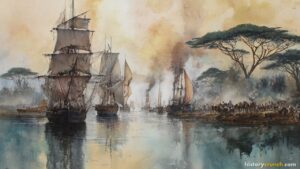
Farther south, French expansion into West Africa was led largely by military officers rather than merchants. One of the most important early figures was General Louis Faidherbe, who became governor of the colony of Senegal in 1854 and began pushing French power inland from the coast. From this base along the Senegal River, French forces gradually advanced eastward into the grasslands of the interior, building forts and forcing local rulers to submit.
How Did Africans Resist French Rule?
French expansion did not go unopposed, and many African states and peoples fought hard to defend their independence. In West Africa, the French met strong and sustained resistance from powerful Islamic states, including the Toucouleur Empire founded by Al Hajj Umar. These conflicts stretched over many years and required repeated military campaigns before France could claim control.
The most famous example of resistance came from Samori Ture, a warrior king who built a large empire in the region that today includes Guinea, Mali, and Ivory Coast. The Wassoulou Empire of Samori Ture mounted prolonged resistance from 1882, and his mobile cavalry and scorched-earth tactics delayed French advances until his capture in 1898. Samori fought the French across two long wars, and even after his defeat he remained a symbol of African resistance for later generations.
Resistance also occurred elsewhere across the empire. In the kingdom of Dahomey, in what is now the country of Benin, French forces fought a war in the 1890s to overcome the armies of King Behanzin before capturing his capital. In each of these struggles France relied on superior weapons, such as fast-firing rifles, along with African soldiers recruited into colonial regiments, to defeat states that were often larger in population than France’s own forces on the ground.
How Was the French Empire in Africa Organized?
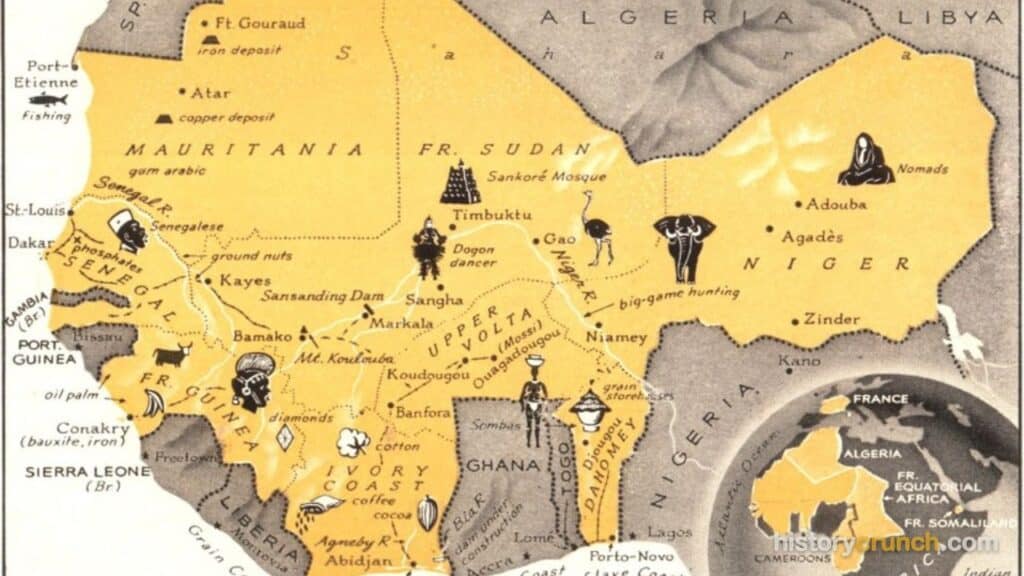
As France’s holdings grew, it grouped many of its scattered colonies into large administrative federations. The first of these was French West Africa. French West Africa was an administrative grouping under French rule from 1895 until 1958 of the former French territories of western Africa, comprising what are now the countries of Benin, Burkina Faso, Côte d’Ivoire, Guinea, Mali, Mauritania, Niger, and Senegal. This federation was enormous. With an area of about 4,689,000 square kilometers, French West Africa was eight times the size of Metropolitan France.
A governor-general oversaw the whole federation from a single capital city. It had its capital at Saint-Louis in Senegal from 1895 to 1902, and at Dakar, also in Senegal, from 1902 on. A second large federation, French Equatorial Africa, was created in 1910 and covered the central part of the continent. French Equatorial Africa was governed from Brazzaville and eventually included the territories that make up the present-day Central African Republic, Chad, the Republic of the Congo, and Gabon.
Life under French rule was harshly unequal for most Africans. Until after World War II, most West Africans living in the colonies of France were not citizens of France; rather, they were “French subjects,” lacking rights before the law, property ownership rights, and rights to travel, dissent, or vote. France organized these colonies mainly to serve its own economy. Colonial officials pushed farmers to grow export crops such as peanuts and cotton, developed mines, and built railways like the Dakar to Niger line to move goods from the interior to coastal ports for shipment to Europe.
How Did the French Empire in Africa End?
The empire began to crack apart during and after World War II. When France was defeated by Germany in 1940, its African territories split between the collaborationist Vichy government and the Free French movement led by Charles de Gaulle. French Equatorial Africa became the strategic center of Free French activities in Africa, and Félix Eboué was installed as governor-general. The contributions of African soldiers and resources to the Allied war effort strengthened calls for greater rights and self-government afterward.
In the years after the war, demands for independence grew across the continent. In North Africa, France granted independence to Morocco and Tunisia in 1955 and 1956. Algeria proved far more difficult, and a long and bloody war there ended only in 1962, when Algeria finally won complete independence following the Evian agreements.
South of the Sahara, the change came more quickly. In 1960, often called the Year of Africa, France granted independence to a large number of its West and Central African territories in a single wave. Within a few years, the enormous federations of French West Africa and French Equatorial Africa had dissolved into more than a dozen separate independent nations.
Significance of French Empire in Africa
The French Empire in Africa was significant because it reshaped the map, economies, and cultures of a huge part of the continent. The colonization of Africa profoundly altered both France and the various African nations that were colonized. The borders that France drew for administrative convenience became the borders of many modern countries, which sometimes grouped together peoples who had little in common and divided others who had once been united.
The empire also left deep cultural and economic marks. French became an official language across much of West and Central Africa, and it is still widely spoken there today. At the same time, colonial economies were built to serve France rather than local needs, which left many newly independent nations dependent on exporting a small number of crops and raw materials.
Finally, the story of the French Empire in Africa is a story of both domination and resistance. The conquest brought violence, forced labor, and racial inequality, but it also produced generations of African leaders who fought for freedom and eventually won it. The legacy of that struggle, along with the lasting ties between France and its former colonies, continues to influence relations between Europe and Africa in the present day.
Frequently Asked Questions
When did France start colonizing Africa?
Long-term French colonization of Africa began in 1830 with the invasion of Algeria. France had traded along the African coast even earlier, but the capture of Algiers marked the start of large-scale conquest and settlement. The empire then grew most rapidly during the Scramble for Africa between 1870 and 1914.
What countries were part of the French Empire in Africa?
Dozens of present-day nations were once ruled by France. These included Algeria, Tunisia, and Morocco in North Africa, along with Senegal, Mali, Guinea, Ivory Coast, Niger, and many others in West and Central Africa. France also controlled island colonies such as Madagascar and Réunion in the Indian Ocean.
What is the difference between a colony and a protectorate?
A colony was ruled directly by France, while a protectorate kept its own local ruler under French control. In colonies like Senegal, French officials governed the population directly and sometimes settled European citizens there. In protectorates like Tunisia and Morocco, a sultan or bey remained on the throne as a figurehead while France ran defense, trade, and foreign affairs.
Who resisted French colonization in Africa?
Samori Ture was the most famous leader to resist French conquest in West Africa. He led his Wassoulou Empire in war against France for roughly sixteen years before his capture in 1898. Other resisters included the Toucouleur Empire under Al Hajj Umar and King Behanzin of Dahomey.
When did French colonies in Africa become independent?
Most French colonies in Africa gained independence between 1956 and 1962. Morocco and Tunisia became independent in the mid-1950s, and a large group of West and Central African nations became independent in 1960. Algeria was the last major territory to break free, winning independence in 1962 after a long war.
Cite This Article
To cite this article as a source, use one of the formats below.
MLA: Millar, B. “French Empire in Africa: A Detailed Summary.” HistoryCrunch, 14 August 2026, https://historycrunch.com/french-empire-in-africa/.
APA: Millar, B. (2026). French Empire in Africa: A Detailed Summary. HistoryCrunch. https://historycrunch.com/french-empire-in-africa/
Chicago: Millar, B. “French Empire in Africa: A Detailed Summary.” HistoryCrunch. August 14, 2026. https://historycrunch.com/french-empire-in-africa/
Sources
- Fordham Modern History Sourcebook
- Peter McPhee, Liberty or Death: The French Revolution.