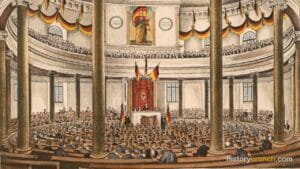
Nationalism is one of the most important political ideas in modern history, and understanding where it came from helps explain how the world was divided into the countries that exist today. The origins of nationalism reach back to the late 18th century, when new revolutions and new ways of thinking convinced ordinary people that they belonged to a “nation” and that this nation deserved to rule itself. This shift belongs to the wider Age of Nationalism, a period stretching from the American and French Revolutions through the unifications of Germany and Italy in the 19th century.
Nationalism is the belief that people who share a common language, culture, history, and identity should have the right to govern themselves as an independent nation. Nationalists hold that the nation is the most natural and important unit of political organization, and that each group of people with a shared identity deserves its own state. In simple terms, nationalism ties a person’s loyalty to their nation rather than to a king, a religion, or a local village.
What Was the Age of Nationalism?
The Age of Nationalism describes the roughly 150-year period, from the late 1700s to the early 1900s, when nationalism became one of the strongest forces in world politics. During this era, the political map of Europe and the Americas was redrawn again and again as peoples demanded the right to rule themselves. In fact, many of the countries on today’s map were created or reshaped during this time.
This age grew out of the wider changes sweeping the Western world, including the Age of Enlightenment, the American Revolution, and the French Revolution. Enlightenment thinkers questioned the old idea that kings ruled by the will of God, and argued instead that governments got their authority from the people. As stated above, this new way of thinking prepared the ground for nationalism to spread quickly across the 19th century.
How Did People Identify Before Nationalism?
Nationalism is a relatively modern idea, and for most of history it did not exist in the form people know today. Before the late 18th century, most people in Europe and elsewhere did not think of themselves as members of a nation in the modern sense. Instead, they thought of themselves as subjects of a king, members of a religious community, or inhabitants of a particular village or region.
For instance, a farmer in France in the year 1700 was far more likely to identify with his local lord, his church, and his village than with the idea of “France” as a whole. The idea that all people sharing a common language and culture formed a single national community with the right to govern itself was simply not widely held. This began to change dramatically in the closing decades of the 1700s.
How Did the American Revolution Shape Nationalism?
The first major developments that gave rise to modern nationalism were the American Revolution of 1776 and the French Revolution of 1789. Both revolutions were built on the idea that governments get their authority from the people rather than from a king or an empire. This principle, known as popular sovereignty, became the foundation of nationalist thinking.
In the American Revolution, thirteen British colonies declared their independence and joined together to form a new country, the United States. More specifically, the colonists came to see themselves as a distinct people with the right to rule themselves, rather than as subjects of a distant British king. In reality, the success of the American Revolution provided a powerful model, showing other peoples around the world that ordinary citizens could break away from an empire and govern themselves.
How Did the French Revolution Spread Nationalism?
The French Revolution, which began in 1789, spread nationalist ideas even further and faster than the American Revolution had. The revolutionaries overthrew the French monarchy and declared that sovereignty belonged to “the nation,” meaning the collective body of the French people. This was a radical idea, because it moved political power away from the king and placed it with ordinary citizens.
The revolutionary government also worked hard to build a shared sense of French identity. For instance, leaders introduced national symbols, patriotic songs, and public ceremonies designed to make people feel proud of being French. They also created more uniform laws and reduced the power of local dialects and regional customs, which helped tie the whole country together under one national identity.
Napoleon Bonaparte, who rose to power after the revolution, spread these ideas across Europe as his armies conquered other lands. In fact, French rule often had an unexpected effect. As French soldiers occupied places like the German and Italian territories, many people in those regions began to develop their own nationalism in response, uniting against foreign control and dreaming of nations of their own.
What Ideas Fueled the Growth of Nationalism?
Beyond revolution, several powerful ideas helped nationalism take root and grow throughout the 19th century. The most fundamental was the idea of a shared national identity, the belief that people who share a common language, culture, history, and traditions form a natural community called a nation. This shared identity was seen as the very thing that gave a nation the right to exist as a political unit.
A second key principle was self-determination, the idea that each nation has the right to determine its own political future and to govern itself without being ruled by a foreign power. Nationalists also placed great value on culture, working to preserve and promote the language, literature, art, and traditions of their people. For instance, in the early 19th century, scholars in Germany and Italy worked to build unified literary languages, and this movement was closely tied to the growth of nationalist feeling in those regions.
The Industrial Revolution also played a role in spreading these ideas. Railroads, newspapers, and growing cities connected people who had once lived in isolated villages, and mass education taught millions of children to read in a common national language. More specifically, these changes made it easier for people spread across a large territory to feel that they belonged to the same nation.
How Did Nationalism Reshape 19th Century Europe?
The 19th century was the great age of nationalism in Europe, and its effects were felt on every part of the continent. In some places, nationalism pulled separate states together into a single country. For instance, both Germany and Italy formally unified as countries in 1871 and 1861, when smaller kingdoms joined into one larger nation whose people identified with each other nationalistically.
In other places, nationalism pulled large empires apart. Multiethnic empires such as the Austro-Hungarian and Ottoman Empires contained many different groups of people, and rising nationalist feeling among these groups threatened to break the empires into pieces. In reality, this tension was especially strong in the Balkans, where different Slavic peoples struggled to define their own identities and demand independence.
Significance of Origins of Nationalism
The origins of nationalism are enormously significant because they transformed the political map of the world and became one of the driving forces behind revolutions, wars of independence, and the formation of many modern countries. Before nationalism, most people identified with a king, a religion, or a village, but afterward they increasingly identified with a nation. This change reorganized the way societies were governed and how people understood who they were.
At the same time, nationalism carried both positive and negative consequences. On one hand, it inspired peoples to seek freedom, self-government, and pride in their shared culture. On the other hand, it created deep rivalries between nations and encouraged some groups to view themselves as superior to others, which helped build the tensions that eventually erupted into World War I. For these reasons, the origins of nationalism remain essential to understanding the modern world.
Frequently Asked Questions
When did nationalism begin?
Nationalism in its modern form began in the late 18th century, especially with the American Revolution of 1776 and the French Revolution of 1789. Before this time, the idea that a shared culture gave people the right to rule themselves was not widely held. These two revolutions turned that idea into a powerful political force that spread rapidly during the 1800s.
What is the difference between a nation and a state?
A nation is a group of people who share a common identity, language, culture, and history, while a state is an organized government that controls a specific territory. Nationalists believe the two should match up, so that each nation has its own state. When a nation governs its own territory, the result is called a nation-state.
How did the Enlightenment influence nationalism?
The Enlightenment influenced nationalism by teaching that governments get their power from the people rather than from God-chosen kings. Enlightenment thinkers promoted ideas like natural rights, equality, and popular sovereignty. These ideas encouraged people to believe that a nation of citizens, not a monarch, should hold political authority.
Why did Napoleon accidentally spread nationalism?
Napoleon accidentally spread nationalism because his conquests caused people in other lands to unite against French control. As his armies occupied German and Italian territories, the people there developed their own national pride and began to dream of independent countries. In this way, resisting Napoleon helped strengthen nationalism across Europe.
Was nationalism a good or bad thing?
Nationalism had both good and bad effects, which is why historians view it as a complicated force. It inspired peoples to seek freedom, unify their countries, and take pride in their culture. However, it also created dangerous rivalries between nations and encouraged feelings of superiority that contributed to conflicts, including World War I.
Cite This Article
To cite this article as a source, use one of the formats below.
MLA: Millar, B. “Origins of Nationalism: A Detailed Summary.” HistoryCrunch, 12 August 2026, https://historycrunch.com/origins-of-nationalism/.
APA: Millar, B. (2026). Origins of Nationalism: A Detailed Summary. HistoryCrunch. https://historycrunch.com/origins-of-nationalism/
Chicago: Millar, B. “Origins of Nationalism: A Detailed Summary.” HistoryCrunch. August 12, 2026. https://historycrunch.com/origins-of-nationalism/
Sources
- David Blackbourn, The Long Nineteenth Century / History of Germany 1780-1918.
- German History in Documents and Images (GHDI)
- Fordham Modern History Sourcebook
- Lucy Riall, Garibaldi / The Italian Risorgimento.