The Provisional Government of Russia was one of the most important governments in modern Russian history, since it was the body that ruled the country during the brief and dramatic gap between the fall of the tsar and the rise of communist power. It was set up in 1917 after Tsar Nicholas II gave up his throne, and it was meant to guide Russia through a difficult transition. However, it lasted only about eight months before it was overthrown by the Bolsheviks. Its short and troubled rule is a key part of the story of the Russian Revolution of 1917.
In simple terms, a provisional government is a temporary government that holds power for a short time until a permanent one can be created. The word provisional means “for the time being,” so the leaders of the Provisional Government of Russia were never supposed to rule forever. Instead, they were expected to keep the country running until a permanent assembly, elected by the Russian people, could write a new constitution and decide what kind of government Russia would have in the future.
What Was the Russian Revolution?
The Russian Revolution of 1917 was one of the most significant events of the early 20th century, and it completely changed the course of Russian and world history. In fact, it involved the downfall of the centuries-old monarchy of Russia and led to the establishment of the world’s first communist state. The revolution unfolded as a series of major events across the single year of 1917, and it left a lasting legacy that shaped politics and ideas around the world for decades afterward.
The revolution had several major causes that had been building up for many years. These included widespread anger toward the tsar and the government of Russia, deep economic instability, and growing discontent among ordinary citizens about the role of Russia in World War I. More specifically, Russia’s participation in the war strained its economy and led to food shortages, rising prices, and general suffering among the population. These problems caused mass protests and strikes, especially in the capital city of Petrograd, which is now called St. Petersburg.
The Russian Revolution was made up of two main events. The first was the February Revolution of 1917, which overthrew the tsar and created the Provisional Government. The second was the October Revolution of 1917, in which the Bolsheviks seized power. The Provisional Government existed in the months between these two events, which is why it sits at the very center of the revolution’s story.
How Was the Provisional Government Formed?
The Provisional Government was created directly out of the February Revolution of 1917. As stated above, mass protests and strikes broke out in Petrograd as people demanded bread, peace, and an end to autocracy, which is a system in which one ruler holds total power. When soldiers who were sent to control the crowds began to join the protesters instead, the tsar’s authority collapsed almost overnight.
Facing this loss of control, Tsar Nicholas II abdicated, meaning he formally gave up his throne, in March of 1917. This ended more than three hundred years of rule by the Romanov family and centuries of tsarist government in Russia. With the old system suddenly gone, there was an empty space of power that had to be filled quickly.
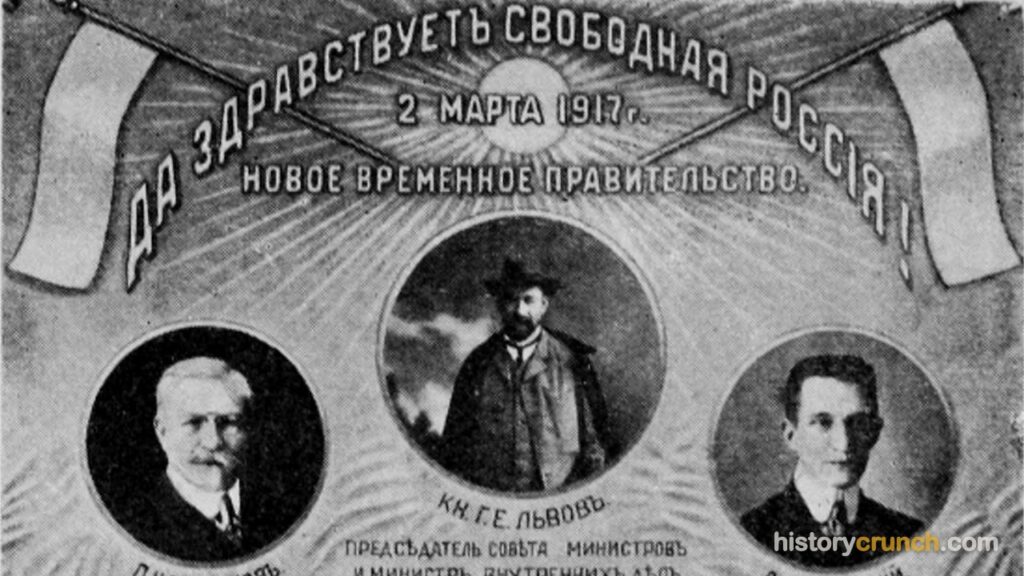
To fill that gap, members of the Duma stepped forward. The Duma was Russia’s elected legislature, or lawmaking assembly, which had been created after an earlier revolution in 1905. A group of Duma members formed the Provisional Government and declared it the temporary ruling body of the country. The new government was made up mostly of liberal and moderate politicians who wanted Russia to become a democracy.
Who Led the Provisional Government?
The first leader of the Provisional Government was Prince Georgy Lvov, a wealthy landowner who supported the idea of turning Russia into a liberal, democratic country. He served as the head of the government, which was made up of a cabinet of ministers drawn largely from the Duma. Under his leadership, the government passed a number of reforms, such as granting new freedoms and removing old restrictions based on religion and nationality.
The most famous figure in the Provisional Government, however, was Alexander Kerensky. At first, Kerensky served as Minister of Justice, and he was the only true socialist in the early cabinet. He later became Minister of War and then, in the summer of 1917, the head of the entire government after Lvov stepped down.
Kerensky was an unusual and important figure because he had connections to both the liberal government and the revolutionary movement. In fact, he was a well-known reformer who tried to steer Russia toward democracy during a time of war and crisis. In the end, though, his efforts failed, and he spent the rest of his life in exile after the Bolsheviks took power.
What Was Dual Power?
One of the biggest weaknesses of the Provisional Government was that it never held complete control of Russia. After the February Revolution, a second center of power appeared alongside it. This body was known as the Petrograd Soviet, and the word soviet simply means “council.” The Petrograd Soviet was a council of workers’ and soldiers’ representatives, and it claimed to speak for the ordinary working people of Russia.
Because two competing bodies both claimed authority at the same time, this situation became known as “dual power.” The Provisional Government had the official position and legal authority, but the Petrograd Soviet had the real support of workers, soldiers, and much of the population. In reality, the government often could not act without the cooperation of the Soviet, which weakened it from the very start.
This divided arrangement made it very hard for the Provisional Government to rule effectively. For instance, if the government gave an order that the Soviet disagreed with, soldiers and workers might simply refuse to follow it. As a result, the Provisional Government struggled to enforce its decisions across the country.
Why Did the Provisional Government Fail?
The Provisional Government failed for several major reasons. The most important was its decision to keep Russia in World War I. Millions of Russians wanted the war to end because it was causing enormous casualties, hunger, and hardship. However, the government chose to continue fighting alongside its allies, and this choice made it deeply unpopular.
The government also failed to solve other pressing problems. For example, it did not carry out land reform, even though millions of peasants wanted farmland to be redistributed to them. In addition, the food shortages, rising prices, and economic troubles that had helped destroy the tsar continued during the government’s rule, and it seemed unable to fix them.
Another major blow came from an event known as the Kornilov Affair. In the late summer of 1917, a Russian general named Lavr Kornilov marched troops toward Petrograd in what looked like an attempt to seize power. Kerensky turned to the workers and even to the Bolsheviks to help defend the capital. While the threat was stopped, this event badly weakened the government and made the Bolsheviks stronger and more popular than before.
All of these failures created an opening for the Bolsheviks, a radical socialist group led by Vladimir Lenin. The Bolsheviks promised the Russian people three things they wanted most: peace, land, and bread. In October of 1917, the Bolsheviks staged a coup and overthrew the Provisional Government in the event now known as the October Revolution, placing power in the hands of the soviets.
Significance of Provisional Government of Russia
The Provisional Government of Russia is significant because it marked the brief moment when Russia might have become a democracy. After the fall of the tsar, the country had the chance to build a new government elected by the people. The failure of the Provisional Government to seize that chance helped decide the future of Russia for the rest of the 20th century.
The government’s collapse also cleared the way for the rise of the Bolsheviks and the creation of the Soviet Union, the world’s first communist state. In this way, the weaknesses of the Provisional Government had effects far beyond Russia itself. The example of a moderate government being pushed aside by a determined revolutionary movement influenced political ideas and struggles around the world for decades.
Finally, the story of the Provisional Government shows how difficult it can be to govern a country during a time of war, hunger, and revolution. Its short life demonstrates that legal authority alone is not enough to hold power. Without the support of ordinary people and the strength to solve their most urgent problems, even a government with good intentions can quickly fall apart.
Frequently Asked Questions
How long did the Provisional Government of Russia last?
The Provisional Government lasted about eight months, from March of 1917 until November of 1917. It came into being right after Tsar Nicholas II abdicated during the February Revolution and ended when the Bolsheviks seized power during the October Revolution. Because the dates are given in two different calendars, the October Revolution is sometimes listed as taking place in November by the modern calendar.
Who was the leader of the Provisional Government?
The Provisional Government had two main leaders during its short life. Prince Georgy Lvov led it first, from March of 1917, and Alexander Kerensky took over as its head in the summer of 1917. Kerensky is the more famous of the two because he was in charge when the Bolsheviks overthrew the government.
What was the difference between the Provisional Government and the Petrograd Soviet?
The Provisional Government was the official government of Russia, while the Petrograd Soviet was a council of workers and soldiers that held real influence over the population. The government had legal authority, but the Soviet controlled the loyalty of many workers and troops. This split created the situation known as dual power, in which neither side held complete control.
Why did the Provisional Government keep Russia in World War I?
The Provisional Government kept Russia in World War I mainly because it wanted to honor the country’s promises to its allies, such as Britain and France. Many of its leaders also believed that Russia needed to win the war to protect the achievements of the revolution. This decision proved fatal, since most Russians wanted peace and turned against the government for continuing to fight.
What replaced the Provisional Government?
The Provisional Government was replaced by a Bolshevik government led by Vladimir Lenin. After the October Revolution, power passed to the soviets, and the Bolsheviks quickly began to build a new political system. This eventually led to the creation of the Soviet Union, the world’s first communist state.
Cite This Article
To cite this article as a source, use one of the formats below.
MLA: Millar, B. “Provisional Government of Russia: A Detailed Summary.” HistoryCrunch, 11 August 2026, https://historycrunch.com/provisional-government-of-russia/.
APA: Millar, B. (2026). Provisional Government of Russia: A Detailed Summary. HistoryCrunch. https://historycrunch.com/provisional-government-of-russia/
Chicago: Millar, B. “Provisional Government of Russia: A Detailed Summary.” HistoryCrunch. August 11, 2026. https://historycrunch.com/provisional-government-of-russia/
Sources
- Norman Davies, Europe: A History.