The Battle of the Nile was one of the most important naval battles of the French Revolutionary Wars, and it dramatically shifted the balance of power in the Mediterranean Sea. Fought on August 1st, 1798, at Aboukir Bay near Alexandria, Egypt, the battle saw a British fleet under Rear Admiral Horatio Nelson destroy a French fleet that had carried Napoleon Bonaparte and his army to Egypt. The stunning British victory trapped Napoleon’s forces far from home and helped turn the tide of the war against France.
Background of the Battle of the Nile
By the late 1790s, France had spent several years at war with a group of European nations that opposed the French Revolution. By 1798, France had defeated most of its enemies on the European continent, and only Great Britain remained a serious rival. Since the two nations were separated by the English Channel, French leaders searched for a way to strike at British power without a direct invasion of Britain itself.
At the time, France was governed by the Directory, a five-member council that ran the country in the final years of the French Revolution. The Directory approved a bold plan proposed by a young and popular general named Napoleon Bonaparte. Napoleon argued that France should invade Egypt, which was then part of the Ottoman Empire. Controlling Egypt would allow France to threaten British trade routes and endanger Britain’s valuable colonial possessions in India.
In May of 1798, Napoleon set sail from the French port of Toulon with a massive expedition. His force included tens of thousands of soldiers, hundreds of transport ships, and a fleet of warships to protect them. Along the way, the French captured the island of Malta before continuing east across the Mediterranean toward Egypt.
The British were alarmed by the news of a large French expedition sailing into the Mediterranean, even though they did not know its true destination. In response, they sent a fleet under Rear Admiral Horatio Nelson to hunt down the French. For weeks, Nelson chased the French across the sea, at one point sailing past them without realizing how close they were. Napoleon’s army landed safely in Egypt in July of 1798, and the French soon captured Alexandria and defeated a local army at the Battle of the Pyramids near Cairo.
After the army came ashore, the French fleet, commanded by Vice Admiral François-Paul Brueys, anchored in Aboukir Bay, about 12 miles (19 km) east of Alexandria. Brueys arranged his 13 large warships in a long line close to the shore. He believed this position was very strong, since he thought no enemy ships could safely pass between his line and the shallow water along the coast. This assumption would prove to be a fatal mistake.
How the Battle of the Nile Unfolded
On the afternoon of August 1st, 1798, Nelson’s fleet finally located the French anchored in Aboukir Bay. Even though evening was approaching and his ships had been sailing hard, Nelson decided to attack immediately rather than wait for the next morning. This bold decision caught the French off guard, because many of their sailors were ashore gathering supplies and were not ready to fight.
Nelson understood that the French had left a gap between their line of ships and the shore. He realized that if there was enough room for the French ships to swing at anchor, there was enough room for his own ships to sail through. As a result, part of the British fleet slipped between the French line and the shallow water, while the rest attacked from the seaward side. This clever move trapped the front of the French line between two lines of British guns.
More specifically, the British were able to concentrate their fire on the leading French ships, overwhelming them one after another before ships further down the line could come to their aid. Attacked from both sides at once, the French vessels at the front of the line suffered terrible damage and were forced to surrender. The British method of enveloping the enemy line proved devastating throughout the night.
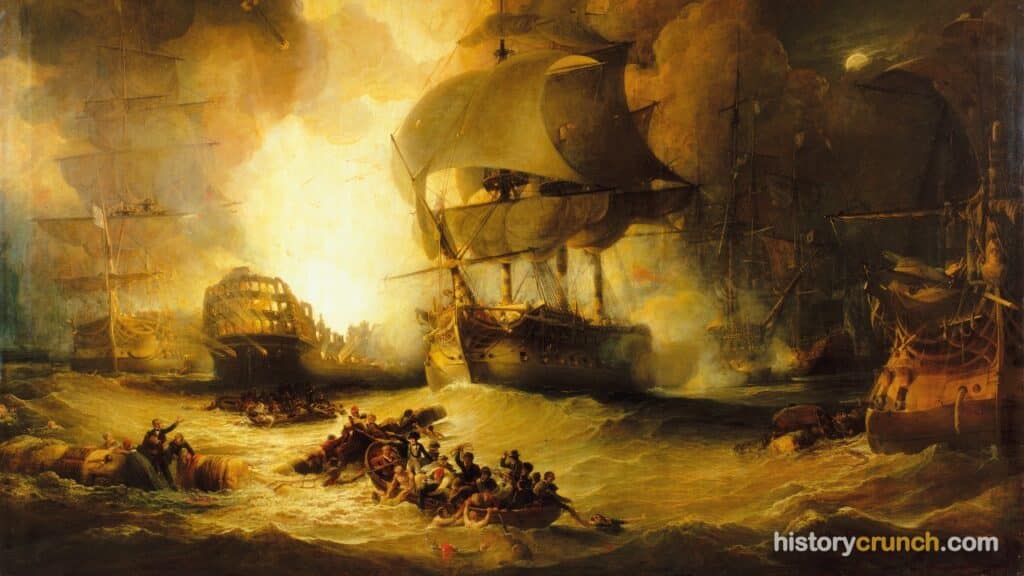
The fighting continued after dark, lit by the flashes of cannon fire. During the battle, Nelson himself was wounded in the head by a piece of flying metal, but he survived and continued to direct his fleet. The most dramatic moment came when the French flagship, a huge warship called L’Orient, caught fire. The flames spread until they reached the ship’s store of gunpowder, and the vessel exploded in a massive blast that could reportedly be seen and heard for miles. The French commander, Vice Admiral Brueys, was killed during the battle.
The explosion of L’Orient stunned both sides, and the fighting briefly paused before resuming. By the following day, the outcome was clear. The British had captured or destroyed the vast majority of the French fleet, with only a small number of ships managing to escape.
In fact, the losses on the two sides were enormously unequal. No British ships were lost, and the British suffered roughly 200 dead and 700 wounded, while the French lost eleven warships and two frigates, with only two warships and two frigates escaping, and suffered around 1,700 dead and 1,500 wounded. The battle was a near-total destruction of French naval power in the region and one of the most complete naval victories of the entire period.
Significance of Battle of the Nile
The Battle of the Nile had enormous consequences for both France and Britain. By destroying the French fleet, Nelson cut Napoleon and his army off from France, leaving them stranded in Egypt with no easy way to receive reinforcements or supplies. In reality, this turned Napoleon’s promising campaign into a slow disaster, as the French army struggled against disease, revolts, and enemy attacks without support from home.
The victory also had a major impact on the overall war in Europe. Before the battle, Great Britain had been fighting Revolutionary France almost alone. Nelson’s triumph encouraged other European powers to take heart and join together against France in a new alliance known as the War of the Second Coalition. As stated above, the loss of the French Mediterranean fleet meant France could no longer easily project power across the sea, and the island of Malta eventually returned to British control.
The Egyptian campaign ultimately ended in failure for France. Napoleon eventually left his army behind and slipped back to France in 1799, avoiding the British ships that patrolled the sea. Despite the defeat of his campaign, Napoleon returned home as a national hero and soon overthrew the Directory to seize control of France. In this way, the events surrounding the Battle of the Nile were closely connected to Napoleon’s dramatic rise to power.
For Britain, the battle confirmed the strength of the Royal Navy and made Horatio Nelson a celebrated national hero. The victory helped secure Britain’s dominant position at sea, a dominance that would continue for much of the next century. For these reasons, the Battle of the Nile is remembered as one of the most decisive naval battles in history.
Frequently Asked Questions
When and where was the Battle of the Nile fought?
The Battle of the Nile was fought on August 1st, 1798, at Aboukir Bay on the Mediterranean coast of Egypt. The bay is located about 12 miles (19 km) east of the city of Alexandria, near one of the mouths of the Nile River, which is how the battle got its name. Despite the name, the fighting took place at sea rather than on the river itself.
Who won the Battle of the Nile?
The British won the Battle of the Nile in a decisive victory over the French. The British fleet was commanded by Rear Admiral Horatio Nelson, while the French fleet was led by Vice Admiral François-Paul Brueys, who was killed in the fighting. The British did not lose a single ship, while the French lost most of their fleet.
Why did Napoleon invade Egypt in the first place?
Napoleon invaded Egypt mainly to weaken Great Britain by threatening its trade routes and its colonies in India. France could not easily attack Britain directly across the English Channel, so controlling Egypt offered a way to strike at British power in a different region. The campaign also aimed to establish a valuable French colony in a location connecting Europe with the East.
What was Nelson’s winning strategy at the battle?
Nelson’s key strategy was to sail part of his fleet between the French line and the shore, trapping the enemy between two lines of British guns. The French had believed the shallow water near the coast would protect that side of their line, so they were unprepared for an attack from that direction. By attacking at once and concentrating fire on the front of the French line, the British overwhelmed the enemy ships one by one.
How did the Battle of the Nile affect Napoleon’s career?
The battle stranded Napoleon’s army in Egypt and helped doom his Egyptian campaign, yet it did not end his career. Napoleon left his army behind and returned to France in 1799, where he was still seen as a hero despite the failed expedition. Soon after, he overthrew the Directory and seized power, beginning his rise to become the ruler of France.
Cite This Article
To cite this article as a source, use one of the formats below.
MLA: Millar, B. “Battle of the Nile: A Detailed Summary.” HistoryCrunch, 11 August 2026, https://historycrunch.com/battle-of-the-nile/.
APA: Millar, B. (2026). Battle of the Nile: A Detailed Summary. HistoryCrunch. https://historycrunch.com/battle-of-the-nile/
Chicago: Millar, B. “Battle of the Nile: A Detailed Summary.” HistoryCrunch. August 11, 2026. https://historycrunch.com/battle-of-the-nile/
Sources
- The British Museum — Egypt collection
- Toby Wilkinson, The Rise and Fall of Ancient Egypt.