The Exile of Napoleon was the final chapter in the life of one of the most powerful rulers in European history, and it marked the definitive end of the Napoleonic Era. After more than two decades of near-constant warfare, the major powers of Europe faced a difficult question. What should be done with a man who had conquered much of the continent, crowned himself emperor, and repeatedly defied the will of the great powers? Their answer came in two stages, first a lenient banishment to the island of Elba in 1814, and then, after a dramatic return and a final defeat at the Battle of Waterloo, a far harsher imprisonment on the remote island of Saint Helena, where Napoleon Bonaparte died in 1821.
Exile is the forced removal of a person from their home country, usually for political reasons and often as a punishment. In Napoleon’s case, exile was a deliberate compromise chosen by the allied powers. They believed he was too dangerous to leave in France but too famous and admired to execute, since killing him risked turning him into a martyr whose memory could inspire future rebellions. Removing him to a distant island seemed the safest way to neutralize his power while avoiding that danger.
What Was the Napoleonic Era?
The Napoleonic Era refers to the period of French and European history dominated by Napoleon Bonaparte, lasting from his seizure of power in France in 1799 to his final defeat and exile in 1815. Napoleon rose to prominence as a young military officer during the French Revolution, a period of upheaval that began in 1789 and saw the French people overthrow their absolute monarchy. Using his string of stunning military victories and the instability of the revolution, he advanced quickly through the ranks and eventually took control of the entire country.
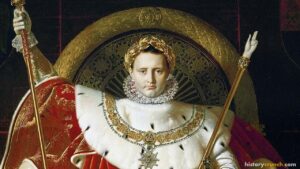
In 1799, Napoleon overthrew the government known as the Directory and appointed himself First Consul, bringing the French Revolution to an end. He crowned himself Emperor of the French in 1804 and spent the next decade waging war against a series of alliances, called coalitions, formed by other European nations. For years his armies were remarkably successful, and at its height his empire stretched across much of the continent. That dominance would not last, however, and a disastrous invasion of Russia in 1812 began the chain of events that led to his downfall and exile.
Why Was Napoleon Exiled to Elba?
Napoleon’s first exile grew directly out of the collapse of his military power. In 1812, he launched an enormous invasion of Russia that ended in catastrophe, as his army was forced into a brutal retreat from Moscow and lost hundreds of thousands of men. Sensing weakness, much of Europe united against him in what became known as the War of the Sixth Coalition, a grand alliance that included Austria, Prussia, Russia, and Britain.
By early 1814, the coalition armies had pushed deep into France, and Paris itself fell to allied forces. With his marshals unwilling to keep fighting, Napoleon had no choice but to give up power. He first offered to step down in favor of his young son, but when this was rejected, he abdicated the throne completely in April of 1814.
The terms of his removal were set out in the Treaty of Fontainebleau. In an arrangement that surprised many, the treaty stripped Napoleon of his empire but allowed him to keep the title of emperor and granted him sovereignty over the small Mediterranean island of Elba. More specifically, he was given control of an island of roughly 12,000 inhabitants, along with an income and a small guard of loyal soldiers. This was not a harsh imprisonment but a remarkably lenient settlement, and it would soon prove to be a serious mistake.
What Was Napoleon’s Life Like on Elba?
Napoleon arrived on Elba in May of 1814 and, rather than sinking into despair, threw himself into governing his tiny new domain. With his characteristic energy, he acted as if the small island were a real kingdom, working to improve its roads, its defenses, its farming, and its mines. His mother and one of his sisters joined him there, and he kept a modest court staffed by a few hundred soldiers who had followed him into exile.
Despite this activity, Napoleon remained restless and closely watched events on the mainland. Elba sat only a short distance off the Italian coast, close enough for him to remain in contact with supporters in France. In fact, this nearness was the fatal flaw in the arrangement, because it left him within easy reach of a country where discontent was quickly growing.
In France, the monarchy had been restored under King Louis XVIII, but the new king proved unpopular with many soldiers and ordinary citizens who still admired their former emperor. As stated above, Napoleon learned that his supporters were stirring, and he also grew worried that the allied powers meeting at the Congress of Vienna might move him somewhere even more remote. These fears, combined with a genuine opportunity, convinced him that the moment for a return had come.
How Did Napoleon Escape and Return to Power?
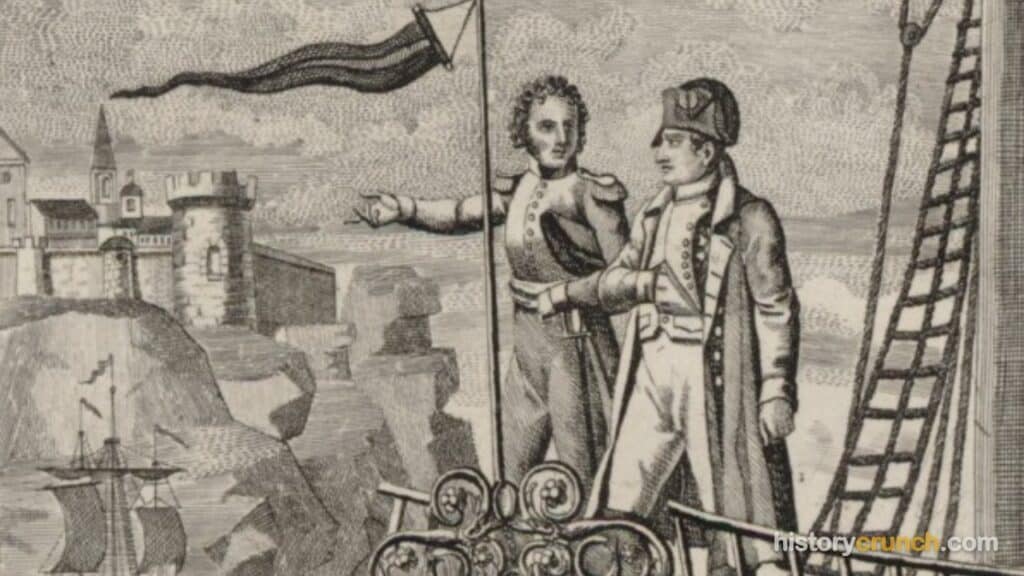
In late February of 1815, after less than a year on Elba, Napoleon slipped away from the island with around a thousand loyal men. He landed on the southern coast of France and began a bold march toward Paris. Rather than fighting his way through, he relied on his fame, and the soldiers sent to stop him instead rallied to his side and joined his advance.
By March 20th, 1815, Napoleon had entered Paris in triumph as King Louis XVIII fled the capital. This began the brief period known as the Hundred Days, during which Napoleon reclaimed the French throne and hastily rebuilt an army. The allied powers, however, refused to accept his return. Within days they declared him an outlaw and formed a new coalition determined to defeat him once and for all.
Napoleon chose to strike first, marching into Belgium in an attempt to defeat the allied armies before they could combine their full strength. His gamble came to a violent end at the Battle of Waterloo on June 18th, 1815, where his forces were crushed by a British-led army under the Duke of Wellington and a Prussian army under Field Marshal Blücher. The defeat was total, and it ended his second reign as suddenly as it had begun.
Why Was Napoleon Sent to Saint Helena?
Just days after Waterloo, on June 22nd, 1815, Napoleon abdicated for the second and final time. He hoped to sail to the United States and live in freedom, but a British naval blockade prevented his escape, and he was forced to surrender himself to the British navy. This time the allies were determined to make certain that no second escape could ever occur.
The lesson of Elba weighed heavily on the allied leaders. The lenient terms of 1814 had left Napoleon with a title, an income, and closeness to France, and they were not willing to repeat that error. This time they chose the island of Saint Helena, a remote British possession in the South Atlantic Ocean located more than 1,000 miles (1,600 km) from the nearest mainland. Its extreme isolation made escape effectively impossible.
Napoleon arrived on Saint Helena in October of 1815 after a sea voyage of roughly ten weeks. Unlike on Elba, he arrived not as a sovereign but as a prisoner under constant guard. A British governor, Sir Hudson Lowe, was appointed to oversee him, and the two men clashed frequently over the terms of Napoleon’s confinement.
How Did Napoleon Spend His Final Years and Die?
On Saint Helena, Napoleon was housed at a property called Longwood House, a damp and windswept residence that was said to be cold, gloomy, and overrun with rats. He lived there with a small group of loyal followers who had chosen to share his exile. To pass the long and monotonous days, he read widely and dictated his memoirs, shaping the way future generations would remember his career.
Over time his health steadily declined. In 1818 the allied powers formally announced that he would remain a prisoner on the island for the rest of his life, news that deepened his isolation and gloom. He spent longer and longer periods indoors, and his condition worsened as the years passed.
Napoleon died at Longwood House on May 5th, 1821, at the age of 51. An examination after his death concluded that he had most likely died of stomach cancer, though rumors that he had been poisoned circulated for many years afterward. He was buried on Saint Helena, and it was not until 1840, nearly two decades later, that his remains were returned to France and entombed at Les Invalides in Paris.
Significance of Exile of Napoleon
The exile of Napoleon carried enormous importance for the history of France and Europe. His final removal to Saint Helena brought a definitive end to the Napoleonic Wars, a conflict that had produced more than two decades of recurrent warfare and cost millions of lives. With Napoleon safely locked away, the major powers could at last reshape the map of the continent without fear of his return.
The two exiles also revealed how much the allies had learned between 1814 and 1815. The generous terms of the first settlement had made a return possible, so the second was designed to eliminate any such possibility. In reality, the harsher peace imposed after the Hundred Days, along with the choice of a distant prison island, reflected a determination never to underestimate Napoleon again.
Beyond its immediate effects, the exile shaped Napoleon’s lasting reputation. His dramatic escape from Elba became a symbol of the idea that political exile is never entirely final, a lesson that echoed in the stories of later deposed leaders. At the same time, his lonely death on a remote rock in the Atlantic gave his story a tragic ending that only deepened the legend surrounding one of history’s most ambitious figures.
Frequently Asked Questions
How many times was Napoleon exiled?
Napoleon was exiled twice during his life. The first exile sent him to the Mediterranean island of Elba in 1814, and the second sent him to the far more remote South Atlantic island of Saint Helena in 1815 after his defeat at Waterloo. The two exiles were separated by his brief return to power known as the Hundred Days.
Where is Elba and where is Saint Helena?
Elba is a small island in the Mediterranean Sea just off the western coast of Italy, which made it dangerously close to France. Saint Helena, by contrast, is a tiny volcanic island in the middle of the South Atlantic Ocean, hundreds of miles from any major landmass. The vast difference in distance is a key reason Napoleon could escape from Elba but never from Saint Helena.
Why didn’t the allies just execute Napoleon?
The allied powers chose exile over execution because they feared turning Napoleon into a martyr. Executing such a famous and beloved figure risked inspiring uprisings and rebellions across Europe in his name. Banishment to a distant island seemed a safer way to remove his power without creating a rallying symbol for his supporters.
Did Napoleon want to go to America instead of Saint Helena?
Yes, after his second abdication Napoleon hoped to sail to the United States and live there in freedom. A British naval blockade along the French coast blocked his escape, forcing him to surrender to the British navy. Only then did he learn that he would instead be sent as a prisoner to Saint Helena.
What happened to Napoleon’s body after he died?
Napoleon was first buried on Saint Helena, the island where he died in 1821. Nearly twenty years later, in 1840, the French government was permitted to bring his remains back to France. He was reburied in a grand tomb at Les Invalides in Paris, a resting place for many of France’s honored military figures.
Cite This Article
To cite this article as a source, use one of the formats below.
MLA: Millar, B. “Exile of Napoleon: A Detailed Summary.” HistoryCrunch, 11 August 2026, https://historycrunch.com/exile-of-napoleon/.
APA: Millar, B. (2026). Exile of Napoleon: A Detailed Summary. HistoryCrunch. https://historycrunch.com/exile-of-napoleon/
Chicago: Millar, B. “Exile of Napoleon: A Detailed Summary.” HistoryCrunch. August 11, 2026. https://historycrunch.com/exile-of-napoleon/
Sources
- David A. Bell, Napoleon: A Concise Biography.
- Andrew Roberts, Napoleon: A Life.
- The Met (Heilbrunn Timeline)