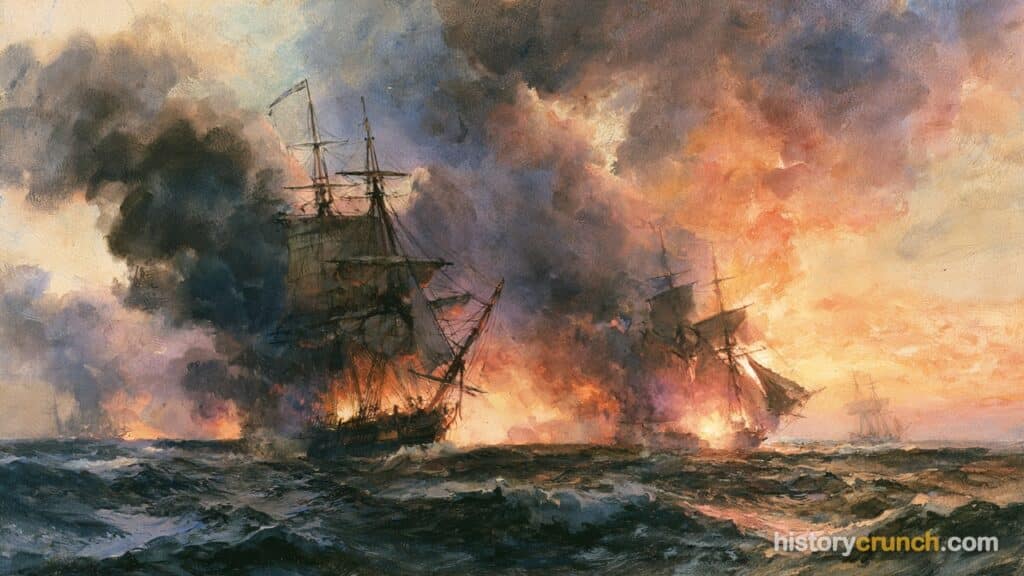
Naval warfare in the American Revolution played a far larger role in the outcome of the war than many people realize, and control of the sea often decided what armies could and could not do on land. The struggle at sea pitted the small and newly created American Continental Navy, along with hundreds of private armed ships, against the Royal Navy of Great Britain, which was the most powerful fleet in the world at the time. Over the course of the war from 1775 to 1783, the fighting stretched across coastal waters, rivers, and the open ocean, and it eventually pulled in the navies of France and Spain. In fact, the final American victory owed as much to events on the water as to the battles fought on land.
Naval warfare simply means armed conflict fought on water using ships, boats, and the sailors and marines who crewed them. In the eighteenth century this involved wooden sailing warships armed with rows of cannon, smaller vessels used for scouting and carrying supplies, and privateers, which were privately owned ships given government permission to attack and capture enemy vessels. Navies were used to blockade ports, move soldiers and supplies, and destroy the enemy’s ability to trade.
What Was the American Revolution?
The American Revolution was the conflict from 1775 to 1783 in which thirteen of Britain’s North American colonies broke away from British rule and formed the United States of America. The causes of the American Revolution grew over more than a decade, driven by disputes over British taxation, the denial of self-government, trade restrictions, and the rights of colonists as British subjects. No single event caused the war. Instead, a series of British policies and colonial responses pushed the two sides further apart until armed conflict became unavoidable.
The fighting began in April of 1775 with the Battles of Lexington and Concord, and the colonists declared their independence in July of 1776. For the first years, the war was essentially a civil war within the British Empire. This changed when France joined the American side in 1778 and Spain joined against Britain in 1779, turning the struggle into an international war. The conflict finally ended with the Treaty of Paris in 1783, which recognized American independence.
How Did the Two Sides Compare at Sea?
At the start of the war the two sides were badly mismatched on the water. When the Revolution began, the thirteen colonies had no real navy, only a large number of merchant ships that were used for trade. These merchant crews were highly experienced sailors, and many colonists had gained wartime experience during earlier fighting between Britain and France. Even so, the colonies had no fleet of dedicated warships ready to fight.
The Continental Congress moved to change this. On October 13th, 1775, Congress authorized the creation of the Continental Navy, and it established the United States Marine Corps the following month. By 1776 the colonies had assembled about 27 warships. In contrast, the British Royal Navy had roughly 270 warships, which meant the Americans were outnumbered by roughly ten to one. Many American vessels were also converted merchant ships rather than purpose-built warships, and their crews often lacked training and discipline.
Because of this imbalance, British sea power gave the Royal Navy enormous advantages. The British could sweep American merchant ships from the oceans and place economic pressure on the rebelling colonies. More importantly, the Royal Navy could transport troops and supplies across the Atlantic, move them along the American coast, and pull them out of danger when needed. Since the colonies lacked the industry to make their own weapons and supplies, they depended heavily on trade with friendly nations, and the British fleet threatened that lifeline.
What Strategy Did the Americans Use?
The leaders of the new navy understood they could not fight the Royal Navy in a stand-up battle of large fleets. As stated above, the British had far more warships and far more firepower. For this reason, American commanders focused on a different kind of warfare. Rather than trying to defeat the British fleet directly, they aimed to raid British shipping, capture supplies, and defend their own trade routes.
Privateers were central to this plan. A privateer was a privately owned ship whose owners received official permission to attack and seize enemy vessels, keeping a share of the captured goods as profit. Hundreds of these ships put to sea during the war. In fact, privateers captured many British merchant vessels, which both supplied the American war effort and kept the Royal Navy busy chasing raiders instead of concentrating its full strength against the Continental Army.
This approach worked in psychological and economic terms as well as military ones. Attacks close to the British Isles shocked members of Parliament and alarmed people living along the British coast. More significantly, the raids caused shipping insurance rates to rise sharply, which dealt a real blow to the British economy and weakened public support for the war.
Who Were the Leading American Naval Commanders?
Despite the overwhelming odds, the Continental Navy achieved some notable early successes. In February of 1776, a small fleet under Commodore Esek Hopkins attacked the British settlement of Nassau in the Bahamas. During the raid, the Americans captured a large quantity of guns and ammunition and took British officials prisoner. This action is remembered as the first amphibious assault carried out by American sailors and Marines, meaning an attack launched from ships onto land.
Several captains stood out for carrying the fight to the enemy, including Lambert Wickes, Gustavus Conyngham, and John Barry. The most famous of all was John Paul Jones. As captain of the ship Ranger, Jones captured a British warship, and he became a hero to Americans of his own time and to later generations.
His most celebrated moment came in September of 1779 in the waters off the coast of Britain. Commanding a converted vessel named Bonhomme Richard, Jones fought a fierce battle against the British warship Serapis. It became one of the bloodiest naval engagements of the war. When the British called on him to surrender, Jones is remembered for refusing and fighting on, and he ended the battle by capturing the Serapis even as his own ship was sinking beneath him.
How Did France Change the War at Sea?
The entry of France into the war in 1778, followed by Spain in 1779, transformed the naval struggle. These European powers had large and powerful fleets of their own, which meant that Britain could no longer treat the Atlantic as its own private highway. As a result, the later stages of the war at sea were fought mainly between Britain and its European rivals, while the American effort was reduced largely to privateering. For the Americans, the arrival of a friendly great-power navy changed everything.
George Washington understood clearly that naval superiority was the key to winning the war. For years he had been locked in a standstill with British forces around New York City. What he needed was a French fleet strong enough to seize temporary control of American waters and trap a British army against the coast, where it could not escape or be reinforced by sea.
Why Was the Battle of the Chesapeake So Important?
The most important naval battle of the war took place on September 5th, 1781, near the mouth of Chesapeake Bay off the coast of Virginia. It is known as the Battle of the Chesapeake, and also as the Battle of the Virginia Capes. In this fight, a French fleet of 24 ships of the line, commanded by Admiral the Comte de Grasse, faced a British fleet of 19 ships of the line under Rear Admiral Thomas Graves. A ship of the line was the largest and most heavily armed type of warship of the age.
The situation on land had set the stage for the battle. British general Charles Cornwallis had moved his army to Yorktown, Virginia, on the Chesapeake, expecting to be supplied and, if needed, evacuated by the Royal Navy. In reality, de Grasse had sailed north from the Caribbean and taken up a blocking position across the mouth of the bay. When Graves arrived to relieve Cornwallis, he found the French fleet waiting.
The actual fighting lasted only a few hours before the two lines of ships drifted apart, and no warships were sunk. Even so, the British suffered more casualties and damage than the French, and Graves eventually decided to withdraw his fleet north to New York rather than renew the attack. This left de Grasse in complete control of the Chesapeake. With the sea route cut off, Cornwallis could not be rescued or reinforced, and his army was trapped.
The result on land followed quickly. Washington’s combined American and French army surrounded Yorktown, and after a siege, Cornwallis surrendered on October 19th, 1781. That surrender was the effective end of major fighting in North America and led directly to the peace that recognized American independence.
Significance of Naval Warfare in the American Revolution
The significance of naval warfare in the American Revolution lies in how deeply the war at sea shaped the outcome on land. Although most of the fighting happened on land, control of the water decided whether armies could be supplied, moved, or trapped. The clearest example is Yorktown, where a French naval victory made the decisive American land victory possible. Without command of the sea at that moment, the war might have dragged on for years longer.
The naval struggle also mattered in less obvious ways. American privateers and raiders damaged British trade, drove up insurance costs, and helped turn British public opinion against continuing the war. In this sense, the pressure applied at sea worked steadily alongside the battles on land to wear down British resolve.
Finally, the Revolution gave birth to an American naval tradition. Figures such as John Paul Jones became lasting heroes, and the wartime creation of the Continental Navy and the Marine Corps laid the groundwork for the armed forces of the new United States. Even though the navy was disbanded soon after the war, the experience showed future leaders how important sea power could be to the survival and success of the nation.
Frequently Asked Questions
When was the Continental Navy created?
The Continental Navy was created on October 13th, 1775, when the Continental Congress voted to outfit warships. This date is now honored as the birthday of the United States Navy. Congress also created a Naval Committee to oversee the new fleet and outfit vessels to intercept British transports carrying troops and military supplies.
Why did the Americans use privateers instead of a large navy?
The Americans relied on privateers because they could not afford to build a fleet large enough to challenge the Royal Navy directly. Privateering was cheaper because the ships were privately owned, and the promise of captured goods gave owners and crews a strong reason to take part. This let the young nation strike at British trade across a wide area without the expense of maintaining a huge government fleet.
Who was John Paul Jones?
John Paul Jones was the most famous captain of the Continental Navy and is often called the father of the American naval tradition. He first served as an officer aboard early American warships before commanding vessels of his own. After the war he spent time in Europe as a diplomat and even served as an admiral in the navy of Russia under Catherine the Great.
What is a ship of the line?
A ship of the line was the largest and most powerful class of warship in the eighteenth century, carrying dozens of heavy cannon on multiple decks. The name came from the standard battle tactic of the age, in which ships sailed in a single line so that all of their guns could fire at the enemy at once. Only the strongest and best-equipped navies could afford to build and crew large numbers of these expensive vessels.
Did the naval war end when Cornwallis surrendered at Yorktown?
No, naval fighting between the European powers continued for about two more years after Yorktown. While the surrender in October of 1781 ended major land fighting in North America, Britain, France, and Spain kept clashing at sea in places such as the Caribbean. The wider conflict was only settled with the signing of the Treaty of Paris in 1783.
Cite This Article
To cite this article as a source, use one of the formats below.
MLA: Millar, B. “Naval Warfare in the American Revolution: A Detailed Summary.” HistoryCrunch, 10 August 2026, https://historycrunch.com/naval-warfare-in-the-american-revolution/.
APA: Millar, B. (2026). Naval Warfare in the American Revolution: A Detailed Summary. HistoryCrunch. https://historycrunch.com/naval-warfare-in-the-american-revolution/
Chicago: Millar, B. “Naval Warfare in the American Revolution: A Detailed Summary.” HistoryCrunch. August 10, 2026. https://historycrunch.com/naval-warfare-in-the-american-revolution/
Sources
- Robert Middlekauff, The Glorious Cause.
- National Archives — Founders Online
- Yale Avalon Project
- Bernard Bailyn, The Ideological Origins of the American Revolution.