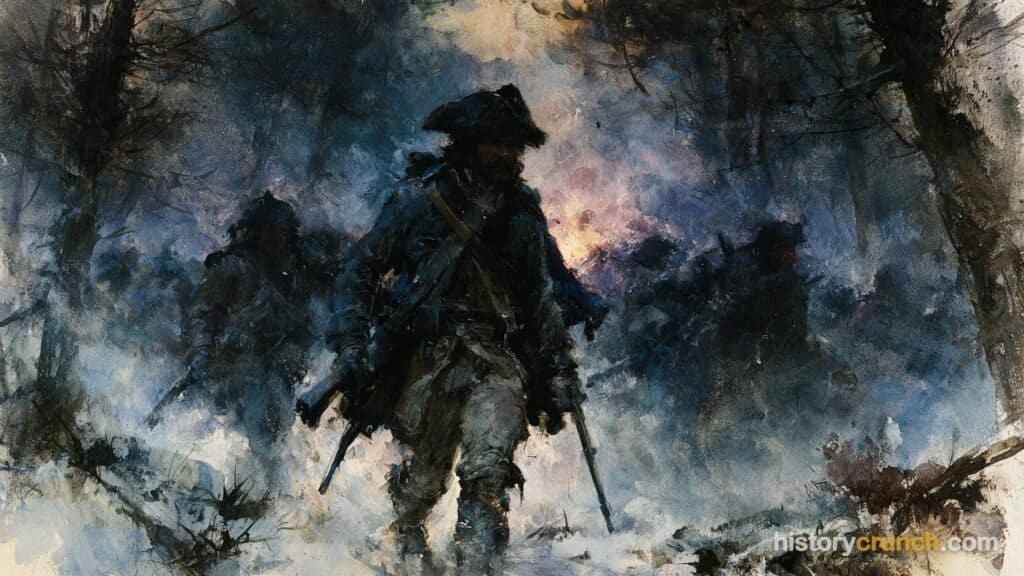
Guerrilla warfare in the American Revolution was one of the most important reasons the outnumbered and outgunned American forces were able to survive against the powerful British army. Rather than always meeting the British in large, open-field battles, American fighters often relied on surprise attacks, ambushes, and hit-and-run raids that wore down the enemy over time. These irregular tactics allowed small groups of colonists to strike quickly, then vanish into the forests, swamps, and countryside they knew far better than their opponents did.
Guerrilla warfare is a style of fighting in which small, mobile groups of soldiers use ambushes, raids, and quick surprise attacks against a larger, more traditional army, instead of standing and fighting in long lines on an open battlefield. In the 1700s this kind of fighting was more often called partisan warfare, but the meaning was the same. The goal was not to win a single crushing victory. Instead, it was to exhaust the enemy, cut off supplies, and make holding territory so costly that the larger army would eventually give up.
What Was the American Revolution?
The American Revolution was the political and military struggle through which the thirteen American colonies broke free from British rule and created the United States of America. It grew out of more than a decade of rising tension between Britain and the colonies over taxation, self-government, trade, and the rights of colonists as British subjects. As stated above, no single event caused the conflict. Instead, a chain of British laws and colonial protests pushed the two sides further apart until war became unavoidable.
Open fighting began in April of 1775 at the Battles of Lexington and Concord in Massachusetts, and the colonies formally declared independence on July 4th, 1776. The war then lasted until 1783, when a peace treaty finally recognized American independence. For much of this period, the professional British army was better trained, better supplied, and far larger than the forces the Americans could put in the field.
Because of this imbalance, the Americans could not rely on traditional battles alone. They needed strategies that made the most of their limited resources and their deep knowledge of the land. Guerrilla warfare became one of those key strategies, used alongside the regular battles fought by the Continental Army.
Why Did Americans Use Guerrilla Warfare?
The main reason Americans turned to guerrilla warfare was the enormous gap in strength between the two sides. The British army was one of the most powerful military forces in the world, with disciplined soldiers, experienced officers, and a strong navy. Meeting such a force in open combat again and again would have quickly destroyed the smaller American army.
In reality, many American fighters were not full-time professional soldiers at all. They were members of local militias, meaning ordinary citizens such as farmers, craftsmen, and shopkeepers who took up arms when danger threatened their communities. These men often owned their own muskets and knew the local woods, rivers, and back roads intimately, which made surprise attacks far easier to plan and escape from.
Guerrilla tactics also served a larger purpose. By constantly harassing British troops, raiding supply wagons, and attacking small detachments, the Americans could exhaust the enemy and drive up the cost of the war. The British had to guard supply lines, stand watch constantly, and chase an enemy that refused to stand still. Over time, this steady pressure drained British resources, energy, and willpower.
What Tactics Did Guerrilla Fighters Use?
The most common guerrilla tactics in the American Revolution were ambushes, raids, and hit-and-run attacks. In an ambush, fighters hid along a road or in the woods and struck a passing British column without warning, then quickly retreated before the enemy could organize a strong response. This allowed a small group to inflict damage on a much larger force while keeping their own losses low.
Raids were another key method. American partisans would strike British supply depots, forts, and communication lines, seizing weapons and food or destroying what they could not carry. More specifically, cutting off supplies was especially damaging because the British depended on long lines of wagons and ships to feed and arm their troops far from home.
Scouting and gathering information were just as important as the fighting itself. Guerrilla leaders relied on networks of local informers who reported on British movements. With this intelligence, small bands could appear suddenly, attack a weak point, and then disappear into swamps or forests where heavily equipped British soldiers could not easily follow.
It is important to note that these tactics did not replace traditional warfare. The Americans used what is often called mixed warfare, combining guerrilla raids with the standard battles fought by the Continental Army. In fact, this blend of methods made the American war effort harder for the British to predict and defeat.
Where Did Guerrilla Warfare Take Place?
Guerrilla-style fighting appeared throughout the war, beginning on its very first day. At Lexington and Concord in 1775, colonial militiamen did not line up in the open against the British regulars. Instead, they fired from behind stone walls, trees, and buildings as the British marched back toward Boston, harassing the exhausted column the entire way.
Irregular fighting continued in the northern states throughout the war, where local militias battled both British soldiers and Loyalists, the colonists who remained loyal to the British crown. Much of this activity happened on its own, driven by local needs, rather than as part of a single grand plan. Frontier regions also saw brutal irregular warfare involving Native American groups allied with different sides.
The most famous guerrilla campaigns, however, took place in the South. After the British captured Charleston, South Carolina, in 1780 and won a crushing victory at Camden, organized American resistance in the region nearly collapsed. It was here that guerrilla fighters kept the fight for independence alive when the regular army could not.
Who Were the Famous Guerrilla Leaders?
The best-known guerrilla leader of the American Revolution was Francis Marion, a South Carolina officer nicknamed the “Swamp Fox” by the British because of his ability to slip away into the swamps after striking. After Charleston fell in 1780, Marion gathered a small band of fighters and led surprise raids on British supply and communication lines in the South Carolina lowlands.
Marion had learned much about ambush and concealment years earlier while fighting on the frontier during the French and Indian War. He used a network of local scouts and informers to gather intelligence, then attacked quickly and vanished before the British could catch him. His men often supplied their own horses and weapons, and they melted back into the civilian population between raids.
Other Southern partisan leaders, including Thomas Sumter and Andrew Pickens, waged similar campaigns against British and Loyalist forces. Their efforts eventually connected with the regular Continental Army in the South under General Nathanael Greene. For instance, Marion joined forces with cavalry officer Henry “Light-Horse Harry” Lee to capture British forts, helping to loosen the British grip on the region.
Even George Washington, the commander of the Continental Army, came to see the value of irregular tactics. While he built and led a traditional army, he also learned to use raids and quick strikes to wear down the enemy and protect his forces from being trapped and destroyed.
Significance of Guerrilla Warfare in the American Revolution
The significance of guerrilla warfare in the American Revolution lies in how it helped a weaker force survive against a stronger one long enough to win. By refusing to be drawn into battles they could not win, and by constantly striking at British supplies and small units, American fighters wore down the enemy’s strength and morale. This steady pressure made controlling the countryside nearly impossible for the British.
In the South especially, guerrilla campaigns kept the cause of independence alive after major defeats. The raids led by leaders such as Francis Marion tied down British troops, disrupted their plans, and supported the regular army as it slowly regained strength. This combination of irregular and traditional warfare helped push British general Charles Cornwallis toward the fateful campaign that ended in his surrender at Yorktown in 1781.
Beyond the Revolution itself, the war became an early and influential example of how a determined population using guerrilla tactics could resist a great military power. The idea that a smaller force could outlast a stronger enemy through persistence and clever tactics would echo in many later conflicts around the world. In this way, guerrilla warfare in the American Revolution left a mark not only on American independence but on the history of warfare overall.
Frequently Asked Questions
What Is Guerrilla Warfare in Simple Terms?
Guerrilla warfare is a type of fighting in which small groups use surprise attacks and quick escapes instead of large open battles. The word comes from a Spanish term meaning “little war,” and it describes fighters who avoid the enemy’s strength and target its weaknesses. This approach relies on speed, secrecy, and knowledge of the local land.
Why Was Guerrilla Warfare Effective Against the British?
Guerrilla warfare was effective because the British were fighting far from home in unfamiliar territory. Their soldiers depended on long supply lines and heavy equipment, which made them slow and easy to ambush. American fighters, by contrast, could travel light, blend in with the local population, and choose exactly when and where to attack.
Who Was the Swamp Fox?
The Swamp Fox was the nickname of Francis Marion, a South Carolina officer famous for his guerrilla raids in the South. British soldiers gave him the name because he would strike suddenly and then escape into the swamps where they could not chase him. His raids became legendary and later inspired stories, songs, and even films.
Did the Americans Only Use Guerrilla Tactics?
No, the Americans used a mix of guerrilla tactics and traditional battles. The Continental Army under George Washington fought many standard European-style engagements, such as the battles in New York and New Jersey. Guerrilla warfare worked alongside these regular operations rather than replacing them entirely.
Was Guerrilla Warfare Used at the Start of the War?
Yes, guerrilla-style fighting appeared on the very first day of the war. At Lexington and Concord in 1775, militiamen fired at the retreating British from behind walls, trees, and houses rather than lining up in the open. This early success showed the Americans how effective irregular tactics could be against a professional army.
Cite This Article
To cite this article as a source, use one of the formats below.
MLA: Millar, B. “Guerrilla Warfare in the American Revolution: A Detailed Summary.” HistoryCrunch, 10 August 2026, https://historycrunch.com/guerrilla-warfare-in-the-american-revolution/.
APA: Millar, B. (2026). Guerrilla Warfare in the American Revolution: A Detailed Summary. HistoryCrunch. https://historycrunch.com/guerrilla-warfare-in-the-american-revolution/
Chicago: Millar, B. “Guerrilla Warfare in the American Revolution: A Detailed Summary.” HistoryCrunch. August 10, 2026. https://historycrunch.com/guerrilla-warfare-in-the-american-revolution/
Sources
- Robert Middlekauff, The Glorious Cause.
- Bernard Bailyn, The Ideological Origins of the American Revolution.