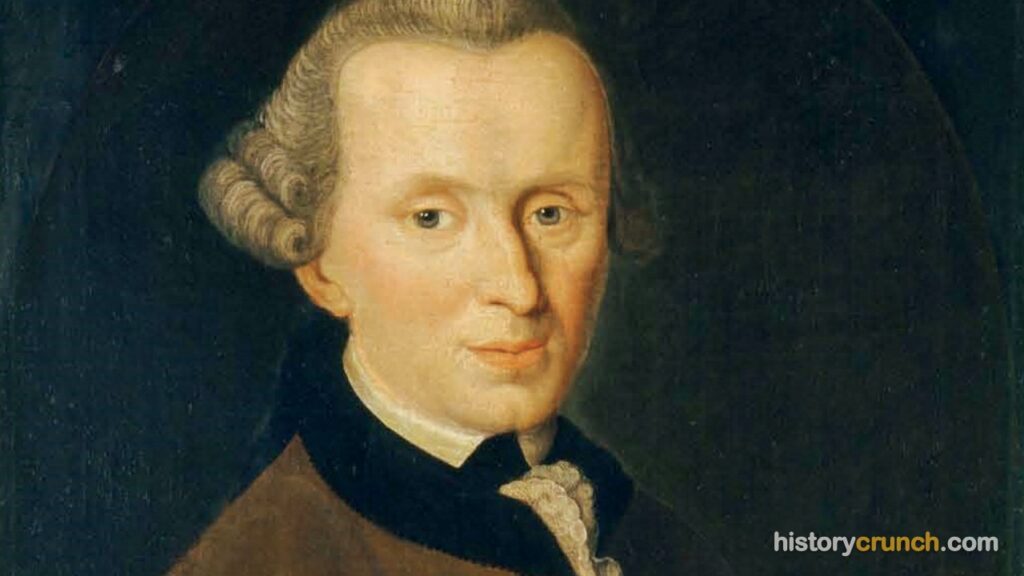
Immanuel Kant is widely regarded as one of the most important philosophers in the history of the Western world, and his ideas shaped nearly every field of philosophy that came after him. A leading thinker of the Age of Enlightenment, he lived during the 18th century and worked to answer some of the biggest questions a person can ask, such as what people can truly know, how they should act, and what makes an action right or wrong. Kant spent almost his entire life in a single city in Prussia, yet his writings reached across Europe and changed the direction of modern thought.
Kant was a German philosopher who tried to bridge two competing ideas about knowledge. On one side stood rationalism, the belief that reason alone is the main source of knowledge. On the other side stood empiricism, the belief that knowledge comes mainly from experience and the senses. Kant argued that both play a role, claiming that the mind actively shapes the raw information gathered by the senses. His careful system of thought became known as his “critical philosophy.”
Early Life and Background
Immanuel Kant was born on April 22nd, 1724, in Königsberg, near the southeastern shore of the Baltic Sea. During his lifetime Königsberg was the capital of East Prussia, and its main language was German. Today the city has a different name and belongs to Russia. Kant lived nearly his whole life in and around this one city, rarely traveling far from home.
Kant grew up in a modest and deeply religious household. His parents were Pietist Lutherans, and his father earned a modest living as a maker of harnesses and saddles. Pietism was a strict form of Lutheran Christianity that stressed personal faith, honesty, and hard work. This upbringing emphasized virtues such as truthfulness and order, values that stayed with Kant for the rest of his life.
Kant showed unusual talent as a student at a young age. He had the opportunity to further his education thanks to a priest who recognized his early intellectual talent. More specifically, he first attended a well-known Pietist school in the city before moving on to higher study. In 1740, at the age of 16, he enrolled at the University of Königsberg, where he would later remain for the rest of his professional life.
Rise as a Scholar
Kant’s path to becoming a famous philosopher was slow and difficult. His family did not have much money, and he could not immediately begin a paid academic career after finishing his studies. In fact, Kant worked as a family tutor for nine years before he finished university, teaching the children of wealthy households in the countryside around Königsberg.
After returning to the university, Kant began to lecture on many subjects. He worked for 15 years as a Privatdozent, or lecturer, at the University of Königsberg until he was appointed to the chair of logic and metaphysics. The word Privatdozent describes a teacher who was paid directly by students rather than by the university itself. During these years he taught topics ranging from logic and physics to geography, and he earned a reputation as a lively and popular teacher.
Even before his most famous works appeared, Kant lived a full and active life. Though he never married, he seems to have had a rewarding social life, and he was a popular teacher as well as a modestly successful author. As stated above, his rise was gradual, and his greatest ideas would only come once he reached his fifties.
Major Achievements
Kant’s most important achievement was a series of books that reshaped how people understood knowledge, morality, and beauty. His most famous work, the Critique of Pure Reason, was published in 1781 and revised in 1787. In this book, he studied the limits of human knowledge and asked what the mind can truly understand about the world.
The central idea of the Critique of Pure Reason was that the human mind is not simply a blank page that records the world. Instead, Kant argued that the mind actively organizes and shapes the information gathered through the senses. He distinguished between things as they are in themselves and things as they appear to people, contending that true knowledge is confined to human experience. In other words, people can never know reality perfectly, only the way it appears through the structures of the mind.
Kant is often said to have carried out a “Copernican revolution” in philosophy. Just as the astronomer Nicolaus Copernicus had shown that the Earth moves around the Sun rather than the reverse, Kant flipped the usual view by suggesting that the mind shapes the world it experiences rather than simply copying it. This synthesis of rationalism and empiricism set the terms for much of nineteenth and twentieth century philosophy.
Kant then turned his attention to questions of right and wrong. He continued with two more great works, the Critique of Practical Reason in 1788 and the Critique of the Power of Judgment in 1790. Together with the first Critique, these three books formed the heart of his critical philosophy. The second book focused on morality, while the third explored beauty and the natural world.
One of Kant’s most famous ideas is the categorical imperative, a rule he used to test whether an action is moral. In Kant’s view, the sole feature that gives an action moral worth is not the outcome that is achieved, but the motive behind it, and the only motive that can give an act moral value is one that arises from universal principles discovered by reason. More specifically, he taught that a person should only act on a rule that they would be willing to see everyone else follow as a universal law.
Kant also argued that people should always be treated with dignity. His ethical philosophy introduced the concept of the categorical imperative, which posits that moral actions are those that could be universally applied. He insisted that human beings should be treated as ends in themselves and never used simply as tools for someone else’s purposes. This idea became a foundation for modern thinking about human rights.
In 1784, Kant wrote a short essay called “What Is Enlightenment?” that spoke to the spirit of his age. The essay belongs to Kant’s most fruitful period, and unlike most of his philosophical works, it is written in non-technical language for a general audience. In it, he famously summed up the motto of the Enlightenment with the phrase “Dare to know,” urging people to have the courage to use their own reason instead of blindly following others.
Later Life
Kant remained hard at work well into his later years. Among the twenty or so books and treatises composed during this time were influential works on rational theology and ethics and on political theory, including the famous essay Perpetual Peace of 1795, in which Kant proposed the creation of a federation or league of nations as a way to prevent international conflict. This idea would later inspire real efforts to build organizations that keep peace between countries.
Kant’s daily life was famous for being extremely regular and orderly. One observer noted that his life was orderly to the point of caricature, and locals in Königsberg were even said to set their timepieces by his daily walks. This steady routine helped him produce an enormous amount of writing over many decades.
As Kant grew old, his health and mental sharpness began to decline. His powers began to fail in his last years, and he gave up lecturing in 1799, slowly fading away as he lost his eyesight and clarity. He suffered from senile dementia in his later years, and he died in Königsberg on February 12th, 1804, and was entombed in the city’s cathedral. Almost all of Königsberg and many people from all over Germany attended his funeral.
Significance of Immanuel Kant
Immanuel Kant is considered one of the most important philosophers of the modern world, and his influence remains powerful today. His comprehensive and systematic work in epistemology, ethics, and aesthetics greatly influenced all subsequent philosophy, especially the various schools of Kantianism and idealism. In reality, few thinkers have shaped so many different fields at once.
Kant’s importance comes in part from the way he settled a long argument that had divided earlier thinkers. His critical philosophy showed that there was a defensible middle ground between the two extremes of empiricism and rationalism, which had before fractured philosophy. By combining the two views, he offered a new way to understand how people gain knowledge.
Kant’s ideas about morality and human dignity also had a lasting effect on the world. His belief that every person deserves respect and that moral rules should apply equally to everyone helped shape later ideas about human rights, law, and government. His essay Perpetual Peace inspired thinking about cooperation between nations that continued long after his death.
Finally, Kant stands as a symbol of the Enlightenment itself. In his essay on Enlightenment, he argued that the movement was about thinking for oneself rather than letting others think for you, and he expressed faith in the idea of steady human progress. This confidence in reason and independent thought remains one of the most important legacies of his life and work.
Frequently Asked Questions
Who Was Immanuel Kant?
Immanuel Kant was a German philosopher of the 18th century who is regarded as one of the most important thinkers in Western history. He is best known for developing a system of “critical philosophy” that explored what people can know and how they should act. He spent almost his entire life in the city of Königsberg in East Prussia.
What Is the Categorical Imperative?
The categorical imperative is Kant’s rule for deciding whether an action is moral. It says that a person should only act on a rule that they would be willing to see turned into a universal law that everyone follows. This idea places importance on duty and reason rather than on the results of an action.
What Books Did Immanuel Kant Write?
Kant’s three most famous books are the Critique of Pure Reason, the Critique of Practical Reason, and the Critique of the Power of Judgment. He also wrote the widely read short essay “What Is Enlightenment?” and the political work Perpetual Peace. Together these writings shaped the study of knowledge, morality, and beauty.
Why Is Immanuel Kant Important?
Kant is important because his ideas influenced nearly every branch of modern philosophy. He found a middle path between rationalism and empiricism and created new ways of thinking about knowledge and morality. His work on human dignity also helped lay the foundation for modern ideas about human rights.
Where Did Immanuel Kant Live?
Kant lived nearly his entire life in Königsberg, the capital of East Prussia. He was born there in 1724, studied and taught at its university, and died there in 1804. The city is now called Kaliningrad and is part of Russia.
Cite This Article
To cite this article as a source, use one of the formats below.
MLA: Millar, B. “Immanuel Kant: A Detailed Biography.” HistoryCrunch, 9 August 2026, https://historycrunch.com/immanuel-kant/.
APA: Millar, B. (2026). Immanuel Kant: A Detailed Biography. HistoryCrunch. https://historycrunch.com/immanuel-kant/
Chicago: Millar, B. “Immanuel Kant: A Detailed Biography.” HistoryCrunch. August 9, 2026. https://historycrunch.com/immanuel-kant/
Sources
- Jerry Bentley & Herbert Ziegler, Traditions & Encounters: A Global Perspective on the Past.
- J.M. Roberts & Odd Arne Westad, The Penguin History of the World.