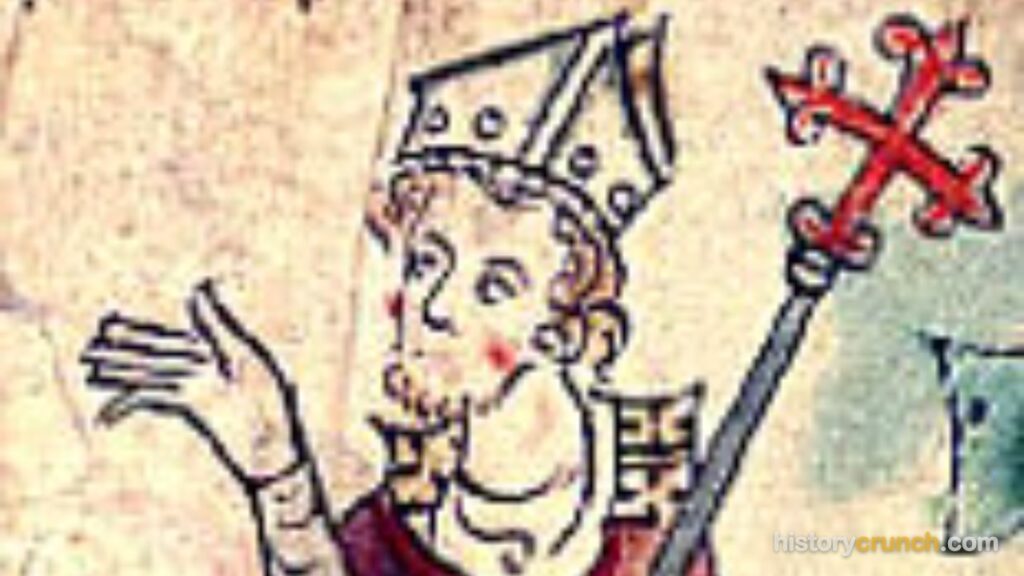
Thomas Becket was one of the most important religious figures of the Middle Ages in England, and his violent death made him one of the most famous saints in all of Europe. He served as Archbishop of Canterbury during the reign of King Henry II, and his long quarrel with the king over the power of the church ended in his murder inside Canterbury Cathedral. That murder shocked people across the medieval world and turned Becket into a martyr whose shrine drew pilgrims for centuries. His life is closely tied to the history of Medieval England and to the ongoing struggle between kings and the church.
An archbishop was the most senior bishop in a large region of the church, and the Archbishop of Canterbury was the highest church official in all of England. This made Becket second in importance only to the pope when it came to religious matters in the kingdom. Because the church and the crown both claimed authority over people and land, the man who held this office often found himself in conflict with the king.
Early Life and Background
Thomas Becket was born around 1120 in Cheapside, a busy district of London. His parents, Gilbert and Matilda, had moved to England from Normandy, and Gilbert was a prosperous merchant, so Becket had a comfortable childhood. Growing up in one of the largest and most crowded cities in the kingdom gave the young Becket an early view of trade, law, and city life.
Becket received a solid education for his time. He first studied at Merton Priory in England before traveling to Paris to continue his learning. When he returned to England, he found work as a clerk in London before joining the household of Theobald, the Archbishop of Canterbury. In fact, this position placed him at the very center of church affairs in England.
Becket was a tall, intelligent young clerk with a magnetic personality who made friends easily, and his remarkable memory and business ability brought him to the attention of the Archbishop of Canterbury. Theobald came to trust him and sent him on important errands, including trips to Rome. This experience gave Becket valuable training in the law and politics of the church.
Rise to Power
Becket’s talents soon brought him to the attention of the king. In 1154, Henry II came to the throne of England and began working to strengthen royal power after years of civil war. Needing a capable and loyal assistant, the king chose Becket, and the two men quickly became close. People even said that the two men “had but one heart and one mind.”
With the archbishop’s recommendation, King Henry II agreed to make Thomas Chancellor of England, a post he held for eight years. The chancellor was one of the most powerful officials in the kingdom, in charge of documents, records, and much of the day to day running of government. As chancellor, Becket served the king faithfully and helped carry out royal policy across England and Henry’s lands in France.
Becket lived a grand and expensive life during these years. Thomas loved his life, spending his money on lavish clothes, extravagant entertainment, hunting parties, and good times. His extravagance was most evident on his trip to Paris in 1158, when he traveled with 250 servants and 24 changes of clothes in his wardrobe. More specifically, he became one of the richest and most influential men in the kingdom, and he even led soldiers on the king’s behalf during military campaigns.
Archbishop of Canterbury
When Archbishop Theobald died, Henry saw a chance to gain even more control over the church. In an unexpected move, Henry nominated Becket as Archbishop of Canterbury, and he was consecrated in a grand ceremony in Canterbury Cathedral on June 3rd, 1162. The king expected that his close friend would help him bend the church to the crown’s wishes.
Instead, Becket changed dramatically once he became archbishop. He gave up his rich lifestyle and began to live simply, and he became a firm defender of the rights of the church against the king. In reality, Becket had warned Henry before taking the job that his loyalty would shift once he served the church, and this warning soon proved true.
This change surprised and angered the king, who had hoped for cooperation. Henry felt that he had raised a trusted servant to the highest church office only to find a stubborn opponent standing in his way. As a result, the friendship between the two men began to break down, and the stage was set for a long and bitter conflict.
Conflict With Henry II
The main dispute between Henry II and Becket concerned the courts. The conflict had to do with the jurisdiction of the secular and church courts, because Henry II was dedicated to legal reform and sought to make his reformed royal system override the church courts. The most heated argument was over what was called “benefit of clergy,” which allowed clergymen accused of crimes to be tried in gentler church courts rather than the king’s courts.
In 1164, Henry tried to settle the matter with a written set of rules. He summoned the leading bishops and nobles to Clarendon to define, as he saw it, the traditional rights of the English crown, and the result was sixteen clauses known as the Constitutions of Clarendon, which he presented as a restoration of the customs observed by earlier kings. These rules limited the power of church courts and reduced the ability of English clergy to appeal to the pope in Rome.
After Henry II presented the articles, the English bishops, led by Becket, reluctantly agreed to the Constitutions of Clarendon, but when Pope Alexander III condemned them, Becket renounced his agreement. This reversal enraged the king and turned the dispute into open warfare between the two former friends. Henry then summoned Becket before the great Council of Northampton in October 1164 to answer accusations that he had abused his position as chancellor.
Fearing for his safety, Becket fled the kingdom. He voluntarily went into exile in November and took refuge in France, and although Henry II sent envoys asking the pope to take action against Becket, Pope Alexander III refused to help the king and lent his support to the archbishop. Becket would remain in exile for about six years.
Return and Murder
The two sides eventually reached an uneasy truce. In December of 1170, Becket returned to England when the king allowed him to continue his ministry in the kingdom. The peace did not last, however, because Becket had angered Henry by punishing bishops who had taken part in the crowning of the king’s son without his permission.
According to a famous story, Henry lost his temper and spoke angry words about the archbishop within earshot of his knights. Whether or not he meant it as an order, four knights took his words as a command to act. Becket was killed in Canterbury Cathedral by four knights loyal to Henry, named Reginald Fitzurse, Hugh de Morville, Richard Brito, and William de Tracy, who had planned to arrest him on behalf of the king.
On December 29th, 1170, the knights attempted to arrest Becket, but he refused, and when he sought refuge in the church, the knights pursued him and burst into the cathedral with swords drawn. They then struck the archbishop down inside the holy building. The murder of an archbishop within his own cathedral was seen as a terrible crime against both God and the church.
Sainthood and Aftermath
The murder caused outrage across Europe. The death of Thomas Becket sent shockwaves through England and beyond, his murder was quickly condemned, Henry expressed his sorrow at what had taken place, and people soon flocked to Canterbury, many believing Becket’s blood possessed the power to heal the sick. Stories of miracles at his tomb spread quickly.
Three years later, the pope made Becket a saint following reports of miracles at his tomb. The king also paid a heavy price for his connection to the crime. The four knights responsible for the murder were excommunicated, and in 1174 Henry walked barefoot to Canterbury Cathedral in penance.
The dispute over the courts ended in a partial victory for the church. After Becket’s murder in 1170, Henry conceded the benefit of clergy, but not other points at issue. In fact, after the murder Henry revoked the two most controversial clauses, but the rest of the Constitutions remained in effect and were integrated into the common law of England.
Significance of Thomas Becket
Thomas Becket is remembered as one of the most important religious figures of the Middle Ages. He is best known as a defender of church authority in England, who defied King Henry II and paid the price of martyrdom. His story became a powerful symbol of the struggle between kings and the church over who held the greater authority.
His shrine at Canterbury became one of the most famous holy sites in all of Europe. The shrine was a popular pilgrimage site throughout the medieval period until it was destroyed during the Reformation, and people still visit Canterbury Cathedral today to stand in the place where history happened. The journey of pilgrims to his tomb later inspired one of the most famous works of English literature.
Becket’s death also shaped how kings and the church dealt with one another for generations. The dramatic clash showed the limits of royal power when a ruler tried to control the church too tightly. As stated above, even though Henry kept many of his legal reforms, the murder forced him to back down on his boldest claims, and it reminded future kings of the dangers of open conflict with the church.
Frequently Asked Questions
Who was Thomas Becket?
Thomas Becket was the Archbishop of Canterbury who was murdered in 1170 after a long quarrel with King Henry II of England. He had first served as the king’s chancellor and close friend before becoming the leading churchman in England. After his death he was declared a saint and became one of the most honored martyrs of the Middle Ages.
Why did Thomas Becket and Henry II become enemies?
They became enemies because Becket defended the power of the church after Henry expected him to support the crown. Once Becket became archbishop, he refused to let the king control church courts or reduce the authority of the pope. Their disagreement was made worse by the fact that they had once been close friends, which made the betrayal feel personal to Henry.
How did Thomas Becket die?
Thomas Becket was killed by four knights inside Canterbury Cathedral on December 29th, 1170. The knights believed they were acting on the wishes of King Henry II, who had spoken angry words about the archbishop. They struck Becket down near the altar after he refused to leave the church with them.
Why is Thomas Becket a saint?
Thomas Becket was made a saint because he was seen as a martyr who died defending the church. Just three years after his murder, the pope declared him a saint, partly because of reports of miracles at his tomb. His willingness to die rather than give in to the king made him a hero to many people in the medieval church.
What were the Constitutions of Clarendon?
The Constitutions of Clarendon were a set of sixteen rules issued by Henry II in 1164 to limit the power of the church. They aimed to bring clergymen accused of crimes under the king’s courts and to reduce appeals to the pope in Rome. Becket’s refusal to fully accept these rules was one of the main causes of his deadly conflict with the king.
Cite This Article
To cite this article as a source, use one of the formats below.
MLA: Millar, B. “Thomas Becket: A Detailed Biography.” HistoryCrunch, 26 July 2026, https://historycrunch.com/thomas-becket/.
APA: Millar, B. (2026). Thomas Becket: A Detailed Biography. HistoryCrunch. https://historycrunch.com/thomas-becket/
Chicago: Millar, B. “Thomas Becket: A Detailed Biography.” HistoryCrunch. July 26, 2026. https://historycrunch.com/thomas-becket/
Sources
- Jerry Bentley & Herbert Ziegler, Traditions & Encounters: A Global Perspective on the Past.
- J.M. Roberts & Odd Arne Westad, The Penguin History of the World.