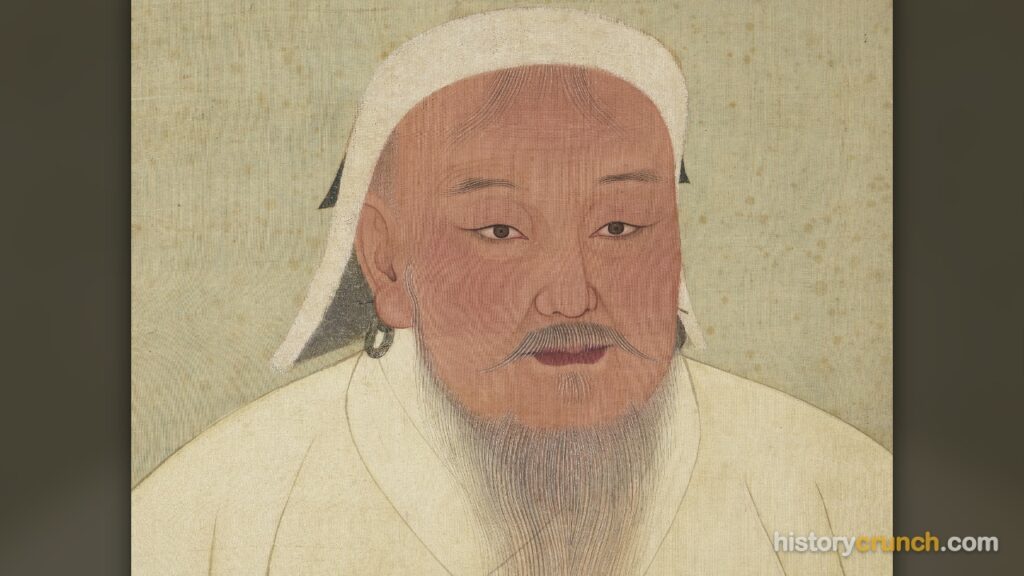
Genghis Khan is remembered as one of the most important conquerors in world history, a leader who rose from a harsh childhood on the grasslands of Central Asia to build the largest connected land empire the world has ever seen. Born with the name Temujin, he united the scattered nomadic tribes of the Mongolian steppe and turned them into a disciplined fighting force that swept across Asia. The Mongol leader rose from humble beginnings to establish the largest land empire in history, and after uniting the nomadic tribes of the Mongolian plateau, he conquered huge parts of central Asia and China. His life and campaigns marked the beginning of the Mongol Empire and reshaped the map of the medieval world.
The name Genghis Khan is actually a title rather than a birth name. The Mongol Empire was founded in 1206, when Temujin, the son of a chieftain, assumed power and changed his name to Chinggis Khan, styled as “Genghis Khan” in the West and meaning “universal ruler.” A khan was a supreme ruler of the Mongol tribes, so the title signaled that Temujin now stood above all other chiefs of the steppe. Throughout his reign he combined ruthless warfare with careful organization, which is why he is studied both as a feared destroyer and as a skilled state builder.
Early Life and Background
Temujin was born around 1162 in the borderlands between modern Mongolia and Siberia, a land of open grassland where rival nomadic tribes constantly fought one another. Temujin was born in 1162 near the border of Mongolia and Siberia, and his early life was marked by a series of hardships, for the region he lived in was treacherous, with rival nomadic tribes constantly battling for dominance. He was the oldest son of a tribal leader, which gave his family noble ties, but that status did not protect him from disaster.
His childhood turned tragic while he was still very young. Before he turned ten, his father was poisoned, and following this, Temujin’s own tribe abandoned his family, unwilling to share their resources with him, his mother, and his six siblings. Left to survive on the open steppe, the family faced starvation and had to live off roots, fish, and small game. These years of hardship shaped Temujin into a determined and self-reliant leader.
His path to power was violent from the start. Facing starvation, Temujin killed his half-brother in a power struggle and assumed responsibility as head of the family. He also endured capture and enslavement by a rival clan before managing to escape, an ordeal that taught him hard lessons about loyalty and survival. As a young man he married a woman named Borte, and when she was kidnapped by an enemy tribe, he mounted a daring rescue that helped build his reputation as a warrior worth following.
Rise to Power
Temujin understood that no single warrior could unite the steppe alone, so he built his strength through alliances. He made a blood brotherhood, called an anda in the Mongol language, with a fellow young leader named Jamukha, and he cultivated the support of Toghrul, the powerful khan of the Kerait tribe who had once been a sworn friend of his father. Temujin cultivated a relationship with Toghrul, khan of the powerful Kerait tribe, who had been a sworn friend of his father, and Toghrul provided crucial military backing during Temujin’s early campaigns.
Over time, the friendship between Temujin and Jamukha collapsed into rivalry, because the two men had very different visions for the future. Jamukha favored the traditional Mongol aristocracy and sought to maintain the existing tribal divisions, while Temujin envisioned a more centralized and meritocratic system. This clash of ideas led to years of warfare between the former friends. Temujin was even defeated badly at one point, yet he regrouped and slowly gained ground.
One reason for his success was a bold reorganization of his army. He divided his soldiers into units of 10, 100, 1,000, and 10,000, a system that let him command his forces with far greater precision. More specifically, he deliberately mixed men from different tribes within each unit, which broke down old rivalries and made every soldier loyal to Temujin rather than to a clan chief. He also made a habit of executing the aristocrats of defeated tribes while absorbing the ordinary warriors into his own ranks, steadily growing his power.
By the early 1200s, Temujin had defeated Toghrul and the Keraits, crushed the Naiman tribe, and finally overcome Jamukha, who was handed over by his own men and executed. After defeating the Naiman tribe and executing Jamukha, Temujin was left as the sole ruler on the Mongolian steppe. The way was now clear for him to be recognized as the undisputed leader of all the Mongols.
That recognition came at a grand assembly of chiefs. In 1206, a kurultai, a grand council of Mongol chiefs and leaders, proclaimed Temujin as Genghis Khan, meaning “Universal Ruler,” and this was the pivotal moment, for the first time the nomadic tribes of the Mongolian steppe were united under a single political authority. The gathering is widely regarded as the official birth of the Mongol Empire.
Major Achievements
Once he held power, Genghis Khan reshaped Mongol society from top to bottom. He reorganized steppe society from the ground up, breaking apart old tribal loyalties by reassigning people into new military and administrative units, ensuring that loyalty flowed to him rather than to traditional clan leaders. He also gave the Mongols tools they had never had before as a united people, which strengthened his growing state.
In fact, several of his reforms outlasted his conquests. Genghis Khan had a fearsome reputation but he was an able administrator who introduced writing to the Mongols, created their first law code, promoted trade, and granted religious freedom by permitting all religions to be freely practiced anywhere in the Mongol world. He also set up a fast messenger service that carried news across huge distances, and he made rules against practices such as the theft of property and the selling of women. These policies helped hold a sprawling empire together.
His military campaigns were equally sweeping. Genghis Khan attacked the Xi Xia and Jin states and then Song China, and in the other direction his fast-moving armies invaded Persia, Afghanistan, and even Russia. His first major target was the Tangut kingdom of Xi Xia along the northwestern border of China, which agreed to Mongol terms, followed by campaigns against the Jin dynasty that led to the capture of Beijing.
The Mongol army was successful partly because of its brutal cleverness. Genghis Khan embraced the use of spies, devised coordinated attacks, and ensured his soldiers were well prepared, carrying not only weapons but also spare food and clothing for long campaigns, and he often used psychological warfare to intimidate his enemies. He was willing to let a few survivors flee a captured city so they would spread terrifying stories, causing other towns to surrender without a fight. When cities did resist, however, the slaughter could be enormous.
One of his most famous campaigns was against the wealthy Khwarazmian Empire in Central Asia and Persia. After Khwarazmian officials killed Mongol traders and envoys, Genghis Khan responded with a devastating invasion that destroyed great cities and left a lasting memory of terror. As stated above, this westward push carried Mongol armies as far as the Caspian Sea and into southern Russia.
Later Life and Death
Even in his final years, Genghis Khan remained on campaign. His last major war returned him to the Tangut kingdom of Xi Xia, whose rulers had defied his orders and refused to send troops to help him. One of Genghis Khan’s last campaigns took place in 1227 in what is now China, where the Tanguts of Xi Xia had defied his orders and were in open revolt. His revenge was swift and merciless, and the Xi Xia state was effectively wiped out.
He did not live to see the very end of that campaign. Genghis Khan died in 1227 during a military campaign against the Chinese kingdom of Xi Xia, and his final resting place remains unknown. According to Mongol tradition, his burial was kept secret, and later legends claim that those who witnessed the funeral procession were killed to protect the location. To this day the site has never been found.
His death did not stop the empire he had created. His son Ogodei was chosen to lead the empire in 1229, and the empire now stretched from the Caspian Sea in the west to the China Sea in the east and from Siberia in the north to Tibet in the south. Under his sons and grandsons, the Mongols pushed even farther into Europe, the Middle East, and China.
Significance of Genghis Khan
Genghis Khan’s greatest legacy was the empire itself, which reached a size never matched by any other connected land power. Genghis Khan’s empire became the largest contiguous land empire ever, stretching from the Pacific Ocean to Eastern Europe, and at its height the Mongol Empire encompassed much of present-day Russia, the Middle East, and Central Asia. His descendants expanded it even further, until it covered roughly 9 million square miles (23 million sq km).
He is also remembered for a mix of destruction and lasting order. Many people were slaughtered in the course of Genghis Khan’s invasions, but he also granted religious freedom to his subjects, abolished torture, encouraged trade, and created the first international postal system. Because of the millions of deaths caused by his conquests, he is viewed as a dark and frightening figure across much of Asia, even as he is honored as a national hero and founding father in Mongolia today.
In reality, his influence stretched well beyond warfare. Genghis Khan built the foundations of an empire which would, under his successors, ultimately control one-fifth of the globe. By linking together vast regions of Eurasia, his empire made the trade routes of the Silk Road safer and helped goods, ideas, and technologies travel between East and West on a scale never seen before. That exchange, along with his image as one of history’s most brilliant and feared military leaders, keeps Genghis Khan at the center of world history.
Frequently Asked Questions
What does the name Genghis Khan mean?
The name Genghis Khan is a title that is usually translated as “universal ruler” or “oceanic ruler.” His birth name was actually Temujin, and he only took the new title in 1206 when the Mongol chiefs recognized him as their supreme leader. The spelling “Genghis Khan” is the Western version of the Mongol title Chinggis Khan.
How did Genghis Khan die?
Genghis Khan died in 1227 while leading a campaign against the kingdom of Xi Xia in what is now China. The exact cause of his death is uncertain, and stories over the centuries have suggested illness, injuries from a fall off a horse, or wounds from battle. What is clear is that he was buried in secret, and his tomb has never been located.
Why was the Mongol army so powerful?
The Mongol army was powerful mainly because of its speed, discipline, and organization on horseback. Genghis Khan’s soldiers were expert riders and archers who could travel long distances quickly and shoot accurately while moving. They also learned siege techniques from the peoples they conquered, allowing them to break through the walls of fortified cities.
How big did the Mongol Empire become?
The Mongol Empire eventually became the largest connected land empire in history, covering about 9 million square miles (23 million sq km). It stretched from the Pacific coast of Asia in the east to Eastern Europe in the west. Most of this growth happened under Genghis Khan’s sons and grandsons after his death in 1227.
Is Genghis Khan seen as a hero or a villain?
Genghis Khan is seen very differently depending on where the question is asked. In Mongolia he is celebrated as a national hero and the founder of the nation, and his image appears on money and public monuments. In many other parts of Asia and the Middle East, however, he is remembered as a brutal conqueror whose armies destroyed cities and caused millions of deaths.
Cite This Article
To cite this article as a source, use one of the formats below.
MLA: Millar, B. “Genghis Khan: A Detailed Biography.” HistoryCrunch, 26 July 2026, https://historycrunch.com/genghis-khan/.
APA: Millar, B. (2026). Genghis Khan: A Detailed Biography. HistoryCrunch. https://historycrunch.com/genghis-khan/
Chicago: Millar, B. “Genghis Khan: A Detailed Biography.” HistoryCrunch. July 26, 2026. https://historycrunch.com/genghis-khan/
Sources
- Jerry Bentley & Herbert Ziegler, Traditions & Encounters: A Global Perspective on the Past.
- J.M. Roberts & Odd Arne Westad, The Penguin History of the World.