Aztec housing was an important part of the overall culture and daily life of the people in the Aztec Empire. In fact, the type of home a family lived in revealed a great deal about their place in Aztec society, since the size, shape, and materials of a house all depended on a family’s wealth and social class. Homes ranged from simple one-room dwellings made of sun-dried mud brick to large stone palaces with courtyards, gardens, and dozens of rooms. Because the Aztec spent much of their time working outdoors, most homes were built mainly as places to sleep, eat, and store belongings.
Aztec housing refers to the buildings and homes in which the Aztec people lived, along with the materials, layouts, and features that made up those dwellings. The word covers everything from the modest adobe huts of farmers and commoners to the grand multi-room homes of nobles, as well as shared features such as family shrines, kitchens, and steam baths. Studying these homes offers a clear window into how the Aztec organized their families, their neighborhoods, and their strict social classes.
What Was the Aztec Empire?
The Aztec Empire was one of the most powerful civilizations in the ancient Americas, based in central Mexico and stretching across much of the region at its height. The Aztec people, who called themselves the Mexica, thrived in the time before the arrival of European explorers during the Age of Exploration. Throughout their history, they expanded across central Mexico and surrounding areas to become the most dominant and powerful people in the region.
The Aztec founded their capital city of Tenochtitlan in 1325 on an island in Lake Texcoco, and it grew into one of the largest cities in the world at the time. More specifically, the empire grew out of the Aztec Triple Alliance, a political and military pact formed in 1428 between Tenochtitlan and the city-states of Texcoco and Tlacopan. It was ruled by a series of leaders known as the huey tlatoani, or Great Speaker. The empire came to an end in 1521 when Spanish conquistadors, allied with rival Mesoamerican city-states, conquered Tenochtitlan.
Aztec society was rich in culture, religion, architecture, and warfare. It was also highly stratified, meaning it was divided into distinct social classes with clear differences between them. This division shaped nearly every part of daily life, including the food people ate, the clothing they wore, and the homes in which they lived.
How Did Social Class Shape Aztec Homes?
In the Aztec Empire, the type of home a family lived in was one of the clearest signs of their status. The Aztec kept sharp differences between social classes, and these rules extended to housing. For instance, commoners, who were known as the macehualtin, lived in small and simple homes, while nobles, who were called the pipiltin, lived in larger and finer dwellings. It was important in Aztec society that a person’s rank could be recognized easily, and homes helped make that rank visible.
The nobles made up only a small fraction of the empire’s population, but they were allowed to decorate their homes lavishly. In contrast, commoners were permitted very little decoration. Rules were strict enough that certain features were reserved only for the upper classes. For example, two-story homes were generally allowed only for nobles and high-ranking warriors, and a commoner who built one could face harsh punishment.
Even the location of a home reflected status. Generally speaking, the closer a house sat to the main temple at the center of the city, the grander it tended to be. Nobles and warriors often lived near the temple and the main square, while commoners and workers lived in homes scattered toward the edges of the city.
What Were Aztec Commoner Homes Like?
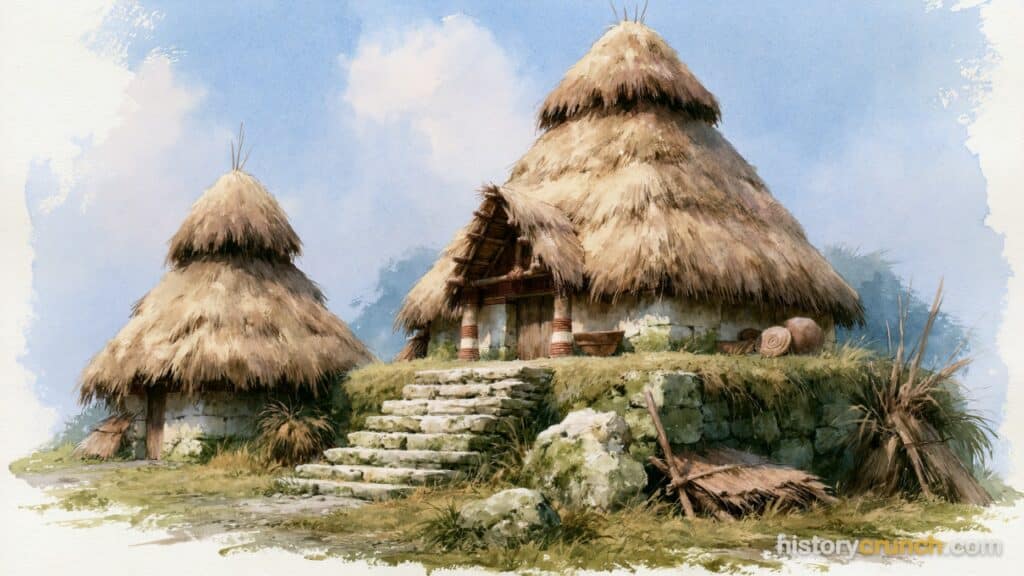
Most Aztec people lived in modest homes, and the typical commoner house was small and practical. In general, these homes were around 160 to 270 square feet (15 to 25 square meters) in size, with one floor and no windows. Many contained a single large room, sometimes with one or two smaller rooms attached. The main room served as the place where the whole family slept, ate, worked, and prayed.
Most simple homes were built of adobe, which is a type of brick made from a mix of mud, sand, water, and straw that is dried in the sun. In some regions, builders used wattle and daub instead, which involved weaving wooden strips together and covering them with plaster. Floors were often just packed earth, and roofs were commonly thatched with straw or plant stalks. In towns, the outside walls were frequently whitewashed with lime so the homes would reflect sunlight and stay cool.
Inside, furniture was simple and sparse. Families slept on reed mats, stored clothing in wooden or leather chests, and gathered at low tables for meals or small tasks. At the heart of the home was the hearth, a fire pit used for cooking that also held religious meaning, since the Aztec connected it to the god of fire. Interestingly, most homes did not have doors, and valuables were left with little protection. Theft was rare, in part because Aztec laws were extremely harsh, with serious robbery sometimes punished by death.
What Were Aztec Noble Homes Like?
Aztec nobles lived in homes that followed a similar layout to commoner houses but were far larger, stronger, and more elaborate. These homes were often built of better materials, such as cut stone and lime plaster, rather than plain adobe and packed earth. In fact, the floors and walls of noble homes were commonly covered with smooth white lime plaster, and the stonework used carefully cut stones instead of the rough river cobbles found in poorer houses.
A common feature of noble homes was a central courtyard, around which the many rooms of the house were arranged. These courtyards often held flower and vegetable gardens, and sometimes a fountain. Gardens were very important to the Aztec, who loved flowers, and wealthy families could afford large and beautiful ones. Some noble homes had peaked roofs, while others had flat or even terraced roofs that could hold a garden.
At the very top of society stood the palaces of the emperor and the highest nobles. These were sprawling structures with many rooms, and the grandest included botanical gardens and even a zoo. As stated above, only the upper classes could build upward, so noble compounds sometimes rose to two stories, a clear marker of their wealth and rank.
How Were Aztec Homes Grouped Together?
Aztec homes were rarely built in isolation. More often, families lived in a neighborhood unit called a calpulli, which functioned somewhat like a clan. A calpulli was a group of related families who lived close together, sometimes as a single large extended family and sometimes as several neighboring families. A smaller calpulli might include only ten to twenty houses.
Within a calpulli, families commonly arranged a handful of homes around a shared central courtyard. The Nahuatl term for those who lived this way meant “those in one yard,” and the patio was where much of the day’s work took place. For instance, families gathered there to grind corn, prepare food, and let children play. Because so much land in the city was also used for growing crops, homes were not packed tightly together.
A calpulli contained far more than just houses. In reality, it often included schools for the neighborhood’s children, temples, markets, and sometimes even a ball court. The calpulli also served as a unit of government. The Aztec state assigned each calpulli to a member of the ruling class, who oversaw its administration and the collection of taxes.
What Was the Temazcalli or Steam Bath?
One feature nearly every Aztec home shared, from the humblest hut to the grandest palace, was the steam bath. This structure was called the temazcalli, a Nahuatl word meaning “house to sweat.” It was usually a small, low building set apart from the main house, often shaped somewhat like a dome with a small, low doorway that helped keep the heat inside.
The steam bath worked by heating a wall with a fire and then pouring water against the hot surface to create steam. The Aztec were known for being very clean, and their doctors believed everyone should have access to a steam bath for both health and cleanliness. As a result, the temazcalli was a place to relax and heal, and it was also used for religious purposes. This love of the steam bath was one of the few things shared by every level of Aztec society.
Significance of Aztec Housing
The significance of Aztec housing lies in what it reveals about the structure of Aztec society as a whole. More specifically, the sharp contrast between the tiny adobe homes of commoners and the stone palaces of nobles shows just how deeply the Aztec divided their people into classes. Laws that reserved certain features, such as second stories and lavish decoration, for the upper classes made these divisions permanent and visible to everyone.
Aztec homes also reveal how families and neighborhoods were organized. The calpulli tied households together into communities that shared work, worship, schooling, and government, showing that the home was not just a private space but part of a larger system. In this way, housing connected the daily life of ordinary families to the running of the entire empire.
Finally, Aztec housing highlights the values and skills of the civilization. The whitewashed walls, careful stonework, and courtyard gardens reflect Aztec craftsmanship and their love of nature, while the shared steam bath reveals a strong culture of cleanliness. Because no complete homes survive today, and only foundations remain, these dwellings remain one of the best clues we have to how the Aztec people actually lived.
Frequently Asked Questions
What were Aztec houses made of?
Most Aztec houses were made of adobe, a brick formed from mud, sand, water, and straw that was dried in the sun. Some builders used wattle and daub, made from woven wooden strips covered in plaster, while wealthier families and nobles used cut stone and lime plaster. Roofs were usually thatched with straw or plant stalks, though noble homes sometimes had flat or terraced roofs.
Did Aztec homes have doors and windows?
Most Aztec homes had no windows and often no solid doors, with a cloth hanging sometimes covering the doorway instead. The lack of secure doors was possible because theft was rare in Aztec society, partly due to very strict laws and severe punishments. Without windows, homes were dark inside and lit mainly by the central fire or small torches made of pine resin.
What is a calpulli in the Aztec Empire?
A calpulli was a neighborhood unit made up of a group of related families who lived close together and shared a central courtyard. It functioned like a clan, offering mutual aid to its members, and often contained schools, temples, and markets. The calpulli also served as a unit of government, since the Aztec state used it to organize taxes and administration.
Why did Aztecs whitewash their homes?
Aztecs whitewashed the outer walls of their homes with lime so the houses would reflect sunlight and stay cooler inside. This was especially common in towns and cities, where homes were built closer together. The bright white surfaces also gave neighborhoods a clean and orderly appearance.
Do any Aztec homes still exist today?
No complete Aztec homes survive today, and in most cases only the stone foundations remain for archaeologists to study. Much of what is known comes from these foundations, from surviving Aztec picture books, and from written accounts made after the Spanish conquest. Steam baths similar to the ancient temazcalli, however, are still used in Mexico today, often for religious and health purposes.
Cite This Article
To cite this article as a source, use one of the formats below.
MLA: Millar, B. “Aztec Housing: A Detailed Summary.” HistoryCrunch, 18 July 2026, https://historycrunch.com/aztec-housing/.
APA: Millar, B. (2026). Aztec Housing: A Detailed Summary. HistoryCrunch. https://historycrunch.com/aztec-housing/
Chicago: Millar, B. “Aztec Housing: A Detailed Summary.” HistoryCrunch. July 18, 2026. https://historycrunch.com/aztec-housing/
Sources
- Richard Townsend, The Aztecs.
- Michael E. Smith, The Aztecs.