The Battle of Actium ranks as one of the most important battles in the history of ancient Rome, because its outcome ended a century of civil war and gave birth to the Roman Empire. It was a large naval battle fought on September 2nd, 31 BCE, off the western coast of Greece, between the fleet of Octavian and the combined fleets of Mark Antony and Cleopatra VII of Egypt. The clash was the climax of more than ten years of bitter rivalry between Octavian and Antony, two men who had once been allies in the wake of the assassination of Julius Caesar. When the fighting was over, Octavian stood as the master of the Roman world, and within a few years he would become its first emperor under the name Augustus.
Background of the Battle of Actium
To understand the Battle of Actium, it helps to look back at the events that followed the murder of Julius Caesar in 44 BCE. Caesar’s death left a dangerous power vacuum in Rome, and several ambitious men rushed to fill it. Out of this chaos rose the Second Triumvirate, a three-man alliance formed in 43 BCE between Octavian, Caesar’s young great-nephew and adopted heir, Mark Antony, one of Caesar’s most trusted generals, and a statesman named Marcus Lepidus. The three men joined forces to hunt down Caesar’s assassins, and they defeated them at the Battle of Philippi in 42 BCE.
After that victory, the three rulers divided the Roman world among themselves. Octavian took control of the west, including Italy, Gaul, and Spain, while Antony took charge of the wealthy eastern provinces, including Greece, Syria, and the client kingdom of Egypt. For a time this arrangement held, but the peace did not last. In 36 BCE Lepidus was pushed out of the alliance by Octavian, which left only Octavian and Antony as rivals for supreme power.
The final break came from Antony’s close ties to Cleopatra, the queen of Egypt. Even though Antony had married Octavian’s sister Octavia, he spent his time in the east with Cleopatra, who bore him several children. To many Romans, this looked like a scandal and a betrayal. Octavian used the situation to launch a fierce propaganda campaign, painting Antony as a man who had abandoned Rome and fallen under the control of a foreign queen.
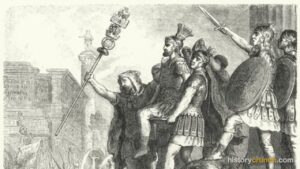
Octavian’s most powerful weapon was Antony’s own will, which he read aloud to the Roman Senate. The document revealed that Antony had left much of his wealth to his children by Cleopatra and wished to be buried in the Egyptian city of Alexandria rather than in Rome. This convinced many Romans that Antony intended to move the center of power away from Rome. In 32 BCE, Octavian persuaded the Senate to declare war, though he cleverly declared it against Cleopatra rather than against Antony, framing the conflict as a war against a foreign enemy rather than a Roman civil war.
Both sides then gathered enormous forces. Antony assembled a huge army and fleet in Greece, drawing on the resources of the eastern provinces and on Cleopatra’s rich kingdom of Egypt. His fleet was made up of large, heavily built war galleys, some equipped with towers full of armed soldiers. Octavian, meanwhile, relied on the skill of his loyal admiral Marcus Agrippa, whose ships were smaller and far more nimble. In early 31 BCE, Antony made his camp at Actium, a promontory on the western coast of Greece that guarded the entrance to the Ambracian Gulf, while Octavian arrived from the north.
How the Battle of Actium Unfolded
In the months before the battle, Agrippa proved to be the deciding factor. He captured a series of key coastal towns and naval bases, including Methone in the Peloponnese, and used fast hit-and-run tactics to cut off Antony’s supply lines from Egypt and the east. As stated above, Antony’s fleet had been penned up in the Ambracian Gulf for months, and the trapped soldiers and sailors began to suffer badly. Food ran short, disease such as malaria spread through the swampy lowlands, and morale collapsed.
As conditions worsened, many of Antony’s allies and officers began to desert to Octavian, including several client kings and prominent Roman senators. In fact, the strategy of delay favored Octavian, who was content to wait while his rival’s position crumbled. Antony’s veteran soldiers still won many of the small clashes on land, but he could not break the blockade that was slowly strangling his forces.
Faced with a hopeless situation, Antony decided that his only real option was to break out by sea. He was so short of rowers that he could not even man all of his ships, so he burned the vessels he could no longer crew and prepared to sail out of the gulf with the rest. His plan was to punch through Octavian’s naval line and escape southward toward Egypt with as much of his fleet and treasure as possible.
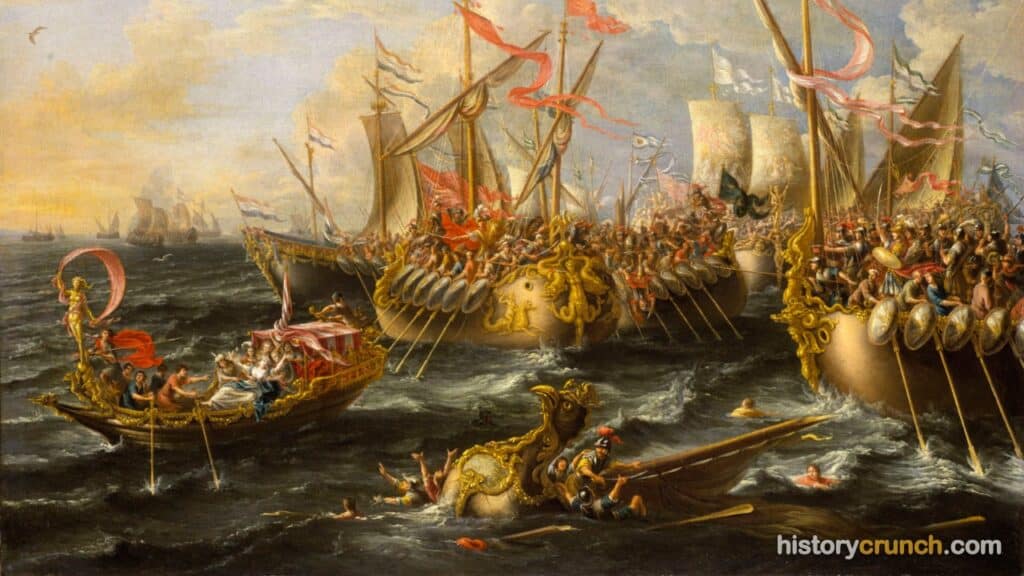
On the morning of September 2nd, 31 BCE, Antony led his large war galleys through the narrow straits and out into the open water of the Ionian Sea. Octavian’s fleet, commanded in practice by Agrippa, was waiting for him in an arc that stretched from north to south, blocking the exit. Antony arranged his ships in a crescent formation across the mouth of the gulf, with Cleopatra’s Egyptian squadron held in reserve behind the main line.
Around midday a strong wind rose, and Antony launched his ships forward, hoping to turn Agrippa’s flank and shatter the enemy line. More specifically, the battle became a contest between two very different kinds of ships. Antony’s massive galleys were like floating fortresses, hurling stones and firing arrows from their towers, but they were slow and hard to steer. Agrippa’s smaller and faster vessels darted among them, ramming their hulls, tearing away their oars, and refusing to be caught.
The fighting was fierce and crowded, so tightly packed that it came to resemble a battle on land more than a battle at sea. Flaming missiles filled the sky with smoke, and the smaller ships swarmed around the larger ones. As the struggle wore on, gaps began to open in the fighting, and Antony’s heavy ships proved unable to stop the relentless attacks of Octavian’s crews.
The turning point came when Cleopatra, watching from the reserve squadron, ordered her Egyptian ships to hoist their sails and flee southward through a gap in the lines. Antony, seeing her go, abandoned his flagship, transferred to a lighter vessel, and followed her with a small number of ships. His departure sealed the fate of the fleet he left behind. Several of his squadrons turned back toward Actium, while others surrendered, and by late afternoon the remaining ships had given up the fight. Roughly 5,000 men had died, and about 300 of Antony’s ships were captured.
The defeat at sea soon led to total collapse on land. Antony’s large army, left behind in Greece under the command of his officer Canidius, waited for orders that never brought hope. Cut off from supplies and news, and learning that their leader had fled, the soldiers surrendered to Octavian within about a week. Antony and Cleopatra, meanwhile, escaped back to Egypt with only a fraction of their once-mighty force.
The following year, in 30 BCE, Octavian pursued them to Egypt and laid siege to Alexandria. With his army melting away and defeat certain, Antony took his own life. Cleopatra, unwilling to be paraded through Rome as a captive, killed herself soon afterward, according to tradition by the bite of a poisonous snake. Their deaths brought an end to the long line of Ptolemaic rulers who had governed Egypt.
Significance of Battle of Actium
The Battle of Actium is widely seen as one of the great turning points in world history, because it ended the era of the Roman Republic and opened the era of the Roman Empire. With Antony and Cleopatra dead, Octavian was left as the single most powerful person in the Roman world, without any serious rival to challenge him. Egypt, with its enormous wealth, became his personal possession, and its treasure helped him pay his soldiers and secure his rule.
In reality, the victory allowed Octavian to reshape the Roman state entirely. In 27 BCE the Senate granted him the honorary title of Augustus, meaning “revered,” along with sweeping powers. Though he kept the outward appearance of the old Republic, calling himself the princeps, or “first citizen,” he now held the true authority of a monarch. In this way, Actium marked the moment when Rome passed from a republic ruled by the Senate into an empire ruled by emperors.
The battle also ushered in a long stretch of stability known as the Pax Romana, or “Roman Peace.” After nearly a century of destructive civil wars, the Roman world entered a period of relative calm and prosperity that would last for generations. The empire that Augustus founded would endure in western Europe for centuries and survive even longer in the east as the Byzantine Empire. For all these reasons, Actium is remembered not simply as a naval battle, but as the birth event of a new order that would dominate the Mediterranean world.
Frequently Asked Questions
Who won the Battle of Actium?
Octavian won the Battle of Actium, thanks largely to his admiral Marcus Agrippa. Octavian himself was not a gifted military commander, so he relied on Agrippa to plan and lead the naval fighting. This victory set Octavian on the path to becoming Rome’s first emperor, Augustus, and it is one reason his reign is remembered as the start of Rome’s golden age.
Where and when did the Battle of Actium take place?
The Battle of Actium took place on September 2nd, 31 BCE, in the Ionian Sea off the western coast of Greece. It was fought near a promontory called Actium, which sat at the entrance to the Ambracian Gulf. The narrow waters there created a bottleneck that trapped Antony’s fleet and made his escape extremely difficult.
Why did Antony lose the Battle of Actium?
Antony lost mainly because his forces were worn down before the fighting even began. His fleet had been blockaded for months, leaving his men short of food and weakened by disease, and many of his allies had already deserted him. His huge ships were also slow and clumsy compared to Octavian’s smaller, faster vessels, which could ram and outmaneuver them with ease.
What role did Cleopatra play in the battle?
Cleopatra provided a large part of Antony’s fleet, his money, and his supplies, which made her a vital ally. During the battle her squadron waited in reserve, and at a key moment she led her Egyptian ships in a retreat southward toward Egypt. Antony followed her, and his departure caused the rest of his fleet to surrender.
Why is the Battle of Actium so important in history?
The Battle of Actium is important because it ended the Roman Republic and led directly to the creation of the Roman Empire. It removed Octavian’s last rival and gave him control over the entire Roman world, including the riches of Egypt. Octavian later used images of the battle on coins and monuments across the empire to celebrate himself as the leader who brought peace after years of war.
Cite This Article
To cite this article as a source, use one of the formats below.
MLA: Millar, B. “Battle of Actium: A Detailed Summary.” HistoryCrunch, 9 July 2026, https://historycrunch.com/battle-of-actium/.
APA: Millar, B. (2026). Battle of Actium: A Detailed Summary. HistoryCrunch. https://historycrunch.com/battle-of-actium/
Chicago: Millar, B. “Battle of Actium: A Detailed Summary.” HistoryCrunch. July 9, 2026. https://historycrunch.com/battle-of-actium/
Sources
- J.M. Roberts & Odd Arne Westad, The Penguin History of the World.
- Jerry Bentley & Herbert Ziegler, Traditions & Encounters: A Global Perspective on the Past.