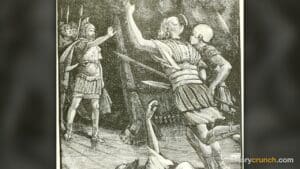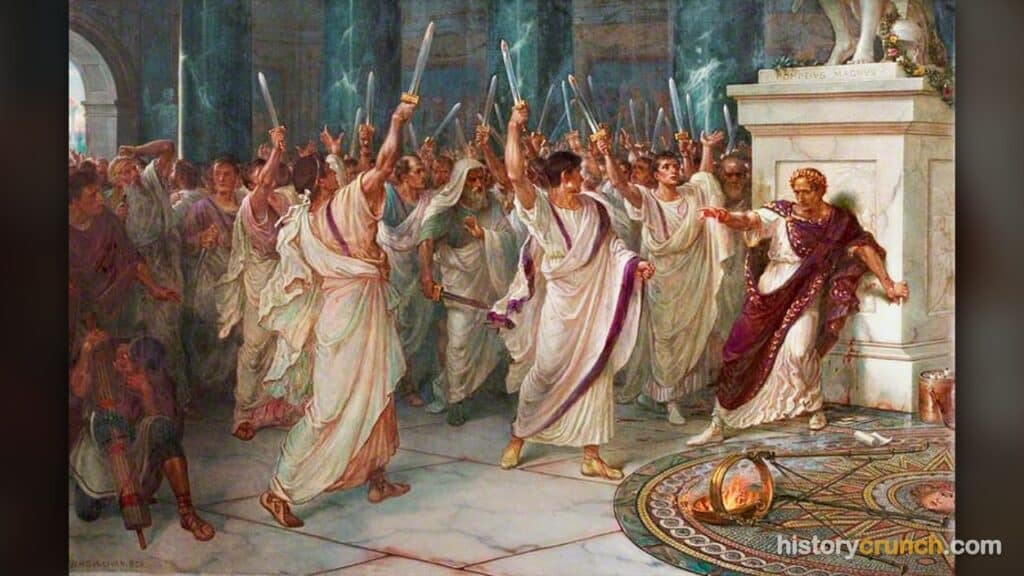
The assassination of Julius Caesar was one of the most important events in the history of Ancient Rome, because it marked the moment when the Roman Republic began to give way to the Roman Empire. On March 15th, 44 BCE, a group of Roman senators surrounded Caesar and stabbed him to death during a meeting of the Roman Senate. Caesar was the most powerful man in Rome at the time, serving as dictator, and his killers hoped that removing him would save the traditional republican system of government. Instead, his death set off a chain of events that destroyed the very Republic they wished to protect.
An assassination is the planned murder of an important public figure, usually for political reasons. In the case of Julius Caesar, a group of senators known to history as the “Liberators” plotted in secret to kill him because they believed he wanted to make himself a king. Their goal was not simply murder but a political act meant to restore the power of the Senate and end what they saw as one-man rule.
What Was Ancient Rome?
Ancient Rome was one of the most powerful and influential civilizations in world history. It began as a small city in central Italy and grew over many centuries into a vast state that controlled lands around the entire Mediterranean Sea, including parts of Europe, North Africa, and the Middle East. Rome is usually divided into three major periods, which are the Roman Kingdom, the Roman Republic, and the Roman Empire.
During the period of the Roman Republic, which lasted from about 509 BCE to 27 BCE, Rome was governed not by a single king but by elected officials and a powerful assembly of leading citizens called the Senate. The most important officials were two consuls, who were elected each year and shared power so that no single person could rule alone. In fact, the Romans deeply feared the idea of a king, since their earliest history had been shaped by kings they believed were cruel and unjust.
By the first century BCE, however, the Republic had entered a period of serious decline. Powerful generals who commanded loyal armies began to compete for control of the government, and wealth inequality and civil wars weakened Rome’s traditional institutions. It was within this troubled time that Julius Caesar rose to power, and it was against this background that his assassination took place.
Who Was Julius Caesar?
Julius Caesar is one of the most important figures in the history of the Roman Republic and the Roman Empire. He was a prominent politician, military general, and leader in Rome, and he had a profound impact on the history of his time. In fact, he is one of the most famous Roman leaders from the entire period of Ancient Rome, especially in relation to his rise to power and his eventual assassination.
Caesar rose to prominence through a combination of political skill and military success. In 60 BCE, he joined with two other powerful men, the wealthy Marcus Licinius Crassus and the respected general Gnaeus Pompeius Magnus, better known as Pompey, to form an informal alliance called the First Triumvirate. This partnership dominated Roman politics for several years and helped Caesar gain the position of governor of Gaul, a large region that covered most of modern France and Belgium.
As governor, Caesar led the Roman army through the Gallic Wars, conquering all of Gaul for Rome and gaining enormous wealth along with an army fiercely loyal to him. When the Senate later ordered him to give up his army and return to Rome as a private citizen, Caesar refused. Instead, he crossed the Rubicon River with his soldiers in 49 BCE, an act of defiance that plunged Rome into civil war. After defeating Pompey and the last of his rivals, Caesar returned to Rome more powerful than ever.
Why Did the Senators Want to Kill Caesar?
After winning the civil war, Julius Caesar was appointed dictator of the Roman Republic. In the Roman system, a dictator was an official granted special emergency powers, but only for a short period, traditionally no longer than six months, during a time of great crisis. Caesar broke sharply with this tradition. In early 44 BCE, he was named dictator perpetuo, a Latin phrase meaning “dictator in perpetuity,” which effectively made him ruler for life.
Many senators found this concentration of power alarming. The Republic had been built on the idea that no single man should hold supreme authority, and Caesar’s endless dictatorship looked to them like the return of a king in all but name. He also accepted a long list of extraordinary honors, placed his image on Roman coins, and made major decisions without consulting the Senate. To his critics, these actions were signs that he was placing himself above the law and above the Republic itself.
As stated above, the Romans feared kingship deeply, and rumors spread that Caesar wished to be crowned. For a group of leading senators, the danger seemed too great to ignore. They concluded that the only way to save the Republic was to remove Caesar entirely, and so they began to plan his assassination in secret.
Who Planned the Assassination of Julius Caesar?
More specifically, the assassination of Caesar was planned and carried out by three main Roman senators, who were Marcus Junius Brutus, Gaius Cassius Longinus, and Decimus Brutus. These men, upset with Caesar’s authority, arranged to assassinate him during a session of the Roman Senate. They called themselves the “Liberators,” because they believed they were freeing Rome from a tyrant.
The conspiracy began after secret discussions between Cassius Longinus and his brother-in-law Marcus Brutus. The two men agreed that something had to be done to stop Caesar from becoming king, and they then began to recruit others to their cause. In the end, the plot grew to include roughly 60 senators, a large number chosen deliberately so that the killing would appear to be a public act on behalf of Rome rather than a private crime.
The plotters met quietly in small groups to avoid being discovered. They had to act quickly, because Caesar was preparing to leave Rome to lead a major military campaign in the east. After debating where to strike, they settled on a meeting of the Senate, which was being held at a large building attached to the Theater of Pompey while the usual Senate house was under repair.
What Happened on the Ides of March?
The assassination took place on March 15th, 44 BCE, a date the Romans called the “Ides of March.” According to later accounts, Caesar had received several warnings before this day. His wife, Calpurnia, was said to have had a frightening dream, and religious signs were interpreted as bad omens. Caesar considered staying home, but one of the conspirators reassured him and persuaded him to attend the Senate meeting anyway.
When Caesar arrived and took his seat, the conspirators gathered around him, at first pretending to present him with a request. Then they drew daggers that they had hidden beneath their togas and began to attack. When he arrived in the Senate, approximately 60 angered senators surrounded him and stabbed him with their weapons. It was recorded that Caesar was stabbed 23 times, and he died on the floor of the meeting hall. He was 55 years old when he died.
According to a famous later legend, Caesar spoke final words to Brutus, whom he had trusted as a friend. The line “Et tu, Brute?” was made famous by a play written many centuries afterward, but there is no reliable evidence that Caesar actually said these words. In reality, the exact details of his death cannot be known with certainty, since no eyewitness account survives.
What Happened After Caesar’s Death?
The Liberators expected the Roman people to celebrate them as heroes. Instead, they were shocked to find that ordinary Romans were furious. Caesar had been extremely popular with the common people, who had benefited from his reforms and his generous public entertainments, and they were enraged that a small group of aristocrats had killed him.
Mark Antony, who had served as Caesar’s close ally and fellow consul, took advantage of this anger. At Caesar’s funeral he delivered a powerful speech that stirred the crowd against the assassins, turning public opinion sharply against them. The conspirators soon lost control of the situation, and Rome was plunged into a new series of civil wars.
A key surprise was that Caesar had named his grandnephew, Gaius Octavius, as his adopted son and heir in his will. Taking the name of the great Caesar, this young man, later known as Octavian, inherited both the loyalty of Caesar’s supporters and much of his fortune. Together with Antony, Octavian pursued the assassins and defeated Brutus and Cassius in battle in 42 BCE, after which both conspirators took their own lives.
Significance of Assassination of Julius Caesar
The assassination of Julius Caesar was an important event in the history of Ancient Rome. For instance, the death of Caesar did not save the Roman Republic, as the plotters had hoped, but instead helped bring about its end and the rise of the Roman Empire. The very system of government the Liberators tried to protect collapsed in the years of civil war that followed.
In the end, Octavian emerged victorious from the long struggle for power. He took the name Augustus and became the first emperor of Rome in 27 BCE, completing the transformation that his adopted father had begun. From that point on, emperors ruled Rome, and the Republic, with its elected consuls and powerful Senate, effectively ceased to exist as a working system of government.
Beyond its political effects, the killing of Caesar became one of the most studied and retold events in world history. The phrase “Ides of March” is still remembered today as a symbol of betrayal and sudden downfall, and the story of Caesar’s death has inspired countless works of literature and art across the centuries.
Frequently Asked Questions
When was Julius Caesar assassinated?
Julius Caesar was assassinated on March 15th, 44 BCE, a date the Romans called the Ides of March. In the Roman calendar, the “Ides” referred to a day near the middle of the month, which usually fell on the 13th or 15th. The killing happened around midday during a meeting of the Roman Senate.
Where was Julius Caesar killed?
Caesar was killed in a large hall attached to the Theater of Pompey, where the Senate was meeting at the time. The usual Senate house was undergoing repairs, so the senators gathered in this temporary location. There is a certain irony in the setting, since the building was connected to a monument built by Pompey, the rival Caesar had defeated in the civil war.
Who was Brutus and why did he betray Caesar?
Marcus Junius Brutus was a Roman senator and one of the leaders of the plot to kill Caesar, even though Caesar had pardoned him after the civil war and treated him as a friend. Brutus came from a family that took great pride in Rome’s republican traditions and its opposition to kings. He believed that killing Caesar was necessary to protect the Republic, which is why his role in the assassination is so often remembered.
Did Julius Caesar really say “Et tu, Brute”?
There is no reliable evidence that Caesar spoke the famous words “Et tu, Brute,” which became well known through a much later stage play. Some ancient writers claimed he said something to Brutus in Greek, while others reported that he said nothing at all and simply covered his face as he was attacked. Because no eyewitness account survives, the truth of his final moments cannot be known.
Who became ruler of Rome after Caesar died?
After years of civil war following Caesar’s death, his adopted son and heir Octavian eventually gained sole control of Rome. He took the name Augustus and became the first emperor of the Roman Empire in 27 BCE. Just two years after the assassination, Caesar himself was officially declared a god by the Roman state, which added to Octavian’s prestige as the “son of the divine Caesar.”
Cite This Article
To cite this article as a source, use one of the formats below.
MLA: Millar, B. “Assassination of Julius Caesar: A Detailed Summary.” HistoryCrunch, 9 July 2026, https://historycrunch.com/assassination-of-julius-caesar/.
APA: Millar, B. (2026). Assassination of Julius Caesar: A Detailed Summary. HistoryCrunch. https://historycrunch.com/assassination-of-julius-caesar/
Chicago: Millar, B. “Assassination of Julius Caesar: A Detailed Summary.” HistoryCrunch. July 9, 2026. https://historycrunch.com/assassination-of-julius-caesar/
Sources
- Adrian Goldsworthy, How Rome Fell / Caesar (military and political).
- H.H. Scullard, From the Gracchi to Nero.
- Mary Beard, SPQR: A History of Ancient Rome.