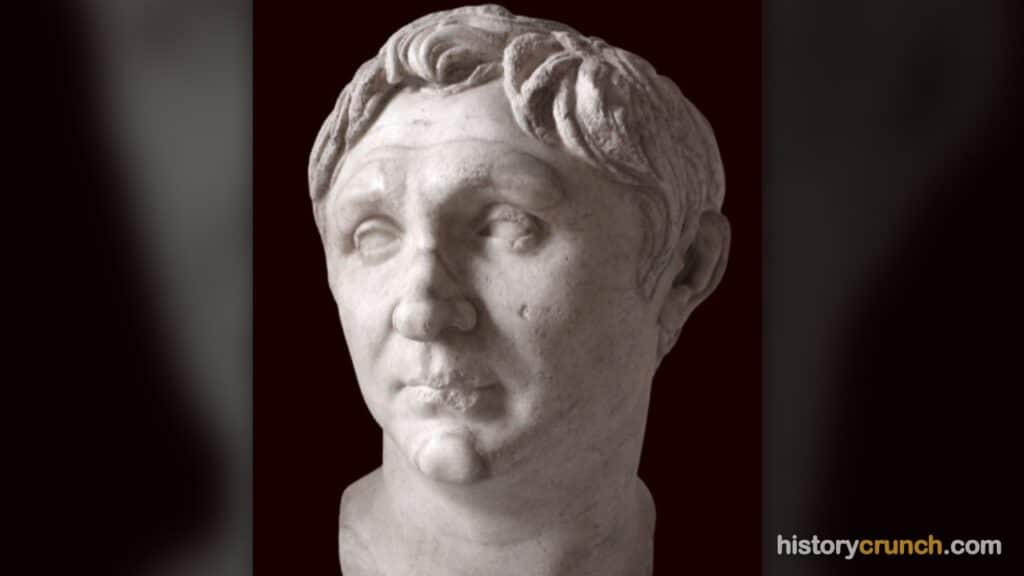
Pompey the Great is one of the most important figures in the history of the late Roman Republic. He was a brilliant military general and powerful politician whose victories helped expand Rome’s territory across the Mediterranean world, and whose rivalry with Julius Caesar helped push the Roman Republic toward civil war and collapse.
His full name was Gnaeus Pompeius Magnus, and the word Magnus is Latin for “the Great.” He rose to fame as a young commander, cleared the Mediterranean Sea of pirates, conquered kingdoms in the east, and joined Julius Caesar and Marcus Licinius Crassus in the alliance known as the First Triumvirate. In the end, Pompey lost a civil war to Caesar and was killed in Egypt, but his career shaped the final decades of the Republic.
Early Life and Background
Pompey was born on September 29th, 106 BCE, into an old and wealthy provincial family from Picenum, a region in what is now eastern Italy. His family was not part of the ancient noble class of Rome, but it had become important through the career of his father, Gnaeus Pompeius Strabo. The Pompeius family became powerful in Rome itself due to the career of Pompey’s father, who reached the office of consul in 89 BCE.
In Ancient Rome, a consul was one of the two highest elected officials, and the two consuls led the government for one year at a time. Strabo served alongside Lucius Cornelius Sulla, one of Rome’s most talented generals. As stated above, this family connection placed young Pompey close to the leading men of his day.
Pompey was well educated, and his early life was divided between the city of Rome and his father’s estates in Picenum. As a teenager, he served on the staff of his father during the Social War, a conflict fought between 91 and 88 BCE. This war pitted Rome against several of its former Italian allies, and it gave Pompey his first taste of military life at a very young age.
The Rome that Pompey grew up in was deeply divided. The Senate and political establishment were split into two overall groups, the populares and the optimates. The populares advocated for the interests of the common people, while the optimates were staunch defenders of the wealthy nobility. This bitter divide, combined with rival generals fighting for control, set the stage for the civil wars that shaped Pompey’s rise.
Rise to Power
Pompey’s rise began during the civil war between the generals Gaius Marius and Lucius Cornelius Sulla. Upon Sulla’s return to Italy in 83 BCE, Pompey declared for Sulla, and after enrolling three new legions, Pompey defeated the Marian forces sent against him. A legion was a large unit of the Roman army, so raising three of them was a remarkable achievement for a private citizen who was still in his early twenties.
Sulla quickly made use of the young man’s talents. During that same year, Pompey cleared Sicily of the Marian enemy. The following year, Pompey took his campaign to North Africa. He set sail in 81 BCE with six legions and 120 galleys to retake Africa from the Marians, and after crossing a flooded river amid heavy rain, he caught his enemies unawares and defeated them in a chaotic battle.
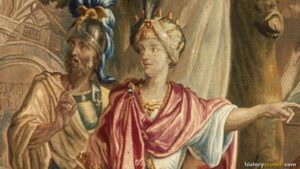
These early victories earned him his famous nickname. Around this time, his troops began referring to him as Magnus, or “the Great,” after Alexander the Great, a figure much admired by the Romans, and shortly thereafter Pompey formally made this part of his name. In fact, because of his handsome looks, his youth, and his military accomplishments, Pompey was compared by his contemporaries to Alexander the Great, the Macedonian king who had conquered Persia and much of the known world.
When he returned to Rome, Pompey demanded a triumph, a grand victory parade through the streets of the city. This was a bold request, because such honors were normally reserved for consuls who had defeated foreign enemies. At first refused a triumph by Sulla on account of his young age, Pompey eventually got his way by threatening not to disband his troops.
After Sulla’s death, Pompey continued to win important commands. He supported the government against attack in Italy, and then he was awarded an important military command in Spain against the rebel general Quintus Sertorius. He also helped bring an end to the famous slave revolt led by Spartacus. After a successful campaign in Spain, he was elected consul, along with Marcus Crassus, for the year 70 BCE.
Major Achievements
One of Pompey’s greatest achievements came in 67 BCE, when he was given a special command to deal with the pirates who were terrorizing the Mediterranean Sea. The Mediterranean Sea was the lifeblood of the Roman Republic, facilitating trade, communication, and military movements, but by this time piracy had become a rampant problem, threatening the security of Rome’s grain supply and the safety of its citizens. Pompey attacked the problem with astonishing speed and organization, sweeping the sea clear in a matter of months.
More specifically, this campaign showed the qualities that made Pompey so effective. He was a great planner and had tremendous organizational skill, which allowed him to devise grand strategies and operate effectively with large armies. These strengths served him well when he turned his attention to the wars in the east.
Soon after clearing the seas, Pompey was given command of the war against Mithridates VI, the powerful king of Pontus, a kingdom on the Black Sea. Turning down a peace offer, Pompey pursued Mithridates ruthlessly, forcing him to retreat into the Crimea region of the Black Sea, and Pompey then successfully brought the kingdom of Armenia into the Roman orbit.
From there, Pompey pushed even further into the eastern lands. With the threat from Pontus and Armenia ended, Pompey turned south into Syria, ending the Seleucid kingdom, which had been founded in the aftermath of the conquests of Alexander, and he conquered Jerusalem and created a client kingdom in Judaea. A client kingdom was a foreign state that ruled itself but answered to Rome. By the time he returned to Rome in 62 BCE, Pompey had successfully extended the boundaries of Roman power almost to the Euphrates River.
These victories brought Pompey enormous fame and a spectacular third triumph. In reality, though, his success also made him enemies. The Senate denied his proposals for land grants for his disbanded soldiers and also refused to approve Pompey’s eastern settlements, a decision led by Cato the Younger. This political roadblock would push Pompey toward one of the most important alliances in Roman history.
First Triumvirate and Rivalry with Caesar
Facing opposition in the Senate, Pompey joined forces with two other powerful men. The First Triumvirate was an informal political alliance formed around 60 BCE among three prominent politicians of the late Roman Republic, Gnaeus Pompeius Magnus, Marcus Licinius Crassus, and Gaius Julius Caesar. You can read more about this partnership in the HistoryCrunch article on Julius Caesar.
The alliance combined Pompey’s military reputation, Crassus’s great wealth, and Caesar’s political skill. In order to bypass constitutional obstacles and force through their political goals, the three men forged the alliance in secret, promising to use their influence to support one another. The bond was sealed by marriage, as the alliance was cemented by Pompey’s marriage to Caesar’s daughter, Julia.
For several years, the arrangement worked well, and the three men dominated Roman politics. Over time, however, the alliance began to fall apart. After the deaths of Julia and Crassus, in 54 and 53 BCE, Pompey aligned himself with the optimates, the conservative faction of the Roman Senate. With Julia gone and Crassus killed fighting the Parthians, nothing was left to hold Pompey and Caesar together.
As Caesar grew more powerful in Gaul, Pompey and the Senate grew more suspicious of him. Pompey grew wary of Caesar’s growing ambitions and drew closer to the Roman senatorial establishment, and in 49 BCE, when Caesar defied Senate demands and entered Italy with his army, Pompey responded with war. Caesar’s decision to cross the Rubicon River with his soldiers was an open act of war, and it plunged Rome into civil conflict.
Later Life and Death
When the civil war broke out, Pompey chose not to defend Italy directly and instead moved his forces to Greece to gather strength. The two armies finally met in 48 BCE. After Julius Caesar destroyed Pompey’s army at Pharsalus in 48 BCE, Pompey fled to Egypt. The Battle of Pharsalus was the turning point of the war, and it was the only truly decisive defeat of Pompey’s long career.
Pompey hoped to find safety and support in Egypt, where the ruling family owed him a debt of loyalty. He anticipated the goodwill of the young Ptolemy XIII, whose father had effectively made Egypt a client kingdom of the Roman Republic. His hopes were badly misplaced.
The young king’s advisers feared angering the victorious Caesar, and so they turned against Pompey. Ptolemy’s advisers had Pompey killed as he was coming ashore. He died on September 28th, 48 BCE, one day before his 58th birthday. It was a sudden and shocking end for a man who had once been the most celebrated general in the Roman world.
Significance of Pompey the Great
The significance of Pompey the Great lies in both his conquests and the way his career helped bring down the Roman Republic. As a general, he expanded Roman power across the Mediterranean, defeated the pirates who threatened Rome’s food supply, and added vast new lands in the east. As a military leader and imperial commander, Pompey greatly extended the bounds of the Roman Republic.
Pompey was also skilled in the difficult work of organizing conquered territory. Beyond his battlefield victories, he was circumspect and thorough, a talented administrator who reshaped the map of the Roman east into provinces and client kingdoms that lasted for generations. Many of the cities and arrangements he created continued to shape the region long after his death.
Yet Pompey is also remembered as one of the men whose ambitions pulled the Republic apart. Together with Julius Caesar and Marcus Crassus, he was one of the three leading figures whose careers and ambitions coincided with the final downfall of the Republic. His defeat by Caesar cleared the way for one-man rule in Rome and, eventually, the birth of the Roman Empire.
For all these reasons, Pompey remains a figure of debate. His legacy remains contested, with some viewing him as an enduring republican figure while others see him as a step toward autocratic rule, reflecting the turbulent politics of his era. Either way, his life stands as one of the great stories of the late Roman Republic.
Frequently Asked Questions
Why was Pompey called “the Great”?
Pompey earned the name Magnus, meaning “the Great,” because of his early military victories in his twenties. His troops began calling him Magnus after Alexander the Great, a conqueror much admired by the Romans. Pompey liked the comparison so much that he made the title a permanent part of his name and encouraged people to link him with the legendary Macedonian king.
What did Pompey do for Rome?
Pompey won major wars that expanded and protected Roman power. He fought in Africa and Spain, quelled the slave revolt of Spartacus, cleared the Mediterranean of pirates, and conquered Armenia, Syria, and Palestine. He also reorganized the eastern lands into new provinces and client kingdoms, and the taxes and wealth from these territories greatly increased Rome’s income.
How did Pompey become allies with Julius Caesar?
Pompey allied with Caesar because the Senate kept blocking his requests, especially land for his veteran soldiers. To get around this opposition, he joined Caesar and the wealthy Crassus in the First Triumvirate around 60 BCE. The alliance was strengthened when Pompey married Caesar’s daughter, Julia, which briefly turned the two rivals into family members and political partners.
How did Pompey the Great die?
Pompey was assassinated in Egypt in 48 BCE after losing to Julius Caesar. On September 28th, Pompey was invited to leave his ships and come ashore, and as he prepared to step onto Egyptian soil, he was treacherously struck down and killed by an officer of Ptolemy. The Egyptian court chose to kill him rather than risk angering the victorious Caesar.
Who was a better general, Pompey or Caesar?
Both were outstanding commanders, but Caesar is often judged the more brilliant battlefield tactician, while Pompey excelled as a strategist and organizer. Pompey is usually considered an outstanding strategist and organizer, who could win campaigns by constantly outmaneuvering his opponents and gradually pushing them into a desperate situation. Caesar’s victory at Pharsalus, however, gave him the final word in their long rivalry.
Cite This Article
To cite this article as a source, use one of the formats below.
MLA: Millar, B. “Pompey the Great: A Detailed Biography.” HistoryCrunch, 7 July 2026, https://historycrunch.com/pompey-the-great/.
APA: Millar, B. (2026). Pompey the Great: A Detailed Biography. HistoryCrunch. https://historycrunch.com/pompey-the-great/
Chicago: Millar, B. “Pompey the Great: A Detailed Biography.” HistoryCrunch. July 7, 2026. https://historycrunch.com/pompey-the-great/
Sources
- Liaquat Ahamed, Lords of Finance.
- Federal Reserve History
- FDR Presidential Library
- David M. Kennedy, Freedom from Fear.