The Civil Rights Movement was a social and political movement in the United States that fought to end racial segregation and discrimination against African Americans and to secure equal rights under the law for all people. The movement is most commonly associated with the period from 1954 to 1968, when a series of important events, court decisions, and new laws changed the country permanently. Led by figures such as Martin Luther King Jr., Rosa Parks, and Thurgood Marshall, and supported by millions of ordinary people across the country, the Civil Rights Movement was one of the most important and far-reaching social movements in American history.
CIVIL RIGHTS MOVEMENT – BACKGROUND
To understand the Civil Rights Movement, it is necessary to understand the system of racial inequality that African Americans lived under for most of American history. Slavery was legal in the United States from the colonial period until the end of the Civil War. The Thirteenth Amendment to the Constitution, ratified in December of 1865, abolished slavery across the country. The Fourteenth Amendment, ratified in 1868, granted citizenship and equal protection under the law to all people born in the United States. The Fifteenth Amendment, ratified in 1870, gave Black men the right to vote.
Despite these new rights, the period after the Civil War, known as Reconstruction, was followed by a determined effort in the South to strip African Americans of their freedoms. Beginning in the 1870s and continuing well into the twentieth century, southern states passed a series of laws known as Jim Crow laws that enforced racial segregation in nearly every area of public life. Under Jim Crow, Black and white Americans were required to use separate schools, hospitals, restaurants, water fountains, restrooms, and public transportation. Black voters were effectively blocked from exercising their right to vote through poll taxes, literacy tests, and outright intimidation and violence. In 1896, the Supreme Court ruled in Plessy v. Ferguson that segregation was legal as long as the separate facilities provided for Black Americans were supposedly equal to those provided for white Americans. They rarely were.
The National Association for the Advancement of Colored People, known as the NAACP, was founded in 1909 and spent decades fighting racial segregation and discrimination through legal challenges, education, and public advocacy. Its work laid the groundwork for the breakthroughs of the 1950s and 1960s.
CIVIL RIGHTS MOVEMENT – BROWN V. BOARD OF EDUCATION
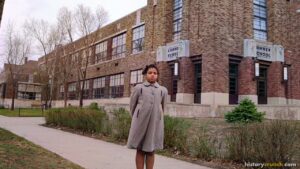
The legal turning point that launched the modern Civil Rights Movement came on May 17, 1954, when the United States Supreme Court handed down its unanimous decision in Brown v. Board of Education. The case was brought by the NAACP Legal Defense Fund, led by attorney Thurgood Marshall, who later became the first Black Supreme Court justice. The case combined five separate cases from different states, all challenging the legality of racially segregated public schools.
Chief Justice Earl Warren wrote the Court’s opinion, declaring that racially segregated schools were inherently unequal and unconstitutional. The ruling overturned Plessy v. Ferguson and struck down the legal foundation of the entire Jim Crow system. It was the most important civil rights decision in the history of the Supreme Court.
Many southern states refused to comply. Some closed their public schools entirely rather than integrate them. Resistance was fierce, and progress was slow. But the Brown decision made clear that the law was on the side of equality, and it energized a generation of activists who were ready to push for change beyond the courtroom.
CIVIL RIGHTS MOVEMENT – EMMETT TILL AND ROSA PARKS
Two events in 1955 helped bring the Civil Rights Movement to national attention and galvanized public opinion. In August of 1955, Emmett Till, a fourteen-year-old African American boy from Chicago, was visiting relatives in Money, Mississippi, when he was kidnapped, brutally beaten, and murdered by two white men who accused him of flirting with a white woman. His body was thrown into the Tallahatchie River with a heavy cotton gin fan tied around his neck. The two men who killed him were acquitted by an all-white jury. Till’s mother, Mamie Till, insisted on an open-casket funeral so that the world could see what had been done to her son. When Jet magazine published photographs of Emmett Till’s body, the images shocked the country and the world, drawing international attention to the reality of racial violence in the United States.
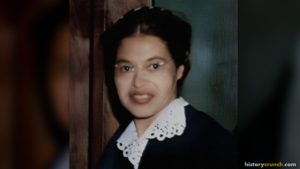
Just three months later, on December 1, 1955, Rosa Parks refused to give up her seat on a city bus in Montgomery, Alabama, to a white passenger. Under Montgomery’s bus segregation rules, Black riders were required to sit at the back of buses and give up their seats to white passengers if the white section filled up. Parks, who was a secretary for the local NAACP chapter, was arrested for refusing to comply. Her arrest sparked the Montgomery Bus Boycott, which lasted 381 days. African American residents of Montgomery, who made up around 75 percent of the bus company’s riders, stopped using the city buses entirely. The boycott caused serious financial damage to the bus company and ultimately succeeded. On December 21, 1956, Montgomery’s buses were desegregated following a Supreme Court ruling that bus segregation was unconstitutional. The boycott also launched the career of its young leader, a twenty-six-year-old pastor named Martin Luther King Jr.
CIVIL RIGHTS MOVEMENT – MARTIN LUTHER KING JR. AND NONVIOLENT PROTEST
Martin Luther King Jr. became the most important leader of the Civil Rights Movement and one of the most influential figures in American history. Born on January 15, 1929, in Atlanta, Georgia, King earned a doctorate in theology from Boston University and was deeply influenced by the philosophy of nonviolent resistance practiced by Mahatma Gandhi in India. He believed that racial justice could be achieved through peaceful protest, civil disobedience, and moral persuasion rather than through violence.
Following the Montgomery Bus Boycott, King helped found the Southern Christian Leadership Conference, known as the SCLC, in January of 1957. The SCLC became one of the main organizations coordinating civil rights activism across the South. King traveled constantly, speaking at churches, universities, and rallies, and organizing campaigns of direct action to challenge segregation.
In April and May of 1963, King led the Birmingham Campaign in Birmingham, Alabama, one of the most segregated cities in the country. The campaign used sit-ins, marches, and economic boycotts to challenge the city’s segregation laws. Public Safety Commissioner Bull Connor ordered police to use fire hoses and police dogs against peaceful protesters, including children. The images of that violence, broadcast on television news across the country, shocked millions of Americans and dramatically increased public support for the Civil Rights Movement.
CIVIL RIGHTS MOVEMENT – KEY EVENTS OF THE 1960s
The 1960s saw a series of major events that pushed the Civil Rights Movement toward its greatest legislative victories.
In February of 1960, four Black college students sat down at a whites-only lunch counter at a Woolworth’s store in Greensboro, North Carolina, and refused to leave when they were denied service. Their sit-in sparked similar protests at lunch counters across the South and gave rise to the Student Nonviolent Coordinating Committee, known as SNCC, which became one of the most active civil rights organizations of the decade.
In 1961, groups of Black and white activists known as Freedom Riders boarded interstate buses to challenge the continued segregation of bus terminals across the South, despite a Supreme Court ruling that such segregation was illegal. The Freedom Riders were met with violent mobs in Alabama, where one bus was firebombed. Their courage drew national attention and forced the federal government to enforce desegregation in interstate transportation.
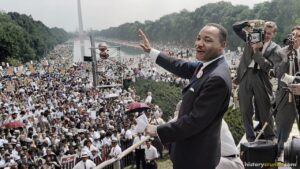
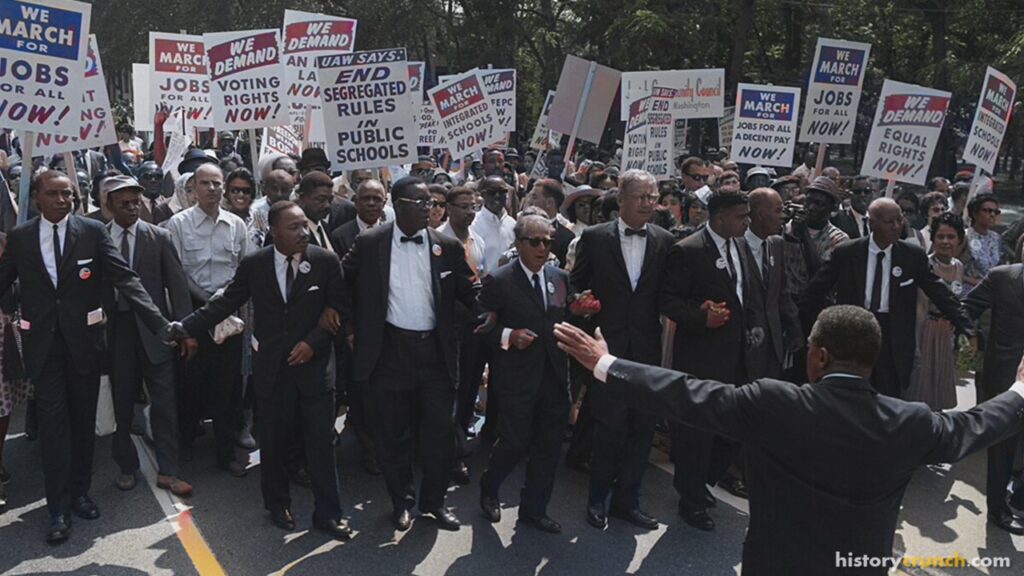
In August of 1963, approximately 250,000 people gathered in Washington, D.C., for the March on Washington for Jobs and Freedom, one of the largest civil rights demonstrations in American history. It was at this march, on August 28, 1963, that King delivered his famous “I Have a Dream” speech at the Lincoln Memorial, calling for racial equality and an end to discrimination. The march put enormous pressure on Congress to act on civil rights legislation.
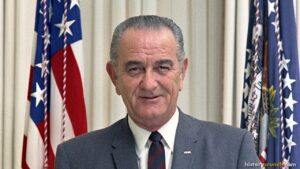
In March of 1965, civil rights activists organized a march from Selma to Montgomery, Alabama, to demand voting rights for Black Americans. On the first attempt, on March 7, 1965, marchers crossing the Edmund Pettus Bridge were attacked by state troopers with clubs and tear gas in an event that became known as Bloody Sunday. The images of peaceful marchers being beaten by police were broadcast on national television and produced widespread outrage. President Lyndon B. Johnson responded by introducing the Voting Rights Act, and the march eventually completed its journey to Montgomery later in March.
CIVIL RIGHTS MOVEMENT – MAJOR LEGISLATION
The Civil Rights Movement achieved its most important goals through landmark federal legislation passed during the presidency of Lyndon B. Johnson.
The Civil Rights Act of 1964, signed by Johnson on July 2, 1964, was the most sweeping civil rights law in American history. It outlawed discrimination based on race, color, religion, sex, or national origin in employment and in places of public accommodation such as hotels, restaurants, and theaters. It also created the Equal Employment Opportunity Commission to enforce these protections. The act had been proposed by President John F. Kennedy before his assassination in November of 1963, and Johnson pushed it through Congress in Kennedy’s honor.
The Voting Rights Act of 1965, signed on August 6, 1965, directly addressed the systematic denial of voting rights to Black Americans in the South. It banned literacy tests and other tools used to stop Black voters from registering, and gave the federal government authority to oversee elections in areas with a history of discrimination. Within a few years of the act’s passage, millions of Black Americans had registered to vote for the first time, permanently changing the political landscape of the South.
The Fair Housing Act of 1968, signed on April 11, 1968, prohibited discrimination in the sale, rental, and financing of housing based on race, religion, national origin, or sex. It was signed just days after the assassination of Martin Luther King Jr. and was partly passed in response to the national grief and outrage that followed his death.
CIVIL RIGHTS MOVEMENT – THE ASSASSINATION OF MARTIN LUTHER KING JR.
Martin Luther King Jr. was assassinated on April 4, 1968, while standing on the second-floor balcony of the Lorraine Motel in Memphis, Tennessee, where he had gone to support striking sanitation workers. He was thirty-nine years old. James Earl Ray was convicted of the murder in 1969. King’s assassination shocked the nation and set off riots in more than 100 cities across the United States. The loss of King removed the movement’s most prominent and unifying voice at a moment when it was grappling with new questions about economic inequality, Black Power, and the direction of the struggle ahead.
CIVIL RIGHTS MOVEMENT – OTHER KEY FIGURES AND ORGANIZATIONS
The Civil Rights Movement was far larger than any single leader. Many other individuals and organizations played essential roles.
Thurgood Marshall was the NAACP lawyer who argued and won the Brown v. Board of Education case and went on to become the first Black Supreme Court Justice in 1967. John Lewis was a leader of SNCC and one of the original Freedom Riders who was beaten on Bloody Sunday at the Edmund Pettus Bridge. He later served for more than thirty years as a member of Congress. Fannie Lou Hamer was a Mississippi sharecropper who became a powerful voting rights activist and spoke movingly at the 1964 Democratic National Convention about the violence and intimidation she faced while trying to register to vote.
Malcolm X offered a different perspective on the struggle for Black rights. Where King emphasized nonviolence and integration, Malcolm X argued for Black self-defense and Black self-determination, and was deeply critical of what he saw as the slow pace of progress through nonviolent protest. He was assassinated on February 21, 1965. The Black Panther Party, founded in Oakland, California, in 1966, combined community programs such as free breakfast for children with a more confrontational approach to police violence in Black communities.
CIVIL RIGHTS MOVEMENT – SIGNIFICANCE
The Civil Rights Movement permanently changed the United States. The legal system of racial segregation that had defined life in the South for nearly a century was dismantled. Millions of African Americans gained the practical ability to vote for the first time. Schools, public facilities, workplaces, and housing were opened to people regardless of race in ways that had not existed before. The legislation produced by the movement, particularly the Civil Rights Act of 1964 and the Voting Rights Act of 1965, remains among the most important in American history.
At the same time, the movement’s achievements, as significant as they were, did not resolve all of the inequalities facing African Americans. Economic inequality, police violence, and racial discrimination in housing, education, and employment remained serious problems in the decades that followed. The work of the movement created the legal foundations for equality, but turning those foundations into lived reality for all Americans remained an ongoing struggle long after 1968. The Civil Rights Movement is studied today not only as a chapter of history but as a reminder of what ordinary people can accomplish when they organize together around a shared belief in justice.