The War of the Fifth Coalition was one of the most important conflicts of the Napoleonic Wars, and it marked a major turning point in the long struggle between France and the powers of Europe. Fought in 1809, it pitted the Austrian Empire, backed by Great Britain, against the French Empire of Napoleon Bonaparte and his many allied states. Although Napoleon won the war and forced Austria to accept harsh peace terms, the fighting also produced his first serious defeat on the battlefield and showed that the French emperor could be beaten.
A coalition, in this setting, was a temporary alliance of nations that joined together to fight a common enemy. Between 1792 and 1815, European monarchies formed a series of these coalitions to oppose first revolutionary France and then the empire of Napoleon. The Fifth Coalition was the fifth such alliance, and it was smaller than most, since only Austria and Britain took an active part against France.
What Was the Napoleonic Era?
The Napoleonic Era refers to the period of French and European history dominated by Napoleon Bonaparte, lasting from his seizure of power in France in 1799 to his final defeat and exile in 1815. Napoleon rose to prominence during the French Revolution, first as a military general and then as the political leader of France, and he crowned himself Emperor of the French in 1804. During his rule he built one of the largest empires in European history and fought a long series of wars against shifting coalitions of rival powers.
These conflicts, known together as the Napoleonic Wars, ran from 1803 to 1815 and involved nearly every major power on the continent. In battle after battle, Napoleon defeated the armies of Austria, Prussia, and Russia, and he reorganized much of Germany and Italy under French control. The War of the Fifth Coalition belongs to the middle of this era, when French power was near its peak but was beginning to face growing resistance.
What Caused the War of the Fifth Coalition?
The main cause of the war was Austria’s desire to reverse the humiliating defeats it had suffered at French hands. Over the previous decade Austria had lost several wars to Napoleon and had been forced to give up large amounts of land and influence in Central Europe. After the crushing loss at the Battle of Austerlitz in 1805, Austria had signed away much of its power, and its leaders were eager to reclaim what they had lost.
In the years that followed, Austria rebuilt and reformed its army, hoping to be ready when the right moment came. That moment seemed to arrive when Napoleon became bogged down in a costly war on the Iberian Peninsula. In October of 1808 France withdrew more than 100,000 troops from Germany, reducing its strength there by more than half in order to reinforce its armies in Spain, which greatly encouraged the pro-war faction in the Austrian government. Many Austrian leaders believed that a distracted Napoleon could finally be pushed out of Germany, Poland, and Italy.
Britain, France’s most determined enemy, also encouraged Austria and promised money and military support. To support the financially troubled Austrians, the British provided them with £250,000, promised a further £1 million, and agreed to send forces to the Low Countries and launch a new offensive in Spain. With this backing, and fearing it could not keep a large army in the field forever, Austria decided to strike.
How Did the War Begin?
On April 10th, 1809, Austrian troops under Archduke Charles crossed the border into Bavaria, a French client state, thus beginning hostilities without a formal declaration of war. Bavaria was Napoleon’s strongest German ally, so the attack struck directly at the French position in Germany. Archduke Charles, the brother of the Austrian emperor, was one of the finest generals of the age and led an army of roughly 200,000 men.
The invasion caught the French by surprise, but the Austrian advance was slow. Bad roads and freezing rain slowed the Austrian advance in the first week, and the opposing Bavarian forces gradually retreated. This delay proved costly, because it gave Napoleon time to rush eastward, take personal command, and gather his scattered forces.
Once Napoleon arrived, the tide turned quickly. The French, initially taken by surprise, were able to defeat the Austrians at Eckmühl, Abensberg, and Ratisbon, and the archduke, fearing that his army might be destroyed, retreated toward Bohemia. This week of French victories, sometimes called the Landshut campaign, opened the road toward the Austrian capital.
Major Battles of the War
With Archduke Charles pulling back, Napoleon pushed on toward Vienna. Napoleon quickly responded, defeating the Austrians and taking Vienna in May of 1809, but even though they lost their capital, Archduke Charles managed to save his army by moving it north of the Danube River, allowing the war to continue. The Danube, a wide and fast-flowing river, now stood between the two armies, and the main bridges had been destroyed.
To reach the Austrians, Napoleon had to build his own crossing. Since all the major bridges across the river had been destroyed, Napoleon needed to build his own, and he chose the floodplain of Lobau Island, south of Vienna, as the ideal location for his river crossing. On May 21st and 22nd, 1809, the French tried to force their way across near the villages of Aspern and Essling.
The result was a disaster for Napoleon. As the French tried to cross, the Austrians attacked the exposed troops on the far bank while repeatedly smashing the fragile French bridges. The Austrians floated flaming barges down the river to punch holes in the French bridge, preventing the rest of the army from crossing. Unable to bring over enough men, Napoleon was forced to withdraw. The Battle of Aspern-Essling marked Napoleon’s first major defeat in a decade and had cost him between 20,000 and 23,000 casualties, including the irreplaceable Marshal Jean Lannes.
The defeat shocked Europe, but Napoleon refused to give up. He spent about six weeks getting ready for his next attack, gathering a huge army of around 172,000 French, German, and Italian soldiers near Vienna. He also built far stronger bridges, protected by artillery and by piers sunk in the river to catch anything the Austrians floated downstream.
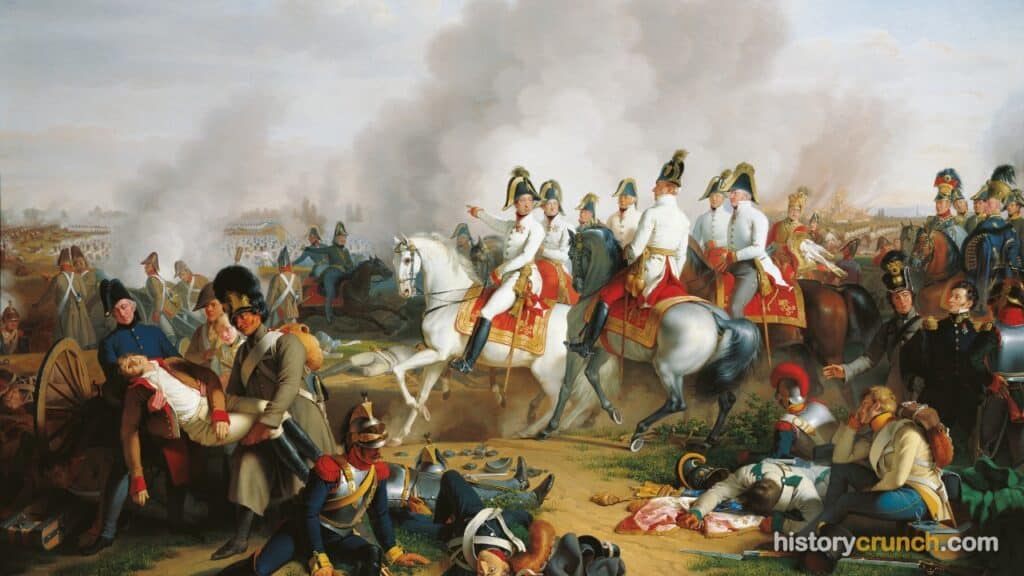
The final showdown came in early July. The Battle of Wagram began when Napoleon crossed the Danube on the night of July 4th and then attacked the Austrian army, which had about 136,000 soldiers. Fought on July 5th and 6th, 1809, on a plain northeast of Vienna, it was the largest land battle Europe had yet seen. French total losses numbered about 37,000, while Charles had seen 43,000 of his men killed, wounded, or missing during the two days of fighting.
Wagram was a hard-fought French victory rather than a crushing one, but it was enough to break Austria’s will to continue. Archduke Charles pulled his battered army away in good order, yet he now knew the war was lost. Within days, Austria asked for an armistice, a temporary halt to the fighting, which was signed after a final clash at Znaim in the days that followed.
How Did the War End?
The armistice halted the fighting, but a full peace treaty took months to negotiate. During this time, Napoleon dealt with the skilled Austrian diplomat Prince Klemens von Metternich, who worked to soften the terms. Since Napoleon had lost Aspern-Essling and had failed to destroy Charles’ army at Wagram, Metternich had some leverage and was able to secure lighter terms for Austria, retaining most of the Habsburgs’ hereditary lands.
The war formally ended with the Treaty of Schönbrunn, signed near Vienna on October 14th, 1809. Even with Metternich’s efforts, the terms were severe. Austria ceded Carinthia, Carniola, and all its Adriatic ports to France, thereby losing access to the sea, and it also had to give West Galicia to the Duchy of Warsaw and the district of Tarnopol to Russia, so that in all the Habsburgs lost around 3 million subjects.
The treaty went beyond the loss of land. Austria also agreed to pay a large indemnity, reduce its army to 150,000 men, and break diplomatic and trade relations with Britain. The last term forced Austria to join the Continental System, Napoleon’s economic blockade meant to ruin the British economy. The following year, Emperor Francis I sealed the new relationship by marrying his daughter, Marie Louise, to Napoleon.
Significance of War of the Fifth Coalition
The most immediate significance of the war was that it confirmed Napoleon’s dominance over Central Europe. Austria, his most stubborn continental enemy, was defeated once again and forced to become a reluctant French ally. With the treaty signed, Napoleon’s empire reached close to its greatest extent, and few powers on the continent seemed able to challenge him.
Yet the war also revealed important weaknesses. At Aspern-Essling, Napoleon suffered his first major defeat in years, proving that the French emperor was not unbeatable and that a reformed Austrian army could stand against him. The fighting was also extremely costly for both sides, and the heavy French losses, including experienced marshals and veteran soldiers, could not easily be replaced.
In the longer run, the War of the Fifth Coalition marked a turning point in the Napoleonic Wars. It was the last conflict in which Napoleon and the French Empire emerged as clear, decisive victors. The lessons other nations learned in 1809 would help fuel the far larger coalitions that eventually brought Napoleon down, beginning with his disastrous invasion of Russia in 1812.
Frequently Asked Questions
When was the War of the Fifth Coalition fought?
The War of the Fifth Coalition was fought in 1809, with its main campaigns lasting from April to July of that year. The fighting began with the Austrian invasion of Bavaria on April 10th and effectively ended after the Battle of Wagram in early July, though the final peace treaty was not signed until October. The war lasted only about six months, making it one of the shorter conflicts of the Napoleonic Wars.
Who fought in the War of the Fifth Coalition?
The war was fought between the Austrian Empire, supported by Britain, and the French Empire of Napoleon along with its many allied states. On the French side stood client states such as the Confederation of the Rhine, the Kingdom of Italy, and the Duchy of Warsaw, and Russia was loosely aligned with France as well. This time Austria bore almost the entire burden of the land fighting, since Britain contributed mainly money and a failed expedition to the Netherlands.
Who won the War of the Fifth Coalition?
France and Napoleon won the War of the Fifth Coalition. Despite an embarrassing defeat at Aspern-Essling, Napoleon recovered to win the decisive Battle of Wagram and forced Austria to accept peace. The victory came at a high price in casualties and did not destroy the Austrian army, which limited how complete the triumph really was.
Why is the Battle of Aspern-Essling important?
The Battle of Aspern-Essling is important because it was Napoleon’s first major personal defeat in nearly a decade. It showed the rest of Europe that the French emperor could be beaten in open battle, which boosted the confidence of his enemies. The loss also cost France one of its finest commanders, Marshal Jean Lannes, and delayed Napoleon’s advance for several weeks.
What was the Treaty of Schönbrunn?
The Treaty of Schönbrunn was the peace agreement that ended the War of the Fifth Coalition, signed near Vienna on October 14th, 1809. It stripped Austria of large amounts of territory, including its access to the sea, and forced it to shrink its army, pay a heavy indemnity, and cut ties with Britain. The treaty left Austria weakened and dependent on France, a relationship soon reinforced by the marriage of the Austrian emperor’s daughter to Napoleon.
Cite This Article
To cite this article as a source, use one of the formats below.
MLA: Millar, B. “War of the Fifth Coalition: A Detailed Summary.” HistoryCrunch, 11 August 2026, https://historycrunch.com/war-of-the-fifth-coalition/.
APA: Millar, B. (2026). War of the Fifth Coalition: A Detailed Summary. HistoryCrunch. https://historycrunch.com/war-of-the-fifth-coalition/
Chicago: Millar, B. “War of the Fifth Coalition: A Detailed Summary.” HistoryCrunch. August 11, 2026. https://historycrunch.com/war-of-the-fifth-coalition/
Sources
- J.M. Roberts & Odd Arne Westad, The Penguin History of the World.
- Jerry Bentley & Herbert Ziegler, Traditions & Encounters: A Global Perspective on the Past.