The steam locomotive and the railroads it powered rank among the most important developments of the Industrial Revolution, because they transformed how people and goods moved across entire nations. Before the railroad, most travel and shipping depended on horses, rivers, and wind-powered ships, which limited how quickly and cheaply anything could reach market. The combination of the steam locomotive and permanent iron rails created a fast, reliable, and affordable transportation system that connected mines, factories, cities, and ports. This period of industrialization reshaped the economies of Britain, Europe, and North America, and the railroad stood at the very center of that change.
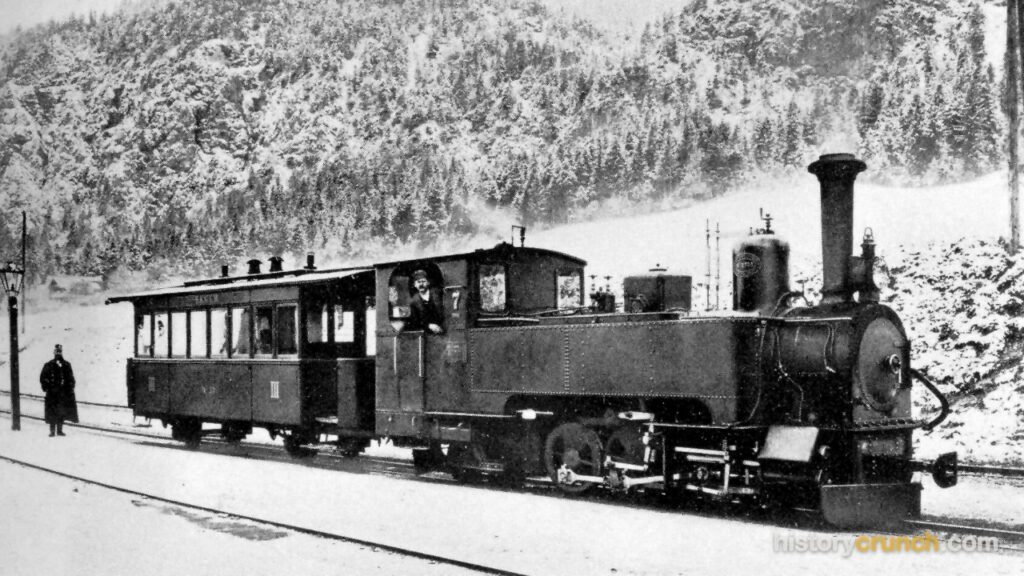
A steam locomotive is a rail vehicle powered by a steam engine. It works by burning fuel, usually coal or wood, to heat water inside a boilerA sealed tank inside a locomotive where water is heated by burning fuel until it turns into pressurized steam. until it becomes steam. That steam is then used to push pistonsSliding parts inside a steam engine that are pushed back and forth by steam pressure to turn the wheels. back and forth, and the moving pistons turn the wheels that pull the train along the rails. A railroad, meanwhile, is the track and system of metal rails on which the locomotive and its cars run.
 FactsthatCrunch
A steam locomotive converted burning coal into moving steam, then used that steam to push pistons that turned the driving wheels and pulled the train along the rails.
What Was the Industrial Revolution?
The Industrial Revolution was a period of major industrialization that took place from the late 1700s until the early 1900s. During this time, economies that had long been based on farming and hand production shifted toward machines, factories, and industrial production. The revolution first began in Britain in the 18th century and soon spread to the rest of Europe and North America.
Several factors helped trigger this change in Britain. For instance, the British Agricultural Revolution increased food production, which led to population growth and pushed farm workers to move into growing cities in search of jobs. In addition, Britain had large supplies of coal and iron ore, which were essential for building machines and providing energy. As factories multiplied and cities swelled, the need for a better way to move raw materials and finished goods grew rapidly, and this demand set the stage for the railroad.
How Did People Travel Before the Steam Locomotive?
Before the arrival of steam-powered trains, transportation on land was slow, expensive, and limited. Goods and people moved by horse-drawn wagon along rough roads, or by boat along rivers and canals. Along the coast, sailing ships carried heavy cargo from port to port. All of these methods depended on animal muscle or the wind, which meant that trade could only move as fast as a horse could walk or a ship could sail.
Long before the steam locomotive, mines used simple tracks called wagonwaysEarly mining tracks where horses pulled wagons along wooden or iron rails to move heavy loads more easily. to move heavy loads. On these early routes, horses pulled wagons along wooden or iron rails, which reduced frictionThe resistance that slows objects moving against each other, which iron rails reduced compared to rough dirt roads. and allowed a single animal to haul much heavier loads than it could on a normal road. In fact, these mining wagonways were used to carry coal to nearby rivers, where the coal could be loaded onto boats. The idea of running wagons on rails was therefore already common, and inventors soon began to imagine replacing the horse with a machine.
FactsthatCrunchBefore steam railroads, a horse pulling a wagon on a rough dirt road could move only a small load, but the same horse pulling wagons along the rails of a wagonway could haul many times that weight.
Wagonways at British coal mines, first built with wooden rails and later with iron, cut friction so much that one animal could do the work of several. Mine owners used them to move coal to nearby rivers and canals for loading onto boats. Rails were already common at mines long before Richard Trevithick built his steam locomotive in 1804.
Who Invented the Steam Locomotive?
The steam locomotive grew out of the steam engine, one of the most important inventions of the entire Industrial Revolution. Earlier steam engines had been used to pump water out of coal mines, but they were large and stayed in one place. The key breakthrough came when engineers developed lighter, high-pressure steam engines that were small and powerful enough to be mounted on wheels and moved from place to place.
The first person to build a successful steam locomotive was Richard Trevithick, a British engineer from Cornwall. On February 21st, 1804, his locomotive ran along a tramwayAn early rail track, similar to a wagonway, on which Trevithick’s first locomotive made its historic run in 1804. at the Penydarren ironworks in South Wales, hauling a load of iron and passengers about 9 miles (14 km). This was the first locomotive in the world to run on rails. However, Trevithick’s engine was heavy and often broke the brittle cast-iron rails of the time, so it ran only a few trips before being set aside.
Over the next two decades, engineers improved on Trevithick’s ideas. The most famous of these was George Stephenson, who is often called the father of the railways. Stephenson built locomotives to haul coal at the mines where he worked, and he also helped strengthen the tracks so they could carry heavy engines. His work, along with the improvement of iron production, helped turn the steam locomotive from an unreliable experiment into a practical machine.
What Were the First Railroads?
The first modern railroad system began operating in England in 1825. Known as the Stockton and Darlington Railway, it ran from the coal fields near Darlington in the north of England to the town of Stockton, which sat close to ports where the coal could be loaded onto ships. Designed with the help of George Stephenson, it became the first public railway to use steam locomotives, and one of its early runs was hauled by a Stephenson locomotive.
An even more important step came in 1829, when a competition called the Rainhill TrialsA competition held in 1829 to find the best locomotive design for the new Liverpool and Manchester Railway. was held to find the best locomotive for a new line between the cities of Liverpool and Manchester. The winner was the Rocket, a locomotive built by George Stephenson and his son Robert. The Rocket used a boiler with many small tubes running through it, a design that produced steam more efficiently and became the standard for locomotives that followed.
The Liverpool and Manchester Railway opened in 1830 and became the first fully timetabledRunning on a fixed, published schedule so passengers and shippers know exactly when trains will depart and arrive. railway service, relying entirely on steam locomotives to pull both passenger and freight trains on a regular schedule. More specifically, it connected two major industrial cities and proved that railroads could move large numbers of people and huge amounts of cargo quickly and dependably. Its success set off a wave of railroad building that spread across Britain and then around the world.
FactsthatCrunchWhat was the key design feature that allowed the Rocket to win the 1829 Rainhill Trials?
How Did Railroads Spread Around the World?
After the success of the early British lines, railroad construction expanded at a remarkable pace. Britain, as the birthplace of the technology, built the first modern railways, and its engineers and locomotives were soon in demand elsewhere. In the early 1800s, the United States imported locomotives from Britain before beginning to build its own around 1830.
As railroads spread across Europe and North America, they knitted together distant regions that had once been nearly cut off from one another. Building these lines required enormous amounts of money, iron, and labor. In fact, a single railroad could cost around two million dollars, an enormous sum in the 1800s, which meant that railroads also became major businesses that attracted large amounts of investment.
FactsthatCrunchBy 1860, the United States had laid more than 30,000 miles (48,000 km) of railroad track, more than any other country, even though America had built almost no railroads before 1830.
Britain opened the first public steam railroad in 1825 and gave the world the technology, yet American builders quickly caught up. In 1830 the United States had fewer than 100 miles (160 km) of track. Thirty years later, its network was the longest of any single country.
How Did Railroads Change Industry and Daily Life?
Railroads and industry grew hand in hand, each one pushing the other forward. Steam railroads sped up industrialization, and industrialization in turn sped up the building and improvement of railroads. As factories produced more goods and mines dug out more coal, the demand for fast transportation guaranteed steady business for the railroads.
The railroad also created huge numbers of new jobs and boosted other industries. For instance, more factories were needed to build locomotives, rails, signals, switches, and railcars, while thousands of workers were hired to lay new track. Because goods and salesmen could now travel quickly, sales happened faster, and the money earned could be reinvested in new lines and more manufacturing. As stated above, the growing demand for coal and iron kept both the railroads and the factories busy for decades.
For ordinary people, the railroad changed daily life in dramatic ways. Travel that had once taken days by horse could now be done in hours, and ordinary families could journey to places they had never seen before. Fresh food, mail, newspapers, and manufactured goods could reach distant towns quickly and cheaply, which helped tie scattered communities into a single connected society.
FactsthatCrunchThe Liverpool and Manchester Railway opened in 1830 as the first fully timetabled steam railway, proving that railroads could move large numbers of people and huge amounts of cargo quickly and dependably. Its success set off a wave of railroad building across Britain and then around the world.
Railroads and industry grew together, each pushing the other forward. Travel that had once taken days by horse could now be done in hours, and ordinary families could reach places they had never visited before.
Significance of Steam Locomotive and Railroads in the Industrial Revolution
The steam locomotive and the railroads stand as some of the most important achievements of the Industrial Revolution because they revolutionized transportation and made rapid industrial growth possible. By moving raw materials like coal and iron faster and cheaper than ever before, railroads fueled the growth of factories and helped spread industry across whole continents.
Railroads also reshaped society in lasting ways. They encouraged the growth of cities, opened up new markets, and created a modern economy built on speed and connection. In reality, the network of tracks that spread across Britain, Europe, and North America laid the foundation for the fast, interconnected world that still exists today, and steam remained the dominant form of rail power until well into the 20th century. For these reasons, the railroad is remembered as one of the defining symbols of the Industrial Revolution.
FactsthatCrunchRailroads became a defining symbol of the Industrial Revolution because they connected raw materials, factories, cities, and ports into one fast network that made large-scale industry possible for the first time.
They moved coal and iron faster and more cheaply than horses or canal boats, which allowed factories to grow larger and produce more goods than ever before.
The Liverpool and Manchester Railway, which opened in 1830 as the first fully timetabled steam railway, proved that railroads could reliably carry both passengers and freight on a fixed schedule, giving businesses a dependable system they could plan around.
Railroads created a wave of new jobs and boosted related industries, since building and running a single line required workers to manufacture locomotives, lay iron rails, and operate signals and switches.
Because goods and fresh food could reach distant towns quickly and cheaply, scattered communities tied together into a single connected economy, which reshaped daily life far beyond the factory floor.
Key Vocabulary
Wagonways
Boiler
Pistons
Tramway
Rainhill Trials
Timetabled
Friction
Frequently Asked Questions
Who Built the First Steam Locomotive?
Richard Trevithick built the first steam locomotive to run on rails, which operated in South Wales in 1804. He was a Cornish engineer who pioneered the use of high-pressure steam, making the engine small and powerful enough to move on its own. His locomotive proved the idea worked, even though the fragile iron rails of the time could not handle its weight for long.
What Was the Rocket Locomotive?
The Rocket was a famous locomotive built by George and Robert Stephenson in 1829 that won a competition called the Rainhill Trials. Its advanced boiler design made it faster and more efficient than its rivals. The Rocket’s success helped launch the Liverpool and Manchester Railway and set the standard for locomotive design for years afterward.
How Fast Were Early Steam Trains?
Early steam trains traveled far faster than horses but were slow by modern standards, often running between about 12 and 30 miles per hour (19 and 48 km/h) in their first decades. Even these speeds amazed people who were used to the pace of a walking horse. As engineering improved through the 1800s, locomotives grew larger, stronger, and much quicker.
Why Were Railroads So Important to the Industrial Revolution?
Railroads were important because they moved raw materials and finished goods quickly and cheaply, which allowed factories to grow and industry to spread. They also created huge numbers of jobs and encouraged huge investments in iron, coal, and manufacturing. Without fast transportation, the rapid growth of industrial cities would not have been possible.
What Fuel Did Steam Locomotives Use?
Steam locomotives were most often powered by coal, though wood and later oil were also used. The fuel was burned in a firebox to heat water in the boiler and turn it into steam. Because coal was cheap and plentiful in industrial nations like Britain, it became the main fuel that kept trains running across the growing railroad networks.
Cite This Article
To cite this article as a source, use one of the formats below.
MLA: Millar, B. “Steam Locomotive and Railroads in the Industrial Revolution: A Detailed Summary.” HistoryCrunch, 12 August 2026, https://historycrunch.com/steam-locomotive-and-railroads-in-the-industrial-revolution/.
APA: Millar, B. (2026). Steam Locomotive and Railroads in the Industrial Revolution: A Detailed Summary. HistoryCrunch. https://historycrunch.com/steam-locomotive-and-railroads-in-the-industrial-revolution/
Chicago: Millar, B. “Steam Locomotive and Railroads in the Industrial Revolution: A Detailed Summary.” HistoryCrunch. August 12, 2026. https://historycrunch.com/steam-locomotive-and-railroads-in-the-industrial-revolution/
Sources
- Robert C. Allen, The Industrial Revolution: A Very Short Introduction.
- Joel Mokyr, The Enlightened Economy.
- Emma Griffin, A Short History of the British Industrial Revolution.