The soviets were among the most important institutions of the Russian Revolution of 1917, and they helped shape the course of Russian history in the early 20th century. In simple terms, a soviet was a council of workers, soldiers, and peasants that gave ordinary Russians a direct voice in politics during a time of massive upheaval. These councils grew powerful enough to rival the official government of Russia, and one of them eventually helped the Bolsheviks seize control of the country and build the world’s first communist state.
The word “soviet” is simply the Russian term for “council” or “assembly.” More specifically, a soviet was a locally elected council made up of representatives chosen by factory workers, soldiers, and peasants to speak and act on their behalf. Because these councils were rooted in the working class rather than the wealthy or the nobility, they became a powerful symbol of the demand for change and gave everyday people a way to organize during the revolution.
What Was the Russian Revolution?
The Russian Revolution of 1917 was one of the most significant events of the early 20th century. It involved the downfall of the monarchy of Russia and led to the establishment of the world’s first communist state. In fact, it marked the end of the Romanov dynasty, which had ruled Russia for centuries, and set the stage for the birth of the Soviet Union.
The revolution unfolded in two major stages during the same year. The first was the February Revolution of 1917, which forced Tsar Nicholas II to give up his throne and ended tsarist rule. The second was the October Revolution of 1917, in which the Bolsheviks, a radical socialist group led by Vladimir Lenin, seized power from the temporary government that had replaced the tsar.
Several deep problems caused the revolution. These included anger toward the tsar and the government of Russia, economic hardship and food shortages, and widespread discontent over Russia’s costly role in World War I. As these pressures mounted, ordinary Russians looked for new ways to represent themselves, and the soviets became one of the most important of those ways.
Where Did the Soviets Come From?
The soviets first appeared not in 1917 but during an earlier uprising known as the Russian Revolution of 1905. That revolution began after an event called Bloody Sunday, in which the tsar’s troops fired on peaceful protesters in the capital. In response, angry workers launched strikes across the country, and to organize these strikes they formed councils that they called soviets.
These early soviets gave workers a shared identity and a way to coordinate their demands. Although the 1905 revolution ultimately failed to overthrow the tsar, it taught Russian workers valuable lessons about organizing. For this reason, historians sometimes describe 1905 as a kind of practice run for the far larger revolution that would follow in 1917.
When revolution broke out again in February of 1917, the memory of these councils was still fresh. As the tsarist government collapsed, workers and soldiers in the capital quickly revived the idea and elected new soviets. In this way, an institution born in defeat in 1905 returned to play a central role in the events that finally toppled the monarchy.
What Was the Petrograd Soviet?
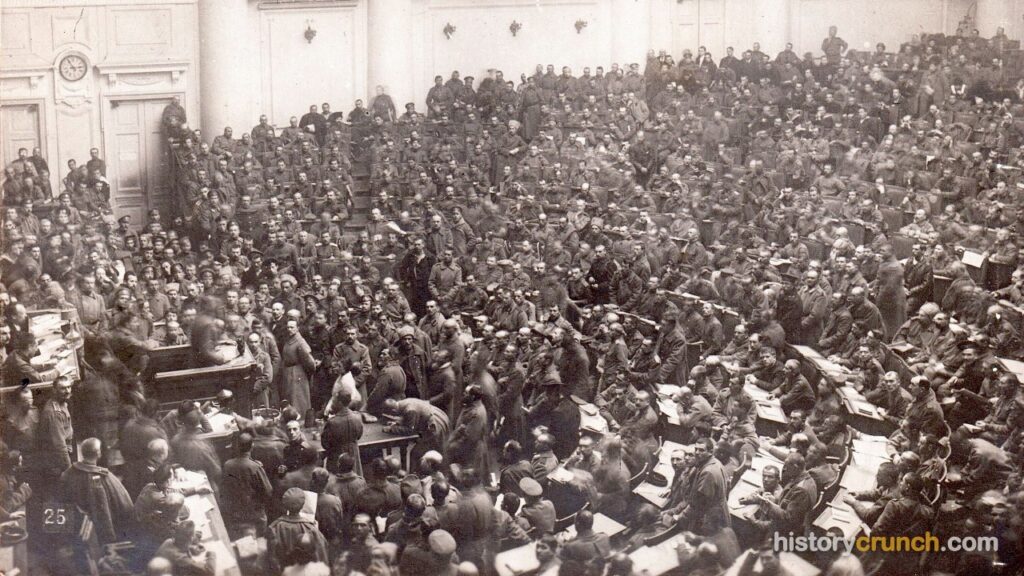
The most important of all the councils was the Petrograd Soviet, formed in the Russian capital, then called Petrograd (modern-day St. Petersburg), in the middle of the February Revolution. It was known as the Soviet of Workers’ and Soldiers’ Deputies because it drew its members from both factory workers and the soldiers of the city’s garrison. Because it represented the very people who made the revolution possible, it held enormous influence over events in the capital.
In its early months, the Petrograd Soviet was led mostly by moderate socialist groups, including the Mensheviks and the Socialist Revolutionaries. The Bolsheviks were only a small minority within it at first. Even so, the Soviet quickly became one of the two most powerful bodies in Russia, since it commanded the loyalty of the workers and soldiers who actually controlled the streets.
One of the Soviet’s most famous actions came very early. On March 1st, 1917, it issued a decree known as Order Number One, which reshaped the way the Russian military was run and made clear how much authority the Soviet intended to claim for itself.
What Was Order Number One?
Order Number One was the first major decree issued by the Petrograd Soviet, and it dramatically shifted power within the armed forces. The order instructed soldiers to elect committees from their own ranks and told units that in political matters they should obey the Soviet rather than any other authority. It also stated that weapons should be placed under the control of these elected committees instead of the officers.
The order made an important exception. While on duty and in battle, soldiers were still expected to obey their officers and keep military discipline. Off duty, however, they were to enjoy the same rights as any other citizen, and their political loyalty belonged to the Soviet.
The effect of Order Number One was to place the loyalty of the soldiers in the hands of the Petrograd Soviet. In reality, this meant that whoever controlled the Soviet could also influence the army, which was one of the most important sources of power in the entire country. As a result, the new temporary government that formed at the same time would struggle to give commands that the soldiers would actually follow.
How Did Dual Power Work?
After the February Revolution, two separate centers of power emerged to replace the fallen tsarist government. One was the Provisional Government, a temporary body made up of liberal and moderate politicians who had come out of the old parliament, known as the Duma. The other was the Petrograd Soviet, which spoke for the workers and soldiers. Historians call this unusual arrangement “dual power.”
Under dual power, the two bodies had very different strengths. The Provisional Government held formal, legal authority and was recognized as the official government of Russia. The Petrograd Soviet, however, held the real ability to get things done, because it controlled the loyalty of the troops, the railways, and the factory workers. In short, the government had authority without real power, while the Soviet had power without formal authority.
This divided system was unstable from the start. The Provisional Government wanted to keep Russia in World War I and delayed major reforms such as giving land to the peasants. Many members of the soviets grew frustrated with these decisions, and the gap between the two centers of power widened over the course of 1917. This growing tension created an opening that a determined political group could exploit.
How Did the Bolsheviks Use the Soviets?
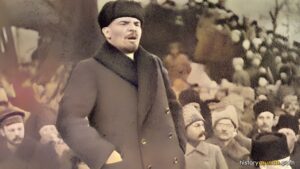
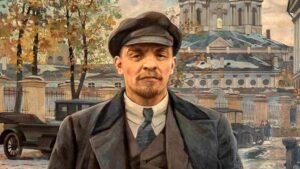
The Bolsheviks, led by Vladimir Lenin, understood that the soviets were the key to seizing power. Rather than trying to work through the Provisional Government, Lenin argued that all authority should be handed to the soviets, summed up in the famous slogan “All Power to the Soviets.” This message appealed to workers and soldiers who were tired of war and hunger.
Over the course of 1917, the Bolsheviks steadily gained support inside the soviets, especially in Petrograd. As the Provisional Government lost popularity, more deputies sided with the Bolsheviks, until the party controlled the Petrograd Soviet. This gave Lenin and his followers a base of real power in the capital.
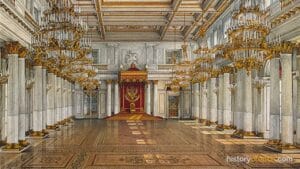
In October of 1917, the Bolsheviks used this position to stage a coup. Bolshevik forces, along with the Red Guard and sailors from the Kronstadt naval base, stormed the Winter Palace in Petrograd and arrested the ministers of the Provisional Government. Following this, the All-Russian Congress of Soviets, dominated by the Bolsheviks and their allies, announced the formation of a new government called the Council of People’s Commissars, with Lenin at its head.
Significance of Soviets in the Russian Revolution
The soviets were one of the most important reasons the Russian Revolution succeeded and took the direction that it did. They gave workers, soldiers, and peasants a way to organize and act that the old tsarist system had never allowed. Without these councils, the ordinary people of Russia would have had far less ability to shape the events of 1917.
The soviets also gave the new communist state its very name and its basic structure. When the country was reorganized in the years after the revolution, it became known as the Union of Soviet Socialist Republics, or the Soviet Union, named directly after these councils. In theory, the soviets remained the foundation of government, even as real power came to rest firmly in the hands of the Communist Party.
Finally, the example of the soviets spread far beyond Russia. The idea of workers’ councils inspired revolutionaries in other countries throughout the 20th century and became closely linked with the overall history of communism. As such, the soviets stand as one of the lasting legacies of the Russian Revolution and a key part of how the modern world took shape.
Frequently Asked Questions
What is a soviet in simple terms?
A soviet was an elected council of workers, soldiers, or peasants in Russia. The word simply means “council” in Russian. These councils allowed ordinary people to choose representatives who would speak for them, make decisions, and organize action during the revolution, giving the working class a level of political power it had never held under the tsar.
When were the first soviets created?
The first soviets were created during the Russian Revolution of 1905, more than a decade before the more famous revolution of 1917. Workers formed them to coordinate strikes against the tsar’s government. Although the 1905 uprising was crushed, the idea of the soviet survived and returned with great force when revolution broke out again in 1917.
What was the difference between the Petrograd Soviet and the Provisional Government?
The Provisional Government was the official government of Russia after the tsar fell, while the Petrograd Soviet represented the workers and soldiers. The government held legal authority but little real control, and the Soviet held real influence over the streets and the army but no official title. Their overlapping authority is what historians call dual power.
What did the slogan “All Power to the Soviets” mean?
“All Power to the Soviets” was a Bolshevik slogan calling for the councils, rather than the Provisional Government, to run the country. Lenin used it to win over workers and soldiers who were angry about continued war and hunger. The slogan helped the Bolsheviks build support inside the soviets and prepare the way for their takeover in October of 1917.
Why is the Soviet Union named after the soviets?
The Soviet Union took its name from the councils that helped bring the Bolsheviks to power. When the new communist state was organized after the revolution, it was officially called the Union of Soviet Socialist Republics to reflect the idea that government rested on these workers’ and peasants’ councils. In practice, however, the Communist Party held the true power in the country.
Cite This Article
To cite this article as a source, use one of the formats below.
MLA: Millar, B. “Soviets in the Russian Revolution: A Detailed Summary.” HistoryCrunch, 11 August 2026, https://historycrunch.com/soviets-in-the-russian-revolution/.
APA: Millar, B. (2026). Soviets in the Russian Revolution: A Detailed Summary. HistoryCrunch. https://historycrunch.com/soviets-in-the-russian-revolution/
Chicago: Millar, B. “Soviets in the Russian Revolution: A Detailed Summary.” HistoryCrunch. August 11, 2026. https://historycrunch.com/soviets-in-the-russian-revolution/
Sources
- S.A. Smith, Russia in Revolution: An Empire in Crisis 1890-1928.
- Orlando Figes, A People's Tragedy.
- Library of Congress — Revelations from the Russian Archives