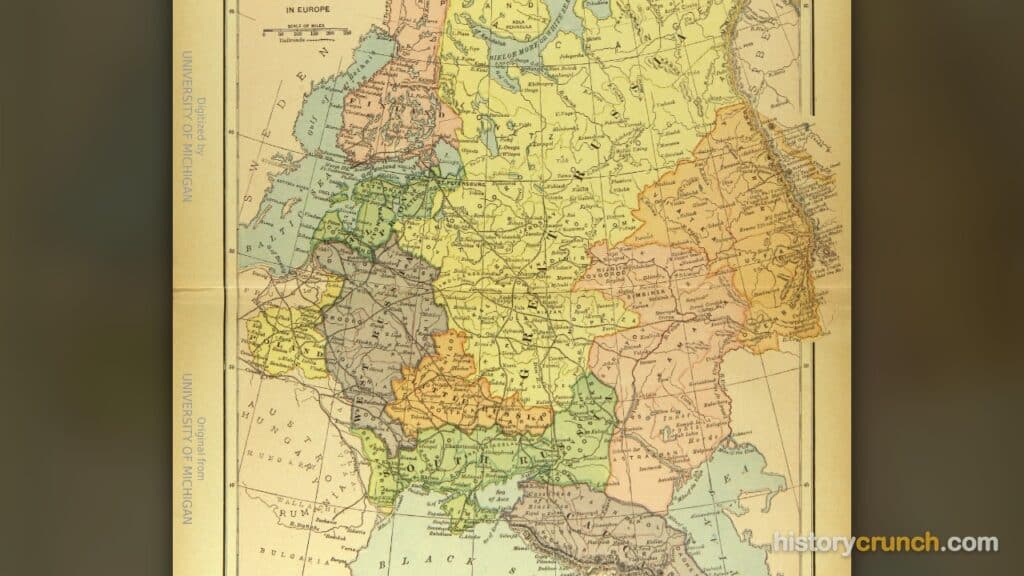
Russia was one of the most important and unusual powers of the Age of Imperialism, a time period that ran from the mid-18th century until the early part of the 20th century and saw the major nations of the world expand their influence across large sections of the globe. While Britain, France, and other European countries built overseas empires by sailing to distant colonies in Africa and Asia, Russia expanded outward across land. In fact, the Russian Empire pushed its borders south into the Caucasus and Central Asia and east across Siberia toward the Pacific Ocean, creating one of the largest land empires in world history.
Imperialism is the term used to describe the process by which one country extends its political, economic, or cultural control over another country or region. In the case of Russia, this control was gained by conquering neighboring peoples and territories along the edges of the empire and then ruling them from the capital. Because these new lands touched Russia directly rather than lying across an ocean, the Russian version of imperialism is often described as continental or overland expansion.
What Was the Age of Imperialism?
The Age of Imperialism was a major period in world history that saw the powerful nations of the time expand their empires and exert their influence across large sections of the globe. It occurred from the middle of the 18th century until the early years of the 20th century. During this era, the major European nations, along with the United States, Russia, and Japan, competed to claim territory and resources in Africa, Asia, and the Pacific.
Historians have identified several main causes of the Age of Imperialism. These included economic motives, the desire to colonize and resettle growing populations, religion, ethnocentrism, and national prestige. More specifically, industrial nations wanted raw materials for their factories and new markets in which to sell finished goods, and they also wanted to appear powerful in front of their rivals. For instance, the competitive nature of this era can best be seen in the Scramble for Africa, which occurred from 1870 until 1914 and saw almost all of Africa divided among the European powers.
Russia shared many of these same motives but pursued them in its own way. Rather than racing for overseas colonies, Russia expanded across the connected landmass of Eurasia. As a result, the empire grew steadily outward from its center, absorbing new peoples, languages, and religions as it went.
How Did Russia Expand as an Empire?
Russian expansion began long before the Age of Imperialism, as tsars had pushed east into Siberia as early as the 16th century. However, the pace and scale of this expansion increased dramatically during the 18th and 19th centuries. By the height of the imperial period, the Russian Empire stretched from Eastern Europe all the way to the Pacific Ocean, covering roughly one sixth of the earth’s land surface.
This enormous empire contained a remarkable mix of peoples. In fact, more than 130 languages were spoken within its borders, and its population included Orthodox Christians, Muslims, Buddhists, Jews, and followers of many local religions. As stated above, this diversity was the direct result of conquering so many different regions and folding them into a single state ruled from the imperial capital.
The Russian government did not always try to include these peoples equally. Instead, the empire often carried out a policy known as Russification, which aimed to spread the Russian language and culture and to weaken the identity of national minorities. More specifically, local languages and traditions were pushed aside in favor of Russian ones, which created lasting resentment among many groups inside the empire.
Expansion into the Caucasus and Central Asia
During the first half of the 19th century, Russia pressed south into the Caucasus, the strip of land between the Black Sea and the Caspian Sea. Through long wars against the Ottoman Turks and the Persians, Russia gradually gained control of this mountainous region. For example, the empire pushed its southern boundary forward in stages, planting new borders in the 1820s and later reaching the city of Kars in 1878.
In the second half of the same century, Russia turned its attention to Central Asia, a region often called Turkestan. There the empire conquered a series of Muslim states, including the khanates centered on cities such as Bukhara, Samarkand, and Khiva. These conquests were achieved at relatively little cost in soldiers and money, and they gave the tsars control of a vast area of great geographic and human diversity.
To hold and connect these distant lands, Russia built railroads across the region. For instance, the Trans-Caspian Railroad reached Samarkand by 1888, and the Orenburg to Tashkent line was completed between 1899 and 1905. These railways began mainly as military tools that allowed the Russian army to move troops quickly and to respond to local resistance, but they later carried settlers, cotton, and other goods as well.
Expansion East Toward the Pacific
At the same time, Russia continued to push east across Siberia toward the Pacific Ocean. This region was rich in furs, minerals, and land, but it was also thinly settled and extremely difficult to travel across because of its harsh winters and enormous distances. In 1858 and 1860, Russia gained control of the Maritime Province in the Far East, and there it founded the port city of Vladivostok, which became the empire’s main outlet on the Pacific.
The greatest tool of this eastward expansion was the Trans-Siberian Railroad. This transcontinental line was intended to supply and populate Siberia, deliver raw materials to industries in the west, and extend Russian influence into East Asia. In reality, the railway helped unite the European and Asian halves of the empire into a single connected whole, much as railroads to the Pacific had done in the United States and Canada.
Russia’s move toward the Pacific also brought it into contact, and competition, with other imperial powers. More specifically, Russian expansion began to press on the interests of China and Japan, as well as on those of Britain and other Europeans active in the region. This growing rivalry set the stage for a serious conflict in the Far East.
Why Did the Russo-Japanese War Happen?
By the early 20th century, Russia and Japan were both trying to gain greater influence over Manchuria and Korea in northeastern Asia. Russia had moved into Manchuria and had taken control of Port Arthur, a warm water port that offered great strategic and commercial value. As the ambitions of the two empires increasingly overlapped, a clash became more and more likely.
The Russo-Japanese War broke out in 1904 when Japanese forces attacked the Russian fleet at Port Arthur, even before the formal declaration of war reached Russia. Over the next year, the two sides fought costly battles on land and at sea, and Japan won most of the major victories. For example, a Russian fleet made the long voyage from the Baltic Sea around Africa and Asia, only to be largely destroyed by the Japanese soon after it arrived in the region.
The war ended with the Treaty of Portsmouth, signed in September of 1905 in Portsmouth, New Hampshire, in the United States. The peace talks were brokered in part by U.S. President Theodore Roosevelt, who later received the Nobel Peace Prize for his role. Under the treaty, Russia recognized Japanese influence in Korea and southern Manchuria and gave up the southern half of Sakhalin Island, which marked a humiliating defeat for the Russian Empire.
How Did Imperialism Affect Russia at Home?
The loss to Japan had powerful effects inside Russia. In fact, the disastrous course of the war helped trigger the Russian Revolution of 1905, a wave of strikes and protests that shook the empire. Faced with this unrest, Tsar Nicholas II was forced to accept limited political reforms, including the creation of a national assembly known as the Duma.
These reforms did not fully solve Russia’s deeper problems. The empire remained an autocracy in which the tsar held enormous power, and its economy was still heavily agricultural compared with the industrializing nations of Western Europe. As a result, the tensions exposed by imperial defeat and domestic upheaval continued to build in the years that followed.
Significance of Russia in the Age of Imperialism
Russia’s role in the Age of Imperialism was significant because it created one of the largest and most diverse land empires in world history. By expanding across the Caucasus, Central Asia, and Siberia, the tsars brought together an enormous variety of peoples, faiths, and languages under a single government. This overland form of imperialism made Russia different from the sea-based empires of Western Europe, yet it produced many of the same effects, including conquest, exploitation, and the suppression of local cultures.
The consequences of this expansion reached far beyond the imperial period itself. When Russia later became the Soviet Union, its leaders drew on many of these older imperial traditions and worked to hold the same vast territory together. In this way, the borders and tensions created during the Age of Imperialism continued to shape the region for much of the 20th century.
Finally, Russia’s experience shows how imperial ambition could backfire. The defeat in the Russo-Japanese War and the unrest that followed weakened the government and revealed deep problems within the empire. As such, Russian imperialism helped set in motion the political changes that would transform the country in the decades ahead.
Frequently Asked Questions
How was Russian imperialism different from British and French imperialism?
Russian imperialism was different mainly because it expanded across connected land rather than across oceans. While Britain and France sailed to distant colonies in Africa and Asia, Russia grew by conquering neighboring regions that touched its own borders. This meant that new territories became part of a single continuous empire instead of separate overseas possessions.
What areas did the Russian Empire control during the Age of Imperialism?
The Russian Empire controlled a huge area stretching from Eastern Europe across northern Asia to the Pacific Ocean. This included the Caucasus region between the Black and Caspian Seas, the Central Asian lands often called Turkestan, and the vast expanse of Siberia. At its height, the empire covered roughly one sixth of the earth’s land surface.
What was Russification?
Russification was a government policy that tried to spread Russian language and culture throughout the empire. Its goal was to make the many conquered peoples more loyal to the state by weakening their own languages, religions, and traditions. This policy often created resentment among national minorities who wished to keep their own identity.
Why was the Trans-Siberian Railroad so important to Russia?
The Trans-Siberian Railroad was important because it tied the enormous Russian Empire together and opened the Far East to development. It allowed people, soldiers, and goods to travel across Siberia far more quickly than before, when travel depended on sledges and rivers. The railway also helped Russia extend its power and trade toward East Asia and the Pacific.
What happened to Russia after it lost the Russo-Japanese War?
After losing the Russo-Japanese War, Russia faced serious unrest at home that grew into the Revolution of 1905. The defeat embarrassed the government and exposed weaknesses in its military and leadership. In response, Tsar Nicholas II agreed to limited reforms, including a national assembly called the Duma, though these changes did not fully calm the empire.
Cite This Article
To cite this article as a source, use one of the formats below.
MLA: Millar, B. “Russia in the Age of Imperialism: A Detailed Summary.” HistoryCrunch, 12 August 2026, https://historycrunch.com/russia-in-the-age-of-imperialism/.
APA: Millar, B. (2026). Russia in the Age of Imperialism: A Detailed Summary. HistoryCrunch. https://historycrunch.com/russia-in-the-age-of-imperialism/
Chicago: Millar, B. “Russia in the Age of Imperialism: A Detailed Summary.” HistoryCrunch. August 12, 2026. https://historycrunch.com/russia-in-the-age-of-imperialism/
Sources
- John Darwin, After Tamerlane / Unfinished Empire.
- Eric Hobsbawm, The Age of Empire 1875-1914.
- State Department — Office of the Historian
- Fordham Modern History Sourcebook