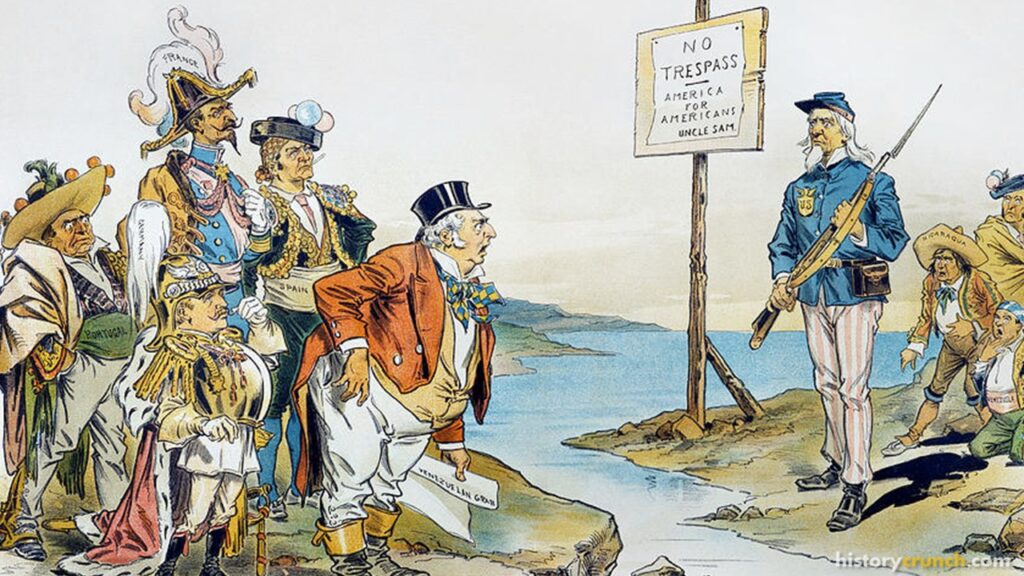
The Monroe Doctrine is an American viewpoint that opposes European imperialism in the Western hemisphere. More specifically, it was first announced by President James Monroe in 1823 as a fundamental element of American foreign policy at the time. This doctrine declared that the Western Hemisphere was off-limits to new European colonization and warned European nations against intervening in the political affairs of the Americas. This article explores the history and significance of the Monroe Doctrine, especially in relation to the era of American Imperialism.
MONROE DOCTRINE – BACKGROUND
In the early 19th century, many Latin American countries were gaining independence from European colonial powers such as Spain and Portugal. At the same time, the United States was emerging as a young nation, eager to assert its influence and protect its interests in the region. This situation posed a potential threat to the sovereignty of newly independent American nations and to the security of the United States. As such, the American government of the time took aim to protect American interests in the region. This led to President James Monroe promoting the doctrine on December 2ns, 1823, as part of his seventh State of the Union Address to Congress.

MONROE DOCTRINE – MAIN PRINCIPLES
The Monroe Doctrine is based on two main principles: ‘non-colonization’ and ‘non-intervention’. For instance, the doctrine asserted that the Americas were no longer open to European colonization. This principle aimed to protect the newly independent nations in Latin America from being dominated again by European powers, and protecting America’s sphere of influence in the region.
The second principle, ‘non-intervention’, stated that European nations should not interfere in the internal affairs of countries in the Western Hemisphere. This was intended to maintain political stability and independence in the region. President James Monroe made it clear that any attempt by European powers to control or influence nations in the Americas would be viewed as a hostile act against the United States.
MONROE DOCTRINE – IMPACT AND SIGNIFICANCE
Initially, the Monroe Doctrine had little immediate impact, as the United States lacked the military power to enforce it. However, it was supported by Great Britain, which had its own interests in preventing the re-colonization of Latin America. Over time, the doctrine became a cornerstone of American foreign policy.
The Monroe Doctrine had long-term implications for American relations with the nations in Latin America. For example, it established the United States as the dominant power in the Western Hemisphere and justified American interventions in Latin American affairs. For instance, during the late 19th and early 20th centuries, the United States invoked the Monroe Doctrine to intervene in various disputes and conflicts in Latin America, often under the pretext of protecting independence and stability. This era was an important aspect of American Imperialism.
With that said, the Monroe Doctrine has also faced criticism for being a tool of American imperialism. Critics argue that it allowed the United States to exert control over Latin American countries and justify interventions that served American interests rather than those of the affected nations.
Despite these criticisms, the Monroe Doctrine has had a lasting legacy. It set a precedent for American involvement in international affairs and influenced subsequent American policies, such as the Roosevelt Corollary and the Truman Doctrine. The principles of the Monroe Doctrine continue to be referenced in discussions of American foreign policy, particularly regarding the Western Hemisphere.