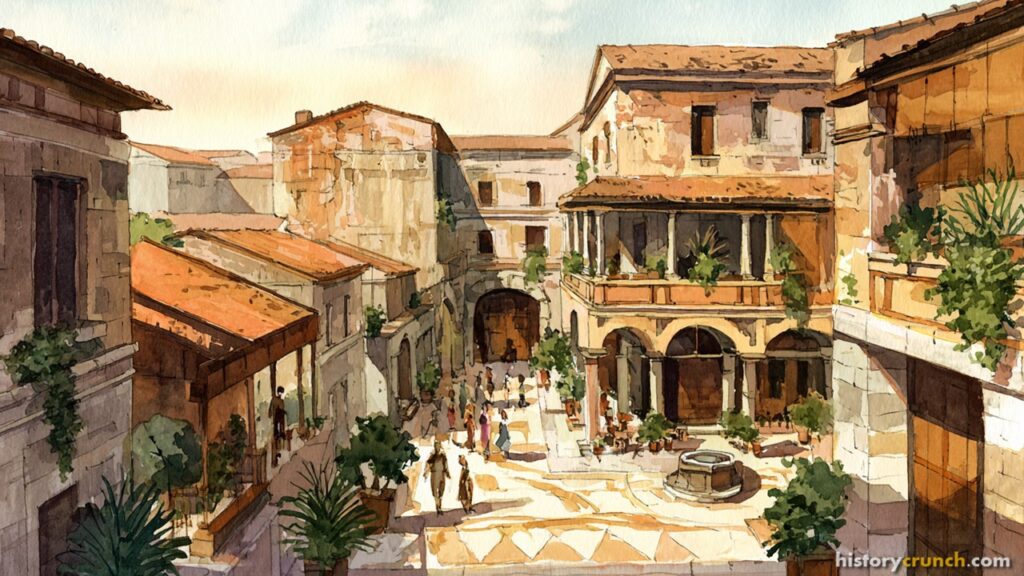
Housing in Ancient Rome was a central aspect of Roman society and the daily lives of the Roman people. The type of home a person lived in depended greatly on their wealth, status and occupation. For instance, the wealthy Romans enjoyed large villas, while the poor lived in crowded apartments. Regardless, housing was an important aspect of the Ancient Roman people.
HOUSING IN ANCIENT ROME – WEALTHY
Wealthy Romans often owned a country estate as well as another home in the city. These estate homes were often attached to farms. Living conditions in these estates were quite comfortable and afforded the people the best that Rome had to offer. These homes were often made of brick and plastered and were often highly decorated on the inside with paintings, carvings and mosaics. As well, these homes often featured a garden which might contain statues, a fountain or a pool.
The type of homes owned by the wealthy were called ‘domus’ and were the typical home of the wealthy elite, such as: senators, nobles and successful merchants. Located in the city or on large estates in the countryside, these houses were built around a central open-air courtyard called an atrium, which served as the heart of the home. The atrium had a rectangular opening in the roof to let in sunlight and rainwater, which collected in a shallow pool below. Surrounding the atrium were various rooms, including bedrooms, dining rooms and a reception area where the owner could host guests.
The domus was not only a place to live but also a symbol of wealth and social standing. Wealthy Romans decorated their homes with mosaics, frescoes and marble sculptures. The floors were often covered with colorful tiles arranged in geometric patterns, while the walls displayed scenes from mythology, nature and daily life in Ancient Rome. Some houses, like those preserved in Pompeii display how advanced Roman interior design was. For instance, some of the uncovered homes had elaborate baths, plumbing and even heated floors. The wealthy also had access to running water supplied by Rome’s famous aqueducts and some homes even had private bathrooms and kitchens.
Outside the city, many wealthy Romans owned villas, which were large country estates used for leisure or agriculture. There were two main types: the ‘villa urbana’, which was a luxurious residence near cities where the wealthy relaxed, and the ‘villa rustica’, which was a working farm managed by servants and slaves.
HOUSING IN ANCIENT ROME – POOR / WORKING CLASS
In contrast, most ordinary Romans lived in ‘insulae’, which were apartment buildings that could rise up to six or seven stories high. These structures housed the working class, which generally consisted of laborers, artisans and shopkeepers. These people made up the majority of Rome’s population. The ground floors of insulae often contained shops or taverns, while the upper floors contained small, cramped apartments. The lower floors were more desirable because they were safer and had better access to water, while the upper levels were cheaper but poorly constructed and prone to fire or collapse.
In Rome, the housing available for people ranged from large apartment blocks to individual homes and estates. The vast majority of people in the cities lived in apartment blocks that could be up to 6 stories high. While some were well built, most apartment blocks were constructed with cheap materials. The walls were generally very thin. It was not uncommon for the poorly built apartment blocks to collapse. Fires were common due to the materials used and these buildings often lacked services such as access to water. Therefore, people were responsible for carrying water up to their own unit.
Living conditions in insulae were often difficult. Apartments were small, dark, and overcrowded, with few windows and no running water. Residents used public fountains and baths for washing and collecting water. Cooking was usually done on small stoves or at local shops. Sanitation was poor and waste was sometimes thrown into the streets. This, obviously, contributed to disease and pollution. Despite these hardships, insulae were essential to housing Rome’s large urban population.