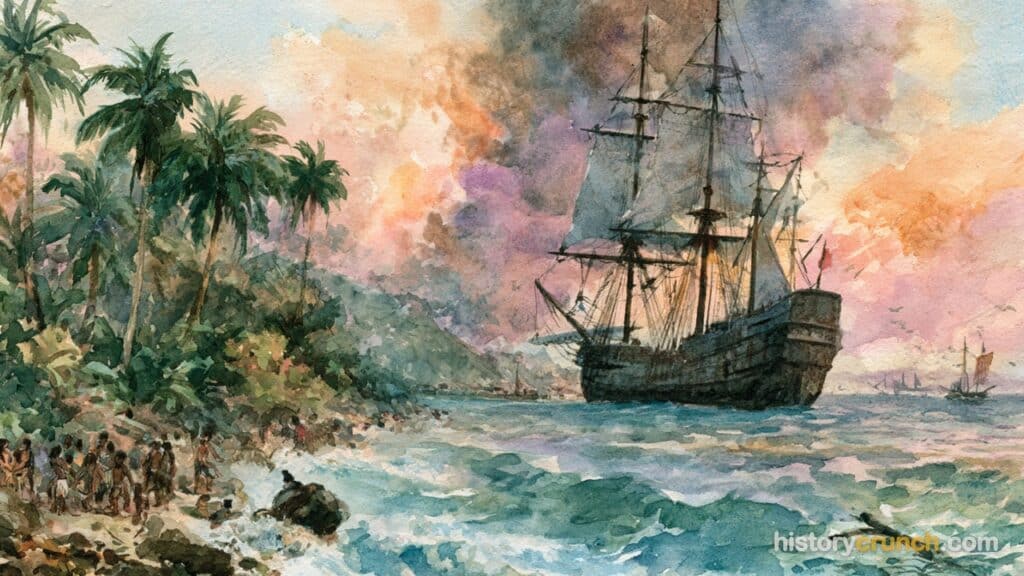
The disease and depopulation of Indigenous peoples is one of the most important and tragic developments to come out of the Age of Exploration. When European explorers and colonists arrived in the Americas after 1492, they carried with them illnesses that the Indigenous peoples of the New World had never encountered. The result was a dramatic decline in the Indigenous population of the Americas, caused primarily by the introduction of new diseases such as smallpox, influenza, and measles, and this catastrophic demographic shift significantly altered the social, cultural, and political landscape of Native American societies and facilitated European colonization and expansion across the continent.
In simple terms, depopulation means a large and rapid drop in the number of people living in a region. In the case of the Indigenous peoples of the Americas, this depopulation happened mostly because of infectious diseases, which are illnesses caused by germs that spread from person to person. These diseases arrived alongside European explorers and settlers and spread far faster than the newcomers themselves, often reaching Indigenous communities before they ever saw a European.
What Was the Age of Exploration?
The Age of Exploration, also called the Age of Discovery, provides the historical background for understanding the depopulation of Indigenous peoples. The Age of Exploration is one of the most important events in the history of the western world, and it began in the early 15th century and continued until the end of the 17th century, involving European explorers using their navigational skills to travel the world. During this time, European nations sent out voyages that connected continents that had long been separated.
In general, the Age of Exploration occurred for several different reasons, particularly in the countries of Portugal, Spain, France and England. These nations bordered the Atlantic Ocean and had access to skilled sailors, ports, and new navigational tools. As a result, they were able to reach the Americas, Africa, and Asia and to build overseas empires.
The exploration and colonization that followed had enormous consequences for the peoples the Europeans encountered. These expeditions resulted in the devastating conquest and colonization of indigenous peoples in the Americas, Africa and Asia. Of all these consequences, the spread of deadly disease was among the most destructive.
What Was the Columbian Exchange?
The depopulation of Indigenous peoples is closely tied to a larger event known as the Columbian Exchange. The Columbian Exchange is the name for the exchange of plants, animals and diseases that occurred between the New and Old Worlds following the major events of the European Age of Exploration. The term is used to describe the movement of living things across the Atlantic Ocean in both directions.
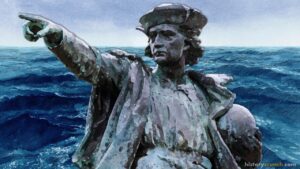
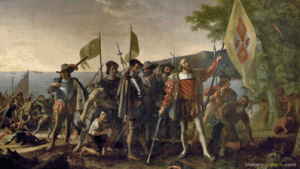
When Christopher Columbus set sail to the Americas in 1493 on his second voyage he brought with him many seeds, plants and livestock, and this cargo started a grand exchange and revolution between the New World and the Old World that would alter the world forever. Foods such as potatoes and maize traveled from the Americas to Europe, while animals such as horses and cattle traveled the other way. Readers can learn more about this topic in the HistoryCrunch article at https://historycrunch.com/columbian-exchange/.
While the exchange of plants and animals reshaped diets and economies, the exchange of diseases proved deadly for Indigenous peoples. European and Asian diseases caused the death of millions in the New World, and smallpox alone was responsible for many deaths, as the indigenous people of the New World had never been exposed to the disease and had not built up immunity. This lack of immunity is the key to understanding why the depopulation was so severe.
Why Did Diseases Spread So Quickly Among Indigenous Peoples?
The main reason diseases spread so fast is that Indigenous peoples had no immunity to them. Immunity is the body’s ability to fight off an illness it has faced before. Diseases introduced by Europeans had no prior exposure among Native American populations, leading to high mortality rates as they lacked immunity.
Europeans, by contrast, had lived alongside many of these diseases for generations and had built up some resistance. Because smallpox had been endemic in Spain for centuries, the Spanish had developed an acquired immunity and were affected relatively little in the epidemic. The word endemic means a disease that is regularly found among a certain group of people. For Indigenous peoples, these same illnesses were brand new and therefore far more dangerous.
The most feared of these illnesses was smallpox, but it was far from the only one. Throughout the sixteenth century and into the seventeenth, twenty-three European infectious diseases appeared in North America, brought not just by the Spanish but by French, Dutch, and British explorers as well, and smallpox, measles, influenza, and the bubonic plague affected Indigenous populations largely east of the Mississippi and in the Southwest. Because Indigenous communities often lived close together and traded over long distances, illnesses spread from village to village with terrible speed.
The suddenness of these outbreaks made them even more deadly. A feature of these new disease outbreaks on a Native population with no previous exposure was their sudden and universal spread, and almost no one was left strong enough to nurse the sick or even provide basic needs. When entire families fell ill at once, there was often no one healthy enough to gather food, carry water, or plant and harvest crops, so many people died not only from the disease itself but from hunger and neglect.
How Did Smallpox Affect the Aztec Empire?
One of the clearest examples of disease and depopulation took place during the Spanish conquest of the Aztec Empire in what is now Mexico. The Aztec Empire smallpox epidemic occurred between 1520 and 1521 and played a pivotal role in the Spanish conquest of the Aztec civilization, beginning when a soldier carrying the virus traveled with Hernán Cortés’s expedition, leading to rapid transmission among the indigenous population, who had no prior exposure or immunity to the disease.
The timing of the outbreak was devastating for the Aztecs. The epidemic struck at a crucial moment, as the Aztecs were already resisting Spanish forces, resulting in devastating fatalities estimated to be between one-third and one-half of the population, which severely weakened the social structure, leadership, and military capability of the Aztecs and contributed to their inability to repel the Spaniards effectively. The disease even killed important leaders, throwing the empire into further disorder.
The Spanish conqueror Hernán Cortés was able to defeat the Aztecs in part because disease had already broken their strength. Through a combination of military force, strategic alliances with indigenous groups, and the devastating spread of European diseases such as smallpox, Cortes was able to conquer the Aztec Empire and bring Mexico under Spanish control. In this way, disease acted almost like a weapon, even though it spread by accident rather than on purpose.
The long-term effects on Mexico’s population were staggering. When Cortés and his army began their campaign against the Aztecs in 1519, over 30 million people were living in Mexico, and one hundred years later, after a series of smallpox epidemics had decimated the local population, it is estimated only around 1.5 to 3 million natives had survived. This was not a single event but a series of repeated outbreaks over many decades.
How Severe Was the Overall Population Loss?
The scale of loss across the Americas is difficult to imagine. Estimates suggest that up to 90 percent of Native American populations were wiped out by disease within the first century of European contact. While exact numbers are impossible to know, nearly all estimates point to a decline that ranks among the greatest population disasters in human history.
Disease often arrived before the Europeans themselves did. Epidemic diseases ravaged coastal tribes even before the arrival of English colonists, allowing settlers to move into largely depopulated regions. This meant that some Europeans found land that seemed empty, not realizing that whole communities had recently died from illness.
It is important to understand that disease was not the only cause of Indigenous suffering. Warfare, enslavement, land expropriation, removals, erasure of identity, and other factors undermined Native populations, and these factors worked together with germs to cause epidemics, worsen mortality, and curtail population recovery. In reality, disease weakened communities so badly that they could not defend their land, which in turn made colonization easier and led to still more loss.
The outbreaks also did not end after the first century of contact. During the nineteenth century, twenty-four epidemics affected Indigenous North Americans, smallpox continued to appear roughly every eight years among some segments of the population, and between the smallpox episodes, Indigenous peoples contracted measles and cholera about every twenty-two years. For many communities, disease remained a constant threat for centuries.
What Were the Effects on Indigenous Societies?
The loss of so many people had effects that reached far beyond the deaths themselves. Entire generations were lost, traditional knowledge was disrupted, and elders, who often held key oral histories, rituals, and medicinal knowledge, died at disproportionate rates. When elders died, priceless knowledge that had been passed down by word of mouth was lost forever.
As populations fell, many communities could no longer continue as they had before. As population densities fell, many indigenous communities were forced to consolidate, migrate, or abandon ancestral lands, accelerating the fragmentation of ethnic and linguistic groups. Villages sometimes merged with neighbors, and once-powerful nations were broken apart.
The depopulation also reshaped the balance of power between Indigenous peoples and Europeans. European populations grew and expanded geographically as declining Indigenous populations relinquished their lands and resources. Over time, land that had belonged to Indigenous nations for thousands of years passed into European hands.
Even so, Indigenous peoples were not simply erased. Despite the catastrophic mortality of the last 500 years, surviving populations proved remarkably resilient and remain demographically viable, in large part because the disease situation improved as time passed since first contact. Many communities survived, adapted, and preserved important parts of their cultures into the present day.
Significance of Disease and Depopulation of Indigenous Peoples
The disease and depopulation of Indigenous peoples stands as one of the most significant outcomes of the Age of Exploration and the Columbian Exchange. The Columbian Exchange played a crucial role in facilitating depopulation among Native Americans through the transfer of diseases from Europe to the Americas, as Europeans settled in the New World and brought with them pathogens that were previously unknown to Indigenous peoples, and the lack of immunity among Native populations resulted in epidemics that decimated communities and made it easier for European powers to establish control over vast territories.
More specifically, disease helps explain how small groups of European explorers were able to conquer large and powerful empires. As stated above, illnesses such as smallpox weakened Indigenous nations before major battles were even fought. In this way, disease shaped the entire course of colonization in the Americas.
Finally, the story of disease and depopulation is significant because its effects are still felt today. Many of the same external threats of epidemics, violence, and displacement continue to adversely affect indigenous populations to this day. Understanding this history helps explain the challenges that many Indigenous communities still face, as well as their long record of survival and resilience.
Frequently Asked Questions
What Diseases Killed the Most Indigenous People?
Smallpox is usually considered the deadliest disease brought to the Americas, but it was joined by many others. Smallpox, measles, influenza, and the bubonic plague affected Indigenous populations across large regions. Later outbreaks of cholera and typhus added to the death toll over the following centuries.
Did Europeans Spread Disease on Purpose?
In most cases, the diseases spread by accident rather than as a planned weapon. In many cases, the spread of disease was not immediately understood by either party, but the impact was unmistakable. People at the time did not yet understand how germs caused illness, so the outbreaks were often a mystery to both Europeans and Indigenous peoples, even though disease still gave Europeans a major advantage.
How Many Indigenous People Died from Disease?
Exact numbers are impossible to know, but the losses were enormous, with some estimates reaching up to 90 percent of the population within a century of contact. In Mexico alone, the population is thought to have fallen from more than 30 million to only a few million within about a hundred years. Because record keeping was limited, historians can only estimate the true scale of the loss.
Why Did Indigenous People Have No Immunity?
Indigenous peoples had no immunity because the diseases were completely new to the Americas and had never circulated there before. The Americas had been separated from Europe, Asia, and Africa for thousands of years, so these illnesses simply did not exist in the New World. As a result, Indigenous bodies had never had the chance to build up any resistance to them.
How Did Disease Help Europeans Conquer the Americas?
Disease helped Europeans by weakening Indigenous nations before and during major conflicts. The Spanish conquistadors, witnessing the devastation wrought by smallpox, took advantage of the weakened state of the Aztecs, which allowed them to conquer Tenochtitlán in 1521 with relatively few soldiers, as the once-mighty Aztec warriors were incapacitated by illness. This pattern repeated across the Americas, where illness cleared the way for European settlement.
Cite This Article
To cite this article as a source, use one of the formats below.
MLA: Millar, B. “Disease and Depopulation of Indigenous Peoples: A Detailed Summary.” HistoryCrunch, 2 August 2026, https://historycrunch.com/disease-and-depopulation-of-indigenous-peoples/.
APA: Millar, B. (2026). Disease and Depopulation of Indigenous Peoples: A Detailed Summary. HistoryCrunch. https://historycrunch.com/disease-and-depopulation-of-indigenous-peoples/
Chicago: Millar, B. “Disease and Depopulation of Indigenous Peoples: A Detailed Summary.” HistoryCrunch. August 2, 2026. https://historycrunch.com/disease-and-depopulation-of-indigenous-peoples/
Sources
- U.S. National Library of Medicine — history of medicine
- CDC — history of disease and pandemics