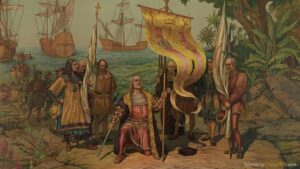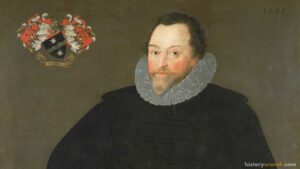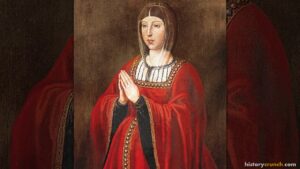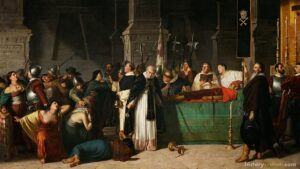
The conquistadors were among the most important figures of the Age of Exploration, because their conquests reshaped the Americas and helped build the largest empire the world had yet seen. The word conquistador is Spanish for “conqueror,” and it describes the soldier-explorers from Spain and Portugal who crossed the Atlantic Ocean in the late 15th and 16th centuries. These men led armed expeditions into lands that were new to Europeans, defeated powerful Native American empires, and claimed vast territories for their kings. Their actions opened the door to Spanish and Portuguese colonization of the New World, but they also caused the destruction of civilizations that had existed for centuries.
A conquistador was not a member of a formal, official army in the way a modern soldier is. Instead, most conquistadors were private adventurers who organized and paid for their own expeditions, often with the hope of winning gold, land, and noble titles. In return for royal permission to conquer, they agreed to give the crown a share of any treasure they found, most famously the “royal fifth,” which was 20 percent of all gold and silver. This mix of private ambition and royal approval made the conquistador a unique figure of the era.
What Was the Age of Exploration?
The Age of Exploration, also called the Age of Discovery, was a period of European overseas travel that began in the early 15th century and continued until the end of the 17th century. During this time, European sailors, navigators, and explorers ventured across the Atlantic, Pacific, and Indian Oceans in search of new trade routes, wealth, and territory. The four nations most closely tied to this era were Portugal, Spain, France, and England, all of which bordered the Atlantic Ocean and had access to skilled sailors and busy sea ports.
Several causes drove this movement, including the search for faster trade routes to Asia, the rise of powerful monarchs who could fund voyages, a desire to spread Christianity, and improvements in navigation and ship design. New vessels such as the caravel and the carrack allowed explorers to sail farther and carry more cargo than ever before. The Age of Exploration led to the creation of overseas colonies and to the Columbian Exchange, which was the transfer of plants, animals, and diseases between the Old World and the New World. It also resulted in the conquest and colonization of Indigenous peoples, and the conquistadors were at the very center of that process in the Americas.
Who Were the Conquistadors?
Most conquistadors were Spaniards, and many came from poorer noble families that had few opportunities at home. A large number came from the region of Extremadura in southwestern Spain, a dry and rugged area where young men had little chance to inherit wealth. For these men, the New World offered the possibility of riches and glory that they could never have won in Europe.
Many conquistadors had grown up in the shadow of the Reconquista, the long centuries of warfare in which Christian kingdoms fought to take back the Iberian Peninsula from Muslim rule. That struggle finally ended in 1492, the same year Christopher Columbus first reached the Americas. As a result, the first generation of conquistadors carried a warlike, crusading spirit and a strong devotion to Catholicism into the New World. They believed they had both a right and a duty to conquer new lands and convert their peoples to Christianity.
It is important to understand that the conquistadors were driven by more than one motivation. In fact, historians often describe their goals with three words: gold, God, and glory. They wanted wealth in the form of gold and silver, they wanted to spread their religion, and they wanted personal fame and social rank. These motives helped push them to take enormous risks in unfamiliar and dangerous lands.
How Did the Conquistadors Defeat Larger Armies?
One of the most surprising facts about the conquistadors is how few of them there were. Expeditions often included only a few hundred men, yet they managed to defeat Native American empires that numbered in the millions. Several advantages help explain these improbable victories.
First, the conquistadors had superior weapons and technology. They carried steel swords, armor, crossbows, and early firearms called arquebuses, and they used cannons that could fire loud, terrifying blasts. They also brought horses, which were unknown in the Americas and gave the Spanish speed and a frightening presence in battle. In addition, some expeditions used trained war dogs to intimidate their enemies.
Second, and even more deadly, was disease. Europeans unknowingly carried illnesses such as smallpox, to which Native Americans had no immunity. These diseases spread rapidly and killed enormous numbers of people, often before the conquistadors even arrived. As a result, the empires the Spanish faced were frequently weakened by sickness and grief.
Third, the conquistadors were skilled at making alliances. Many Native peoples resented the empires that ruled over them and were willing to join the Spanish against a common enemy. By combining their small forces with thousands of Indigenous warriors, the conquistadors could field armies far larger than their own numbers alone.
Conquest of the Aztec Empire
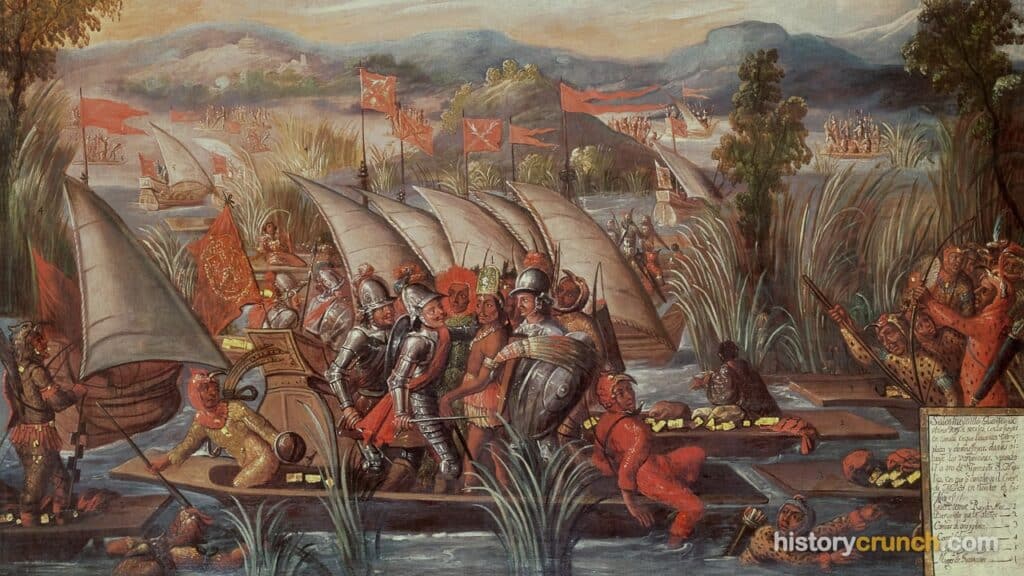
The most famous conquistador was Hernan Cortés, who led the conquest of the Aztec Empire in what is now Mexico. As a young man, Cortés traveled to the Spanish colonies in the Caribbean and later convinced Diego Velasquez, the governor of Cuba, to let him lead an expedition to Mexico. Right before he departed, the order was canceled, but Cortés defied it and sailed anyway with about 11 ships and just over 500 men.
After landing on the coast, Cortés made alliances with peoples such as the Tlaxcala, who were enemies of the Aztecs. He then marched inland toward the great Aztec capital of Tenochtitlan, ruled by the emperor Moctezuma II. More specifically, Cortés used a mix of diplomacy, force, and the help of Indigenous allies to press his advantage. After fierce fighting and a devastating outbreak of disease, the Spanish captured Tenochtitlan in 1521, ending the Aztec Empire and giving Spain control over much of Mexico.
Conquest of the Inca Empire
The other most famous conquistador was Francisco Pizarro, who conquered the Inca Empire in South America. Pizarro was directly inspired by Cortés and had even read accounts of the conquest of the Aztecs. However, Pizarro had far fewer men and fewer resources, which is why his conquest is often called one of the most improbable military victories in recorded history.
In 1532, Pizarro entered the Andes with only 168 Spanish soldiers, along with his brothers and Indigenous allies. He arrived at a fortunate moment, because the Inca Empire had just been torn apart by a civil war between two brothers, Atahualpa and Huascar. At the town of Cajamarca, Pizarro sprang a trap, ambushed the emperor Atahualpa, and captured him in the middle of a huge crowd of his followers.
Atahualpa offered a room filled with gold and silver in exchange for his freedom, and the Spanish accepted the ransom. In reality, once the treasure was paid, Pizarro had the emperor executed anyway. The Spanish then marched on the Inca capital of Cuzco, and by 1533 they controlled much of the empire. A few years later, Pizarro founded the new capital city of Lima, which still exists today.
Other Famous Conquistadors
While Cortés and Pizarro are the best known, many other conquistadors expanded Spanish power across the Americas. For instance, Vasco Núñez de Balboa crossed the Isthmus of Panama and became the first European to see the Pacific Ocean from the New World. Others explored and conquered vast new regions in search of gold and land.
Pedro de Valdivia explored and settled Chile, founding the city of Santiago in 1541. Gonzalo Jiménez de Quesada marched inland from the Caribbean coast and founded the city of Bogotá in what is now Colombia. Still other conquistadors explored parts of the present-day southern and western United States, pushing the reach of Spain across two continents. Together, these expeditions helped Spain build a colonial empire that stretched from North America to the tip of South America.
Significance of Conquistadors
The conquistadors were among the most important figures of the Age of Exploration because their conquests permanently changed the history of the Americas. By defeating the Aztec and Inca Empires, they gave Spain control over huge territories and enormous amounts of gold and silver. This wealth flowed back across the Atlantic and made Spain one of the most powerful nations in the world during the 16th century.
At the same time, the arrival of the conquistadors brought terrible suffering to Native American peoples. Warfare, forced labor, and above all European diseases killed millions of Indigenous people, and ancient civilizations were destroyed forever. The conquistadors also spread the Spanish language and the Catholic religion, both of which remain central to much of Latin America today.
By the middle of the 16th century, the age of the conquistadors was coming to an end. As stated above, these men were given more to fighting and searching for gold than to governing, so the Spanish crown gradually replaced them with trained administrators, settlers, and priests. Even so, the conquistadors left a lasting mark on the modern world, and their expeditions remain one of the most studied and debated parts of the Age of Exploration.
Frequently Asked Questions
What does the word conquistador mean?
The word conquistador is Spanish for “conqueror.” It was used to describe the soldier-explorers from Spain and Portugal who conquered lands in the Americas and beyond during the 15th and 16th centuries. In English, the term is used most often for the Spanish adventurers who conquered the Aztec and Inca Empires.
Where did most conquistadors come from?
Most conquistadors came from Spain, and a large share came from the poor region of Extremadura in the southwest. Many were the younger sons of minor noble families who had little chance to inherit wealth or land at home. The New World offered them a rare opportunity to gain riches and higher social rank.
How were so few conquistadors able to win?
The conquistadors won mainly because of steel weapons, horses, guns, deadly diseases, and Indigenous allies. Native peoples had never faced firearms or horses in battle, which gave the Spanish an early edge. Above all, European diseases like smallpox killed vast numbers of people and weakened the empires before the fighting even began.
Who was the most famous conquistador?
Hernan Cortés is usually considered the most famous conquistador for conquering the Aztec Empire in Mexico. Francisco Pizarro is nearly as well known for conquering the Inca Empire in Peru. Both men became models that later conquistadors tried to copy in their own expeditions.
Why did the age of the conquistadors end?
The age of the conquistadors ended because the Spanish crown wanted stable government rather than constant fighting and treasure hunting. By the mid-16th century, kings began replacing the conquistadors with trained officials, settlers, and priests who could manage the colonies. This shift turned areas of conquest into organized parts of the Spanish Empire.
Cite This Article
To cite this article as a source, use one of the formats below.
MLA: Millar, B. “Conquistadors: A Detailed Overview.” HistoryCrunch, 2 August 2026, https://historycrunch.com/conquistadors/.
APA: Millar, B. (2026). Conquistadors: A Detailed Overview. HistoryCrunch. https://historycrunch.com/conquistadors/
Chicago: Millar, B. “Conquistadors: A Detailed Overview.” HistoryCrunch. August 2, 2026. https://historycrunch.com/conquistadors/
Sources
- The John Carter Brown Library — early colonial Americas
- Henry Kamen, Empire: How Spain Became a World Power, 1492-1763.