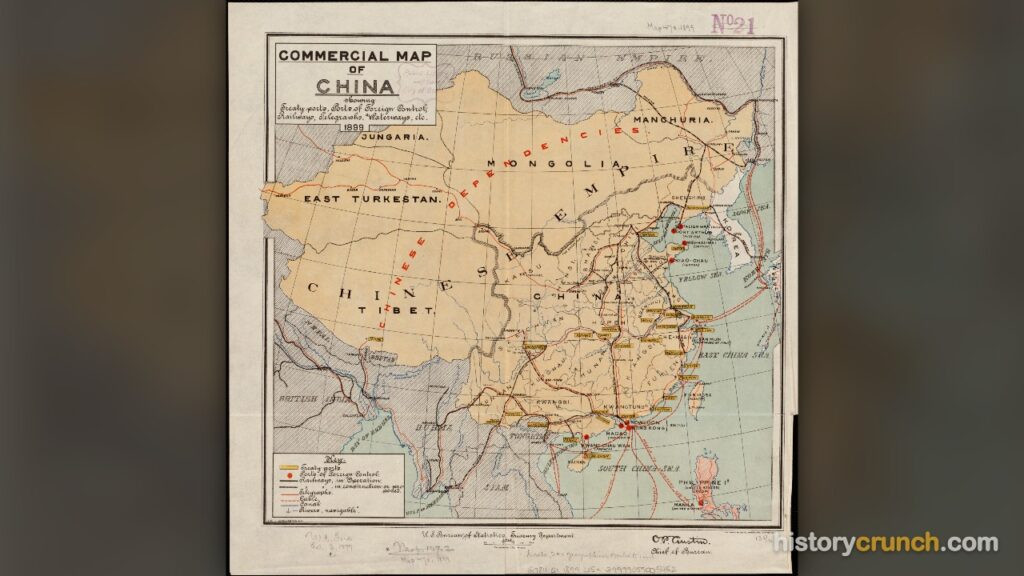
Imperialism in China is considered one of the most important events in world history, and it helped shape the modern nation that China is today. During the 19th century and into the early 20th century, powerful foreign nations forced their way into China, seized control of trade, and claimed large sections of the country as areas they could dominate. Understanding why this happened means looking at the mix of economic ambition, military power, and internal weakness that drew outside nations toward China in the first place.
Imperialism is a term that describes when one country extends its political, economic, or cultural authority over another country or region. This process usually involves the dominant country taking control through direct invasion, through political power, or by gaining authority over the economy of the weaker nation. In the case of China, foreign powers rarely took over the whole country the way they did in some colonies. Instead, they carved out “spheres of influence,” which were regions where a single foreign nation held special trading rights and economic control.
What Was the Age of Imperialism?
The Age of Imperialism was a period from roughly the mid-18th century until the early part of the 20th century. During this time, the major European nations, along with the United States, Russia, and Japan, expanded their influence across large regions of Africa and Asia. Britain built the largest empire of the era, followed by France, while Germany, Belgium, Italy, Portugal, and Spain all played significant roles as well.
Historians usually point to five main causes or motives that drove the Age of Imperialism. These were economic gain, colonization, religion, ethnocentrism, and prestige. Imperialism in China unfolded alongside other major events of this same age, such as British imperialism in India and European imperialism in Africa during the event known as the Scramble for Africa. In fact, the same forces that pushed European nations into Africa also pulled them toward China.
Who Ruled China During This Period?
At the time of foreign imperialism, China was ruled by the Qing Dynasty. The Qing Dynasty existed from the early 1600s until 1912, when the Republic of China replaced it. It was formed after Manchu forces from the northern region known today as Manchuria took over the country and defeated the Ming Dynasty, which had controlled China since the 14th century.
For most of its history, China had been one of the most powerful and wealthy states on earth, and its rulers viewed China as the center of the civilized world. This attitude shaped how the Qing government treated outsiders. More specifically, the Qing tried to keep foreign traders at a distance rather than welcome them as equals, and this clash between Chinese confidence and foreign ambition became a major source of tension.
Economic Causes of Imperialism in China
The most important cause of imperialism in China was economic. The Industrial Revolution, which began in Britain in the late 18th century and spread across Europe in the 19th century, transformed European economies and created a huge demand for both raw materials and new markets. European factories needed places to sell their manufactured goods, and China, with its enormous population, looked like one of the largest possible markets in the world.
China also produced goods that Europeans wanted very much, especially tea, silk, and porcelain. For instance, the demand for Chinese tea in Britain was so great that British merchants were spending huge amounts of silver to buy it. The problem for Britain was that China had little interest in European products and preferred to be paid in silver, which created a serious trade imbalance in China’s favor. This economic frustration became one of the strongest motives for foreign nations to force their way into Chinese markets.
How Did the Canton System Create Tension?
The Qing Dynasty tried to control outside influence through a trading arrangement known as the Canton System. In short, the Canton System forced all foreign nations to trade only at the single port of Canton, a city in southern China that is today called Guangzhou. Foreign companies were also required to deal only with a group of licensed Chinese merchants rather than trade freely throughout the country.
The Qing set up these rules in the hope of limiting the effect of foreigners on Chinese society. However, the system deeply annoyed European merchants because it restricted their access to the rest of the country and to the goods they wanted to buy. As a result, the demand for Chinese products led the European nations, especially Britain and France, to push China to end the Canton System. This push to open China’s markets was a direct cause of the conflicts that followed.
Why Was Opium a Cause of Imperialism?
To fix the trade imbalance, British merchants found a product that Chinese buyers would purchase in large amounts, and that product was opium. Opium is a powerful and addictive drug, and British traders grew it in India and then sold it illegally in China in exchange for silver. That silver was then used to buy Chinese tea and other goods, which reversed the flow of money in Britain’s favor.
As opium use spread, it caused widespread addiction and serious social and economic problems across China. In reality, the drug weakened the workforce and drained silver out of the country. The Qing government viewed opium as both a moral threat and an economic danger, so it cracked down on the trade by seizing and destroying large stores of the drug. This crackdown collided directly with British demands for free trade, and the disagreement helped spark open war.
Military Weakness and the Opium Wars
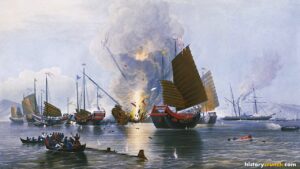
A major reason foreign nations were able to impose imperialism on China was the gap in military technology. The Industrial Revolution had given European armies and navies steam-powered ships, advanced cannons, and modern rifles, while the Qing military still relied on older weapons and tactics. This imbalance became clear during the First Opium War, which took place from 1839 until 1842 between China and Britain.
Britain won the First Opium War, and the defeat forced China to accept the Treaty of Nanking. Under its terms, China had to hand over the island of Hong Kong to Britain, open several ports to foreign trade, and pay large sums of money. A Second Opium War followed from 1856 until 1860, this time with Britain and France fighting against China, and China lost again. These defeats proved how weak the Qing military had become, and that weakness invited even more foreign demands.
Internal Problems Within Qing China
Foreign imperialism did not happen only because outside nations were strong. It also happened because China was growing weaker from within. A rapid rise in population left millions of peasants struggling to survive on small plots of land, while official corruption and rising taxes made daily life even harder.
These pressures helped fuel massive internal uprisings, the largest of which was the Taiping Rebellion that began in 1850. The rebellion caused enormous destruction and drained the Qing government’s soldiers and money. As stated above, a weakened and distracted China was far easier for foreign powers to pressure, and this internal instability became one of the causes that allowed imperialism to deepen.
Competition Among Foreign Powers
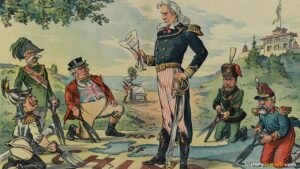
Once the Opium Wars showed how much could be gained in China, other nations rushed to claim their own advantages. Rivalry among the foreign powers became a cause of imperialism in its own right, since no nation wanted a competitor to gain more territory or trade than itself. Britain, France, Germany, Russia, and Japan all sought special rights and pushed to expand their spheres of influence.
This competition mirrored what was happening in Africa during the Scramble for Africa, where the same nations fought to divide up territory. In China, the result was a series of unequal treaties that granted foreigners privileges the Chinese did not have, including the right to be tried under their own laws rather than Chinese ones. The fear of falling behind rivals pushed each nation to demand more, which steadily eroded Chinese control.
Significance of Causes of Imperialism in China
The causes of imperialism in China are significant because they explain how one of the oldest and most powerful civilizations in the world came to be dominated by outside nations. The combination of economic ambition, the opium trade, superior foreign military technology, and internal Qing weakness created the conditions for foreign control. Together, these causes set off a chain of events that historians in China often call the “century of humiliation.”
These causes also had lasting effects on the modern world. The unequal treaties and spheres of influence that followed weakened and eventually helped topple the Qing Dynasty, which fell in 1912. In fact, the resentment created during this period shaped Chinese nationalism and helped drive later movements to rebuild China as a strong and independent nation. For that reason, the causes of imperialism in China remain a key part of understanding both Chinese history and the overall Age of Imperialism.
Frequently Asked Questions
What were the main causes of imperialism in China?
The main causes of imperialism in China were economic ambition, the opium trade, foreign military strength, internal Qing weakness, and competition among rival nations. Each of these worked together, since foreign powers wanted Chinese markets and goods while a weakened China was unable to resist their demands. The result was that outside nations gained growing control over Chinese trade and territory.
Why did European countries want to trade with China?
European countries wanted to trade with China because it offered both valuable goods and a massive population of possible customers. Products like tea, silk, and porcelain were in high demand back in Europe, and factories built during the Industrial Revolution needed new markets to sell their manufactured products. China’s size made it one of the most attractive economic prizes of the entire era.
How did opium lead to imperialism in China?
Opium led to imperialism because Britain used the drug to reverse its trade imbalance and gain a foothold in China. When the Qing government tried to stop the illegal opium trade, the disagreement escalated into the Opium Wars, which China lost. Those defeats forced China to accept treaties that opened the country to even greater foreign control.
Why was China unable to stop foreign powers?
China was unable to stop foreign powers mainly because of the huge gap in military technology and its own internal problems. Industrialized nations had modern warships and weapons, while the Qing military used older equipment and tactics. At the same time, rebellions, corruption, and a growing population weakened the government and left it unable to defend the country effectively.
What were spheres of influence in China?
Spheres of influence were regions of China where a single foreign nation held special economic and trading rights. Rather than taking over the entire country as a colony, powers such as Britain, Germany, Russia, and Japan each controlled sections of China where their businesses had priority. This arrangement allowed multiple foreign nations to profit from China at the same time without going to war with one another.
Cite This Article
To cite this article as a source, use one of the formats below.
MLA: Millar, B. “Causes of Imperialism in China: A Detailed Summary.” HistoryCrunch, 12 August 2026, https://historycrunch.com/causes-of-imperialism-in-china/.
APA: Millar, B. (2026). Causes of Imperialism in China: A Detailed Summary. HistoryCrunch. https://historycrunch.com/causes-of-imperialism-in-china/
Chicago: Millar, B. “Causes of Imperialism in China: A Detailed Summary.” HistoryCrunch. August 12, 2026. https://historycrunch.com/causes-of-imperialism-in-china/
Sources
- Mark Edward Lewis, The Early Chinese Empires: Qin and Han.
- Patricia Buckley Ebrey, The Cambridge Illustrated History of China.
- Fordham East Asian History Sourcebook
- The Met (Heilbrunn Timeline) — Chinese art