The Battle of Crécy was one of the most important battles of the Hundred Years’ WarThe long armed conflict fought between England and France from 1337 to 1453., the long conflict fought between England and France from 1337 to 1453. The Battle of Crécy occurred on August 26, 1346, in Crécy-en-Ponthieu, France. On that day, a smaller English army led by King Edward III crushed a much larger French force under King Philip VI. The victory shocked Europe and showed that a well-organized army of foot soldiers and archers could defeat the mounted knights who had ruled the battlefield for centuries.
A battle is a single armed clash between two military forces, usually fought at one place over a short period of time. Crécy was the first major land battle of the Hundred Years’ War, and it took place in northern France near a small village about 45 miles (72 km) south of Calais. It set the pattern for later English victories and helped make the English longbowA tall English bow, 5 to 6 feet long, that could fire arrows fast enough to pierce armor. famous across the medieval world.
 FactsthatCrunch
The medieval English longbow measured 5 to 6 feet (1.5 to 1.8 m) in length and was most commonly made from yew, with bowstrings of hemp. Arrows were roughly 33 inches (83 cm) long and made of ash or oak to add weight. A trained archer could release approximately 15 arrows per minute, a rate of fire no other hand weapon of the period could match.
Modern competitive archery governing bodies, including World Archery, recognize the longbow as a distinct equipment class in tournaments alongside compound and recurve bows. Clubs across the United Kingdom and the United States hold traditional longbow competitions using bows built to the same general proportions as medieval war bows. Yew is still used by some craftspeople who build traditional English longbows by hand today.
A weapon shaped by medieval English warfare survived into the 21st century as a living sport, with dedicated competitors and craftspeople keeping its design largely unchanged.
Background of the Battle of Crécy
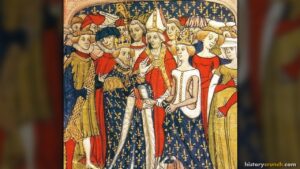
The roots of the battle lay in a bitter dispute over who had the right to rule France. The battle came about because of tensions between France and England that resulted from the death of Charles IV of France without a male heir, and Edward III of England was his closest male relative, but the French crowned Philip VI instead. Edward believed the French throne rightly belonged to him through his mother, Isabella of France, and he never forgot this claim.
At first, Edward accepted the situation. Edward reluctantly accepted this and did homageA formal act of loyalty sworn by a lesser lord to a more powerful ruler over land. for his lands as Duke of Aquitaine, but in 1337 Philip confiscated Aquitaine, precipitating war between the two kingdoms. More specifically, English kings had long held lands in France while also owing loyalty to the French king, and this awkward arrangement caused constant friction. The dispute over Guyenne is even more important than the dynastic question in explaining the outbreak of the war.
In the summer of 1346, Edward decided to strike. In mid-July 1346, Edward landed an invasion force of about 14,000 men on the coast of Normandy, and from there, the English army marched northward, plunderingRaiding and stealing from an enemy’s countryside to damage their resources and morale. the French countryside. This kind of destructive raid, meant to damage the enemy’s land and morale, allowed the English to move quickly and live off the countryside as they went.
King Philip soon gathered a huge army to stop the invaders. Crécy occurred after Edward led a long plundering raid through France, and Philip finally caught up to him with a significantly larger army, but Edward chose his position well to lessen the effectiveness of Philip’s large cavalry. Before the French could trap him, Edward’s men escaped across the Somme River. When Edward learned of a tidal causeway called the Blanchetaque that could be crossed when the tide was out, his men made quick work of it, crossing in less than an hour, easily beating off the French force sent to harass them.
Once safely across, Edward chose ground for the battle he now expected. The English army, numbering some 12,000 to 13,000, of which 6,000 to 7,000 were longbowmen, was aligned on a ridge between Crécy and Wadicourt, and the ground in front of the Crécy-Wadicourt ridge slopes away to a shallow valley with a small river. Fighting on rising ground meant that any French attack would have to charge uphill, making it slower and easier to shoot down.
The two armies were very different in makeup. An army of English, Welsh and allied troops from the Holy Roman Empire led by Edward III faced a much larger army of French, Genoese and Majorcan troops led by Philip VI of France. The French relied on their proud heavy cavalry, the mounted knights who were seen as the finest in Europe, along with thousands of hired Genoese crossbowmenSoldiers who fired a mechanical bow that was powerful but very slow to reload.. The English relied instead on discipline, terrain, and above all the longbow.
The longbow was the key English weapon and the reason the battle turned out the way it did. These longbows measured some 5 to 6 feet (1.5 to 1.8 m) in length and were made most commonly from yew and strung with hemp, and the arrows, capable of piercing armor, were about 33 inches (83 cm) long and made of ash and oak to give them greater weight. A skilled archer could fire arrows at the rate of 15 a minute, or one every four seconds. By contrast, a crossbow was slow to reload, so the longbow could send far more arrows into the enemy in the same amount of time.
FactsthatCrunchHow did the Hundred Years' War break out in 1337? Several separate pressures built up over decades and finally forced England and France into open conflict.
How the Battle of Crécy Unfolded
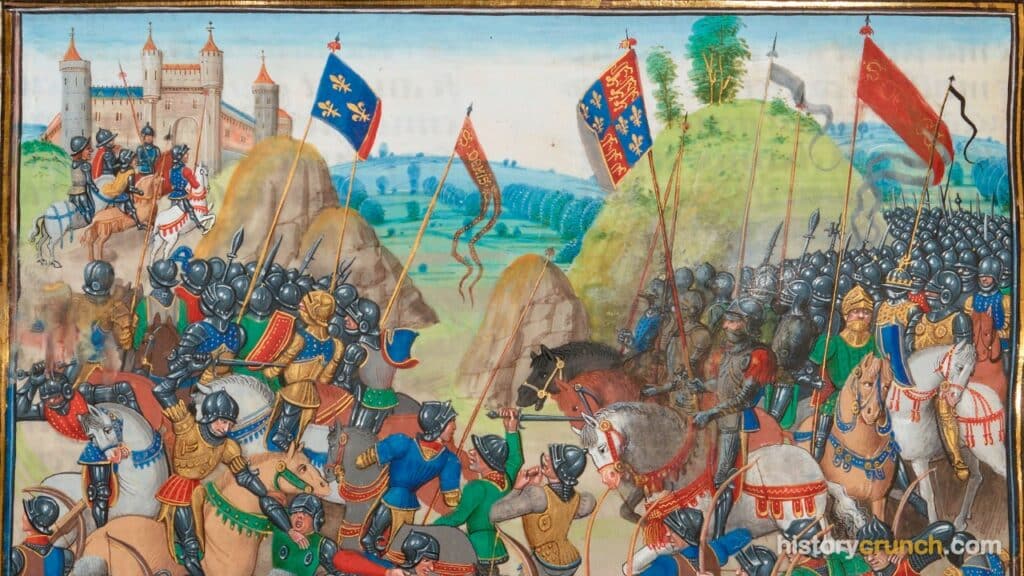
Knowing he was badly outnumbered, Edward made a bold decision about how his knights would fight. Realizing that the impending battle would be a defensive one, Edward III dismounted his knights before the battle, and on foot these heavy infantrymen were placed alongside his longbowmen, providing Edward’s lightly armored archers ample protection if the French knights managed to reach them. The archers were spread out so their arrows could sweep across the field from the sides.
The French army, by contrast, arrived in a state of disorder. In ignorance and battle lust, they arrived piecemeal on the field of battle in the late afternoon, hungry and tired but straining to attack the English line. Philip wanted to wait, but he could not hold his eager men back, so he ordered the attack to begin late in the day.
The Genoese crossbowmen went in first, and everything went wrong for them. Tired from the march, the Genoese crossbowmen also complained at having to advance without their pavisesLarge shields that crossbowmen hid behind while reloading their slower weapons. and reserves of ammunition, which were still far back in the baggage train. Pavises were large shields that crossbowmen normally hid behind while reloading, and without them the Genoese were fully exposed. To make matters worse, heavy rain had soaked the field, turning it into sticky mud, and the sun also favored the English, as it shone into the faces of the French.
When the shooting started, the difference between the two weapons was clear at once. The Genoese soon suffered heavily from the English longbow fire; so fast was the rate of fire of the English longbows that, according to one source, it appeared to the French army as though it was snowing, and unable to counter the barrage, the Genoese mercenaries retreated. The French knights behind them were furious at the sight. Upon seeing the Genoese crossbowmen retreating, the French knights became outraged, and a merciless slaughter soon followed as the horsemen rode through their own fleeing allies.
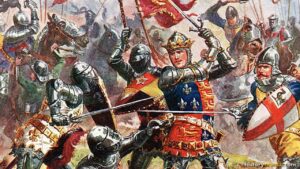
The French knights then charged the English line again and again. More and more French cavalry came up to make further charges at the English center, but while the latter stood firm, the archers wheeled forward, and the successive detachments of horsemen were mowed down by arrow shots from both sides. The English also used a few early gunpowder weapons, which added noise and fear even if they caused little real damage.
The charges continued long into the night. The battle lasted from four in the afternoon until about midnight, and the French army had made 15 to 16 distinct charges in all. Each wave broke apart under the arrow storm before it could reach the English foot soldiers. Even King Philip himself was in danger, for King Philip had two horses shot out from under him and was hit by an arrow in the jaw, and he finally withdrew the French forces from the field.
When the fighting ended, the losses were shockingly one-sided. Between 5,000 and 8,000 French and Genoese were killed, including as many as 1,500 knights, compared to about 100 of Edward’s men. Among the dead were some of the greatest nobles in Europe. The French suffered heavy losses, including notable figures like Charles II of Alençon and King John of Bohemia.
FactsthatCrunchThen the English archers stept forth one pace and let fly their arrows so wholly and so thick, that it seemed snow.
Jean Froissart · Chronicles · Approximately 1370
Jean Froissart was a French-speaking chronicler who recorded the Hundred Years' War between England and France. He was a child when the Battle of Crécy was fought on August 26th, 1346, so he built his account from the memories of soldiers who had been there. These words describe the English longbow volleys during the battle, a mass of arrows so fast and so dense that it cut down the Genoese crossbowmen and reminded onlookers of falling snow.
Significance of Battle of Crécy
Crécy was far more than a single victory, because it changed how people thought about war. The battle marked the decline of the mounted knight in European warfare and the rise of England as a world power. For centuries, the armored knight on horseback had been seen as almost unbeatable, but Crécy proved that ordinary archers on foot could destroy the finest cavalry in Europe.
The defeat was a terrible blow to France. This was a huge number for a 14th-century battle and left nearly every castle and chateau in France in mourning, and the defeat of its warrior elite shattered France’s military capabilities and shook its confidence for a generation. So many noble families lost fathers and sons that the effects were felt across the whole kingdom.
The battle also gave England a lasting foothold on the mainland. From Crécy, Edward marched on to Calais, which surrendered to him in 1347. In fact, Calais was captured by English rule and became an exclaveA piece of territory belonging to one country that is surrounded by another country’s land. of England, the Pale of Calais, for over 200 years. This port gave England a base for supplies and armies in northern France for generations.
The lessons of Crécy shaped warfare for decades. The devastating effectiveness of the longbow at Crécy meant that for some 50 years thereafter knights dismounted to fight. The victory also began a shift toward more professional armies. Crécy marked the beginning of a change in the way medieval armies conducted themselves, moving away from chivalry toward professional armies.
Finally, Crécy was only the first in a series of famous English triumphs. The Battle of Crécy was the first major battle fought by England and France in the Hundred Years’ War and the first of three famous English victories during the conflict, followed by Poitiers in 1356 and Agincourt in 1415. Together these battles gave England the early advantage in a war that would last more than a century.
Explore Middle Ages · 476 – 1500 CE
Keep exploring Middle Ages with these History Crunch resources.
Key Vocabulary
Hundred Years’ War
Homage
Plundering
Longbow
Pavises
Crossbowmen
Exclave
Frequently Asked Questions
When and where was the Battle of Crécy fought?
The Battle of Crécy was fought on August 26th, 1346, near the village of Crécy-en-Ponthieu in northern France. The site sat on a ridge between Crécy and the nearby village of Wadicourt, roughly 45 miles (72 km) south of the port of Calais. Edward III chose this high ground on purpose so that the French would have to attack uphill.
Who won the Battle of Crécy?
England won the Battle of Crécy in a crushing and one-sided victory. The English army was led by King Edward III, while the French were led by King Philip VI. Even though the French had far more men, their disorganized attacks were destroyed, and Philip was wounded before he fled the field.
Why was the English longbow so effective at Crécy?
The longbow was effective because it could fire far faster and farther than the French crossbow. A trained archer could shoot around 15 arrows a minute, while a crossbowman needed much longer to reload with a winch. Thousands of longbowmen shooting together created a deadly rain of arrows that knights and horses could not survive.
Why did the Genoese crossbowmen fail at Crécy?
The Genoese crossbowmen failed mainly because they were sent into battle unprepared. They were tired from a long march, their large protective shields called pavises had been left behind in the baggage train, and a sudden rainstorm may have weakened their bowstrings. Exposed and outranged, they were shot down and forced to retreat almost at once.
What happened after the Battle of Crécy?
After the battle, Edward III marched north and laid siege to the port city of Calais, which surrendered to him in 1347. Calais then became an English possession for more than 200 years, giving England a vital base in France. The victory also encouraged Edward to keep pressing his claim, leading to further English success at the Battle of Poitiers in 1356.
Cite This Article
To cite this article as a source, use one of the formats below.
MLA: Millar, B. “Battle of Crécy: A Detailed Summary.” HistoryCrunch, 26 July 2026, https://historycrunch.com/battle-of-cr-cy/.
APA: Millar, B. (2026). Battle of Crécy: A Detailed Summary. HistoryCrunch. https://historycrunch.com/battle-of-cr-cy/
Chicago: Millar, B. “Battle of Crécy: A Detailed Summary.” HistoryCrunch. July 26, 2026. https://historycrunch.com/battle-of-cr-cy/
Sources
- J.M. Roberts & Odd Arne Westad, The Penguin History of the World.
- Jerry Bentley & Herbert Ziegler, Traditions & Encounters: A Global Perspective on the Past.