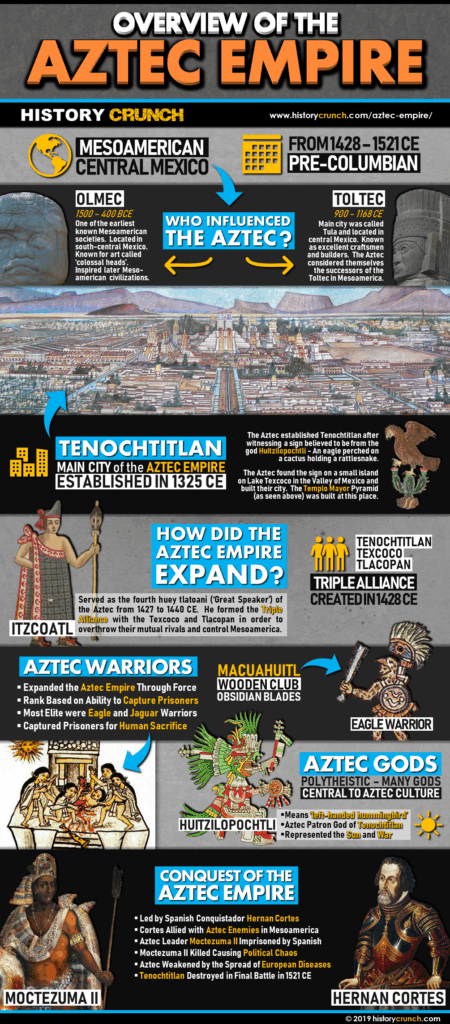
The Aztec Empire was one of the most significant civilizations in the history of the Americas. Centered in the Valley of Mexico, the Aztec built the magnificent island capital of Tenochtitlan and expanded their empire across most of central Mexico through military conquest and strategic alliances. Their civilization came to an end in 1521 when Spanish conquistadors led by Hernan Cortes conquered Tenochtitlan and ended Aztec rule forever. This infographic was designed for students to visually summarize the key aspects of the Aztec Empire and is based on the History Crunch article titled Aztec Empire Overview.
Aztec Empire Overview – Infographic
About This Infographic
This Aztec Empire overview infographic was created by the History Crunch team to help students and teachers quickly understand the most important aspects of one of the great civilizations of the pre-Columbian Americas. It is designed as a visual learning and study tool, summarizing the essential information covered in our full article on the Aztec Empire Overview. Teachers may use it as a classroom display, a discussion prompt, or a study aid for students preparing for assessments.
What This Infographic Covers
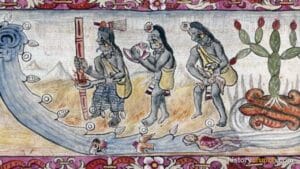
The Aztec people, who referred to themselves as the Mexica, are said to have originated in the desert areas of northwest Mexico. According to Aztec history, they spent two centuries migrating south in search of a new homeland, a period known as the Long Migration. They finally settled on the swampy shores of Lake Texcoco in the Valley of Mexico after spotting the divine sign they had been searching for: an eagle perched on a cactus holding a rattlesnake. The city of Tenochtitlan was officially founded on July 20th, 1325.
The infographic covers the formation and significance of the Aztec Triple Alliance in 1428. Under the leadership of the Aztec ruler Itzcoatl, the Aztec joined forces with the neighboring city-states of Texcoco and Tlacopan to overthrow their mutual rivals the Tepanec. Together the Triple Alliance established dominance over the Valley of Mexico and continued expanding outward, eventually controlling most of central Mexico. The Aztec became the dominant partner in the alliance and Tenochtitlan grew into one of the largest cities in the world, with a population estimated at between 200,000 and 300,000 people by the early 16th century.
The infographic also highlights the key features of Aztec society and culture. Aztec society was organized into distinct social classes including the pipiltin, the noble ruling class who controlled government, religion and the military, and the macehualtin, the commoner class who made up the majority of the population. The Aztec economy was based on agriculture, particularly the use of chinampas or floating gardens built up in the shallow waters of Lake Texcoco, as well as a widespread tribute system that required conquered peoples to supply Tenochtitlan with food, goods and warriors. Aztec culture was rich and distinctive, expressed through elaborate art, clothing, religious ceremonies and the construction of impressive pyramids and temples.
Finally the infographic covers the Spanish conquest of the Aztec Empire. Hernan Cortes arrived in Mexico in 1519 with approximately 500 men and quickly formed alliances with groups who resented Aztec domination, most importantly the Tlaxcala. A combination of military pressure, political maneuvering and the devastating spread of smallpox among the Aztec population led to the fall of Tenochtitlan on August 13th, 1521. The conquest ended the Aztec Empire and opened the door to Spanish colonization of the Americas.
How to Use This Infographic in the Classroom
This infographic works well as a visual introduction to the Aztec Empire before students read the full overview article. It can also be used as a review tool before an assessment, or as a discussion prompt asking students to consider what factors made the Aztec Empire so powerful and what factors ultimately led to its downfall. Teachers may also use it alongside the map of the Aztec Empire and Aztec Triple Alliance to give students both a visual summary of the civilization and a geographic understanding of its extent across central Mexico.
Related Articles
To learn more about the topics covered in this infographic, visit the following History Crunch articles: