Entertainment in Ancient Rome was an important part of daily life and culture of the ancient Roman people. In fact, the Romans believed that providing public entertainment helped maintain social order and unity. As such, Ancient Roman emperors offered several forms of entertainment for their people, including: gladiatorial games, theater performances, chariot races and public baths.
ENTERTAINMENT IN ANCIENT ROME – GLADIATOR GAMES
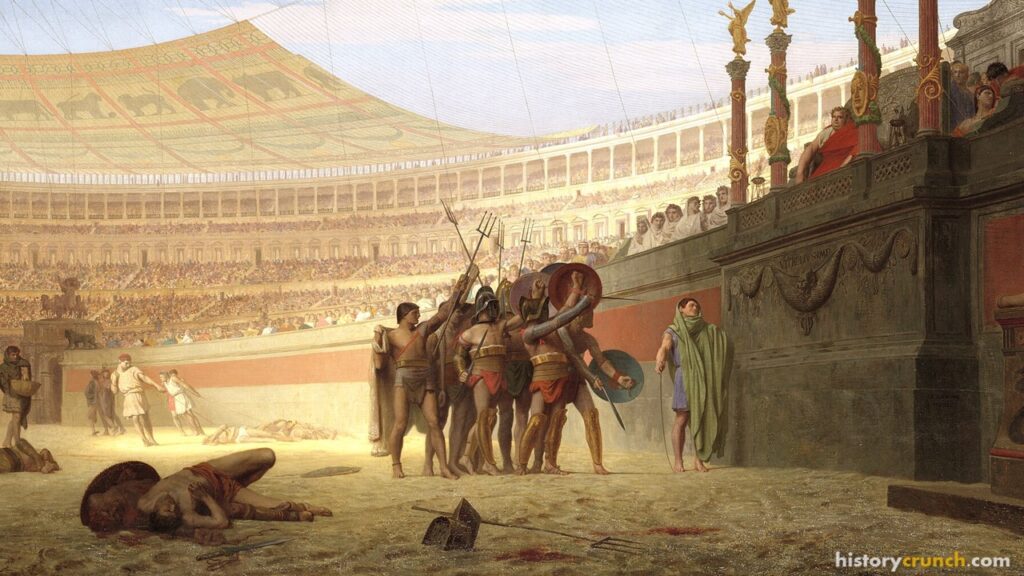
As mentioned above, there were several significant types of entertainment in Ancient Rome, but likely the most famous was the games with gladiators. These games were held in enormous amphitheaters such as the Colosseum in Rome. Every Roman city and town had an amphitheater, which was a large stadium where entertainment would occur for the citizens. The Romans called their entertainment ‘games’ but it generally consisted of fights between gladiators and the public execution of criminals. Roman citizens often enjoyed entertainment that was violent and bloody. The fights between the opposing gladiators were often brutal. Most gladiators were slaves, including prisoners of war and criminals. While the lives of gladiators were usually short, a successful gladiator could potentially win his freedom.
These events were carefully staged and often accompanied by music, parades and rituals. The emperors used these games to demonstrate their generosity and power, reinforcing their popularity among the Roman people.
ENTERTAINMENT IN ANCIENT ROME – CHARIOT RACING
Another favorite form of entertainment in Ancient Rome was chariot racing. These races took place in massive stadiums called circuses, with the largest being the Circus Maximus in Rome. The Circus Maximus could hold over 250,000 spectators, making it one of the largest sporting venues in history.
Racing was a highly professional sport, with riders belonging to different teams. Each team was supported by its own set of trainers, veterinarians, blacksmiths and carpenters. While the riders were often slaves, they could buy their freedom by winning races. Drivers, known as aurigae, risked their lives in races that often resulted in crashes and injuries.
Similar to the gladiator games, chariot races were highly competitive sports, but also a political tool of the emperors to maintain authority.
ENTERTAINMENT IN ANCIENT ROME – THEATER
Theater was another important aspect of ancient Roman entertainment. Roman theaters had permanent sets, a raised stage and tiers of seats for citizens that were shaped in a half-circle. Plays were performed in large theaters and included tragedies, and comedies. Ancient Roman actors wore masks to portray different characters and performances often included music and dance.
Theater was popular among all social classes, though it was considered lesser than gladiatorial games or chariot races. Regardless, theater was an important part of entertainment in Ancient Rome and was significant to the daily lives of the ancient Roman people.
ENTERTAINMENT IN ANCIENT ROME – PUBLIC BATHS
Public baths were another significant element of entertainment in Ancient Rome. Bathhouses, or thermae, were not just places to bathe but also centers for socializing, exercise and relaxation. For instance, ancient Roman people met friends, discussed business and enjoyed the different facilities of the public baths. In fact, some public baths were as grand as palaces and even had art mosaics, marble statues and heated pools.
Most Romans visited the baths on a daily basis in order to exercise and stay healthy. After exercising, the people would bath in different temperature pools. The bathers would scrub themselves with olive oil and then bathe in the pools.