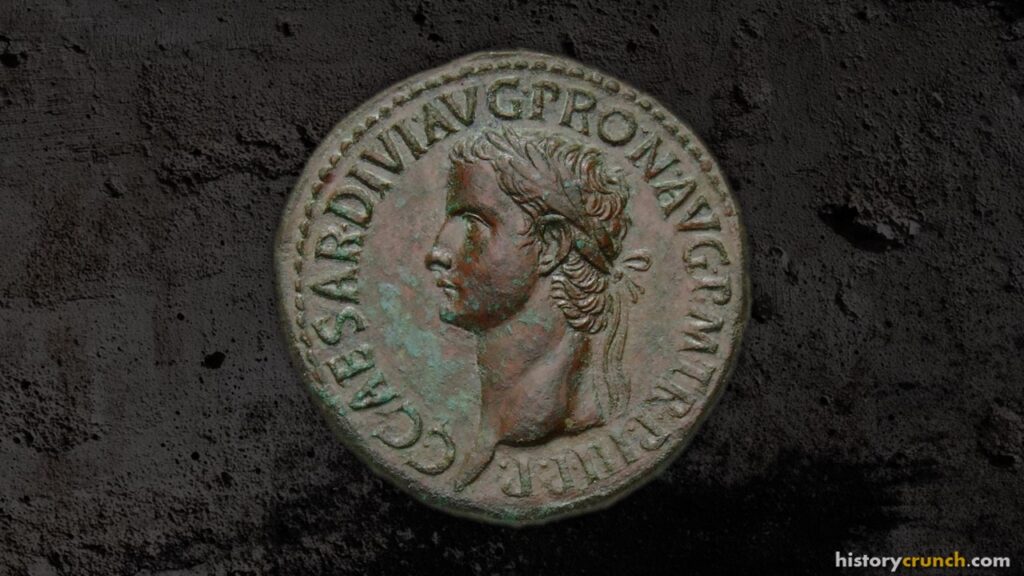
Caligula was the third Roman emperor and ruled from 37 CE to 41 CE. This period of time was one of the most controversial periods in all of ancient Roman history. In fact, while his rule began with great promise, stories emerged of Caligula and his cruelty, extravagance, and odd behavior. Although some historians have argued that these stories were created by those that disagreed with Caligula and his reign, it should still be noted that the era of Caligula’s reign was a troubled and chaotic time in the history of Ancient Rome. Caligula’s reign ended in 41 CE when he was assassinated.
CALIGULA – EARLY LIFE
Caligula was born on the 31st of August in 12 CE. He was born in the ancient city of Antium, which today is the modern city of Anzio, Italy. Caligula was a nickname for Gaius Julius Caesar Augustus Germanicus, and the nickname was given by soldiers while he was a young boy, since he accompanied his father on military campaigns in Europe. The nickname meant ‘little boots’. Caligula’s father, Germanicus was a very successful general, and was one of Rome’s most adored public figures. Caligula’s mother was Agrippina the Elder, the granddaughter of the first emperor, Augustus.
Caligula’s father died under mysterious circumstances, and his mother and brothers were accused of treason against Emperor Tiberius. As a result, they were either executed or exiled. In fact, only Caligula survived and he began living under Tiberius’s protection on the island of Capri until he was adopted as the emperor’s heir.
CALIGULA – EMPEROR OF ROME
Caligula succeeded as Emperor of Rome after Tiberius died in 37 CE. Caligula was just 24 years old at the time. He ruled as emperor of Rome between 37 CE and 41 CE, and was part of the Julio-Claudian dynasty of rulers. There is little information about Caligula’s rule, however there are some reports that described him as a fair ruler at the start of his reign. In fact, it appears that the Roman people saw him as the son of the beloved Germanicus, and his early policies appeared generous and fair. For instance, supposedly he released political prisoners, reduced taxes, organized public games and gave generous bonuses to soldiers. These actions made him relatively popular among the Roman people.
However, he soon became known as cruel and even some accounts that say he was an insane tyrant. For instance, ancient historians describe Caligula’s later rule as increasingly tyrannical. He executed senators and nobles on suspicion of conspiracy and spent huge sums of money on his own lifestyle. For example, he built luxurious palaces for himself and carried out massive public games. Caligula also demanded to be worshipped as a living god and ordered temples and statues to be built in his honor. There was even a rumor that he appointed his favorite horse, Incitatus, as a priest and supposedly planned to make it a consul in his government.
CALIGULA – ASSASSINATION
Ultimately, Caligula did not rule for long, as he was unpopular as emperor. In fact, Caligula was assassinated after only four years of rule by members of his Praetorian Guard. He was just 28 years old at the time. After his death, the conspirators also killed his wife and young daughter in an effort to end his bloodline. The Senate briefly considered restoring the Republic, but the Praetorian Guard quickly declared Claudius, Caligula’s uncle, the new emperor.
CALIGULA – SIGNIFICANCE
Caligula was a highly significant emperor in Ancient Rome despite his short-lived reign. For instance, his rule exposed the weaknesses of the early imperial system, showing how easily a single ruler could abuse absolute power. The Senate’s inability to check Caligula’s authority demonstrated the collapse of the republican ideals that once defined Ancient Rome. As well, Caligula’s excesses and chaotic behavior also led future emperors, like Claudius and Vespasian, to govern more carefully and maintain better relations with the Senate and the people of Rome.