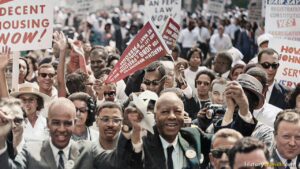
The assassination of Martin Luther King Jr. was a shocking event in American history. King was murdered on April 4th, 1968, in Memphis Tennessee, when he was shot by a rifle by James Earl Ray. King had been one of the most important leaders of the Civil Rights Movement and played a key role in American political life throughout the 1950s and 1960s. During that time, he had dedicated his life to fighting racial segregation in American through the promotion of nonviolent protest. For instance, he had led or participated in some of the most important events in the Civil Rights Movement, such as: the Montgomery Bus Boycott, the March on Washington, and the Selma to Montgomery marches. He remains a celebrated figure in the United States and around the world for his commitment to equality, justice and the promotion of human rights.
ASSASSINATION OF MARTIN LUTHER KING JR. – BACKGROUND
The assassination of Martin Luther King Jr. was an important event in the history of the United States, especially in relation to the Civil Rights Movement, which occurred mainly in the 1950s and 1960s. In short, the Civil Rights Movement was characterized by the struggle to end racial segregation, discrimination, and inequality faced by African Americans in the United States. In fact, while slavery was abolished in 1865, and African Americans were legally free, they still faced brutal racism and segregation. This was especially prevalent under the practise of ‘Jim Crow’ laws, which were state and local laws that enforced racial segregation in the southern United States throughout the timeframe of the 1950s and 1960s. For instance, during this time, African Americans faced discrimination in education, housing, voting, employment, and other aspects of public life.
However, prominent Civil Rights leaders such as Martin Luther King Jr. led protests and marches to oppose segregation, which helped advance the goals of the Civil Rights Movement. For instance, the Civil Rights Movement unfolded as a series of important events, including: the March on Washington, Montgomery Bus Boycott and the Freedom Rides.
The societal tensions present during this time, set the stage for the assassination of Martin Luther King Jr. in 1968.
ASSASSINATION OF MARTIN LUTHER KING JR. – SUMMARY
As stated above, Martin Luther King Jr. was assassinated on April 4th, 1968 in Memphis, Tennessee. In fact, King had headed to Memphis, Tennessee with other members of the Southern Christian Leadership Council (King was the founder and primary leader of the group) to plan a march on Washington to support a worker’s strike while the SCLC was in the midst of planning a March on Washington to lobby for legislation to help the poor.
With that said, by the late 1960s, King had expanded his fight beyond the Civil Rights Movement and also commonly dealt with societal issues such as poverty, workers rights and the Vietnam War. While some people supported his expanded approach to issues, others were critical and felt that he should only focus on civil rights. For example, as the Civil Rights Movement gained momentum in the 1960s, there became an onslaught of young radical African Americans who followed the preaching of black nationalist Malcolm X, whom was calling for a more confrontational approach towards gaining equality. X himself publicly claimed that King’s tendency to protest in a non-violent manner was ‘criminal’ because of the repression faced by Black Americans.
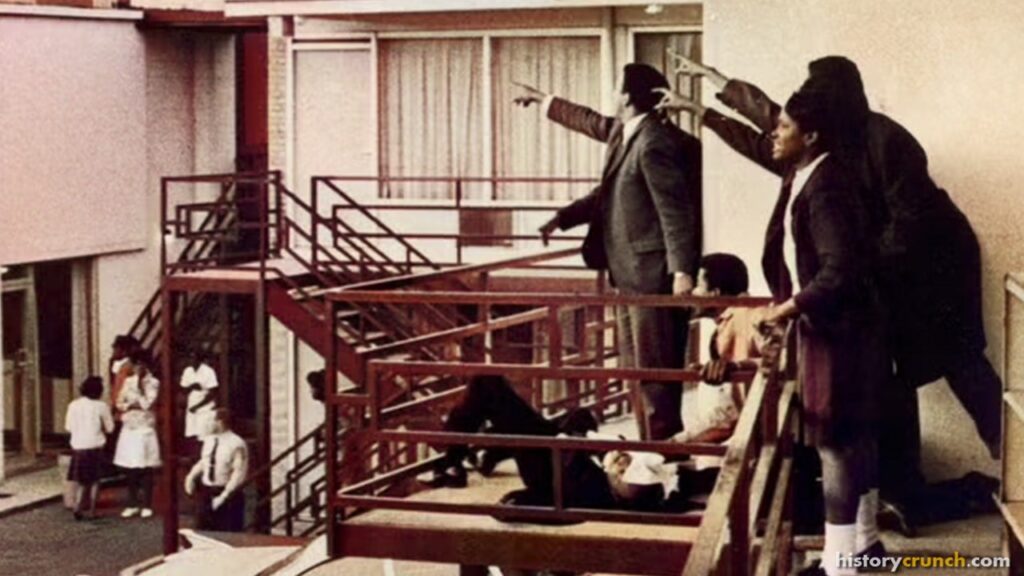
The march, which was planned for later that year, would not happen for King, as he never left Memphis. On April 4th, 1968, Dr. Martin Luther King Jr. was standing on the balcony of his hotel room with his colleagues when a sniper shot him in the neck. King was rushed to the hospital and pronounced dead approximately an hour after he was shot. He was 39 years old at the time of his death.
ASSASSINATION OF MARTIN LUTHER KING JR. – SIGNIFICANCE
As the news of the assassination began to spread, rioting erupted across the United States, which would include burning and looting of more than 100 cities. Even though President Lyndon B. Johnson was advocating against the riots, urging citizens to ‘reject the blind violence’, it is easy to imagine why they were occurring. The ‘apostle of nonviolence’ as President Johnson had called Dr. King had been murdered.
A few months later, a man by the name of James Earl Ray was apprehended and arrested for the murder of King. Although there is some controversy surrounding Ray and his role in the assassination (specifically the notion that King’s family supports Ray), all of the evidence points towards Ray being the assassin. Although truly horrific, Dr. King’s assassination did come with some positive benefit as only 5 days later, President Johnson signed the Civil Rights Act of 1968, something that King and his supporters had been advocating so heavily for. In fact, President Johnson called the signing ‘a fitting legacy to King and his life’s work.’
Like only someone as understanding as Dr. King could, he had very appropriate final speech the day before his assassination where he said: “I’ve seen the promised land. I may not get there with you. But I want you to know tonight, that we, as a people, will get to the Promised Land. And I’m happy tonight. I’m not worried about anything. I’m not fearing any man. Mine eyes have seen the glory of the coming of the Lord.”