Hernando de Soto was a Spanish conquistadorA Spanish soldier and explorer who conquered lands and peoples in the Americas during the 1500s. and explorer who played an important role in the early Spanish exploration of the Americas. For instance, he is best known for his expedition through the southeastern region of modern United States and for being the first European to cross the Mississippi River. As such, he was a central figure during the Age of Exploration.
 FactsthatCrunch
De Soto commanded the first European expedition into the interior of the southeastern United States, leading roughly 600 men through present-day Florida, Georgia, South Carolina, North Carolina, Tennessee, Alabama, Mississippi, and Arkansas. He also played a key command role in Francisco Pizarro's conquest of the Inca Empire, including military and diplomatic operations that led to the capture of the Incan emperor Atahualpa.
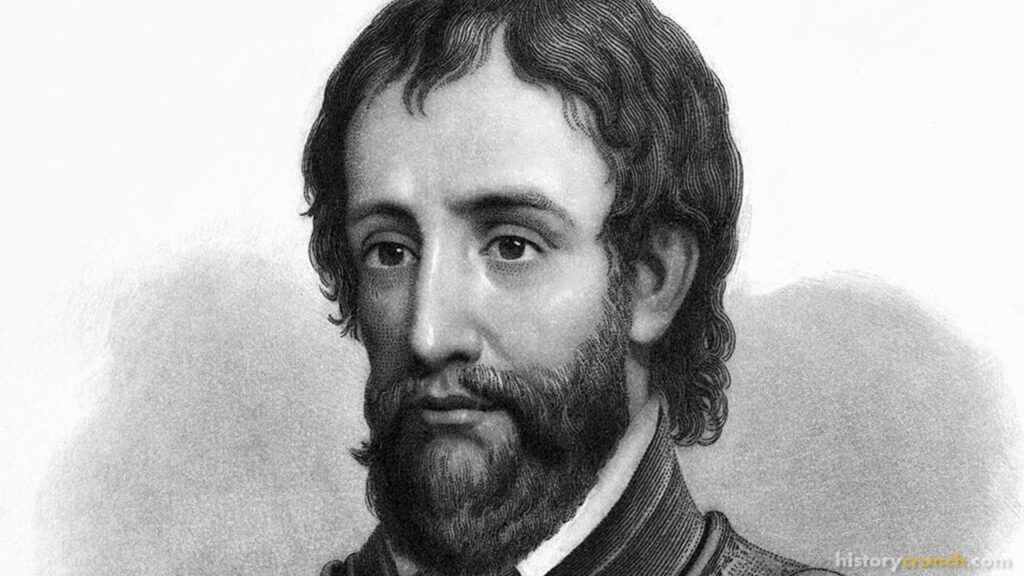
Hernando De Soto – Early Life
Hernando de Soto was born sometime between 1490 and 1500 in Jerez de los Caballeros, Spain. The exact date of his birth is unknown. De Soto’s parents were relatively poor, and he moved around a lot with them as they tried to find work. Like many of the young people at the time, De Soto heard of the possible fame and fortune that came to explorers of the New World. As a result, he traveled to the New World as a young man, where he quickly proved himself as a skilled horseman, conquistador and leader. In fact, his early career was marked by involvement in the conquest of Central America.
Hernando De Soto – Voyages in the Age of Exploration
As stated above, Hernando de Soto was a significant figure in the Age of Exploration. In fact, de Soto sailed to the New World on a number of voyages that resulted in the Conquest of Central America, and the Spanish colonization of the New World.
On his first voyage, Hernando de Soto sailed with Pedro Arias Davila, who was the first Governor of Panama. Then, in 1520, de Soto went on the expedition to Veragua and in 1524 he set sail under Francisco Hernandez de Cordoba to Nicaragua. De Soto developed many important skills and became known for being a brave leader, loyal to his men and for his ruthless schemes. Over time, these things became his hallmarksQualities or actions that a person becomes reliably known for over time. during the Conquest of Central America. He also developed skills as a horseman, fighter, and tacticianSomeone skilled at planning military moves to gain an advantage in battle. and became famed for these things.
De Soto’s reputation rose further when he joined Francisco Pizarro in the conquest of the Inca Empire in the early 1530s. He played a key role in diplomatic negotiations and military operations, including the capture of the Incan emperor Atahualpa. As a reward, de Soto received a large share of the Inca ransomThe enormous payment in gold and silver collected to free the captured Incan emperor Atahualpa. and returned to Spain in 1536 as a wealthy and celebrated man.
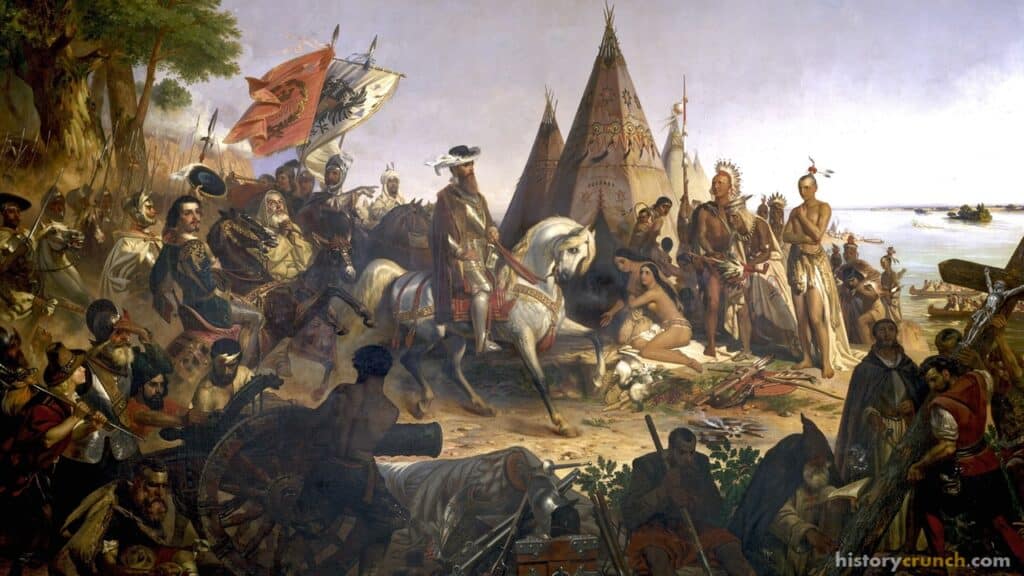
With that said, Hernando de Soto is best remembered today for his expedition to North America in 1539. In fact, de Soto led the first European expedition to the then unexplored southern states of the United States. He first landed in the area of Tampa Bay, Florida, with a well-equipped expedition of about 600 men, horses, and supplies. Over the next three years, his forces marched through present-day Florida, Georgia, South Carolina, North Carolina, Tennessee, Alabama, Mississippi and Arkansas. Along the way, de Soto’s men clashed with numerous Native American tribes and regularly used violence to gather information or food from the tribes. For instance, his forces burned villages, enslaved people, and unknowingly introduced European diseases, which would go on to have profound impacts on the indigenous people of the region.
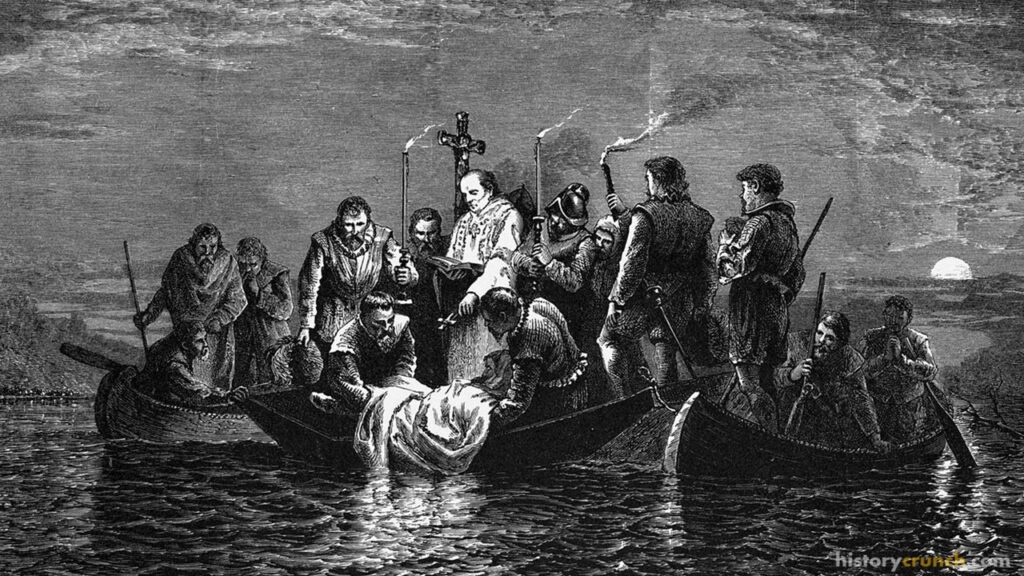
In 1541, de Soto became the first European to see the Mississippi River. This was a significant geographical achievement at the time. Despite this, he never found the riches he was searching for. Ultimately, the expedition struggled due to issues including starvation, disease and resistance from Native Americans. De Soto died of fever on May 21st in 1542 near the Mississippi River in present-day Louisiana or Arkansas. His remaining men, now leaderless and diminished, buried his body in the river to prevent local tribes from discovering his death, fearing it would encourage rebellion.
 FactsthatCrunch
In 1541, Hernando de Soto became the first European to see the Mississippi River, the largest river drainage system in North America.
De Soto reached the river during a three-year march through the southeastern part of what is now the United States. The Mississippi and its tributaries drain all or part of 31 U.S. states and two Canadian provinces, covering approximately 1.2 million square miles (3.1 million square kilometers), roughly one eighth of the entire continent. De Soto never found the gold he was searching for, and he died of fever on May 21st, 1542, near the river's banks. His men buried his body in the river to keep local tribes from learning of his death.
Hernando De Soto – Significance
Hernando de Soto was one of the most significant explorers during the time of the Age of Exploration. In fact, de Soto’s expedition provided the first European contact with the interior of the southeastern United States. As such, his expedition significantly expanded European knowledge of North American geography. For example, his journey mapped major rivers, forests, and regions previously unknown to Europeans. This laid the foundation for future explorers and colonizers in the New World.
With that said, de Soto’s expedition also had a tremendously negative impact on the Native American peoples. For instance, the expedition was marked by widespread violence and destruction, which was typical of Spanish conquests during the period. Many of de Soto’s interactions with Native Americans resulted in armed conflict, mass killings, and the destabilizationThe process of breaking apart and weakening the normal order of a community or society. of entire communities. Furthermore, like other European expeditions, de Soto and his men inadvertentlyDone without meaning to or realizing the result at the time. spread European diseases such as: smallpox and measles. These diseases devastated indigenous populations who had no immunityThe body’s natural ability to resist and fight off a particular disease.. This destroyed entire communities of indigenous people, who were left to deal with the consequences of the destruction. As such, de Soto is a controversial figure in history. Some celebrate him as a brave explorer in a difficult time, while others criticize his violent methods and overall negative impacts.
FactsthatCrunchTap each impact to read what it led to.
Explore Age of Exploration · 1415 – 1600 CE
Keep exploring Age of Exploration with these History Crunch resources.
Key Vocabulary
Conquistador
Hallmarks
Tactician
Inca ransom
Inadvertently
Immunity
Destabilization
Frequently Asked Questions
Who was Hernando de Soto?
Hernando de Soto was a Spanish conquistador and explorer who helped lead early Spanish exploration of the Americas. He is best known for his expedition through the southeastern United States. He also became the first European to cross the Mississippi River.
What is Hernando de Soto most famous for?
Hernando de Soto is most famous for being the first European to see the Mississippi River in 1541. He led the first European expedition into the interior of the southeastern United States. His journey covered large parts of what are now eight states.
Where did Hernando de Soto explore in North America?
De Soto landed near Tampa Bay, Florida, in 1539 with about 600 men and supplies. Over three years his forces marched through present-day Florida, Georgia, South Carolina, North Carolina, Tennessee, Alabama, Mississippi, and Arkansas. His men often used violence against Native American tribes along the way.
How did Hernando de Soto die?
De Soto died of fever on May 21st, 1542, near the Mississippi River in present-day Louisiana or Arkansas. His expedition had been weakened by starvation, disease, and Native American resistance. His men buried his body in the river so local tribes would not learn of his death.
Why is Hernando de Soto a controversial figure?
De Soto is controversial because his expedition caused great harm to Native American peoples. His forces burned villages, enslaved people, and killed many in armed conflict. His men also spread diseases like smallpox and measles, which destroyed communities that had no immunity.
Cite This Article
To cite this article as a source, use one of the formats below.
MLA: Woida, K.L. “Hernando de Soto: A Detailed Biography.” HistoryCrunch, 22 October 2026, https://historycrunch.com/hernando-de-soto/.
APA: Woida, K. L. (2026). Hernando de Soto: A Detailed Biography. HistoryCrunch. https://historycrunch.com/hernando-de-soto/
Chicago: Woida, K.L. “Hernando de Soto: A Detailed Biography.” HistoryCrunch. October 22, 2026. https://historycrunch.com/hernando-de-soto/
Sources
- Fordham Modern History Sourcebook
- Gilder Lehrman Institute
- Alfred W. Crosby, The Columbian Exchange.
- J.H. Parry, The Age of Reconnaissance.