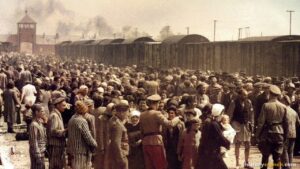
The United Nations Human Rights Council is an organization within the United Nations which works to address issues related to human rights violations. Throughout the 20th century, the idea of fundamental and universal human rights was an important topic, due to the many different examples of genocides, war crimes and crimes against humanity. This can be seen in more modern genocides and war crimes, such as the Rwanda Genocide. However, other modern issues related to human rights also include: women’s rights, poverty, modern slavery, modern child labor, voting rights, and more. To deal with these more modern issues, the United Nations established the United Nations Human Rights Council (UNHRC).
UNITED NATIONS HUMAN RIGHTS COUNCIL – SUMMARY
The United Nations Human Rights Council (UNHRC) was established on March 15th, 2006 and is headquartered in Geneva, Switzerland. As stated above, the goal of the UNHRC is to deal with claims of United Nations member nations and human rights violations. It attempts to achieve this through member groups made up of 47 different nations. Member nations of the United Nations General Assembly elect these 47 different nations to serve on the UNHRC, and each of the 47 nations holds their seat for a period of three years. Furthermore, no nation may serve on the UNHRC for two consecutive terms. As such, the members of the UNHRC are constantly changing. This is important because it allows many different voices and points of view in the process of protecting and promoting human rights. Another important aspect is that membership in the UNHRC is based upon regions. This means that different regions have different numbers of seats on the UNHRC. For example, both Africa and Asia have thirteen seats, Latin America and the Caribbean have eight seats, Western Europe has seven seats, and Eastern Europe has six seats. These ratios are maintained when a new membership group of the UNHRC is elected every three years.
The UNHRC can call a special session at any time to address an ongoing and significant violation of human rights that it feels is an emergent situation. Beyond that however, the UNHRC meets on a regular schedule, with three sessions a year. In these sessions, the UNHRC debates and votes on measures to be taken to address human rights issues facing the world. For example, the UNHRC can call for the arrest of specific individuals that it has determined are responsible for human rights violations. As well, the UNHRC has also produced reports and recommendations on specific human rights issues. For example, during its existence the UNHRC has issues reports on issues related to the Myanmar Rohingya Genocide of 2016, the ongoing Israel-Palestinian Conflict, and Climate Change.
UNITED NATIONS HUMAN RIGHTS COUNCIL – CRITICISMS
While the UNHRC serves an important function in the world by bringing countries together to address modern human rights issues, it has also been criticized throughout its history. For instance, some countries and individuals have accused the UNHRC of focusing too heavily on certain issues, while ignoring others. More specifically, both the United States and Israel have expressed frustration towards the UNHRC when it issued reports denouncing the actions of Israel in the ongoing Israel-Palestinian Conflict. In particular, Israel was angered that the UNHRC focused so heavily on Israeli actions while seeming to ignore other human rights violations committed by other nations around the world.