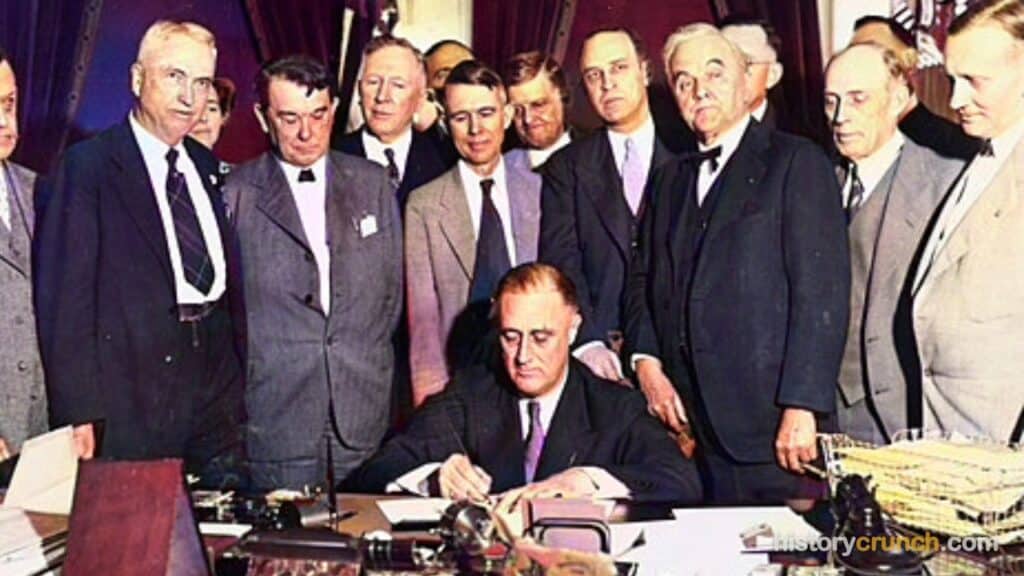
The Tennessee Valley Authority, often called the TVA, was one of the most ambitious government programs created during the Great Depression, and it changed daily life across a large and poor region of the American South. Created in 1933, the TVA was a federal agency built to control flooding, improve river travel, and bring cheap electricity to millions of people who had never had it before. Its work touched seven states along the Tennessee River, and it grew into a model for how the government could plan and develop an entire region at once.
The Tennessee Valley Authority is a federally owned corporation, which means it is a business owned and run by the national government rather than by private investors. It was given the power to build dams, generate and sell electricity, manage the river, and help improve farming and industry across the Tennessee Valley. Because it combined so many different jobs under one agency, it became the first large regional planning agency in the history of the United States government.
What Was the New Deal in the Great Depression?
The New Deal was a series of government programs and reforms that President Franklin D. Roosevelt created to help the United States recover from the Great Depression. The Great Depression was one of the worst economic crises in modern history, and it began with the crash of the American stock market in October of 1929. Over the next several years it wiped out jobs, businesses, and savings, and by the time Roosevelt took office in 1933, nearly one in four American workers had no job.
In response, Roosevelt promised the country a “new deal” and moved quickly to put people back to work. His overall plan aimed at three goals, often summed up as relief, recovery, and reform. To reach these goals, the government created many new agencies, which were sometimes nicknamed the “alphabet agencies” because they were known by their initials, such as the CCC, the WPA, and the TVA.
The New Deal is often divided into two parts. The First New Deal ran from 1933 to 1934 and focused heavily on the banking crisis and on quick relief. The Second New Deal ran from 1935 to 1938 and included lasting programs such as the Social Security Act. The Tennessee Valley Authority was created during the very first months of Roosevelt’s presidency and became one of the boldest experiments of the entire New Deal era.
Why Was the Tennessee Valley Authority Created?
Before the TVA, the Tennessee River Valley was one of the poorest parts of the country. Its farmers struggled to grow crops on worn-out land, and more than two-thirds of them could not read or write. The river itself flooded again and again, destroying crops and damaging homes, and disease was common. Fewer than one in ten homes in the region had electric power.
The roots of the TVA reached back to World War I. In 1916, the federal government acquired land at Muscle Shoals, Alabama, a stretch of the Tennessee River where the water dropped sharply and blocked boats from moving upstream. The plan was to build a dam there to make electricity for producing explosives, but the war ended before the project was finished. This left the government owning an unfinished dam and set off a long national argument over whether the government should own and run power plants at all.
For years, a Nebraska senator named George W. Norris pushed for the federal government to keep and use the Muscle Shoals project to provide cheap electricity to ordinary people. Private power companies fought the idea, and earlier bills were vetoed by two presidents during the 1920s. When Franklin Roosevelt won the presidency in 1932, the plan finally had a supporter in the White House. On May 18th, 1933, Roosevelt signed the Tennessee Valley Authority Act into law.
What Were the Goals of the TVA?
The Tennessee Valley Authority Act gave the new agency a wide list of jobs. More specifically, the TVA was told to improve navigation on the Tennessee River, provide flood control, plan reforestation and repair worn-out farmland, and support both farming and industry in the valley. It was also directed to operate the government facilities at Muscle Shoals, including the Wilson Dam.
Perhaps the boldest part of the law was its instruction to improve the “economic and social well-being” of the people living in the river basin. This meant the TVA was not just an engineering project but also an attempt to lift up an entire region and its people. In fact, this comprehensive nature reflected many of Roosevelt’s own interests, including conservation, regional planning, and helping poor Americans who had long been left behind.
To run this large agency, the law created a board of three directors appointed by the president. The first board included Arthur Morgan, Harcourt Morgan, and David Lilienthal. Each director focused on different parts of the mission, from engineering and dam building to farming and the sale of electric power.
How Did the TVA Change the Tennessee Valley?
The TVA went to work almost immediately by building a system of dams along the Tennessee River and its branches. Construction of the Norris Dam in Tennessee began in October of 1933, and dam building of this kind created thousands of jobs at a time when work was desperately needed. Each dam was designed to serve several purposes at once, holding back floodwaters, producing electricity, and helping boats travel the river.
As stated above, the dams were managed together as a single system, and flood control proved very effective. Locks built into the dams allowed ships to pass from one section of the river to the next, opening a long channel that reached all the way to Knoxville. As a result, river trade grew rapidly, and the once-dangerous Tennessee River became a reliable route for shipping goods.
The most famous change was electricity. In the 1930s, about 90 percent of city dwellers had electric power, but only about 10 percent of rural residents did. The TVA brought affordable power to homes and farms that had lived by candlelight and oil lamps, and by 1935 the cost of electricity across the Tennessee Valley had dropped to about 30 percent below the national average. This helped families run lights, pumps, and machines, and it improved both daily life and farm production.
The TVA also became a model for the rest of the country. Its success inspired Roosevelt to create the Rural Electrification Administration in 1935, which helped carry electric power to farms across the nation through local cooperatives. Together these efforts began the long process of bringing electricity to nearly every American home.
What Problems and Controversies Did the TVA Face?
The TVA was not without serious problems. Private power companies saw the government agency as unfair competition and challenged it in court many times during the 1930s. In reality, almost all of these lawsuits were brought by private utilities, and the agency had to fight to prove it had the right to generate and sell electricity. The courts eventually upheld the TVA and allowed its work to continue.
Building dams also came at a human cost. Creating the large lakes behind the dams flooded land where people had lived for generations. The construction of the Norris Dam alone forced nearly 3,000 people from their homes, and many families lost farms that had been in their families for years. The government offered payments and help with moving, but the loss of homes and communities was painful and permanent.
The TVA also fell short of treating all Americans equally. During the 1930s, civil rights groups investigated the agency several times over racial discrimination in its hiring, housing, and job training. For instance, African American workers were often denied the same opportunities offered to white workers, which showed the limits of the New Deal’s promise of a better life for everyone.
Significance of Tennessee Valley Authority (TVA)
The Tennessee Valley Authority is remembered as one of the crowning achievements of the New Deal. By the end of the 1930s, it had survived its lawsuits and was generating and distributing large and growing amounts of electricity across a secure territory. Ship traffic on the river was growing, rural homes were modernizing, and new industries were appearing in a region that had once seemed hopeless.
The TVA also mattered far beyond the Tennessee Valley. It proved that the federal government could plan and develop an entire region, and it became a global example that other nations studied when trying to modernize their own poor rural areas. More specifically, it showed how flood control, river travel, and electric power could be combined into a single plan to improve millions of lives at once.
Finally, the TVA still exists today, which makes it one of the longest-lasting programs of the New Deal. It remains the largest public power provider in the United States, serving millions of people across its region. In this way, the agency stands as a lasting reminder of how the government responded to the hardships of the Great Depression by reshaping the land, the river, and the future of the American South.
Frequently Asked Questions
When was the Tennessee Valley Authority created?
The Tennessee Valley Authority was created on May 18th, 1933, when President Franklin D. Roosevelt signed the Tennessee Valley Authority Act. This happened during Roosevelt’s famous first 100 days in office, a period when he pushed many New Deal laws through Congress very quickly. The speed of its creation showed how urgently the government wanted to fight the Great Depression.
What states does the TVA cover?
The TVA’s work covers parts of seven states within the drainage basin of the Tennessee River. These states are Alabama, Georgia, Kentucky, Mississippi, North Carolina, Tennessee, and Virginia. The agency’s boundaries follow the river and its branches rather than the borders of any single state, which was part of what made it a true regional program.
Who was the “father” of the TVA?
Senator George W. Norris of Nebraska is often called the father of the TVA. For about ten years he fought private power interests and pushed the federal government to keep and use the dam at Muscle Shoals for public power. His long campaign finally succeeded when Roosevelt became president, and one of the TVA’s major dams was later named the Norris Dam in his honor.
Did the TVA help end the Great Depression?
The TVA helped many people in its region, but by itself it did not end the Great Depression. It created thousands of jobs and brought lasting improvements like cheap electricity and flood control to the Tennessee Valley. Even so, the overall economy did not fully recover until later, and many historians point to the huge spending of World War II as a major reason the Depression finally ended.
Does the Tennessee Valley Authority still exist today?
Yes, the Tennessee Valley Authority still exists and is now the largest public power provider in the United States. Over time it shifted from its wide New Deal mission toward focusing mainly on producing electricity and maintaining its dams and reservoirs. Today it supplies power to millions of people through a network of local distributors across its seven-state region.
Cite This Article
To cite this article as a source, use one of the formats below.
MLA: Millar, B. “Tennessee Valley Authority (TVA): A Detailed Summary.” HistoryCrunch, 14 August 2026, https://historycrunch.com/tennessee-valley-authority-tva/.
APA: Millar, B. (2026). Tennessee Valley Authority (TVA): A Detailed Summary. HistoryCrunch. https://historycrunch.com/tennessee-valley-authority-tva/
Chicago: Millar, B. “Tennessee Valley Authority (TVA): A Detailed Summary.” HistoryCrunch. August 14, 2026. https://historycrunch.com/tennessee-valley-authority-tva/
Sources
- Jerry Bentley & Herbert Ziegler, Traditions & Encounters: A Global Perspective on the Past.
- J.M. Roberts & Odd Arne Westad, The Penguin History of the World.