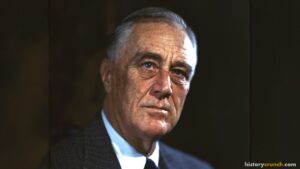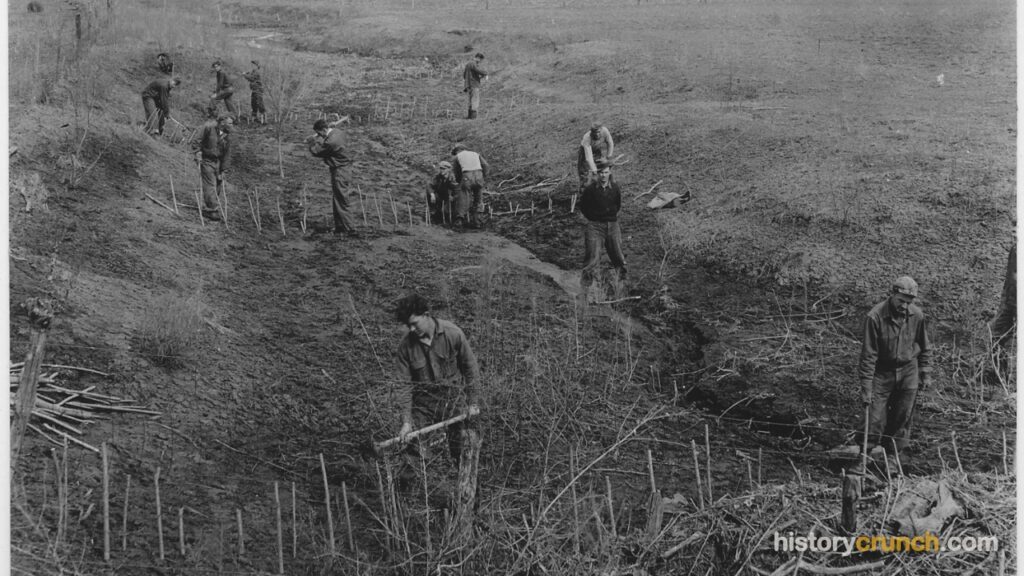
The Civilian Conservation Corps (CCC) was one of the most popular and successful programs of the New Deal, the plan that President Franklin D. Roosevelt used to fight the Great Depression in the United States. Created in 1933, the CCC put hundreds of thousands of unemployed young men to work on conservation projects across the country. The Civilian Conservation Corps was created in 1933 during the Great Depression to relieve unemployment and conserve the country’s natural resources, and it helped save forest lands and restore agricultural topsoil lost in the Dust Bowl. Because of the millions of trees it planted, the program earned the nickname “Roosevelt’s Tree Army.”
The Civilian Conservation Corps was a government work relief program, which means it was a program designed to give jobs and income to people who were out of work. Instead of simply handing out money, the CCC paid young men to complete useful public projects, especially the protection and improvement of natural resources like forests, soil, and parks. In this way, the CCC combined two goals at once, which were helping struggling families and caring for the American landscape.
What Was the New Deal in the Great Depression?
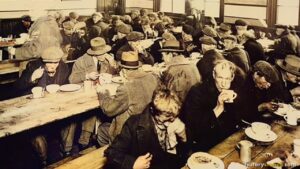
The Great Depression was one of the worst economic crises in modern history. It lasted from 1929 through much of the 1930s and affected millions of people across the United States and around the world, beginning with the collapse of the American stock market in October of 1929 and quickly spreading, wiping out jobs, businesses, and savings on a massive scale. At its worst, about one quarter of American workers had no job at all.
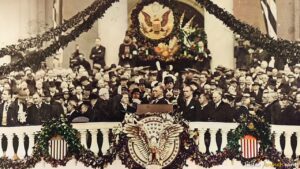
In response to this crisis, President Franklin D. Roosevelt launched a series of government programs known as the New Deal. In general, Roosevelt’s plan was for the federal government to spend money in an attempt to achieve three goals, which were economic recovery, job creation, and investment in public works projects. Roosevelt set about to achieve many of these goals within the first 100 days of his presidency.
The New Deal created many new agencies that were often known by their initials, so they were sometimes called “alphabet agencies.” For instance, these included the Works Progress Administration (WPA), the Tennessee Valley Authority (TVA), and the Public Works Administration (PWA). The Civilian Conservation Corps was one of the earliest and most beloved of these agencies, and it belongs to the group of New Deal programs focused on relief, meaning quick help for people in need.
How Was the Civilian Conservation Corps Created?
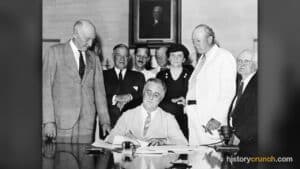
The CCC was one of the first programs Roosevelt pushed through during his famous First Hundred Days in office. Roosevelt signed the Emergency Conservation Work Act on March 31st, 1933, establishing the CCC, and days later, on April 5th, Executive Order 6101 formally created the Corps and appointed Robert Fechner as its director. The program was first called the Emergency Conservation Work program before it became widely known as the Civilian Conservation Corps.
The new program grew at an astonishing speed. Camp Roosevelt in Virginia opened as the first CCC camp, and by July 1st, just three months later, 1,433 camps were operational and 300,000 men were at work across the country. This rapid start showed how badly the young men of America needed jobs and how eager the government was to provide them.
Running the CCC required several parts of the government to work together. The Department of Labor selected the men enrolled, the Department of War administered the work camps with army officers, and the Departments of Agriculture and the Interior devised and supervised the projects. This shared arrangement allowed the government to organize hundreds of thousands of workers quickly and to place them where their labor was most needed.
Who Could Join the Civilian Conservation Corps?
The CCC was aimed at young men whose families were struggling the most during the Great Depression. Those eligible for enrollment were unmarried men between the ages of 18 and 25, later changed to 17 and 28, whose families were on relief. Enrollees agreed to serve for a set period of time. Men involved in the camps enlisted for six month intervals and were able to serve up to two years.
The program was open to a wide range of young men, and over the years it grew to include far more than just single teenagers. In addition to younger men, the CCC enrolled World War I Army veterans, skilled foresters and craftsmen, and roughly 88,000 Native Americans living on Indian reservations. In total, close to three million men would serve in the CCC during its nine years of operation.
Sadly, the CCC also reflected the racism of the time. Though an amendment forbade racial discrimination, segregation was widely practiced, confining African American and Native American men to separate camps. More specifically, around 250,000 African American men served in the CCC, but most were placed in separate companies, often in remote areas, under the unfair laws of that era.
What Was Life Like in a CCC Camp?
Life in the CCC was organized much like life in the military, since army officers ran the camps. Young, unmarried men lived in remote work camps under a semi-military regime. The men followed a strict daily schedule. They lived in wooden barracks, rising when the bugle sounded at 6:00 in the morning, reported to work by 7:45, and after a lunch break worked until 4:00 in the afternoon.
In return for their labor, enrollees received food, housing, clothing, and a small wage. Workers received monthly cash allowances of $30, supplemented by necessities, and they kept $5 and sent $25 to their families. This rule was important because the money sent home helped support families across the country who were suffering during the Great Depression.
Camp life was not only about hard work, as education and recreation were also priorities. Educational activities played a major role in the enrollee’s daily routine, camps were furnished with libraries, and classes were held to teach enrollees vocational skills and provide basic educational needs, and they were also permitted to take high school and college classes. In fact, many young men who could not read or write learned to do so during their time in the CCC. In the evenings and on weekends, enrollees played sports, formed bands, and sometimes traveled to nearby towns.
What Kind of Work Did the CCC Do?
The main purpose of the CCC was to conserve, or protect, the nation’s natural resources. CCC projects included planting trees, building flood barriers, fighting forest fires, and maintaining forest roads and trails. The most famous of these efforts was tree planting on a scale never seen before. The CCC planted more than three billion trees and constructed trails and shelters in more than 800 parks nationwide during its nine years of existence.
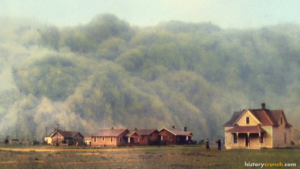
The work of the CCC changed over time as new needs appeared. In 1934, the Dust Bowl hit the Great Plains, and the Corps expanded its work into soil conservation, conserving 40 million acres of land, and then, in the late 1930s, it expanded again into park development work, developing 800 new state parks from the ground up and improving national parks across the country. The Dust Bowl had been a period of terrible dust storms caused by drought and poor farming, and the CCC helped repair some of that damage.
The CCC also became a key part of protecting American forests from fire. The CCC provided the first truly organized wildland fire suppression crews. Between planting trees, fighting fires, and building the trails, roads, cabins, and picnic areas found in parks, the young men of the CCC reshaped huge stretches of the American landscape.
Why Did the Civilian Conservation Corps End?
The CCC lasted for nine years, but the coming of World War II brought it to a close. The CCC ceased operations on June 30th, 1942, and began to dispose of its assets. As the United States prepared to enter the war and defense industries created new jobs, the high unemployment that the CCC had been designed to fight began to disappear.
In reality, the very young men who had served in the CCC were now needed for military service. The discipline, teamwork, and outdoor skills they had learned in the camps prepared many of them for the challenges of army life during the war. In this way, the program that had helped the country through the Great Depression also helped prepare a generation for the fight ahead.
Significance of Civilian Conservation Corps (CCC)
The Civilian Conservation Corps is remembered as one of the most successful New Deal programs because it helped people and the environment at the same time. The CCC was a work relief program that gave millions of young men employment on environmental projects during the Great Depression. For families across the country, the wages sent home from the camps meant the difference between hardship and survival.
The program also left a lasting mark on the American landscape that people still enjoy today. The CCC helped to shape the modern national and state park systems. Many of the trails, cabins, shelters, and roads found in parks were built by CCC workers, and the billions of trees they planted continue to grow across the country.
Finally, the CCC changed how Americans thought about conservation and government service. It showed that the federal government could organize young people to care for the nation’s natural resources on a huge scale. For this reason, the CCC has often been used as a model for later programs, and it stands as a lasting symbol of how the New Deal tried to bring the country through its darkest economic days.
Frequently Asked Questions
What did the CCC stand for?
CCC stood for the Civilian Conservation Corps, a New Deal work relief program. The word “civilian” meant that its members were not part of the military, “conservation” referred to protecting natural resources, and “corps” meant an organized body of workers. Even so, the camps were run in a military style by army officers.
Who started the Civilian Conservation Corps?
President Franklin D. Roosevelt started the Civilian Conservation Corps in 1933. Conservation was a cause he cared about deeply, and he had promoted similar tree-planting work while serving as governor of New York before he became president. He viewed the CCC as a way to rescue both young men and the land at the same time.
How much money did CCC workers make?
CCC workers earned $30 per month, and most of that money went to their families. They got paid $30 a month, $25 of which was sent directly home to their parents, and they got $5 for their own use. While this pay was low, it was greatly valued during a time when so many people had no income at all.
Why was the CCC called Roosevelt’s Tree Army?
The CCC was nicknamed “Roosevelt’s Tree Army” because of the enormous number of trees its members planted. The program was responsible for a huge share of all the tree planting done in the United States during the twentieth century. The word “army” also fit because the camps were run with military discipline and daily routines.
Did women serve in the Civilian Conservation Corps?
The main CCC program was open only to young men, but a smaller number of women took part in related camps. By the end of the program in 1942, the CCC employed nearly three million men and 8,500 women. These women’s camps were far smaller and less well known than the men’s camps, and they did not carry out the same heavy conservation labor.
Cite This Article
To cite this article as a source, use one of the formats below.
MLA: Millar, B. “Civilian Conservation Corps (CCC): A Detailed Summary.” HistoryCrunch, 14 August 2026, https://historycrunch.com/civilian-conservation-corps-ccc/.
APA: Millar, B. (2026). Civilian Conservation Corps (CCC): A Detailed Summary. HistoryCrunch. https://historycrunch.com/civilian-conservation-corps-ccc/
Chicago: Millar, B. “Civilian Conservation Corps (CCC): A Detailed Summary.” HistoryCrunch. August 14, 2026. https://historycrunch.com/civilian-conservation-corps-ccc/
Sources
- Jerry Bentley & Herbert Ziegler, Traditions & Encounters: A Global Perspective on the Past.
- J.M. Roberts & Odd Arne Westad, The Penguin History of the World.