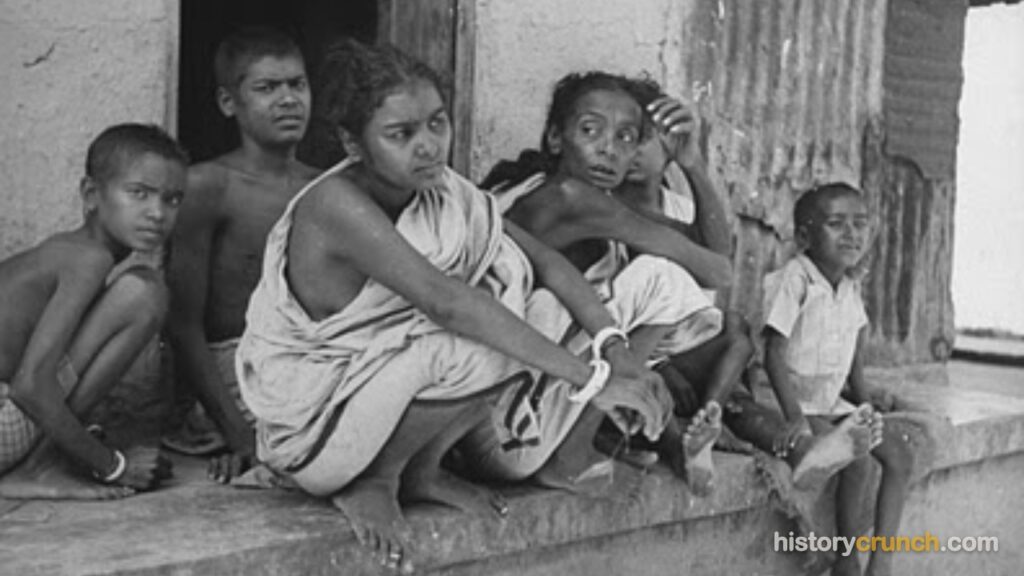
The Bengal Famine of 1943 was one of the most devastating human tragedies of the twentieth century, and it stands as one of the darkest chapters in the history of British rule in India. During the famine, an estimated three million people died from starvation, malnutrition, and disease in the region of Bengal, which today makes up the Indian state of West Bengal and the independent nation of Bangladesh. What made the disaster so shocking was that it did not stem mainly from a natural shortage of food. Instead, it grew out of wartime policies, economic breakdown, and the failure of the colonial government to respond in time.
A famine is a widespread and severe shortage of food that leads to hunger, sickness, and mass death across a region or population. Famines can be triggered by natural events such as droughts, floods, or crop diseases, but they can also be made far worse, or even caused, by human decisions about how food is grown, priced, and distributed. In the case of Bengal in 1943, many of the deaths came not because food had completely run out, but because millions of poor people could no longer afford to buy the food that did exist.
What Was British Imperialism in India?
To understand the Bengal Famine, it helps to understand the overall era of British rule in India. British Imperialism in India was one of the most significant examples of European colonial rule during the Age of Imperialism, when powerful European nations extended their political, economic, and cultural control over other regions of the world. Britain’s involvement in India began through the British East India Company, a trading organization that slowly expanded its political and military power across the Indian subcontinent from the 1600s onward.
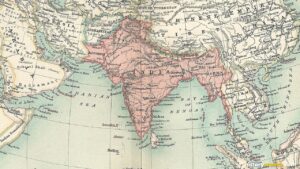
Following the Sepoy Rebellion of 1858, the British government took direct control of India and created what became known as the British Raj, a period of formal colonial rule that lasted from 1858 until Indian independence in 1947. The word raj translates to “rule” in the languages of northern India. At its height, the British Raj governed almost all of modern-day India, Pakistan, and Bangladesh, making it one of the largest and most valuable colonies in the entire British Empire. In fact, India was so important economically that Britain often called it the “Jewel in the Crown.”
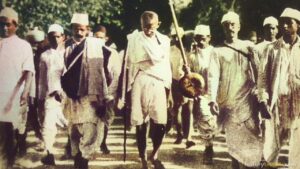
By the time of the Bengal Famine, this system of colonial rule had already lasted for many decades. As stated above, the British controlled India’s economy, its exports, and the movement of vital goods such as rice. This meant that when a crisis struck a region like Bengal during the Second World War, the fate of millions of people rested largely in the hands of colonial officials rather than local leaders.
Where and When Did the Bengal Famine Happen?
The Bengal Famine took place mainly in 1943 and continued into 1944 in the province of Bengal in eastern British India. Bengal was one of the most densely populated regions in the entire British Empire, and its economy was largely agrarian, meaning it depended heavily on farming. Rice was by far the most important crop and the main food for the people of Bengal.
Before the famine, much of Bengal’s rural population already lived in poverty, with many families barely producing enough to survive. This left them extremely vulnerable to any disruption in the food supply. When several problems struck at the same time during the war, the region had almost no cushion to absorb the shock, and the result was catastrophe.
What Caused the Bengal Famine?
The Bengal Famine was caused by a combination of natural and human factors that came together during the Second World War. One trigger was a cyclone that struck coastal Bengal in October of 1942, flooding rice fields with saltwater and destroying a large part of the winter harvest. Around the same time, an outbreak of a fungal plant disease damaged much of the remaining rice crop, further reducing the harvest.
Another major factor was the war itself. In 1942, the Empire of Japan conquered neighboring Burma, which is today called Myanmar. Before the war, Burma had exported large amounts of rice to India, and the loss of these imports removed an important source of food for Bengal. At the same time, refugees fleeing the fighting in Burma poured into Bengal, adding even more people who needed to be fed.
Perhaps the most damaging causes, however, were the British “denial policies.” Fearing that Japan would invade India through Bengal’s coast and rivers, British military authorities began a scorched-earth strategy in 1942. Under the “rice denial” policy, stocks of rice in coastal districts such as Midnapore were removed or destroyed so that an invading army could not use them. These were often the very districts that normally produced extra rice for the rest of Bengal.
Alongside this came the “boat denial” policy. Because Bengal was a land of rivers, boats were the main way that people fished and moved rice from surplus areas to areas in need. The British seized or destroyed tens of thousands of boats, including all boats capable of carrying ten or more passengers in vulnerable coastal districts. In fact, roughly 66,000 boats were taken out of use, which crippled fishing communities and shattered the network that normally carried food across the region.
Why Did So Many People Die?
One of the most striking facts about the Bengal Famine is that it did not coincide with a total collapse in food production. In reality, the rice harvest of 1943 was only slightly below normal and was actually larger than the harvest of 1941, a year in which there had been no famine. This has led many to conclude that the disaster was largely man-made rather than the simple result of nature.
The real problem was that food could no longer reach the people who needed it, and the poor could no longer afford it. As supplies grew uncertain, the price of rice skyrocketed. In the city of Calcutta, the price of rice rose many times over between 1941 and the summer of 1943. Wartime inflation, panic buying, and hoarding by merchants and officials pushed prices far beyond what ordinary laborers and farmers could pay.
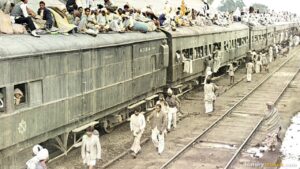
Government decisions made the situation worse. In early 1943, the government of Bengal abandoned its price controls, hoping that grain would flow freely into the province. Instead, prices exploded even higher and speculators took advantage of the crisis. As families ran out of money, they sold their land, their tools, and their belongings, and many left their villages in search of relief. Men often traveled to Calcutta looking for work or food, while women and children became homeless migrants crowding into the cities.
Meanwhile, the British war cabinet, led by Prime Minister Winston Churchill, was slow to send help. The government insisted that India continue exporting rice for the war effort even as people were dying, and it turned down or delayed several requests for grain imports. Relief did eventually arrive, and by late 1943 hundreds of thousands of tons of grain had been shipped to India while free kitchens fed over a million people each day, but for many this help came far too late.
Significance of Bengal Famine
The Bengal Famine was one of the largest losses of civilian life on the Allied side during the entire Second World War, and yet the victims died not from enemy attack but from starvation and disease within the British Empire itself. For this reason, the famine has become a powerful symbol of the failures and injustices of colonial rule. The future Prime Minister of independent India, Jawaharlal Nehru, described it as a final judgment on British rule in India.
The famine also deepened Indian anger toward British rule and strengthened the growing movement for independence. Many Indians pointed to the disaster as clear proof that the colonial government cared more about the war and its own interests than about the lives of ordinary Indian people. Political groups, including the Indian National Congress, protested against the denial policies and the government’s failure to prevent the tragedy.
In the years that followed, the famine also fueled political and religious tensions that contributed to the difficult path toward the Partition of India in 1947. More broadly, the Bengal Famine changed the way scholars and governments think about hunger. It helped show that famines are not always caused by a lack of food, but often by poverty and the failure to distribute food fairly. This idea, sometimes called an entitlement failure, remains an important lesson in the study of hunger and human rights today.
Frequently Asked Questions
How many people died in the Bengal Famine?
Most estimates suggest that around three million people died during the Bengal Famine of 1943 and 1944. Because the poorest and most vulnerable people were hit hardest, and because record-keeping in rural areas was limited, the exact number will never be known, and some estimates range from under one million to nearly four million.
Was the Bengal Famine man-made?
Many historians and economists describe the Bengal Famine as largely man-made because it happened without a complete collapse in food production. While a cyclone and crop disease reduced the harvest, the greater causes were wartime inflation, hoarding, the British denial policies, and slow government relief, all of which placed food out of the reach of the poor.
What was the denial policy in Bengal?
The denial policy was a British scorched-earth strategy meant to keep resources away from a possible Japanese invasion. It involved removing or destroying rice stocks in coastal districts and seizing or sinking tens of thousands of boats, which wrecked the region’s fishing industry and its ability to move food from place to place.
Did Winston Churchill cause the Bengal Famine?
Winston Churchill’s role in the Bengal Famine is heavily debated among historians. His wartime government was slow to send food aid and insisted that India keep exporting rice, which critics say made the famine worse, though defenders argue that a severe shortage of ships and the demands of a global war limited what could be done.
Where did the Bengal Famine take place?
The Bengal Famine took place in the province of Bengal in eastern British India, a region that today is divided between the Indian state of West Bengal and the independent country of Bangladesh. The coastal and river districts near the border with Burma, such as Midnapore, Chittagong, and Noakhali, were among the hardest hit.
Cite This Article
To cite this article as a source, use one of the formats below.
MLA: Millar, B. “Bengal Famine: A Detailed Summary.” HistoryCrunch, 14 August 2026, https://historycrunch.com/bengal-famine/.
APA: Millar, B. (2026). Bengal Famine: A Detailed Summary. HistoryCrunch. https://historycrunch.com/bengal-famine/
Chicago: Millar, B. “Bengal Famine: A Detailed Summary.” HistoryCrunch. August 14, 2026. https://historycrunch.com/bengal-famine/
Sources
- Jerry Bentley & Herbert Ziegler, Traditions & Encounters: A Global Perspective on the Past.
- J.M. Roberts & Odd Arne Westad, The Penguin History of the World.