Shaka Zulu was one of the most important leaders in the history of southern Africa, and his reign transformed a small clan into a powerful kingdom that reshaped the region forever. Shaka ruled the Zulu people during the early 19th century, and in little more than a decade he built a centralized state, invented new methods of warfare, and set in motion a period of upheaval that changed the map of the subcontinent. His life story is one of hardship, ambition, military genius, and eventually violence and grief.
 FactsthatCrunch
Shaka Zulu transformed a small Nguni clan into a powerful state in southeastern Africa, uniting more than a hundred chiefdoms under a single ruler in little more than a decade. He introduced new weapons, age-based military regiments, and the buffalo horns battle formation, and his military methods continued to shape Zulu warfare long after his death.
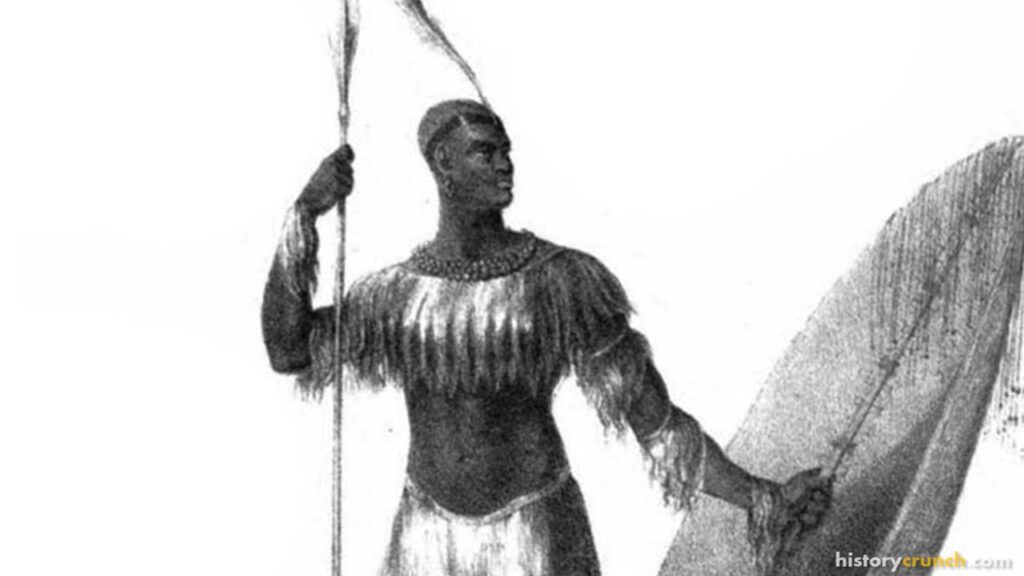
The Zulu Kingdom was a monarchy in what is now the KwaZulu-Natal region of South Africa, located along the coast of the Indian Ocean. Under Shaka, it grew from a minor chiefdomA small territory ruled by a single chief, less organized than a full kingdom. into the largest and most feared state in southeastern Africa, organized around a strict military culture in which the army stood at the center of daily life. The kingdom he created outlived him and survived until it was conquered by the British in 1879.
Early Life and Background
Shaka was born around 1787 in the region between the Drakensberg mountains and the Indian Ocean, an area filled with many independent Nguni chiefdoms. His father, Senzangakhona, was a minor chief of the small Zulu clan, and his mother, Nandi, was the daughter of a chief from the neighboring Langeni clan. Because his parents came from different clans and were not properly married by tradition, Shaka’s birth broke Zulu custom and was treated as a disgrace.
The relationship between Nandi and Senzangakhona did not last. As a result of tribal pressure, the couple separated, and Shaka and his mother were driven away from his father’s clan. In fact, the boy’s very name became a mark of insult, because his father had at first claimed that Nandi was not pregnant but was suffering from a stomach illness caused by an insect known as the iShaka beetle.
The years that followed were painful. Shaka and his mother wandered from one settlement to another, often treated with cruelty and scorn, and the other boys teased and bullied him wherever they went. More specifically, this harsh childhood is often used to explain the anger and ambition that drove him later in life. Through all of it, Shaka remained deeply attached to his mother, and their bond would prove important throughout his reign.
Around 1803, Shaka and Nandi finally found safety among the Mthethwa people, who were the dominant power group in the region. There, under the protection of the Mthethwa chief Dingiswayo, Shaka’s fortunes began to improve. As he grew older, he became tall, strong, and physically fearless, and he began to stand out as a natural leader among the young men.
FactsthatCrunchRise to Power
As a young man, Shaka served as a warrior in the army of Dingiswayo, who had built a federationA group of many clans or states joined together under one leading power, while still keeping some independence. of dozens of clans through a mix of diplomacy and warfare. Shaka fought for about six years and quickly gained a reputation for courage and skill in battle. During this time he also began to develop the fighting ideas that would later make him famous.
When Shaka’s father Senzangakhona died, Dingiswayo helped him seize control of the Zulu clan, and around 1816 Shaka became its chief. At the time, the Zulu were only a small and insignificant group, but Shaka immediately set about reorganizing them into a disciplined military force. He was determined to turn the clan that had once rejected him into the strongest power in the region.
Shaka’s rise was soon tested by a powerful rival. In 1818, Dingiswayo was captured and killed by Zwide, the chief of the Ndwandwe clan. Shaka sought revenge, and the struggle against Zwide became the defining conflict of his early reign.
One of the most famous clashes came at the Battle of Gqokli Hill around 1818, where Shaka’s army faced the far larger Ndwandwe force. Although he was heavily outnumbered, Shaka’s warriors were better trained and used superior tactics, and they won the day. In 1820, Shaka gained his full revenge with a decisive victory over the Ndwandwe at the Mhlatuze River, after which the defeated clan fled northward and Shaka became the undisputed master of the region.

Major Achievements
Shaka’s greatest achievement was his complete transformation of how war was fought in southern Africa. Before his reign, battles were often fought at a distance, with warriors throwing long spears and rarely closing in for hand-to-hand combat. Shaka rejected this style and instead trained his warriors to fight up close in fierce, direct clashes.
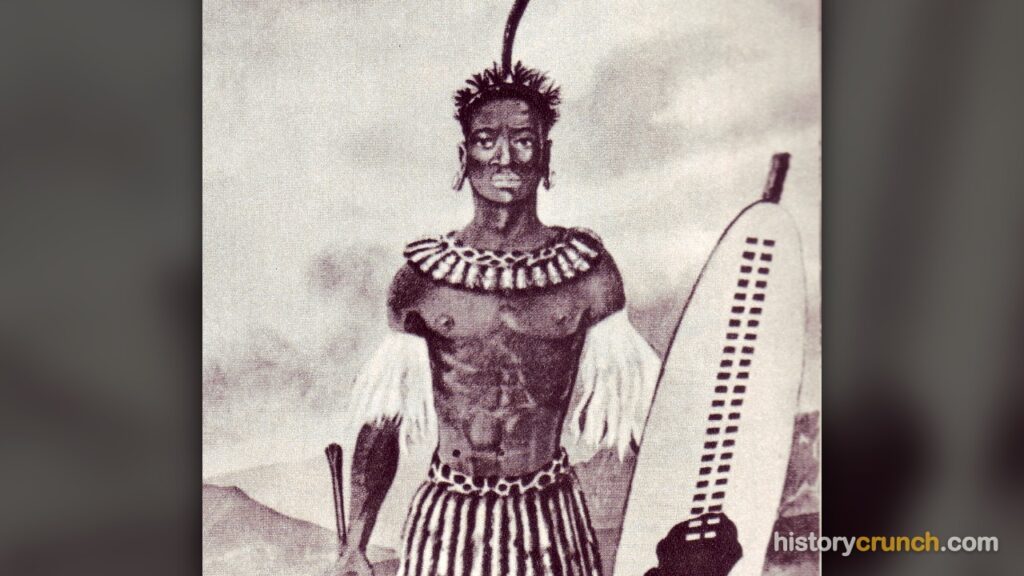
To make this possible, he made famous a new weapon called the iklwaA short stabbing spear with a broad, heavy blade made for close combat rather than throwing., a short spear with a broad, heavy blade meant for stabbing rather than throwing. Its name is said to come from the sound it made when it was pulled from an enemy’s body. In reality, the traditional throwing spear was not fully abandoned, since it was still thrown from a distance at the start of a battle before the warriors charged in to fight with the iklwa. Warriors also carried large cowhide shields, which they used to hook aside an enemy’s shield and expose the body for a fatal thrust.
Shaka also perfected a battle plan known as the “buffalo horns” formation. In this tactic, the strongest and most experienced warriors formed the “chest,” which attacked the enemy head on. Two “horns” of faster warriors swept out to the sides to surround and trap the enemy, while a reserve group known as the “loins” waited behind, ready to reinforce any part of the line or block an escape.
Beyond weapons and tactics, Shaka reshaped Zulu society itself around the army. He organized warriors into regiments called impisAge-based warrior regiments that lived and trained together in special military settlements under Shaka., grouping men together by age, and these regiments lived and trained together in special military settlements. Warriors were often required to remain unmarried for many years until Shaka gave them permission to wed, which built strong loyalty and discipline. He even had his men give up sandals so that their bare feet would toughen and allow them to move faster over rough ground.
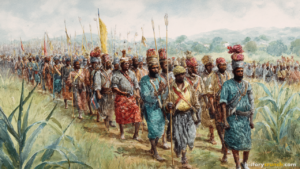
With this powerful army, Shaka conquered one chiefdom after another. As he defeated rival groups, he absorbed their people into the growing Zulu nation rather than simply destroying them. In this way, the Zulu Kingdom’s population swelled into the hundreds of thousands, and at the height of his power Shaka could send tens of thousands of trained warriors into battle, controlling a huge stretch of territory between the Pongola River in the north and the Tugela River in the south.
FactsthatCrunchThe buffalo horns formation was a battle plan Shaka Zulu used to surround and trap an enemy force so it could not escape.
Shaka and the Mfecane
The rapid growth of the Zulu Kingdom came at a terrible cost to other peoples. Shaka’s conquests are closely linked to a period of upheaval known as the MfecaneA wave of wars, forced migrations, and famine across southern Africa in the 1820s, often translated as ‘the crushing’ or ‘the scattering.’, a word often translated as “the crushing” or “the scattering.” This was a time of widespread warfare, forced migration, and famine that spread across large parts of southern and central Africa during the 1820s.
As Shaka’s armies expanded, groups that were not killed or absorbed fled from their homelands to escape. These displaced peoples in turn attacked and displaced others, creating a chain reaction of violence that spread far beyond Zulu territory. The effects were felt as far away as present-day Tanzania, Malawi, and Zambia, and it has been estimated that around two million people died during the chaos.
It is important to note that historians continue to debate exactly how much of the Mfecane was caused by Shaka alone. Other factors, such as drought, population pressure, and competition over trade near the coast, likely played a major role as well. Even so, the Zulu expansion under Shaka was clearly one of the central forces behind this dramatic reshaping of the region.
Later Life and Death
As Shaka’s power grew, his rule became harsher and more feared. Anyone who disobeyed his orders could be put to death instantly, and he was willing to destroy entire settlements to send a message to others. This mix of military brilliance and cruelty is why he is remembered so differently by different people, celebrated by some as a symbol of African achievement and condemned by others for his violence.
In 1827, at the height of his power, Shaka’s mother Nandi died, and he was overcome with grief. His mourning turned into a period of extreme and destructive behavior across the whole kingdom. He forced his people into mourning as well, and he is said to have ordered that no crops be planted and no milk be used for a year, along with other cruel and deadly commands that caused great suffering.
These erratic and violent decisions turned many people against him, including members of his own family. In September of 1828, Shaka was assassinatedDeliberately killed, usually for political reasons, by a person or group acting in secret. by a small group of conspirators that included two of his half-brothers, Dingane and Mhlangana. After the killing, Dingane murdered Mhlangana and took the throne for himself, becoming the next ruler of the Zulu Kingdom.
FactsthatCrunchShaka was assassinated in September 1828 by a group that included two of his own half-brothers, Dingane and Mhlangana.
Dingane then took the throne and ruled the Zulu Kingdom until 1840. The kingdom Shaka built lasted another fifty years, until the British defeated it in the Anglo-Zulu War of 1879.
Significance of Shaka Zulu
Shaka Zulu is remembered as the founder of the Zulu Kingdom and as one of the most influential leaders in African history. In just over a decade, he turned a small and unimportant clan into the most powerful state in southeastern Africa, uniting more than a hundred chiefdoms under a single ruler. The kingdom he built was strong enough to survive his death and to resist European expansion for many more years.
His military innovations changed the face of warfare in the region forever. The short stabbing spear, the large shield, the age-based regiments, and the buffalo horns formationA battle plan where a central ‘chest’ attacked head-on while two ‘horns’ swept out to surround and trap the enemy. became the foundation of Zulu military strength. In fact, these same methods helped later Zulu armies win a stunning victory over British forces at the Battle of Isandlwana in 1879, long after Shaka’s death.
At the same time, Shaka’s legacy is complicated and often debated. His conquests brought enormous suffering during the Mfecane and left him with a reputation for ruthlessness and violence. Yet for the Zulu people, he remains a powerful symbol of unity, identity, and pride, and his name is still closely tied to Zulu culture in South Africa today.
FactsthatCrunchKey Vocabulary
Chiefdom
Mfecane
Iklwa
Impis
Buffalo horns formation
Federation
Assassinated
Frequently Asked Questions
Who was Shaka Zulu?
Shaka Zulu was the leader who founded the Zulu Kingdom in southern Africa in the early 19th century. Born around 1787, he rose from a difficult and outcast childhood to become a brilliant military commander who united many clans into one of the strongest states the continent had ever seen. His full name is often given as Shaka kaSenzangakhona, meaning Shaka, son of Senzangakhona.
What weapons did Shaka Zulu invent?
Shaka is best known for popularizing the iklwa, a short stabbing spear with a broad blade designed for close combat. He paired it with a large cowhide shield that warriors used to control and expose their opponents in battle. While he did not invent the short spear entirely on his own, he trained his army to use it in a disciplined new way that made the Zulu nearly unstoppable.
How did Shaka Zulu die?
Shaka Zulu was assassinated in September of 1828 by a group of conspirators that included two of his half-brothers, Dingane and Mhlangana. His increasingly cruel and unpredictable behavior, especially after the death of his mother, had turned many people against him. After the killing, Dingane eliminated his fellow plotter Mhlangana and seized the throne.
What was the buffalo horns formation?
The buffalo horns formation was Shaka’s signature battle tactic, designed to surround and destroy an enemy force. The “chest” attacked directly while two “horns” swept around the sides to encircle the foe, and a reserve called the “loins” waited behind to reinforce the line or stop any escape. This coordinated plan allowed smaller Zulu armies to defeat much larger opponents.
Why is Shaka Zulu important in history?
Shaka Zulu is important because he founded the Zulu Kingdom and revolutionized African warfare in ways that shaped the entire region. His conquests helped trigger the Mfecane, a massive period of migration and conflict that redrew the map of southern Africa. Today he is viewed both as a symbol of Zulu pride and as a figure whose reign brought great violence.
Cite This Article
To cite this article as a source, use one of the formats below.
MLA: Millar, B. “Shaka Zulu: A Detailed Biography.” HistoryCrunch, 14 August 2026, https://historycrunch.com/shaka-zulu/.
APA: Millar, B. (2026). Shaka Zulu: A Detailed Biography. HistoryCrunch. https://historycrunch.com/shaka-zulu/
Chicago: Millar, B. “Shaka Zulu: A Detailed Biography.” HistoryCrunch. August 14, 2026. https://historycrunch.com/shaka-zulu/
Sources
- J.M. Roberts & Odd Arne Westad, The Penguin History of the World.
- Jerry Bentley & Herbert Ziegler, Traditions & Encounters: A Global Perspective on the Past.