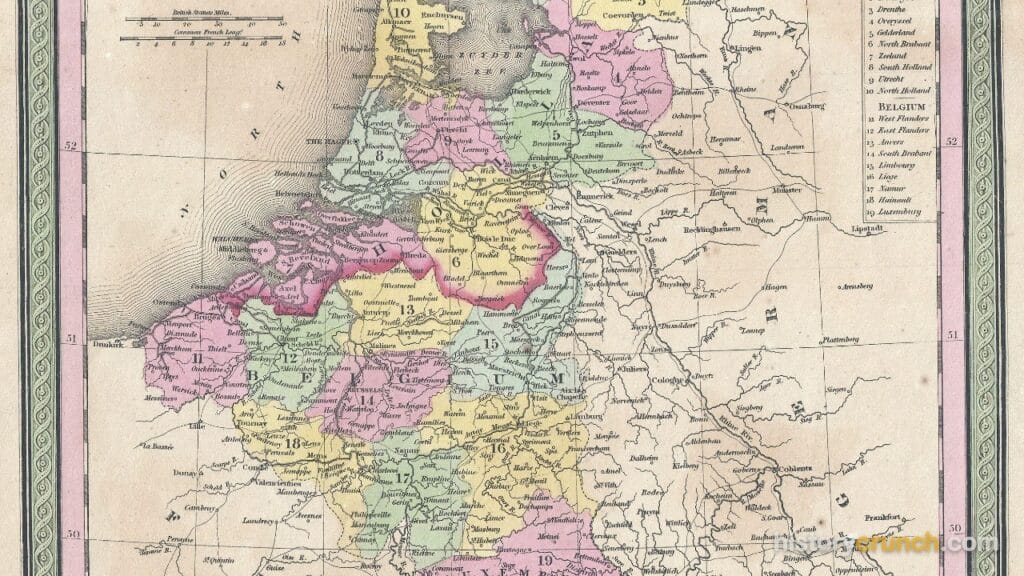
Belgium played an important role in the Age of Imperialism, even though it was one of the smallest nations in Europe. Its involvement is best remembered through King Leopold II, who created a private empire in Central Africa known as the Congo Free State. In fact, Belgium’s story stands out because much of its imperial activity was carried out not by the government but by a single monarch acting on his own behalf. The brutal treatment of the Congolese people under Leopold II’s rule became one of the most shocking examples of the entire imperial era.
Imperialism is the term historians use to describe the process by which one country extends its political, economic, or cultural control over another country or region. In the case of Belgium, this control was focused almost entirely on the Congo River Basin in Africa. Unlike Britain or France, which built large empires spread across many continents, Belgium’s imperial reach centered on this one enormous territory, which was many times larger than Belgium itself.
What Was the Age of Imperialism?
The Age of Imperialism was a period of intense colonial expansion that took place primarily from the 1870s through the early 20th century. During this era, European nations competed to establish formal political control over territories in Africa, Asia, and the Pacific, driven by economic interests, nationalist rivalry, and a belief in racial and cultural superiority. The major powers of the time raced to claim as much land as they could before their rivals did.
Major imperial powers like Britain, France, Germany, Belgium, and Italy carved up entire continents, imposing European political systems, languages, and cultures on the different peoples of the world. As stated above, Britain built the largest empire, while France ranked second in size. Belgium, though small, secured one of the most valuable single territories on the African continent.
The most dramatic expression of this era was the Scramble for Africa. This competition occurred from 1870 until 1914, and during these years almost all of Africa came under the control of the major European powers, including Britain, France, Germany, Belgium, Italy, Portugal, and Spain. More specifically, the European powers were driven by the desire for raw materials, new markets, and national prestige, and they justified their actions with the false idea that they were bringing civilization to the peoples of Africa and Asia.
Why Did Belgium Become an Imperial Power?
Belgium became a nation only in 1830, which made it a young country when the Age of Imperialism reached its height. Its ruler during the most important years of imperial expansion was King Leopold II. Leopold II was the King of Belgium from 1865 until 1909, and his reign occurred generally at the same time as the Scramble for Africa, which extended from 1870 until 1914.
Leopold II was determined that Belgium, and he personally, should share in the wealth and prestige that came with owning colonies. For instance, he watched Britain and France grow rich from their overseas territories and believed that a colony would bring similar rewards. However, the Belgian government and public were not eager to spend money on distant lands. As a result, Leopold decided to pursue an empire as a private individual, using his own resources and connections rather than the power of the Belgian state.
To achieve his goal, Leopold created an organization that presented itself as a scientific and humanitarian society. He presented his territorial claims under the guise of a philanthropic organization, later known as the International Congo Society, a strategic move that allowed him to cloak his true intentions, the ruthless exploitation of the region’s resources, in a veneer of noble purpose. This clever disguise helped him win the support of other European nations.
How Did Leopold II Gain Control of the Congo?
Two main events allowed Leopold II to take control of the Congo. The first was the work of the explorer Henry Morton Stanley. Stanley explored the central regions of Africa while in search of the origin of the Nile River, and his expeditions eventually took him to the Congo River Basin, which led to Leopold II laying claim to the region. Leopold hired Stanley to sign treaties with local African leaders, establishing his presence in the area.
The second event was the Berlin Conference. The Berlin Conference of 1884 was called by German Chancellor Otto von Bismarck in order to help divide the continent of Africa for the European powers. The goal of the conference was to help Europe avoid a war over disagreements in Africa, and as part of this agreement, Leopold II of Belgium gained personal control over the Congo region. No African leaders were invited to take part in these decisions about their own lands.
In fact, Leopold II officially formed the Congo Free State in 1885 and ruled over it as his own private possession, using his control over the region as a way of amassing a fortune for himself. It is important to understand this point clearly. He ruled over the Congo as a personal possession, which means that he was responsible for it and not the country of Belgium. In reality, the other European nations granted him control over the Congo on the basis that he would help the Congolese people and carry out humanitarian work in the area.
What Happened in the Congo Free State?
Once he controlled the Congo, Leopold II turned it into a machine for extracting wealth. The Congo area had valuable resources, such as rubber, ivory, copper, and other raw materials. Rubber was the most important of these. Rubber was an incredibly valuable resource at the time, as the newly invented rubber tire was being used in bicycles and early automobiles. As demand for rubber soared around the world, so did Leopold’s determination to squeeze as much of it as possible out of the Congo.
To collect this rubber, Leopold’s officials forced the Congolese people to work under a harsh quota system. Villages were ordered to deliver set amounts of rubber, and those who failed faced terrible punishments. If the people did not meet their quota for rubber then they could have one or both of their hands cut off. Soldiers of the colonial army carried out these punishments, and the practice of cutting off hands became one of the most infamous symbols of the entire period of imperialism.
The human cost of Leopold’s rule was staggering. In all, it is estimated that as many as 15 million Congolese people died during the years of Leopold II’s reign. People died from violence, forced labor, starvation, and disease as the population was worked to the point of collapse. Strangely, Leopold himself never once traveled to the Congo, yet he grew immensely wealthy from the suffering that took place there.
How Did the World Learn About the Abuses?
For many years, Leopold managed to hide the reality of his rule behind a public image of charity and progress. Over time, however, the truth began to spread. The horrific reality of the Congo Free State eventually became known to the world, largely due to the efforts of activists, journalists, and a British diplomat named Roger Casement, and the exposure of Leopold’s regime by the Congo Reform Association sparked an international outcry.
The growing scandal put enormous pressure on Leopold and on Belgium. The atrocities eventually drew international attention, and the intense pressure caused the Belgian government to investigate what was occurring in the Congo Free State. As a result, the private arrangement that had made Leopold so rich could no longer be defended.
The public indignation grew so great that Leopold was finally forced to cede his personal control over the territory to the Belgian government, and in 1908 the Congo Free State was dissolved and annexed as a state-run colony known as the Belgian Congo. Belgium continued to rule the Congo as a colony until it gained independence in 1960. However, the patterns of exploitation that Leopold created did not disappear overnight.
Significance of Belgium in the Age of Imperialism
Belgium’s role in the Age of Imperialism is significant because it shows how even a small nation could have a massive impact on the wider world. Through King Leopold II, Belgium came to control one of the largest and richest colonial territories in Africa. In fact, the story of the Congo Free State demonstrates how the desire for profit and prestige could lead to enormous human suffering.
The Belgian experience also stands as a powerful example of the darkest side of imperialism. King Leopold II of Belgium ruled over the Congo Free State throughout the period of Imperialism in Africa, and his actions in the Congo have come to symbolize the brutality of the period of the Age of Imperialism, and how it created a differing set of legacies for Europe and Africa. For Belgium, the Congo brought wealth, while for the Congolese people it brought loss and hardship on a massive scale.
Finally, the effects of Belgian imperialism reached far beyond the colonial era. The borders that Leopold established in the 1880s helped shape the modern Democratic Republic of the Congo, and the patterns of resource extraction he set in motion continued long after independence. As such, Belgium’s chapter in the Age of Imperialism remains one of the most studied and debated examples of European colonial rule.
Frequently Asked Questions
Who was Leopold II of Belgium?
Leopold II was the King of Belgium and the driving force behind Belgian imperialism. He was born in Brussels in 1835 and became king in 1865 after the death of his father, Leopold I. He is remembered mostly for creating and ruling the Congo Free State as his own private empire rather than as a Belgian government colony.
What was the Congo Free State?
The Congo Free State was a huge territory in Central Africa that Leopold II owned personally from 1885 to 1908. It covered around 900,000 square miles (about 2.3 million square km), making it far larger than Belgium itself. Despite its hopeful sounding name, it was one of the most oppressive colonial regimes in history.
Why was rubber so important in the Congo?
Rubber was important because the growth of bicycles and early automobiles created a huge worldwide demand for it. The Congo’s wild rubber vines made it a source of enormous profit for Leopold II. This demand drove the harsh quota system that led to forced labor and widespread violence against the Congolese people.
How did Belgium lose control of the Congo Free State?
Leopold II lost personal control of the Congo in 1908 because of an international scandal over the abuses there. Investigations and reports exposed the killings, forced labor, and mutilations taking place under his rule. The outrage forced Leopold to hand the territory over to the Belgian government, which then ran it as the Belgian Congo.
What is the lasting impact of Belgian imperialism?
The lasting impact of Belgian imperialism can still be seen in Central Africa today. The modern Democratic Republic of the Congo shares much of the same territory that Leopold II first claimed, and the country continued to struggle with exploitation and instability long after independence in 1960. For this reason, Belgian imperialism is often studied as a lesson about the human cost of colonial rule.
Cite This Article
To cite this article as a source, use one of the formats below.
MLA: Millar, B. “Belgium in the Age of Imperialism: A Detailed Summary.” HistoryCrunch, 12 August 2026, https://historycrunch.com/belgium-in-the-age-of-imperialism/.
APA: Millar, B. (2026). Belgium in the Age of Imperialism: A Detailed Summary. HistoryCrunch. https://historycrunch.com/belgium-in-the-age-of-imperialism/
Chicago: Millar, B. “Belgium in the Age of Imperialism: A Detailed Summary.” HistoryCrunch. August 12, 2026. https://historycrunch.com/belgium-in-the-age-of-imperialism/
Sources
- Daniel R. Headrick, The Tools of Empire.
- Eric Hobsbawm, The Age of Empire 1875-1914.