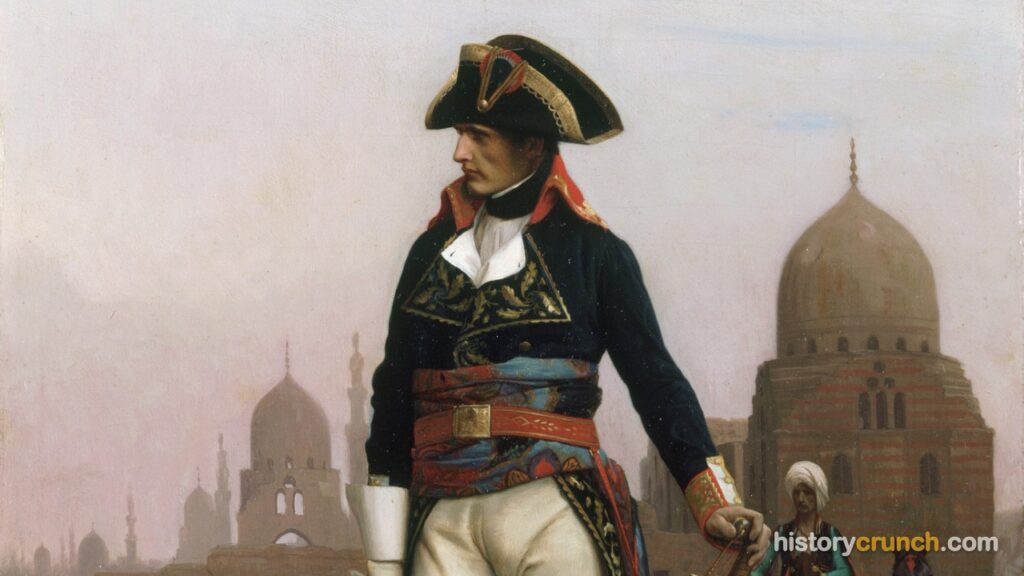
Napoleon’s Egyptian Campaign was one of the most ambitious and revealing military ventures of the late 18th century, and it helped launch Napoleon Bonaparte from a rising general into a national figure who would soon rule France. Between 1798 and 1801, a French army invaded Egypt in an effort to weaken Great Britain, threaten its trade route to India, and expand French power in the Mediterranean. The campaign involved dramatic land victories, a crushing naval defeat, a failed invasion of Syria, and a wave of scientific discovery that changed how Europeans understood the ancient world. In the end, the military effort failed, but its lasting effects reached far beyond the battlefield.
In simple terms, Napoleon’s Egyptian Campaign was a French expedition that tried to seize control of Egypt, which was then loosely part of the Ottoman Empire but ruled locally by a warrior class called the Mamluks. It combined a military invasion with a large team of scholars and scientists who studied Egypt’s land, people, and ancient monuments. The campaign is remembered both as a costly military failure and as the beginning of the modern study of ancient Egypt.
What Were the French Revolutionary Wars?
The Egyptian Campaign took place during the French Revolutionary Wars, a series of conflicts fought between the new French Republic and several European powers from 1792 to 1802. The French Revolution had begun in 1789 when the people of France overthrew their absolute monarchy and set up a republic based on liberty, equality, and fraternity. Neighboring monarchies feared these radical ideas would spread, and they went to war to crush the revolution.
By the end of 1797, France had defeated most of its enemies on the European continent and stood dominant in Western Europe. Great Britain, however, remained at war and refused to make peace. In reality, Britain’s power rested largely on its navy and its wealthy colonies, especially India, so French leaders searched for a way to strike at Britain indirectly. During this period, France was governed by the Directory, a five-member council that ran the country in the final years of the revolution. It was the Directory that approved the plan to invade Egypt.
Why Did Napoleon Invade Egypt?
Napoleon and the Directory chose Egypt for both practical and strategic reasons. More specifically, controlling Egypt would give France a base in the eastern Mediterranean and could threaten Britain’s vital trade routes to India, which passed near the Red Sea. French leaders also hoped that a colony in Egypt would bring in new wealth and open the door to further expansion in the region.
There were personal reasons as well. Napoleon had just won a string of stunning victories in Italy and was eager for further glory. A daring eastern expedition appealed to his ambition, and the Directory was not unhappy to send its most popular general far away from Paris. At the time, Egypt was officially part of the Ottoman Empire, but real power lay with the Mamluks, a military class that had ruled for centuries and was widely disliked for its harsh taxes. Napoleon planned to present himself as a liberator freeing the Egyptian people from Mamluk rule, even as he seized the country for France.
How Did the Campaign Begin?
Napoleon set sail from France in May of 1798 with a huge expedition of around 400 ships and roughly 35,000 soldiers. Along with his troops, he brought a team of more than 150 scholars, scientists, engineers, and artists, showing that this was meant to be more than an ordinary military conquest. On the way, the French seized the strategic island of Malta, then slipped past the British fleet under Admiral Horatio Nelson that was hunting for them in the Mediterranean.
The French landed near Alexandria on July 1st, 1798, and captured the city the following day after brief fighting. From there, Napoleon marched his army south across the harsh desert toward Cairo, the key to controlling Egypt. The march was brutal, as the soldiers suffered from heat, thirst, and constant harassment. In fact, the difficult conditions weakened and demoralized the army even before it reached the main enemy force.
What Happened at the Battle of the Pyramids?
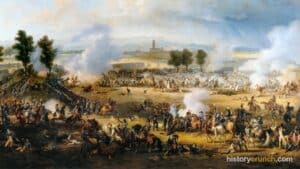
On July 21st, 1798, the French army met the main Mamluk force near the village of Embabeh, across the Nile River from Cairo and within sight of the great pyramids at Giza. The Mamluks were famous for their powerful and highly trained cavalry, but they had little experience against a modern European army. Before the fighting, Napoleon is said to have urged his soldiers on with the dramatic claim that forty centuries of history were looking down on them from the pyramids.
The battle was a one-sided French victory. Napoleon arranged his troops into massive rectangular formations known as divisional squares, which allowed his infantry to fire in every direction and repel wave after wave of cavalry charges. The Mamluk horsemen were cut down in large numbers, while French losses were very light. As a result, the French captured Cairo and effectively broke the centuries-old power of the Mamluks in Egypt.
Why Was the Battle of the Nile So Important?
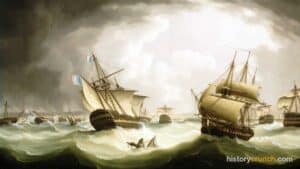
Napoleon’s triumph on land was quickly undone at sea. On August 1st, 1798, Admiral Horatio Nelson finally located the French fleet anchored in Aboukir Bay, near the mouth of the Nile. Nelson launched a bold surprise attack at dusk, catching the French ships unprepared and poorly positioned. Over the course of the battle, the British destroyed or captured almost the entire French fleet.
This engagement, known as the Battle of the Nile, was one of the most decisive naval victories in British history. More importantly for the campaign, it left Napoleon’s army stranded in Egypt with no easy way to receive supplies or reinforcements from France. The victory also encouraged Britain’s enemies of France and helped the Ottoman Empire join the fight against the French. In reality, the loss of the fleet doomed the entire expedition, no matter how well the army performed on land.
What Was the Invasion of Syria?
With his army cut off, Napoleon tried to strengthen his position by marching into Syria in early 1799 to strike at the Ottomans before they could gather forces against him. His troops advanced up the coast, capturing towns along the way, and won a battle at Mount Tabor in April of 1799 against a much larger Ottoman army. The high point of resistance came at the fortified city of Acre.
The Siege of Acre proved to be Napoleon’s first major defeat. The defenders, supported by British warships that supplied them and blocked French artillery from arriving by sea, held out against repeated French assaults. Disease, especially plague, spread through Napoleon’s ranks and killed many of his men. After weeks of failed attacks, Napoleon lifted the siege in May of 1799 and led his weakened, sickly army back across the desert to Egypt.
How Did the Campaign End?
By the summer of 1799, Napoleon’s situation in Egypt was hopeless. His fleet was gone, his army was shrinking from disease and combat, and revolts were breaking out among the Egyptian population that resented French rule and taxation. Meanwhile, news arrived that the political situation in France was unstable and that new opportunities were opening for an ambitious general back home.
In August of 1799, Napoleon secretly boarded a ship and sailed back to France, leaving his army behind under the command of General Jean-Baptiste Kléber. He timed his return well. Arriving as a celebrated hero, he took part in a coup that overthrew the Directory and made him the ruler of France by the end of 1799. The soldiers he left behind fought on for two more years. Kléber was assassinated in 1800, and the remaining French forces finally surrendered to a combined British and Ottoman army in 1801, ending the campaign in complete military failure.
What Was the Scientific Legacy of the Campaign?
Although the campaign failed militarily, the scholars and scientists Napoleon brought with him produced remarkable results. These experts, often called savants, studied Egypt’s geography, animals, plants, and ancient monuments, and their findings were later published in a massive series of volumes describing the country in great detail. Their work introduced Europeans to the wonders of ancient Egypt and helped launch a wave of fascination with Egyptian art and culture.
The most famous discovery came in 1799, when French soldiers rebuilding a fort near the town of Rosetta uncovered a large inscribed stone. This artifact, known as the Rosetta Stone, carried the same message written in three scripts, including Greek and Egyptian hieroglyphics. Decades later, scholars used it to finally decode hieroglyphic writing, unlocking the history of ancient Egypt. The stone itself was surrendered to the British after the French defeat and remains a celebrated treasure to this day.
Significance of Napoleon’s Egyptian Campaign
The significance of Napoleon’s Egyptian Campaign lies in its mixed and far-reaching results. As a military operation, it was a clear failure, ending with a defeated French army stranded and forced to surrender. It also confirmed British naval dominance in the Mediterranean and demonstrated that Napoleon, for all his talent, could be beaten.
Yet the campaign proved deeply important in other ways. For Napoleon personally, it built his reputation and gave him the fame and confidence he needed to seize power in France, setting the stage for his rise to emperor. For the study of history, it opened the door to modern Egyptology and reshaped how the world understood one of the greatest ancient civilizations. In this way, a failed invasion left a lasting mark on both European politics and the study of the past.
Frequently Asked Questions
When Did Napoleon’s Egyptian Campaign Take Place?
Napoleon’s Egyptian Campaign lasted from 1798 to 1801. Napoleon himself was only present for part of that time, sailing to Egypt in 1798 and secretly leaving in 1799. The French troops he left behind continued to hold parts of Egypt until they surrendered in 1801.
Did Napoleon Win or Lose in Egypt?
Napoleon ultimately lost the campaign in Egypt. He won several impressive land battles, including the Battle of the Pyramids, but the destruction of his fleet at the Battle of the Nile trapped his army. Without supplies or reinforcements, the French were slowly worn down and forced to surrender by 1801.
Who Were the Mamluks?
The Mamluks were a military class that ruled Egypt on behalf of the Ottoman Empire. They originally came from regions near the Caucasus Mountains and were known especially for their skilled cavalry. Although they held real power in Egypt, many ordinary Egyptians resented them for their heavy taxes and harsh rule.
Why Did Napoleon Leave His Army in Egypt?
Napoleon left his army in Egypt because the campaign had become hopeless and a bigger opportunity awaited him in France. His fleet was destroyed, his forces were shrinking from disease and revolt, and the French government was weak and unstable. By returning quickly, he was able to take advantage of the chaos in Paris and seize power.
How Did the Rosetta Stone Get to the British Museum?
The Rosetta Stone passed into British hands after France’s defeat in Egypt. When the French forces surrendered in 1801, the British demanded the artifacts the French scholars had gathered, including the stone. It was then shipped to Britain, where it has remained on display for more than two centuries.
Cite This Article
To cite this article as a source, use one of the formats below.
MLA: Millar, B. “Napoleon's Egyptian Campaign: A Detailed Summary.” HistoryCrunch, 11 August 2026, https://historycrunch.com/napoleons-egyptian-campaign/.
APA: Millar, B. (2026). Napoleon's Egyptian Campaign: A Detailed Summary. HistoryCrunch. https://historycrunch.com/napoleons-egyptian-campaign/
Chicago: Millar, B. “Napoleon's Egyptian Campaign: A Detailed Summary.” HistoryCrunch. August 11, 2026. https://historycrunch.com/napoleons-egyptian-campaign/
Sources
- The Met (Heilbrunn Timeline)
- David A. Bell, Napoleon: A Concise Biography.
- Fordham Modern History Sourcebook
- Andrew Roberts, Napoleon: A Life.