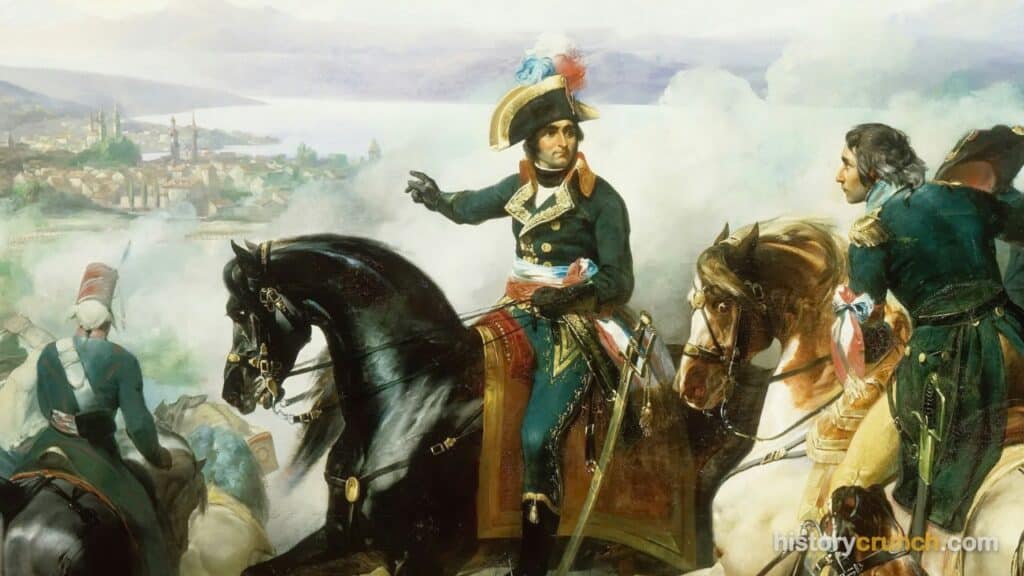
The Napoleonic Era was one of the most dramatic and transformative periods in European history, lasting from 1799 to 1815 and reshaping the political map of an entire continent. It refers to the years when Napoleon Bonaparte rose from a young military officer to Emperor of the French, fought a long series of wars against the other great powers of Europe, and spread the ideas of the French Revolution far beyond the borders of France. By the time it ended with his final defeat and exile, the era had toppled ancient kingdoms, redrawn national borders, and set loose forces of nationalism and reform that would shape the modern world.
More specifically, the Napoleonic Era is generally dated from Napoleon Bonaparte’s seizure of power in France in 1799 to his final defeat and exile to the island of Saint Helena in 1815. It grew directly out of the French Revolution and is often described as its final stage, blending revolutionary ideals with the ambitions of a single powerful ruler. During these years, France under Napoleon dominated much of Europe through a combination of military genius, political skill, and sweeping legal and administrative reforms.
Causes of the Napoleonic Era
The most fundamental cause of the Napoleonic Era was the French Revolution and the instability it produced across Europe. The Revolution, which began in 1789, had overturned the old monarchical order in France, executed the king, and proclaimed the principles of liberty, equality, and popular sovereignty. These ideas alarmed the ruling families of Europe, who feared that revolution might spread into their own lands.
In fact, the major European powers, particularly Austria, Prussia, Britain, and Russia, viewed the revolutionary government in France with deep suspicion and hostility. They believed that ideas such as democracy, nationalism, and the abolition of aristocratic privilege would destabilize their own political systems. This fear led to the first attempts to crush the Revolution by force, plunging France into more than a decade of nearly continuous warfare even before Napoleon took power.
The chaos of the Revolution also created the opportunity for a strong leader to seize control. By the late 1790s, the French government known as the Directory was weak, corrupt, and unpopular. Napoleon, who had become a national hero through his victories in Italy and his campaign in Egypt, used this instability to overthrow the government in a coup in 1799 and appoint himself First Consul, effectively bringing the Revolution to an end and beginning the era that bears his name.
Rise of Napoleon Bonaparte
Napoleon Bonaparte was born on the Mediterranean island of Corsica on August 15th, 1769, into a family of minor nobility. As a boy he was sent to military schools in mainland France, where he learned French and trained as an artillery officer. He became a second lieutenant in the French army in 1785, and the outbreak of the French Revolution soon gave him the chance to rise quickly through the ranks.
His reputation grew above all through his campaigns in Italy between 1796 and 1797. As commander of the French Army of Italy, he led his troops on a rapid and aggressive campaign that caught his enemies off guard and produced a string of decisive victories. He forced Sardinia to make peace and then defeated the Austrians, ending the campaign with a treaty in which Austria gave up large amounts of territory to France.
After a bold but ultimately failed campaign in Egypt, Napoleon returned to France as a celebrated hero. He then joined a plot to overthrow the Directory in November of 1799, an event that made him the most powerful man in France. By 1804, he had crowned himself Emperor of the French, completing a remarkable transformation from an unknown officer into one of the most powerful rulers in European history.
Reforms Under Napoleon
Beyond his battlefield victories, Napoleon reshaped the government and society of France through a wide range of reforms. His most lasting achievement was the Napoleonic Code, a comprehensive body of civil law enacted in 1804. It replaced the confusing patchwork of hundreds of regional legal systems that had existed before the Revolution with a single, clearly written set of laws that applied equally to all citizens.
Napoleon also brought political stability to a country worn down by years of revolution and war. He centralized the government, reformed the tax system, reorganized education, and created a strong professional civil service. In 1801 he made peace with the Catholic Church through an agreement known as the Concordat, healing one of the deepest divisions the Revolution had created.
As his empire spread, many of these reforms were carried into other parts of Europe. Territories under French control adopted versions of the Napoleonic Code, abolished feudal privileges, and reorganized their governments along more modern lines. In this way, the era spread the ideals of legal equality and efficient administration far beyond France itself, and much of that influence outlasted Napoleon’s fall.
Key Events of the Napoleonic Era
The defining feature of the Napoleonic Era was a long series of conflicts known as the Napoleonic Wars, fought between France and shifting coalitions of European powers from 1803 to 1815. At their height, these wars involved nearly every major European state and extended into Egypt, the Caribbean, and Latin America, making them one of the first truly global conflicts in history. Britain was France’s most persistent enemy and financed most of the coalitions that opposed Napoleon.
The most famous of Napoleon’s victories came at the Battle of Austerlitz on December 2nd, 1805, where his French army defeated a larger combined Austrian and Russian force. Often called his greatest triumph, the battle is also known as the Battle of the Three Emperors because Napoleon, Tsar Alexander I of Russia, and Emperor Francis II of Austria were all present. In the years that followed, Napoleon defeated Prussia and Russia in turn, reaching the height of his power across the continent.
Napoleon’s fortunes began to turn in 1808, when he invaded Spain and placed his brother Joseph on the Spanish throne. This sparked the Peninsular War, a long and brutal conflict in which Spanish and Portuguese fighters, backed by British forces, waged guerrilla warfare that drained French strength for six years. The war became a costly wound that Napoleon could never fully heal.
The greatest disaster came in 1812, when Napoleon invaded Russia with a massive army of hundreds of thousands of soldiers. Although he reached Moscow, the Russians refused to surrender, and the bitter winter, hunger, and constant attacks destroyed most of his forces during the retreat. This catastrophe is often seen as the turning point of the entire era.
Sensing weakness, the European powers united once more and defeated Napoleon at the Battle of Leipzig in 1813, also known as the Battle of the Nations and the largest battle of the wars. Napoleon was forced to abdicate in 1814 and was exiled to the small island of Elba. He escaped in 1815 and briefly returned to power during a period known as the Hundred Days, only to suffer his final defeat at the Battle of Waterloo on June 18th, 1815.
End of the Napoleonic Era
After Waterloo, Napoleon was exiled a second time, now to the remote South Atlantic island of Saint Helena, where he died in 1821. His defeat brought the Napoleonic Era to a close and left the great powers of Europe with the task of rebuilding a continent that had been at war for more than two decades. The old ruling families that Napoleon had displaced were largely restored to their thrones.
The work of reshaping Europe fell to a major diplomatic meeting known as the Congress of Vienna, held from 1814 to 1815. Its leaders redrew national boundaries across the continent, restored many old dynasties, and created new arrangements designed to prevent any single power from dominating Europe again. France was reduced to roughly its pre-war borders but was treated with relative leniency so it could rejoin the European order.
As stated above, the guiding aim of these negotiations was to maintain a balance of power among the major states. This principle became a foundation of European diplomacy for decades afterward and helped preserve a general peace across the continent. Even so, the ideas unleashed during the era could not be undone.
Significance of Napoleonic Era
The significance of the Napoleonic Era lies in the lasting changes it brought to Europe and the wider world. Its impacts included the spread of nationalism, the influence of the Napoleonic Code, the redrawing of European borders, the rise of Britain as the dominant world power, and the growth of resistance movements that reshaped political life across the continent. In this way, the era did far more than simply lift one man to power.
One of its most powerful effects was the spread of nationalism. As French armies conquered and occupied foreign lands, they carried revolutionary ideas of equality and self-government with them, while at the same time provoking proud resistance movements among the peoples they ruled. This double effect helped inspire later movements to unify nations such as Germany and Italy.
The era also reached far beyond Europe. Napoleon’s invasion of Spain weakened Spanish control over its colonies in Latin America, opening the door to independence movements across the region. His sale of the Louisiana Territory to the United States, meanwhile, greatly strengthened the young American nation. For all these reasons, the Napoleonic Era stands as one of the most important turning points in the making of the modern world.
Frequently Asked Questions
When did the Napoleonic Era take place?
The Napoleonic Era is generally dated from 1799 to 1815. It began when Napoleon Bonaparte seized power in France in a coup in November of 1799 and ended with his final defeat at the Battle of Waterloo in June of 1815. Historians often describe it as the final stage of the French Revolution because it grew directly out of that upheaval.
Why is it called the Napoleonic Era?
It is called the Napoleonic Era because Napoleon Bonaparte dominated the politics and warfare of Europe during these years. A single leader shaped nearly every major event of the period, from sweeping legal reforms at home to conquests across the continent. His name became a shorthand for an age of dramatic change and near-constant war.
How did Napoleon become Emperor of France?
Napoleon crowned himself Emperor of the French in 1804, five years after seizing power as First Consul. Rather than being crowned by the pope, he famously placed the crown on his own head during the ceremony, a bold act that showed his power came from himself and the French people rather than the Church. This marked the completion of his rise from military officer to absolute ruler.
What caused the fall of Napoleon?
Napoleon’s fall was caused mainly by overreach, especially his disastrous invasion of Russia in 1812. The loss of most of his army in that campaign encouraged the European powers to unite against him, defeating him at Leipzig in 1813 and forcing him into exile. His brief return to power in 1815 ended for good after his defeat at Waterloo.
What was the Napoleonic Code?
The Napoleonic Code was a comprehensive system of civil law enacted in France in 1804. It replaced hundreds of conflicting regional laws with a single clear code that treated citizens equally and was based on Enlightenment ideas. It became a model for legal systems in many countries and remains one of Napoleon’s most enduring achievements.
Cite This Article
To cite this article as a source, use one of the formats below.
MLA: Millar, B. “Napoleonic Era: A Detailed Overview.” HistoryCrunch, 11 August 2026, https://historycrunch.com/napoleonic-era-overview/.
APA: Millar, B. (2026). Napoleonic Era: A Detailed Overview. HistoryCrunch. https://historycrunch.com/napoleonic-era-overview/
Chicago: Millar, B. “Napoleonic Era: A Detailed Overview.” HistoryCrunch. August 11, 2026. https://historycrunch.com/napoleonic-era-overview/
Sources
- Fordham Modern History Sourcebook
- Andrew Roberts, Napoleon: A Life.