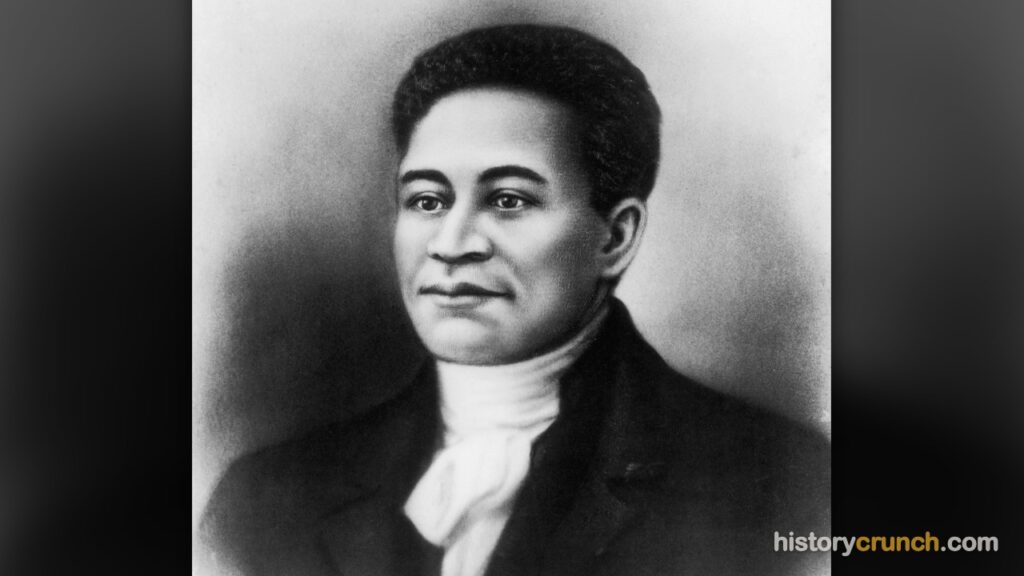
Crispus Attucks is remembered as the first person killed at the Boston Massacre and, by tradition, the first American to die in the struggle that became the American Revolution. A sailor and dockworker of both African and Native American descent, he stood at the front of the crowd that faced British soldiers on the night of March 5th, 1770. His death turned an ordinary laborer into a lasting symbol of the fight for liberty, first for the Patriots who wanted to break from Britain and later for those who fought to end slavery and win equal rights.
Attucks lived at a time when the American colonies were growing angry at British rule. Because so little about his life was written down, most of what is known about him comes from a runaway advertisement, from stories passed down in his hometown, and from the trial of the soldiers who fired on the crowd. What survives paints a picture of a hardworking man of the sea who was drawn into one of the most important events leading to the Revolution.
Early Life and Background
Crispus Attucks was born around 1723 near Framingham, Massachusetts, in the years when the region was still a British colony. His father is believed to have been an enslaved African man, and his mother a Native American woman connected to the Wampanoag people. Because of this mixed heritage, Attucks grew up in a world where he did not fully belong to any single group.
Some accounts place his birth in Natick, a “praying town” set up so that Native people who had converted to Christianity could live safely apart from colonists. Whatever the exact spot, Attucks spent his early years in and around the small towns west of Boston. In fact, his very name reflects his roots, since “Attucks” is thought to come from a Native word for deer.
For much of his early life, Attucks was enslaved. Town histories describe him as the slave of a Framingham man named Deacon William Brown. In this position he had little control over his own life, and like many enslaved people, he longed for freedom and a chance to earn his own living.
Escape from Slavery
The most important turning point in Attucks’s early life came in 1750, when he was about 27 years old. In that year he escaped from slavery and set out to build a life on his own. More specifically, an advertisement placed in the Boston Gazette on October 2nd, 1750 offered a reward for the return of a runaway described as a “mulatto fellow” about 27 years of age named Crispas, and many believe this notice describes Attucks himself.
Escaping slavery was a bold and dangerous act. A person who ran away could be captured, punished, and returned to the person who claimed to own them. By choosing to flee, Attucks risked his own freedom and safety in order to live as he wished.
To avoid being recaptured, Attucks turned to the sea. Life aboard ships kept him away from Massachusetts for long stretches and made him hard to find. In reality, this decision shaped the rest of his life, since it tied him closely to the busy waterfront world of colonial Boston.
Life as a Sailor and Dockworker
For roughly the next twenty years, Attucks worked as a sailor on whaling ships and trading vessels that sailed in and out of Boston Harbor. Whaling was hard and dangerous work, often carried out far from land for months at a time. This kind of labor demanded strength, courage, and skill, and Attucks made his living doing it.
When he was in port and not at sea, Attucks took other work along the waterfront. He is often described as a rope maker, a trade that supplied the thick lines needed to rig ships. He also worked as a dockworker, loading and unloading cargo on the wharves.
By early 1770, this waterfront life had become tense and difficult. British soldiers stationed in Boston often looked for part-time jobs when off duty, and they competed with local men for the same work. For a sailor and laborer like Attucks, the soldiers were not only a symbol of British rule but also rivals for the wages he needed to survive.
Boston on the Edge of Revolution
Attucks lived in Boston during a period of rising anger against Great Britain. The trouble grew out of a series of taxes that Parliament placed on the colonies without giving colonists any voice in the decision. The Stamp Act of 1765 and the Townshend Acts of 1767 taxed everyday goods and sparked loud protests across Massachusetts.
To control the unrest, Britain sent about 2,000 soldiers to occupy Boston in 1768. Rather than calming the city, this move made things worse. Colonists resented seeing armed troops in their streets, and small fights between soldiers and townspeople became common.
The mood grew even darker in February of 1770, when an eleven-year-old boy named Christopher Seider was shot and killed during a clash with a British customs official. His death outraged the city. As stated above, the waterfront was already a place of daily quarrels between soldiers and workers, and by early March the whole city felt ready to explode.
Role in the Boston Massacre
On the cold, snowy night of March 5th, 1770, the tension in Boston finally boiled over. A crowd of colonists gathered near the Customs House on King Street, where a British soldier stood guard. What began as taunts and insults quickly grew into an angry mob.
Many accounts place Attucks at the front of this crowd. According to witnesses who later testified at the trial, he helped lead a group of sailors and dockworkers up from the waterfront toward the soldiers, some of them carrying sticks and clubs. Because he was tall and strong, he stood out among the men pressing toward the troops.
As the crowd grew to several hundred people, it threw snowballs, ice, and objects at the soldiers, who loaded their muskets and aimed at the townspeople. In the chaos, the soldiers opened fire even though their commanding captain had given no clear order to shoot. Attucks was among the first to be struck, and he fell dead in the street.
In all, five colonists were killed in the shooting. Their deaths turned a street brawl into a rallying cry, and Attucks, as the first to fall, became the best known of the victims. Whether he acted as a bold leader or was simply caught in the front of a furious crowd, his role that night made him central to the story of the massacre.
Aftermath and Burial
News of the shooting spread quickly, and Patriot leaders such as Samuel Adams used the event to stir up anger against Britain. The silversmith Paul Revere created a famous engraving of the scene that showed the soldiers firing on the crowd like an organized army. Copies of the image were spread through the colonies and helped shape how people viewed British rule.
Because Attucks had no family home in the city, his body was carried to Faneuil Hall, where it lay for several days before burial. He and the other victims were then buried together in a shared grave at the Granary Burying Ground in Boston. A large crowd of Boston residents joined the funeral procession, treating the fallen men as heroes.
The soldiers involved were later put on trial. In an effort to show that the colonies believed in fair justice, the lawyer John Adams agreed to defend them. He argued that Attucks had helped turn the crowd into a dangerous mob, and in the end most of the soldiers were found not guilty, while two were convicted of the lesser charge of manslaughter.
Significance of Crispus Attucks
Crispus Attucks matters in American history because his death helped push the colonies toward revolution. As the first person killed at the Boston Massacre, he became a martyr whose story Patriots used to argue that British rule had grown cruel and unjust. His name gave a human face to the anger that would later erupt into war.
His importance grew even greater over time because of who he was. As a man of African and Native American descent who had escaped slavery, Attucks showed that people of all backgrounds took part in the birth of the nation. In the 1800s, abolitionists who wanted to end slavery pointed to his sacrifice as proof that Black Americans had bled for the country from its very beginning.
Later generations kept his memory alive. In 1888, a monument honoring Attucks and the other victims was unveiled on Boston Common. In the twentieth century, leaders of the civil rights movement praised his courage, and today he remains a powerful example of how ordinary people can shape great events.
Frequently Asked Questions
Who was Crispus Attucks?
Crispus Attucks was a sailor and dockworker who is remembered as the first person killed at the Boston Massacre in 1770. He was a man of African and Native American descent who had escaped slavery and spent about twenty years working on ships and along the Boston waterfront before his death.
Why is Crispus Attucks important in American history?
Crispus Attucks is important because his death became a symbol of resistance against British rule and helped fuel the American Revolution. He is also honored as one of the earliest heroes of both the fight for independence and the later struggle for the rights of African Americans.
Was Crispus Attucks a slave?
Crispus Attucks was born into slavery and is believed to have been enslaved by a Framingham man named Deacon William Brown. Around 1750 he escaped and avoided recapture for the next twenty years by living as a sailor, though some details of his early life remain uncertain.
How did Crispus Attucks die?
Crispus Attucks was shot and killed by British soldiers during the Boston Massacre on March 5th, 1770. He was standing at the front of an angry crowd on King Street when the troops opened fire, and he was among the first to be struck.
Is there a monument to Crispus Attucks?
Yes, a monument honoring Crispus Attucks and the other Boston Massacre victims was unveiled on Boston Common in 1888. Schools, clubs, and other places have also been named after him, keeping his memory alive for new generations.
Cite This Article
To cite this article as a source, use one of the formats below.
MLA: Millar, B. “Crispus Attucks: A Detailed Biography.” HistoryCrunch, 10 August 2026, https://historycrunch.com/crispus-attucks/.
APA: Millar, B. (2026). Crispus Attucks: A Detailed Biography. HistoryCrunch. https://historycrunch.com/crispus-attucks/
Chicago: Millar, B. “Crispus Attucks: A Detailed Biography.” HistoryCrunch. August 10, 2026. https://historycrunch.com/crispus-attucks/
Sources
- Eric Foner, Give Me Liberty!: An American History.