The Battle of Camden was one of the worst defeats ever suffered by an American army during the American Revolution. Fought on August 16th, 1780, near the town of Camden, South Carolina, it pitted a large but poorly prepared American force under Major General Horatio Gates against a smaller, more experienced British army led by Lieutenant General Charles Cornwallis. The clash ended in a crushing British victory that shattered the American army in the South and left much of the region under British control.
Camden was part of the Southern Campaign of the Revolutionary War, a phase of the conflict in which Britain shifted its main effort toward the southern colonies. After years of fighting to a stalemate in the North, British leaders hoped to take advantage of what they believed was strong Loyalist support in the South. Loyalists were American colonists who remained loyal to the British Crown, and Britain expected them to rise up and help crush the rebellion once regular troops arrived.
Background of the Battle of Camden
The first several years of the Revolutionary War were fought mostly in the northern states. However, British leadership changed its approach beginning in late 1778. The war in the North had reached a stalemate, and Britain hoped to tap into the supposedly large Loyalist population in the South in order to retake the region. This shift became known as the Southern Strategy.
The strategy achieved early success. British forces captured Savannah, Georgia, in December of 1778, and then won a major prize the following year. In May of 1780, they captured Charleston, South Carolina, forcing the surrender of more than 5,000 American Continentals, state troops, and militia. It was one of the most damaging American losses of the entire war.
After taking Charleston, British forces under Cornwallis established a supply depot and garrison at Camden as part of their effort to secure control of the South Carolina backcountry. Camden sat about 115 miles (185 km) inland from the coast, at an important crossroads near the Wateree River. In fact, its central location made it a key base for controlling the interior of the state, and the British stockpiled large amounts of supplies there.
To meet the growing crisis, the Continental Congress sent Major General Horatio Gates south to take command of American forces. Gates was famous as the “Hero of Saratoga,” the general credited with the American victory at the Battle of Saratoga in 1777. Congress hoped he could repeat that success in the South. In July of 1780, Gates marched his army into South Carolina, intent on driving the British out.
Gates chose a hard route through country that offered little food, and his march proved brutal. His hungry soldiers were reduced to eating unripe corn and peaches, which left many of them sick with dysentery. Dysentery is a serious intestinal illness that causes severe cramps and diarrhea, and it badly weakened the army just before the battle. By August 13th, Gates had reached Rugeley’s Mills, about a dozen miles north of Camden.
The American army numbered around 4,000 men, but it was far from a balanced fighting force. Only about 1,500 were veteran Continentals, the trained regular soldiers of the Continental Army. The rest were roughly 2,500 state troops and militia, many of them inexperienced and untested in battle. Among the American leaders was Major General Johann de Kalb, a respected German volunteer serving the American cause.
When Cornwallis learned of Gates’s approach, he left his headquarters at Charleston and hurried to Camden, arriving on the night of August 13th to 14th. His army was smaller, numbering about 2,100 men, but it was made up largely of trained British regulars along with some Loyalist troops. More experienced and better supplied, the British force was in far better condition than the exhausted Americans.
How the Battle of Camden Unfolded
By coincidence, both armies decided to march at night. On the evening of August 15th, Gates ordered a night march toward Camden. At almost the same time, Cornwallis set out from Camden directly toward the American camp. As a result, the two armies were moving straight at each other in the dark without either commander realizing it.
Around 2:00 in the morning on August 16th, the advance cavalry of the two armies collided on the Waxhaws Road a few miles north of Camden. After a brief and confused firefight, both sides pulled back to wait for daylight. When Gates learned that he was facing Cornwallis and a force of experienced British regulars, he decided it was too late to retreat and prepared for combat.
The battlefield itself worked against a large army. Swamps along the nearby creeks squeezed the fighting into a narrow front, which limited how the Americans could use their greater numbers. More specifically, the terrain meant that both armies had to line up in a tight space with little room to maneuver.
Then Gates made a fatal decision in how he arranged his troops. He placed his most reliable soldiers, the Maryland and Delaware Continentals under de Kalb, on the right wing. On the left he positioned the untried Virginia and North Carolina militia. This meant that his weakest, least experienced men stood directly across from the best British regular troops.
When the fighting opened at dawn, the British advanced against the American left with a bayonet charge. The militia, many of them sick and facing a wall of steel they had no bayonets to answer, panicked almost immediately. In reality, most of them fired few shots or none at all before throwing down their weapons and fleeing the field. The collapse of the left wing tore a huge hole in the American line.
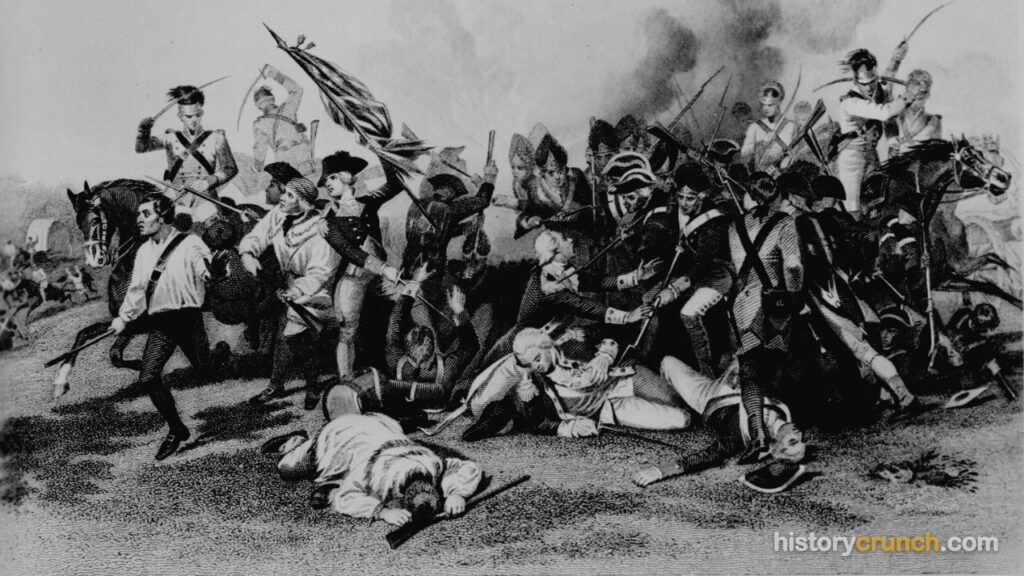
On the right, the situation was very different. The Maryland and Delaware Continentals under de Kalb stood their ground and fought fiercely, even as they were badly outnumbered after the militia ran. For a time these veterans held firm and even pushed back against the British, but they were eventually surrounded once the rest of the army had scattered.
De Kalb was struck by multiple wounds during the desperate fighting and fell on the field. He died a few days later from his injuries. With his Continentals overwhelmed and the militia gone, the American army disintegrated completely. Gates himself was swept up in the flight of the militia and rode far to the north, abandoning what was left of his command.
The results were lopsided. The Americans suffered more than 2,000 casualties, with roughly 900 killed or wounded and about 1,000 captured. They also lost enormous quantities of supplies, including their artillery, thousands of muskets, and dozens of wagons of equipment. By contrast, British losses came to only about 324 men killed or wounded, a fraction of the American total.
Significance of Battle of Camden
The Battle of Camden was arguably the worst American defeat of the entire Revolutionary War. It destroyed the main American army in the South and left the British in temporary control of the southern colonies. In the immediate aftermath, the Continental cause in the region appeared bleak, and Camden became an even stronger fortified British base.
The defeat also ruined the reputation of Horatio Gates. His decision to place inexperienced militia against seasoned British regulars, along with his flight from the battlefield, ended his career as a field commander. In fact, the disaster led Congress to remove him, and General George Washington replaced him with General Nathanael Greene.
Greene’s appointment turned out to be one of the most important consequences of the battle. Rather than risk his small army in another head-on clash, Greene adopted a strategy of movement and hit-and-run warfare that gradually wore the British down. Combined with American militia and partisan fighters who harassed British outposts, this approach slowly reversed British fortunes in the South.
The British victory also opened the way for Cornwallis to invade North Carolina and push his campaign northward. Over the following months, that path would eventually carry Cornwallis into Virginia and toward a coastal town called Yorktown. There, in 1781, his surrender would help bring the war to an end. As stated above, Camden looked like a triumph for Britain at the time, but it set in motion a chain of events that ultimately helped doom the British effort in the South.
Frequently Asked Questions
Who won the Battle of Camden?
The British won the Battle of Camden in a decisive victory. Although the American army under Horatio Gates was larger, the smaller British force under Charles Cornwallis routed it completely, inflicting heavy losses while suffering relatively few casualties of its own.
Where and when was the Battle of Camden fought?
The Battle of Camden was fought on August 16th, 1780, a few miles north of Camden, South Carolina. The site sat in the state’s backcountry near swampy creeks, and today the core battlefield is preserved as a historic park with walking trails and interpretive signs.
Why did the Americans lose the Battle of Camden?
The Americans lost largely because Gates placed his weakest, most inexperienced militia directly opposite the best British regulars. Many of his men were also sick and exhausted from a difficult march, and when the British charged with bayonets the militia panicked and fled, causing the whole line to collapse.
What happened to General Horatio Gates after the battle?
Gates was removed from command and never led troops in the field again. His reputation, built on the earlier victory at Saratoga, was destroyed at Camden, and General Nathanael Greene took his place as commander of the American army in the South.
Who was Johann de Kalb at the Battle of Camden?
Johann de Kalb was a German-born officer who volunteered to fight for the American cause and commanded the Continental troops on the American right wing. He and his Maryland and Delaware soldiers fought bravely and held their ground far longer than the militia, but he was badly wounded during the battle and died a few days later.
Cite This Article
To cite this article as a source, use one of the formats below.
MLA: Millar, B. “Battle of Camden: A Detailed Summary.” HistoryCrunch, 10 August 2026, https://historycrunch.com/battle-of-camden/.
APA: Millar, B. (2026). Battle of Camden: A Detailed Summary. HistoryCrunch. https://historycrunch.com/battle-of-camden/
Chicago: Millar, B. “Battle of Camden: A Detailed Summary.” HistoryCrunch. August 10, 2026. https://historycrunch.com/battle-of-camden/
Sources
- J.M. Roberts & Odd Arne Westad, The Penguin History of the World.
- Jerry Bentley & Herbert Ziegler, Traditions & Encounters: A Global Perspective on the Past.