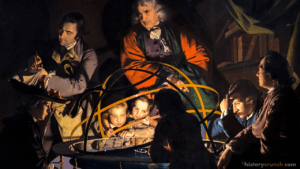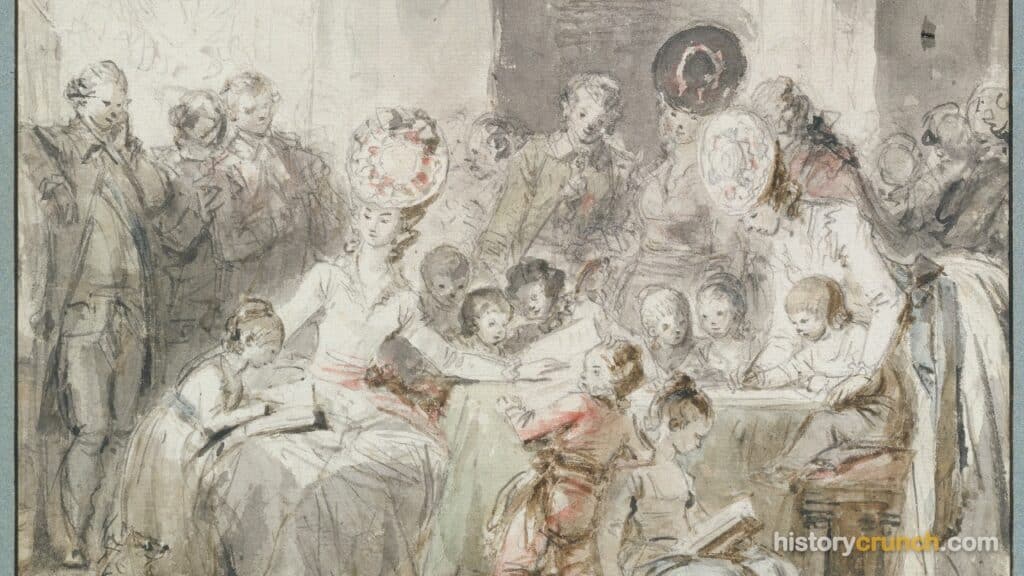
The French salons of the Enlightenment were among the most important gathering places for new ideas in 18th-century Europe. In these private meetings, thinkers, writers, artists, and nobles came together to talk about politics, philosophy, science, and literature. The salons helped spread the ideas of the Age of Enlightenment across France and beyond, and they gave educated women a rare chance to lead and shape intellectual life.
A salon was a regular social gathering, usually held weekly in the home of a wealthy or well-connected woman, where invited guests met to discuss ideas and share their work. The woman who hosted and directed a salon was called a salonnière, a French word for a female host of such gatherings. She chose the guests, guided the conversation, and kept the discussion polite and lively so that people from different backgrounds could exchange views as equals.
What Was the Age of Enlightenment?
The Age of Enlightenment, also known as the Age of Reason, was a major intellectual movement that spread across Europe during the 17th and 18th centuries. During this time, thinkers, writers, and scientists began to challenge traditional ideas about government, religion, and society, and argued that reason and evidence should guide human life. In fact, the movement had an especially strong center in France, where many of its most famous thinkers lived and wrote.
Enlightenment thinkers were often called philosophes, a French word for the writers and philosophers who questioned the old order and promoted new ideas about liberty, equality, and reason. Some of the most famous philosophes were Voltaire, Baron de Montesquieu, Jean-Jacques Rousseau, and Denis Diderot. These thinkers wanted to understand the world through observation and logic rather than simply accepting old traditions, and their ideas would later help inspire the American Revolution and the French Revolution.
One of the biggest challenges these thinkers faced was finding a way to share and test their ideas. The government and the Catholic Church often censored writing they viewed as dangerous, so bold ideas could not always be printed openly. As a result, people needed safe and welcoming places to talk freely, and this is exactly the role that the French salons came to fill.
Where Did the French Salons Come From?
The salon tradition began well before the Enlightenment, in the early 1600s. Most historians trace the first true salon to Catherine de Vivonne, the Marquise de Rambouillet, who from about 1608 onward invited writers, scholars, and nobles to gather in a room of her Paris home. This room was decorated in blue, and it became famous as the chambre bleue, or “blue room.”
These early gatherings were mostly about literature, good manners, and refined conversation among the nobility. Over time, they also played a part in shaping French taste and the French language, and they helped support the founding of the French Academy, an official group that set standards for the language. In reality, the salon began as an elegant social custom of the upper class long before it became a center for Enlightenment debate.
During the 1700s, the salons changed in an important way. The center of social and intellectual life slowly moved away from the royal court at Versailles and toward the homes of Paris hosts. As a result, the salon shifted from being mainly a leisure gathering of nobles into a serious meeting place for philosophers, writers, and scientists.
What Happened Inside an Enlightenment Salon?
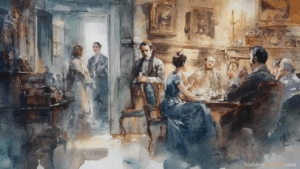
A typical salon met at the same time each week in the host’s home, often in an elegant reception room. Guests came from a mix of backgrounds, including aristocrats, writers, artists, scientists, and visitors from other countries. This mixing of men and women from different levels of society was a defining feature of the salon and set it apart from the stiff formality of the royal court.
Conversation was the heart of every salon. Guests discussed literature, art, philosophy, science, and sometimes politics, and they were expected to speak with clarity, wit, and good manners. More specifically, writers often read their new works aloud so that others could react to them, which meant the salon also acted as a place where new books and ideas were tested before the public ever saw them.
The salonnière played a key part in keeping the discussion running smoothly. She guided the talk, calmed arguments, and made sure quieter guests had a chance to speak. In this way, the host set the tone of the gathering and helped turn a lively debate into a productive exchange of ideas rather than a shouting match.
The salons also served a very practical purpose for writers and thinkers. They were places to build connections, find wealthy patrons, and gain protection from powerful friends. For a struggling philosophe, an invitation to the right salon could open doors to fame, money, and safety.
Who Were the Famous Salonnières of the Enlightenment?
Several women became famous for hosting the leading salons of 18th-century Paris. One of the earliest was Madame de Tencin, whose salon in the 1720s and 1730s welcomed writers and philosophers such as the thinker Fontenelle and the political philosopher Montesquieu. Her gatherings helped set the pattern for the intellectual salons that followed.
Perhaps the most celebrated salonnière was Marie-Thérèse Geoffrin, who hosted her gatherings on the Rue Saint-Honoré in Paris. Interestingly, she came from a middle-class background rather than the nobility, yet she became one of the most respected hosts in Europe. She held her salon on two different days each week, welcoming artists on one day and writers and philosophers on another, and she even helped pay for the publication of one of the most important books of the age.
That book was the Encyclopédie, a massive collection edited by Denis Diderot and Jean le Rond d’Alembert that aimed to gather human knowledge about science, art, and society into a single work. Because it questioned old ideas about religion and government, it faced censorship, and support from wealthy salon hosts helped keep the project alive. In fact, the salons and the Encyclopédie were closely linked, since many of its writers were regular salon guests.
Other important hosts included the Marquise du Deffand, whose salon was known for its foreign visitors, especially from England, and Julie de Lespinasse, who first worked as a companion in du Deffand’s salon before starting her own famous gathering. Her salon became a favorite meeting place for the writers of the Encyclopédie. Later hosts, such as Suzanne Necker and Sophie de Condorcet, continued the tradition into the years of the French Revolution.
How Did the Salons Help Spread Enlightenment Ideas?
The salons were powerful tools for spreading new ideas because they brought influential people together face to face. When a writer read a new work aloud or explained a bold theory, it could reach dozens of educated and well-connected listeners at once. Those listeners then carried the ideas into their own circles, letters, and books, which helped the ideas travel quickly across France and Europe.
The salons also created a space where people could discuss subjects that were difficult to print openly. As stated above, censorship made it risky to publish direct attacks on the church or the monarchy, so the freedom to talk in a private home was valuable. In this way, the salons acted as a kind of public conversation that shaped opinion outside the control of the government.
News from around the world reached the salons as well. During the 1780s, for instance, reports and documents from the American Revolution were studied and debated in Paris, and American visitors were welcomed into the most respected gatherings. These discussions helped connect the ideas of the Enlightenment to real political change happening across the ocean.
Significance of French Salons of the Enlightenment
The French salons of the Enlightenment were significant because they helped turn private ideas into a shared public conversation. By bringing thinkers, writers, and nobles together on a regular basis, they gave Enlightenment ideas a place to grow, spread, and gain influence. Without these gatherings, many of the era’s most important works and debates might never have reached such a wide audience.
The salons were also important because they gave women a leading role in intellectual life at a time when they were usually shut out of formal education and power. As salonnières, women decided who attended, guided serious debates, and supported major projects such as the Encyclopédie. This was a rare example of women shaping elite culture, and it helped open the door to later ideas about equality.
Finally, the salons connected the world of ideas to the world of action. The debates about liberty, reason, and government that filled these rooms helped prepare the way for the French Revolution and influenced political thinking far beyond France. For this reason, the salons are remembered as one of the key institutions that carried the Enlightenment forward.
Frequently Asked Questions
What Was a French Salon in the Enlightenment?
A French salon was a regular social gathering, usually held in a wealthy woman’s home, where invited guests discussed ideas about philosophy, art, science, and politics. Most salons met on a set day each week in Paris, and the meetings blended relaxed conversation and games with serious intellectual debate. They were private events, so an invitation from the host was needed to attend.
Why Were Women So Important in the Salons?
Women were important because they hosted and directed the salons, choosing the guests and guiding the conversation. During the 1700s, women were usually denied formal schooling and public power, so running a salon was one of the few ways they could shape learning and culture. Many salonnières also acted as patrons, using their money and connections to support writers and thinkers they admired.
Who Attended the French Salons?
Guests at the salons came from a mix of backgrounds, including nobles, writers, artists, scientists, and travelers from other countries. This blend of men and women from different social levels was unusual for the time and made the salons feel more open than the royal court. Famous philosophes and diplomats often appeared, and the presence of foreign visitors helped ideas spread across borders.
Where Were the Most Famous Salons Held?
The most famous salons were held in private homes in Paris, which was the center of French intellectual life during the Enlightenment. Hundreds of salons took place across the city, each hosted by a different woman in her own reception rooms. Paris was so central that hosting a leading salon there could bring a woman fame throughout Europe.
Did the Salons Cause the French Revolution?
The salons did not directly cause the French Revolution, but they helped spread the ideas that inspired it. By encouraging open debate about liberty, reason, and the role of government, they shaped public opinion in the years before 1789. Historians still debate exactly how much influence the salons had, but most agree they were an important part of the intellectual world that made revolutionary change possible.
Cite This Article
To cite this article as a source, use one of the formats below.
MLA: Millar, B. “French Salons of the Enlightenment: A Detailed Summary.” HistoryCrunch, 9 August 2026, https://historycrunch.com/french-salons-of-the-enlightenment/.
APA: Millar, B. (2026). French Salons of the Enlightenment: A Detailed Summary. HistoryCrunch. https://historycrunch.com/french-salons-of-the-enlightenment/
Chicago: Millar, B. “French Salons of the Enlightenment: A Detailed Summary.” HistoryCrunch. August 9, 2026. https://historycrunch.com/french-salons-of-the-enlightenment/
Sources
- Stanford Encyclopedia of Philosophy
- Dorinda Outram, The Enlightenment.
- Fordham Modern History Sourcebook