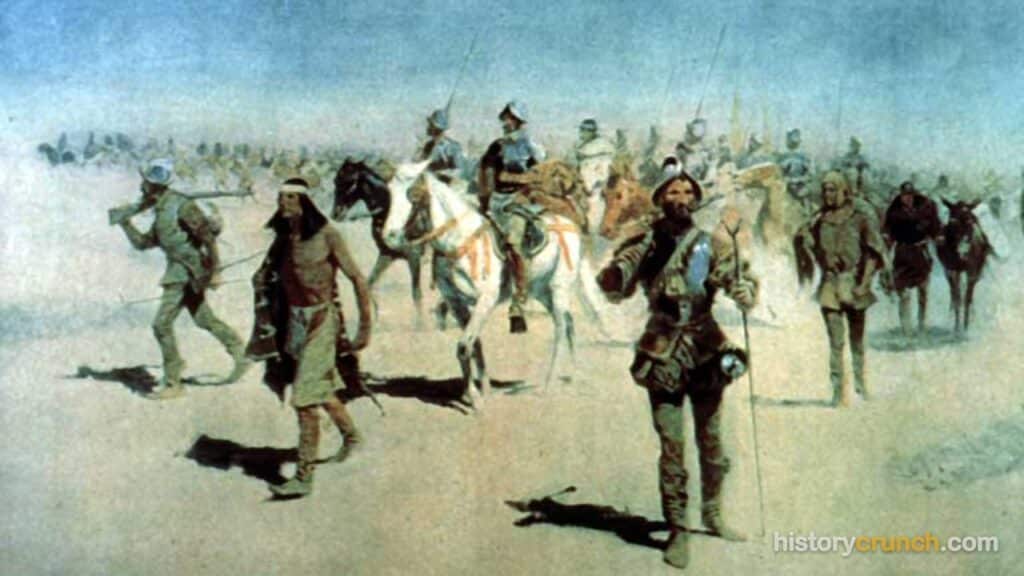
Francisco Vásquez de Coronado was one of the most important Spanish conquistadors to explore North America, and his famous journey took Europeans into the American Southwest for the first time. Between 1540 and 1542, he led a huge expedition north from Mexico in search of the legendary Seven Cities of Gold, also known as the Seven Cities of Cíbola. Although he never found the riches he was seeking, his men became the first Europeans to see landmarks such as the Grand Canyon and the vast grasslands of the Great Plains. His story is a key part of the history of Spanish exploration and colonization of the Americas.
A conquistador was a Spanish soldier or leader who explored and conquered new lands in the Americas during the 1500s. The word conquistador comes from Spanish and means “conqueror.” These men usually searched for gold, land, and glory, and they claimed new territory for the king of Spain. Coronado fit this pattern closely, since he set out to find treasure and to expand Spain’s growing empire in the New World.
Early Life and Background
Francisco Vásquez de Coronado was born around 1510 in Salamanca, Spain, into a family of minor nobility. His family was wealthy and owned a large estate, so young Francisco most likely received a good education. As stated above, his family held a respected place in Spanish society, which gave him important connections early in life.
However, Coronado was a younger son, and in Spain at this time the oldest son usually inherited the family’s title and money. As a result, Coronado could not expect to inherit the family fortune and instead had to make his own way in the world. Like many other ambitious young Spaniards of his time, he decided to seek his fortune across the ocean in the New World, the European name for North and South America.
Rise to Power in New Spain
In 1535, Coronado sailed to Mexico, which the Spanish then called New Spain. He traveled as part of the party of Antonio de Mendoza, the first viceroy of New Spain. A viceroy was a powerful official who ruled a colony in the name of the king. The friendship and support of Mendoza would prove very important to Coronado’s career.
Soon after arriving, Coronado married Beatriz de Estrada, the young daughter of Alonso de Estrada, a former colonial treasurer. This marriage was a great advantage, because it gave Coronado one of the largest estates in New Spain and made him a wealthy and well-connected man. In fact, marrying into such a rich family helped him rise quickly through the ranks of colonial society.
Coronado also gained the favor of Mendoza by helping to put down rebellions among enslaved workers and Native peoples laboring in the Spanish mines. As a reward, in 1538 he was named governor of the province of Nueva Galicia, a region on the northwest frontier of New Spain. This position placed him in charge of Spanish exploration along the northern edge of the colony, and it set the stage for the great adventure of his life.
Search for the Seven Cities of Gold
During the 1530s, exciting stories spread through New Spain about seven cities full of gold and jewels supposedly located far to the north. These tales were partly fueled by four survivors of an earlier failed Spanish expedition, who reported hearing about wealthy cities from Native peoples. The rumors grew stronger when a Franciscan priest named Fray Marcos de Niza returned from a scouting trip and claimed to have seen signs of the fabulous Seven Cities of Cíbola.
Convinced that great riches waited in the north, Viceroy Mendoza chose Coronado to lead a large expedition to find them. On February 23rd, 1540, Coronado set out from Compostela on Mexico’s western coast. His force was one of the largest ever assembled in the New World, including around 300 Spanish soldiers, hundreds of Native allies, and herds of horses, cattle, and other livestock. A handful of Franciscan priests also joined the journey, since one purpose of the mission was to spread the Christian faith.
After months of hard travel across rugged deserts and mountains, the expedition finally reached Cíbola in the summer of 1540. On July 7th, 1540, Coronado and an advance guard attacked and defeated the Zuni people at a settlement called Hawikuh, near what is now western New Mexico. However, the great disappointment quickly became clear. Instead of golden cities, the Spanish found modest villages built of adobe, which is sun-dried clay, with no treasure at all.
Exploring the American Southwest
Even though Cíbola held no gold, Coronado refused to give up. He sent out smaller groups to explore the surrounding lands and gather information. One of these groups, led by an officer named García López de Cárdenas, became the first Europeans to see the Grand Canyon, the enormous gorge carved by the Colorado River in present-day Arizona.
The main expedition then moved east and spent the winter among the Pueblo peoples along the Rio Grande, in a region the Spanish called Tiguex. During this time, tensions between the Spanish and the local peoples exploded into violence. The Spanish demanded food, clothing, and shelter, and their harsh treatment led to fierce fighting known as the Tiguex War, in which many Native people were killed or driven from their homes.
While among the Pueblos, Coronado met a captive Native guide the Spanish called the Turk. The Turk told the Spanish about a rich land called Quivira, far out on the Great Plains, where he claimed gold and silver were plentiful. Desperate to find treasure and not wanting to return home empty-handed, Coronado decided to follow this new lead.
Journey to Quivira
In 1541, Coronado set out across the flat, endless grasslands of the Great Plains in search of Quivira. His route carried him across the Llano Estacado and through the region that is now the Texas Panhandle, and his men became some of the first Europeans to see the huge herds of American bison, or buffalo, that roamed there. The Spanish were amazed by the enormous size of these herds and by the treeless landscape stretching in every direction.
Eventually Coronado left most of his army behind and pushed ahead with a small group of about thirty horsemen. After weeks of travel, he reached Quivira in what is now central Kansas. There he found the Wichita people living in villages of grass houses, but once again there was no gold, only crops and simple huts.
The Turk soon confessed that he had made up the story of Quivira in order to lead the Spanish out onto the plains and get them lost so they would die there. He admitted that the leaders of a Pueblo town had encouraged him to trick the Spanish as revenge for their cruel behavior. For this deception, the Turk was executed on Coronado’s orders.
Later Life and Death
After the failure at Quivira, Coronado returned to the Rio Grande and spent a second winter among the Pueblo peoples. In the spring of 1542, having found no riches after more than two years of searching, the expedition began the long march home to Mexico. The journey back was difficult, and Coronado himself was injured in a fall from his horse along the way.
Spanish officials in Mexico viewed the entire expedition as a costly failure. Coronado had helped pay for the journey himself, so he returned home disgraced and deeply in debt. He went back to his position as governor of Nueva Galicia, but his troubles were far from over.
In 1544, during an official government inquiry, Coronado was charged with mismanagement and with the brutal treatment of Native peoples during the expedition. He was removed from his post as governor, though he was declared innocent of the charges two years later. He then returned to Mexico City, where he kept a seat as a member of the city council. Francisco Vásquez de Coronado died on September 22nd, 1554.
Significance of Francisco Vásquez de Coronado
The significance of Francisco Vásquez de Coronado lies in the way his expedition opened the American Southwest to European knowledge, even though it failed to find gold. His men were the first Europeans to reach many important landmarks of the region, including the Grand Canyon, the Rio Grande valley, the Great Plains, and Palo Duro Canyon in what is now Texas. More specifically, the written accounts of his journey gave Europeans their earliest detailed descriptions of the land and of the Native peoples who lived there.
Coronado’s travels also helped Spain claim a large part of what is now the southwestern United States. In reality, no permanent Spanish settlements followed right away, but his expedition marked the beginning of lasting European interest in the region. Later Spanish explorers and settlers would return to New Mexico and eventually build colonies there.
At the same time, the expedition brought great suffering to the Native peoples of the Southwest. The violence at Hawikuh and during the Tiguex War, along with the demands the Spanish placed on Pueblo communities, showed the harsh side of Spanish conquest. Today, sites such as Coronado National Memorial in Arizona remember both the exploration and its lasting effects on the first peoples of the land.
Frequently Asked Questions
What was Francisco Coronado famous for?
Francisco Coronado is most famous for leading a Spanish expedition through the American Southwest between 1540 and 1542 in search of the Seven Cities of Gold. His journey is remembered as the first major European exploration of the region, even though he never found any treasure. His name is now attached to many places, including towns, schools, and national parks across the Southwest.
Did Coronado ever find the Seven Cities of Gold?
No, Coronado never found the Seven Cities of Gold, because they did not actually exist. The stories were based on rumors, misunderstandings, and false reports rather than on real cities of treasure. Instead of golden cities, Coronado found Native villages built of adobe and grass, and he returned to Mexico without the riches he had hoped to claim.
What countries and states did Coronado explore?
Coronado’s expedition began in Mexico and pushed north into what are now the states of Arizona, New Mexico, Texas, Oklahoma, and Kansas. He crossed deserts, mountains, and the wide grasslands of the Great Plains during his search. This route covered thousands of miles across land that no European had ever mapped before.
Who told Coronado about the cities of gold?
A Franciscan priest named Fray Marcos de Niza gave the most exciting reports that convinced Coronado and Viceroy Mendoza the golden cities were real. His stories built on earlier rumors spread by survivors of a failed Spanish expedition who had traveled through the region years before. Later, a Native guide known as the Turk lured Coronado even farther north with false tales of a rich land called Quivira.
Why is Coronado’s expedition considered a failure?
Coronado’s expedition is considered a failure because it cost a great deal of money and found none of the gold it set out to claim. Coronado had helped pay for the journey himself, so he came home in debt and in disgrace. Spanish officials judged the mission a waste, though later generations recognized the geographic discoveries the expedition made along the way.
Cite This Article
To cite this article as a source, use one of the formats below.
MLA: Millar, B. “Francisco Vásquez de Coronado: A Detailed Biography.” HistoryCrunch, 2 August 2026, https://historycrunch.com/francisco-v-squez-de-coronado/.
APA: Millar, B. (2026). Francisco Vásquez de Coronado: A Detailed Biography. HistoryCrunch. https://historycrunch.com/francisco-v-squez-de-coronado/
Chicago: Millar, B. “Francisco Vásquez de Coronado: A Detailed Biography.” HistoryCrunch. August 2, 2026. https://historycrunch.com/francisco-v-squez-de-coronado/
Sources
- Jerry Bentley & Herbert Ziegler, Traditions & Encounters: A Global Perspective on the Past.
- J.M. Roberts & Odd Arne Westad, The Penguin History of the World.