Aztec families were the foundation of daily life in one of the most powerful civilizations of the ancient Americas, the Aztec Empire. Family units organized how people lived, worked, learned, and worshipped, and they connected each person to the overall structure of Aztec society. The Aztec Empire was a Mesoamerican civilization based in central Mexico, and understanding how its families were arranged helps explain how the empire fed itself, raised its children, and kept order across a vast territory.
An Aztec family was a group of related people, usually parents, children, and often grandparents or other relatives, who shared a household and worked together to survive. Families were the smallest and most basic building block of Aztec society. They belonged to larger neighborhood groups and social classes, and each family had duties that tied it to the community, the local government, and the empire as a whole.
What Was the Aztec Empire?
The Aztec Empire was a civilization in central Mexico that thrived in the time before the arrival of European explorers during the Age of Exploration. Throughout its history the empire expanded across much of central Mexico and other surrounding areas to become the most dominant and powerful people in the region. The Aztecs, who called themselves the Mexica, founded their capital city of Tenochtitlan in 1325 on an island in Lake Texcoco.
The empire grew out of the Aztec Triple Alliance, a political and military pact formed in 1428 between Tenochtitlan and the city-states of Texcoco and Tlacopan. It was ruled by leaders known as the huey tlatoani, or Great Speaker. Aztec society was rich in culture, religion, architecture, and warfare, and the empire maintained its power through a tribute system that required conquered peoples to send goods and resources to Tenochtitlan.
Tenochtitlan grew into one of the largest cities in the world at the time. By the early 16th century, the city is estimated to have covered three to five square miles (8 to 13 km) and had a population of between 200,000 and 300,000 people. This means it was larger than any city in Europe at that time, and all of those people lived in families that formed the heart of the Aztec world.
How Were Aztec Families Organized?
Aztec families did not live entirely on their own. Instead, they belonged to a larger neighborhood group called a calpulli. The word calpulli translates to “large house,” and it referred to a small group or clan of people who lived together within a city-state, which the Aztec called an altepetl.
A calpulli can best be understood as being related to a family, since it was a group of people responsible for the day-to-day living of the whole group. In fact, calpulli were usually made up of a few different families, although in some areas a calpulli could be based entirely on a single family unit. Many of these families were connected to one another through marriage, which meant that neighbors were often relatives as well.
The calpulli was important because it handled many of the tasks that helped families survive. For instance, the calpulli coordinated the use of land and assigned different people to different farming jobs. It also collected taxes, since the central government would tax the calpulli, who would then tax their individual families. In this way, each family was linked to the larger machinery of the empire through its neighborhood group.
Roles of Men and Women in Aztec Families
Within an Aztec family, men and women had very different roles and responsibilities. In general, men were expected to do more laborious work, while women were expected to manage the household and care for the family. These roles were passed down through tradition and shaped daily life for nearly everyone in the empire.
Aztec men were primarily warriors, farmers, and craftsmen, responsible for defending the empire and providing for their families. Most commoner men, who were called macehualtin, worked as farmers growing crops such as maize (corn), beans, and squash. Others worked as artisans, merchants, priests, or government officials, and all Aztec men were expected to serve time in the military as warriors.
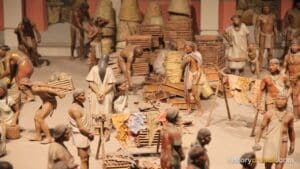
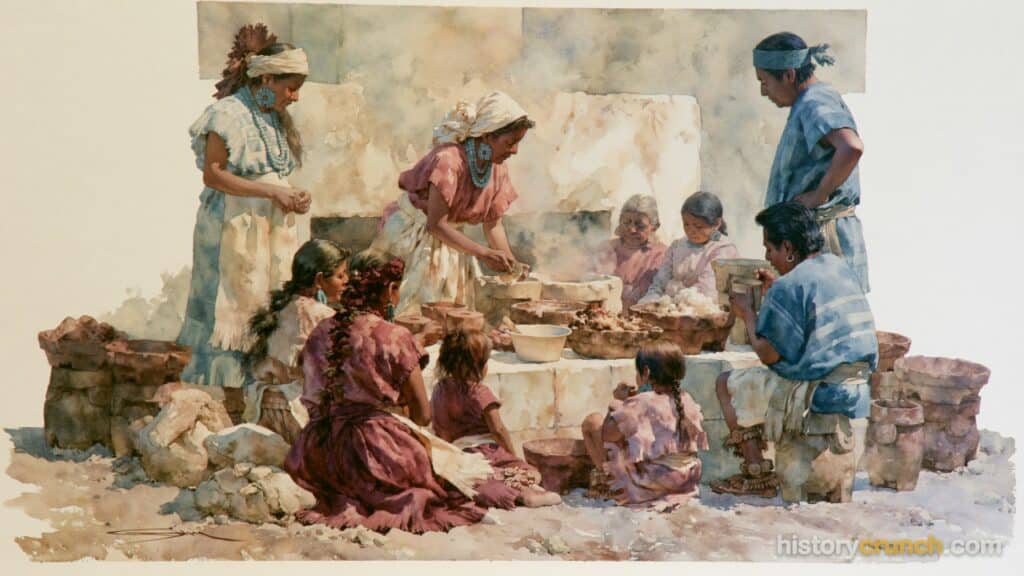
Aztec women generally managed the household, cooked meals, wove textiles, and cared for young children. More specifically, women were tasked with preparing food, repairing clothing, and raising the youngest members of the family. Some women also worked as midwives, healers, or merchants, and a number of them created goods as artisans that they sold in the many markets that were so important to the Aztec economy. While men dominated political and military life, women played crucial roles in religion, trade, and holding the household and community together.
What Was Childhood Like in an Aztec Family?
Children were highly valued in Aztec families and were seen as precious gifts. The birth of a child was an important event, celebrated with ceremonies that could last several days. From the very start of life, a child was welcomed into both the family and the calpulli.
As children grew, they were expected to help with chores and learn the skills they would need as adults. Young children began learning simple household tasks, such as fetching water and cleaning, from about the age of four. Boys often learned the work of their fathers, while girls learned cooking, weaving, and other household skills from their mothers. Aztec parents were known to be strict, and children who misbehaved could face tough punishments.
Discipline and hard work were seen as important values in Aztec families. Parents constantly instructed and corrected their children so they would grow up to be responsible members of the community. In this way, the family was the first place where every Aztec learned the customs, beliefs, and duties of their people.
How Did Education Fit Into Family Life?
Education was an important part of daily life for young people in the Aztec Empire, and it began at home. At first, Aztec children were taught by their parents, until they were in their teens when they attended formal schools. In fact, education was free for all people regardless of their social class, which was unusual in the ancient world.
Boys between the ages of ten and twenty were required to attend school. Boys of the commoner class attended schools called Telpochcalli, which focused on preparing them for warfare and teaching them how to use different weapons. Boys from the noble class, called pipiltin, attended schools called Calmecac, which prepared them to become leaders in the military, priesthood, and government.
Aztec religion was also a central part of these schools. Children were taught about the many Aztec gods and the traditions connected to each one. For instance, they learned to recite the correct songs and poems for each religious festival and practiced dances for different ceremonies. In this way, schools reinforced the lessons that families had already begun teaching at home.
Aztec Families and Social Class
The daily life of an Aztec family depended heavily on the social class it belonged to. Aztec society was divided into an upper class, a middle class, and a lower class, and each family fit into one of these groups. The class a family belonged to shaped its home, its clothing, and the kind of work its members did.
The upper class were called the pipiltin, and they were the nobility. Noble families generally lived in larger homes, could afford luxury items, and held the highest positions in government, religion, and the military. Their children received the best education available and were trained from a young age to serve as leaders.
The middle class were called the macehualtin, and they made up the largest group of people in Aztec society. These commoner families mostly worked as farmers, merchants, artisans, and warriors, and they lived in more moderate homes. Below them were the tlacotin, the lowest class, who were enslaved people. Importantly, slavery among the Aztec was not something a person could be born into, so it did not pass automatically from parents to children within a family.
Significance of Aztec Families
Aztec families were significant because they were the foundation on which the entire empire was built. Every part of Aztec life, from farming and trade to religion and war, depended on strong family units that raised children, produced food, and passed on traditions. Without families organized into calpulli, the Aztec would not have been able to feed their huge cities or fill the ranks of their military.
Families also connected individual people to the larger structures of government and the economy. As stated above, taxes flowed from the central government down through the calpulli to individual families, and land was shared through these same neighborhood groups. In reality, the family was the point where the vast Aztec Empire touched the life of each ordinary person.
Finally, families preserved and passed down Aztec culture from one generation to the next. Parents taught their children the values, skills, and religious beliefs of their people long before those children reached school. For this reason, the Aztec family was not only the center of daily life but also the key to keeping Aztec culture alive across the years.
Frequently Asked Questions
What was a calpulli in Aztec society?
A calpulli was a neighborhood group made up of several related families who lived and worked together. The word means “large house,” and the calpulli handled shared tasks such as farming, taxation, and running local schools. It acted like an extended family that connected each household to the wider community and the government.
How many people lived in an Aztec household?
Most Aztec households held somewhere between four and seven people. Families often lived in joint households that combined close relatives, such as the families of two brothers, under one roof. This meant that grandparents, parents, children, and other relatives frequently shared the same home.
Did Aztec children go to school?
Yes, Aztec children attended school, and remarkably, education was free for everyone regardless of social class. Boys from the commoner class went to schools called Telpochcalli, while noble boys attended Calmecac schools that trained future leaders. Before starting school in their teens, children were taught at home by their parents.
What jobs did Aztec women do?
Aztec women mainly managed the household, cooked meals, wove cloth, and raised young children. Beyond the home, some women worked as midwives, healers, or merchants who sold goods in the busy Aztec markets. Their work was essential to both family life and the economy.
How were Aztec families connected to the government?
Aztec families were linked to the government through their calpulli, which acted as the middle step between the household and the empire. The central government collected taxes from each calpulli, which then passed those taxes down to its member families. Land was also distributed to families through the calpulli, tying everyday life directly to the ruling system.
Cite This Article
To cite this article as a source, use one of the formats below.
MLA: Millar, B. “Aztec Families: A Detailed Summary.” HistoryCrunch, 18 July 2026, https://historycrunch.com/aztec-families/.
APA: Millar, B. (2026). Aztec Families: A Detailed Summary. HistoryCrunch. https://historycrunch.com/aztec-families/
Chicago: Millar, B. “Aztec Families: A Detailed Summary.” HistoryCrunch. July 18, 2026. https://historycrunch.com/aztec-families/
Sources
- Matthew Restall, When Montezuma Met Cortés / Seven Myths of the Spanish Conquest.
- The Met (Heilbrunn Timeline) — Aztec art