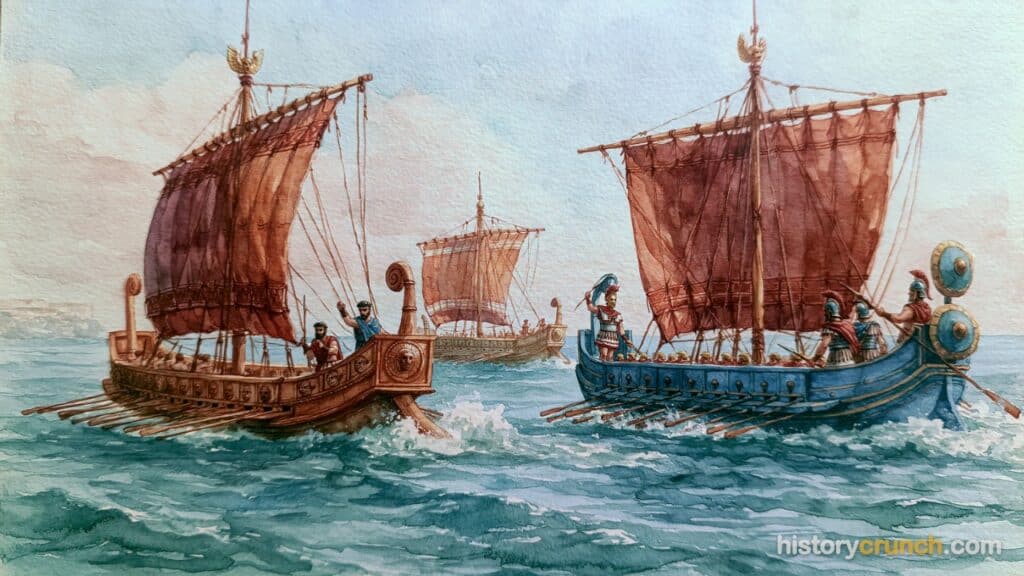
The First Punic War was one of the most important conflicts of the ancient world, and it marked the moment when Rome first challenged Carthage for control of the western Mediterranean. It was the first of three great wars, known together as the Punic Wars, that Rome and Carthage fought between 264 BCE and 146 BCE. Fought largely on the island of Sicily and in the waters around it, the war lasted for 23 years and forced Rome to build a navy almost from nothing. By the end, Rome had defeated the strongest sea power of the age and taken its first territory outside of the Italian Peninsula.
In simple terms, the First Punic War was a long struggle between the Roman Republic, a rising land power in Italy, and Carthage, a wealthy trading city-state in North Africa that ruled a large maritime empire. The word “Punic” comes from the Latin word the Romans used for the Carthaginians, a reference to their Phoenician ancestors who had founded Carthage centuries earlier. The two states had once traded peacefully, but their competing ambitions in Sicily pushed them into a war that neither side expected to last so long.
Background of the First Punic War
By the middle of the 200s BCE, Rome had grown from a single city into the dominant power across the Italian Peninsula. It had defeated neighboring peoples in a long series of wars and had absorbed the Greek cities of southern Italy. As stated above, Carthage had followed a very different path. It had built a trading empire that stretched across North Africa, southern Spain, and the islands of Corsica, Sardinia, and the western half of Sicily.
These two powers had different strengths. Rome possessed a large and disciplined army but had almost no experience at sea. Carthage, in contrast, was the leading naval power of the region, with a fleet that protected its trade routes and its overseas possessions. For years the two states had kept friendly relations, and they had even signed trade treaties and cooperated against a common enemy during earlier conflicts.
The trouble began over the island of Sicily, which sat directly between Italy and North Africa. Because of its location, Sicily was almost bound to become a point of conflict between the two rising powers. At the time, the island was divided among Greek cities, the independent kingdom of Syracuse, and Carthaginian territory in the west.
The spark came from a group of Italian mercenaries called the Mamertines, who had seized the city of Messana, on the northeastern tip of Sicily, after killing or driving out many of its people. When the powerful king Hiero II of Syracuse moved against them, the Mamertines first asked Carthage for help. A Carthaginian force soon arrived and stationed a garrison in the city, which gave Carthage control of the narrow strait between Sicily and Italy.
The Mamertines quickly regretted inviting Carthage in, and so they turned to Rome and asked for protection instead. In fact, this request created a difficult debate in Rome. Some Romans were reluctant to help the Mamertines, who had behaved like pirates, and worried about fighting a war outside of Italy against a great sea power. Others feared that if Carthage controlled all of Sicily, it would sit dangerously close to Italy itself. In the end, Rome decided to send an army under the consul Appius Claudius Caudex to take Messana, and the First Punic War had begun.
How the First Punic War Unfolded
The war opened in 264 BCE with the Romans crossing over to Sicily and seizing Messana. Faced with this new enemy, Carthage and Syracuse briefly joined together against Rome, but the Romans pressed their attack. Before long, Rome persuaded Hiero II of Syracuse to switch sides and become an ally, which gave the Roman army a valuable base and a steady source of supplies on the island.
With Syracuse on their side, the Romans turned against the main Carthaginian stronghold at Agrigentum on the southern coast. They laid siege to the city, and in 262 BCE a large Carthaginian relief army marched to break the siege. The Romans defeated it at the Battle of Agrigentum, and the city fell. This early victory showed that Rome could win on land, but it also revealed a serious problem. As long as Carthage controlled the sea, it could keep supplying its coastal fortresses and move its armies at will.
To break this deadlock, Rome made a bold decision to build a navy of its own. The Romans had little experience with warships, so they used a captured Carthaginian vessel as a model and copied its design. In a remarkably short time, they constructed a large fleet of quinqueremes, which were heavy galleys rowed by many oarsmen.
Roman engineers also added a clever invention called the corvus, which was a hinged boarding bridge that could be dropped onto an enemy ship. More specifically, the corvus allowed Roman soldiers to storm across onto a Carthaginian deck and fight hand to hand, which turned a sea battle into something close to a land battle. This helped Rome, because its soldiers were far better at close combat than at sailing. Using this device, Rome won an early naval victory that proved the Carthaginians could be beaten at sea.
Confident after these successes, Rome tried to end the war quickly by carrying the fight to North Africa. In 256 BCE, a Roman army under the general Regulus landed near Carthage and won early victories. The following year, however, the Carthaginians reorganized their forces under a skilled Greek commander and destroyed the invading Roman army. This disaster forced Rome to turn back to Sicily and settle in for a much longer struggle.
For the next several years the war became a grinding stalemate. The rugged, hilly landscape of Sicily made it hard to move large armies, so the fighting turned into a long series of raids, sieges, and blockades. Rome slowly gained control of most of the island, but Carthage clung to its strong naval bases in the west, especially the fortress cities of Lilybaeum and Drepana.
The sea proved deadly for both sides. Rome won several naval battles, yet it also lost enormous numbers of ships and men, sometimes in fierce combat and sometimes in violent storms that wrecked entire fleets. Over the course of the war, Rome lost hundreds of warships and tens of thousands of men, and Carthage suffered heavy losses as well. In reality, this was one of the costliest wars of the ancient world in terms of lives and ships.
The war finally turned in 241 BCE. Wealthy Roman citizens loaned the money needed to build yet another fleet, while the Carthaginian government, unwilling to spend more, had let much of its own navy fall out of readiness. When Carthage sent a fleet to resupply its cut-off garrisons in western Sicily, the better-trained Roman navy intercepted it at the Battle of the Aegates Islands. The undermanned Carthaginian fleet was crushed, and its surviving forces on Sicily were left stranded.
With no way to supply or rescue its troops, Carthage had little choice but to make peace. The two sides agreed to the Treaty of Lutatius, which brought the long war to an end. Under its terms, Carthage gave up all of Sicily, released its Roman prisoners, and agreed to pay a large sum of silver to Rome over the following years.
Significance of First Punic War
The First Punic War changed the balance of power in the western Mediterranean. Before the war, Carthage was the dominant sea power and Rome was a rising land power. Afterward, Rome had shown that it could match and defeat the greatest navy of the age, and it now considered itself the leading military power of the region.
The victory also gave Rome its first territory outside of the Italian Peninsula, as Sicily became Rome’s first overseas province. This marked an important step in the growth of Rome from a power in Italy into a state that ruled distant lands. In the years that followed, Rome took advantage of Carthaginian weakness to seize the islands of Sardinia and Corsica as well, which deepened the bitterness between the two states.
The effort of the war also transformed Rome into a naval power for the first time. The huge shipbuilding program laid the foundation for Roman control of the seas that would last for centuries. In fact, the experience Rome gained at sea would prove valuable in the wars that came later.
Finally, the peace settled nothing for long. Carthage was left weakened and deeply in debt, and it soon faced a violent revolt by its unpaid mercenary soldiers. To recover its wealth and manpower, Carthage expanded into Spain, and this set the stage for a second and even larger conflict. The unresolved rivalry between Rome and Carthage led directly to the Second Punic War, in which the famous general Hannibal Barca would carry the fight into Italy itself.
Frequently Asked Questions
When was the First Punic War fought?
The First Punic War was fought from 264 BCE to 241 BCE, lasting 23 years in total. This made it the longest continuous war of the ancient world up to that time. It ended when Carthage lost the Battle of the Aegates Islands and agreed to the Treaty of Lutatius.
Who won the First Punic War?
Rome won the First Punic War, defeating Carthage after more than two decades of fighting. Rome forced Carthage to abandon Sicily and to pay a heavy sum in silver over ten years. The win established Rome as the strongest military power in the western Mediterranean.
What was the corvus and why did it matter?
The corvus was a hinged boarding bridge that Roman engineers attached to their warships. When it dropped onto an enemy vessel, Roman soldiers could rush across and fight hand to hand, where they had the advantage. Over time the Romans stopped using it, partly because its heavy weight made ships unstable in rough seas.
Why did Rome and Carthage go to war over Sicily?
Sicily sat right between Italy and North Africa, so both powers wanted to control it. The immediate trigger was a plea for help from the Mamertines, a group of mercenaries who had seized the city of Messana. When Rome and Carthage both got involved, their competing interests turned a small local dispute into a full-scale war.
How did the First Punic War lead to the Second Punic War?
The First Punic War left Carthage weakened and resentful, especially after Rome later seized Sardinia and Corsica. To rebuild its strength, Carthage expanded into Spain and gained new wealth and soldiers there. This recovery, and the ongoing rivalry with Rome, set the stage for the Second Punic War that began in 218 BCE.
Cite This Article
To cite this article as a source, use one of the formats below.
MLA: Millar, B. “First Punic War: A Detailed Summary.” HistoryCrunch, 7 July 2026, https://historycrunch.com/first-punic-war/.
APA: Millar, B. (2026). First Punic War: A Detailed Summary. HistoryCrunch. https://historycrunch.com/first-punic-war/
Chicago: Millar, B. “First Punic War: A Detailed Summary.” HistoryCrunch. July 7, 2026. https://historycrunch.com/first-punic-war/
Sources
- J.M. Roberts & Odd Arne Westad, The Penguin History of the World.
- Jerry Bentley & Herbert Ziegler, Traditions & Encounters: A Global Perspective on the Past.